General Knowledge: Driving emergencies, ABS and skids — Part 3
Questions in this part include: “You have stopped on an uphill escape route. How do you keep the vehicle from rolling backward?” · “Why does a failed rear tire often not make a vehicle fishtail?”
Independent educational site · not affiliated with any government agency or DMV
Ready? Test yourself
Answer to start, or tap Start below:
You have stopped on an uphill escape route. How do you keep the vehicle from rolling backward?
- Instant feedback with an explanation
- Every answer cites its source in the manual
- Your best score is saved on this device
- Keyboard: press 1 to 3 to answer and Enter for the next question
Questions are written in our own words from the CDL manual; they are not the real test's questions. With your state chosen, every answer gives its page in your state's CDL manual. Without a state, answers cite the CDL manual, national model as printed by New Jersey (July 2017).
All 18 questions in this practice test
Take the test above first, then use this list to study. Tap “Show answer” to see the correct answer and explanation.
Show the questions and answersHide the questions
-
You have stopped on an uphill escape route. How do you keep the vehicle from rolling backward?
- Put it in low gear and apply the parking brake
- Leave the transmission in neutral and wait
- Shift to the highest gear and turn off the engine
Show answer
Correct answer: Put it in low gear and apply the parking brake
After stopping, use low gear and the parking brake so the vehicle does not roll back.
Source: CDL manual, national model as printed by New Jersey, Sections 1 to 3 (July 2017)
-
What will almost always prevent brake failure on a long downgrade?
- Riding the brake lightly all the way down
- Staying in a high gear to save the engine
- Going slow enough and braking the right way
Show answer
Correct answer: Going slow enough and braking the right way
A slow enough speed together with proper braking almost always prevents brake failure on long downgrades.
Source: CDL manual, national model as printed by New Jersey, Sections 1 to 3 (July 2017)
-
Where is an escape ramp usually found on a long downgrade?
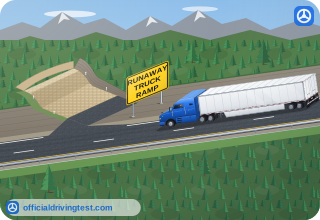
- A few miles down from the top
- Right at the bottom of the hill
- Exactly halfway along the grade
Show answer
Correct answer: A few miles down from the top
Escape ramps are usually placed a few miles below the top of the grade, and signs tell you about them.
Source: CDL manual, national model as printed by New Jersey, Sections 1 to 3 (July 2017)
-
What do some escape ramps use to bring a runaway vehicle to a stop?
- Water-filled barriers across the lane
- Soft gravel that resists the vehicle motion
- A smooth paved surface that is level
Show answer
Correct answer: Soft gravel that resists the vehicle motion
Some ramps have soft gravel that resists the vehicle's motion. Others turn uphill and use soft gravel to hold the vehicle in place.
Source: CDL manual, national model as printed by New Jersey, Sections 1 to 3 (July 2017)
-
You lose your brakes going downhill and an escape ramp is available. What may happen if you skip it?
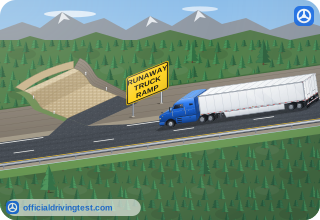
- Your chance of a serious crash may be much greater
- You may find a safer stretch of road farther down
- The engine will slow the vehicle enough to stop it
Show answer
Correct answer: Your chance of a serious crash may be much greater
A driver who loses brakes on a downgrade should use an available escape ramp. Skipping it may raise the chance of a serious crash.
Source: CDL manual, national model as printed by New Jersey, Sections 1 to 3 (July 2017)
-
With no escape ramp available and your brakes gone, when should you move to an escape route?
- Once you reach the bottom of the hill
- Only after trying the brakes several more times
- As soon as you know the brakes do not work
Show answer
Correct answer: As soon as you know the brakes do not work
Act at once. Every moment of delay lets the vehicle pick up speed and makes it harder to stop.
Source: CDL manual, national model as printed by New Jersey, Sections 1 to 3 (July 2017)
-
You hear a loud bang while driving and are not sure where it came from. What is the safest thing to assume?
- That a tire on a nearby vehicle has blown
- That the sound was an engine or exhaust noise
- That your own vehicle has had a tire blowout
Show answer
Correct answer: That your own vehicle has had a tire blowout
A blowout can take a few seconds to affect your vehicle, so the sound may seem to come from elsewhere. Treat any bang as your own tire failing.
Source: CDL manual, national model as printed by New Jersey, Sections 1 to 3 (July 2017)
-
A rear tire goes flat. What may be the only warning you get?
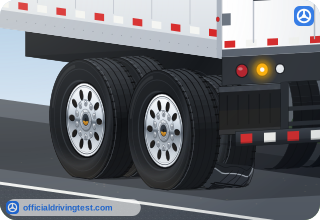
- The steering suddenly feels heavy
- A pull toward the side of the road
- The vehicle thumps or vibrates heavily
Show answer
Correct answer: The vehicle thumps or vibrates heavily
Heavy thumping or vibration can be the only clue to a flat rear tire. Heavy steering points to a front tire instead.
Source: CDL manual, national model as printed by New Jersey, Sections 1 to 3 (July 2017)
-
Your steering suddenly feels heavy. Which tire has most likely failed?
- A rear tire on the trailer
- A tire on the drive axle
- A front tire
Show answer
Correct answer: A front tire
Heavy steering usually means one of the front tires has failed.
Source: CDL manual, national model as printed by New Jersey, Sections 1 to 3 (July 2017)
-
Why does a failed rear tire often not make a vehicle fishtail?
- The steering axle keeps the rear in line
- The trailer weight holds the rear in line
- Dual rear tires usually prevent the sliding
Show answer
Correct answer: Dual rear tires usually prevent the sliding
Failure of a rear tire can make the vehicle fishtail, but dual rear tires usually prevent this.
Source: CDL manual, national model as printed by New Jersey, Sections 1 to 3 (July 2017)
-
How can you stop a failing front tire from twisting the steering wheel out of your hand?
- Steer lightly with one hand on the wheel
- Keep both hands firmly on the wheel at all times
- Brake hard before the wheel starts to turn
Show answer
Correct answer: Keep both hands firmly on the wheel at all times
A front tire failure can jerk the wheel. Holding it firmly with both hands all the time is the only prevention.
Source: CDL manual, national model as printed by New Jersey, Sections 1 to 3 (July 2017)
-
A tire fails and nothing is in your path. What should you do about the brakes at first?
- Brake firmly to stop as fast as possible
- Pump the brake pedal several times quickly
- Keep off the pedal while the vehicle slows
Show answer
Correct answer: Keep off the pedal while the vehicle slows
Braking right after a tire failure could make you lose control. Let the vehicle slow down first unless you are about to hit something.
Source: CDL manual, national model as printed by New Jersey, Sections 1 to 3 (July 2017)
-
After a blown tire has slowed the vehicle, how should you bring it to a stop?
- Steer sharply to the shoulder and brake hard
- Ease on the brake lightly, leave the road, stop
- Stop in your lane and turn on the hazard flashers
Show answer
Correct answer: Ease on the brake lightly, leave the road, stop
Once speed has dropped, use very gentle braking while moving off the road to stop.
Source: CDL manual, national model as printed by New Jersey, Sections 1 to 3 (July 2017)
-
After stopping from a suspected tire failure, the vehicle seems to handle normally. What should you do?
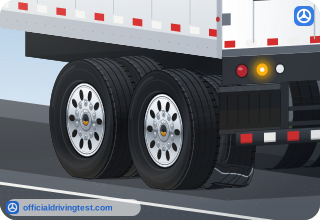
- Check only the tire you think failed
- Continue driving and check at the next stop
- Get out and check all of the tires
Show answer
Correct answer: Get out and check all of the tires
Some failures, such as one tire of a dual pair, may not be noticed from the cab, so check every tire even if the vehicle handles normally.
Source: CDL manual, national model as printed by New Jersey, Sections 1 to 3 (July 2017)
-
How might you learn that one tire of a dual pair has failed?
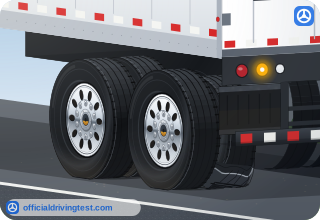
- By getting out and looking at it
- By a loud bang every time
- By a warning lamp on the dash
Show answer
Correct answer: By getting out and looking at it
A failed tire in a dual pair may give no clear sign from the cab, so you may have to look at it.
Source: CDL manual, national model as printed by New Jersey, Sections 1 to 3 (July 2017)
-
What does a computerized antilock braking system (ABS) do?
- Stops the vehicle in a shorter distance always
- Holds the brakes on when parked on a hill
- Keeps wheels from locking during hard braking
Show answer
Correct answer: Keeps wheels from locking during hard braking
ABS is a computer-controlled system that prevents wheel lockup when you brake hard.
Source: CDL manual, national model as printed by New Jersey, Sections 1 to 3 (July 2017)
-
How does ABS relate to your normal brakes?
- It adds on without changing braking power
- It replaces the normal brakes
- It makes the normal brakes stronger
Show answer
Correct answer: It adds on without changing braking power
ABS is an add-on. Your normal braking power is neither reduced nor increased by it.
Source: CDL manual, national model as printed by New Jersey, Sections 1 to 3 (July 2017)
-
When does ABS become active?
- Only when wheels are about to lock up
- Whenever the brake pedal is pressed
- Whenever the vehicle goes over a set speed
Show answer
Correct answer: Only when wheels are about to lock up
Normal braking works as usual. ABS steps in only when a wheel is close to locking.
Source: CDL manual, national model as printed by New Jersey, Sections 1 to 3 (July 2017)