General Knowledge: Driving emergencies, ABS and skids — Part 2
Questions in this part include: “You must return to the pavement before you can stop. How should you do it?” · “In stab braking, what happens if you press the brakes again before the wheels start rolling?”
Independent educational site · not affiliated with any government agency or DMV
Ready? Test yourself
Answer to start, or tap Start below:
You must return to the pavement before you can stop. How should you do it?
- Instant feedback with an explanation
- Every answer cites its source in the manual
- Your best score is saved on this device
- Keyboard: press 1 to 3 to answer and Enter for the next question
Questions are written in our own words from the CDL manual; they are not the real test's questions. With your state chosen, every answer gives its page in your state's CDL manual. Without a state, answers cite the CDL manual, national model as printed by New Jersey (July 2017).
All 18 questions in this practice test
Take the test above first, then use this list to study. Tap “Show answer” to see the correct answer and explanation.
Show the questions and answersHide the questions
-
You must return to the pavement before you can stop. How should you do it?
- Edge back onto the road a little at a time
- Brake hard first, then turn back slowly
- Turn sharply and hold the wheel tightly to return
Show answer
Correct answer: Turn sharply and hold the wheel tightly to return
A gradual return can make the tires grab suddenly and cause a loss of control. A firm, sharp turn back onto the road is safer.
Source: CDL manual, national model as printed by New Jersey, Sections 1 to 3 (July 2017)
-
When returning to the pavement, when should you counter-steer?
- After the vehicle has fully stopped
- When both front tires are back on pavement
- When the rear tires touch the pavement
Show answer
Correct answer: When both front tires are back on pavement
Counter-steer as soon as both front tires are on the pavement. The two turns should be done as one steer-counter-steer move.
Source: CDL manual, national model as printed by New Jersey, Sections 1 to 3 (July 2017)
-
Someone suddenly pulls out in front of you. When is braking a good response?
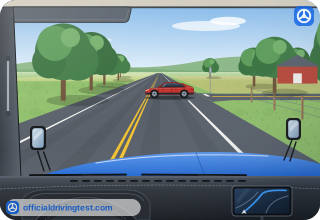
- When there is enough room to stop and you brake right
- Whenever you are not able to steer
- Only when the road is dry and the trailer is empty
Show answer
Correct answer: When there is enough room to stop and you brake right
Braking works when there is enough room to stop and the brakes are used the right way.
Source: CDL manual, national model as printed by New Jersey, Sections 1 to 3 (July 2017)
-
What two things should your emergency braking let you do?
- Stop in the shortest distance and keep steering still
- Slow the trailer first and then the tractor
- Hold a straight line and still be able to turn
Show answer
Correct answer: Hold a straight line and still be able to turn
Brake so the vehicle stays straight and you can still steer away if that becomes necessary.
Source: CDL manual, national model as printed by New Jersey, Sections 1 to 3 (July 2017)
-
With the controlled braking method, how hard do you press the brakes?
- As hard as you can, but short of wheel lockup
- Lightly, so the vehicle slows down a little at a time
- All the way down so the wheels lock briefly
Show answer
Correct answer: As hard as you can, but short of wheel lockup
Controlled braking means the hardest braking possible short of wheel lockup, with only very small steering movements.
Source: CDL manual, national model as printed by New Jersey, Sections 1 to 3 (July 2017)
-
How should you move the steering wheel while using controlled braking?
- With large, quick turns to dodge the hazard
- By holding the wheel perfectly still all the time
- With very small movements only
Show answer
Correct answer: With very small movements only
Steering moves must stay very small during controlled braking. A larger steering move means the brakes should be released first.
Source: CDL manual, national model as printed by New Jersey, Sections 1 to 3 (July 2017)
-
While using controlled braking, the wheels lock. What should you do?
- Hold the pedal down until the vehicle stops fully
- Release the brakes, then re-apply as soon as you can
- Pump the pedal lightly while steering sharply
Show answer
Correct answer: Release the brakes, then re-apply as soon as you can
Release the brakes when the wheels lock or when a larger steering move is needed, then re-apply them as soon as possible.
Source: CDL manual, national model as printed by New Jersey, Sections 1 to 3 (July 2017)
-
In the stab braking method, what do you do when the wheels lock up?
- Release, then press fully again once wheels roll
- Keep the pedal down until the vehicle stops
- Ease off the pedal a little and keep it there
Show answer
Correct answer: Release, then press fully again once wheels roll
With stab braking you press the brakes fully, let go when the wheels lock, and press fully again as soon as the wheels start rolling.
Source: CDL manual, national model as printed by New Jersey, Sections 1 to 3 (July 2017)
-
After you release the brakes in stab braking, how long can it take for the wheels to start rolling?
- Up to one second
- Up to five seconds
- Less than a tenth of a second
Show answer
Correct answer: Up to one second
It can take up to one second. If you press the brakes again before the wheels roll, the vehicle will not straighten out.
Source: CDL manual, national model as printed by New Jersey, Sections 1 to 3 (July 2017)
-
In stab braking, what happens if you press the brakes again before the wheels start rolling?
- The vehicle will not straighten out
- The vehicle stops in a shorter distance
- The wheels start rolling sooner than before
Show answer
Correct answer: The vehicle will not straighten out
The wheels must be rolling again before you re-apply the brakes. Pressing too soon keeps the vehicle from straightening out.
Source: CDL manual, national model as printed by New Jersey, Sections 1 to 3 (July 2017)
-
Why is pushing the brake pedal down as hard as you can a poor way to stop in an emergency?
- The wheels stay locked, so the vehicle skids
- The brake lines may burst from the pressure
- The engine will stall and power steering is lost
Show answer
Correct answer: The wheels stay locked, so the vehicle skids
Stamping on the pedal keeps the wheels locked and causes a skid. A skidding vehicle cannot be controlled.
Source: CDL manual, national model as printed by New Jersey, Sections 1 to 3 (July 2017)
-
What are the two usual causes of hydraulic brake failure?
- Worn tires and loose wheel nuts on the axles
- Low air pressure and a stuck governor valve
- Loss of hydraulic pressure and fade on long hills
Show answer
Correct answer: Loss of hydraulic pressure and fade on long hills
Most hydraulic brake failures come from losing hydraulic pressure or from brake fade on long hills.
Source: CDL manual, national model as printed by New Jersey, Sections 1 to 3 (July 2017)
-
What will you notice at the brake pedal when a hydraulic system cannot build up pressure?
- The pedal feels spongy or goes to the floor
- The pedal becomes very hard and will not move
- The pedal vibrates and pulses under your foot
Show answer
Correct answer: The pedal feels spongy or goes to the floor
When pressure cannot build, the pedal feels spongy or sinks all the way to the floor.
Source: CDL manual, national model as printed by New Jersey, Sections 1 to 3 (July 2017)
-
Your hydraulic brakes have lost pressure. How does downshifting help?
- It rebuilds pressure in the brake lines
- A lower gear helps slow the vehicle
- It releases any brakes that have locked
Show answer
Correct answer: A lower gear helps slow the vehicle
A lower gear adds engine braking, which helps slow the vehicle when the brakes are not working.
Source: CDL manual, national model as printed by New Jersey, Sections 1 to 3 (July 2017)
-
After a loss of hydraulic pressure, what may build enough pressure to stop the vehicle?
- Holding the pedal steadily at the floor
- Pumping the brake pedal
- Shifting the transmission into neutral
Show answer
Correct answer: Pumping the brake pedal
Pumping the pedal can sometimes create enough hydraulic pressure to stop the vehicle.
Source: CDL manual, national model as printed by New Jersey, Sections 1 to 3 (July 2017)
-
Why can the parking brake help slow a vehicle whose hydraulic brakes have failed?
- It works from its own system, apart from hydraulics
- It is connected to the same fluid lines as the pedal
- It uses engine vacuum to build up its pressure
Show answer
Correct answer: It works from its own system, apart from hydraulics
The parking or emergency brake is a separate system from the hydraulic brakes, so it can still slow the vehicle.
Source: CDL manual, national model as printed by New Jersey, Sections 1 to 3 (July 2017)
-
When you use the parking brake to slow a vehicle with failed hydraulic brakes, what must you do at the same time?
- Turn off the engine and coast to a stop slowly
- Press the release button or pull the lever
- Shift into the highest gear and release the clutch
Show answer
Correct answer: Press the release button or pull the lever
Using the release button or lever lets you adjust the brake pressure so the wheels do not lock up.
Source: CDL manual, national model as printed by New Jersey, Sections 1 to 3 (July 2017)
-
While looking for an escape route after brake loss, which kind of path helps slow and stop the vehicle?
- One that turns uphill
- One that runs along a downhill slope
- One that stays level on the highway
Show answer
Correct answer: One that turns uphill
Turning uphill uses the slope to slow and stop the vehicle.
Source: CDL manual, national model as printed by New Jersey, Sections 1 to 3 (July 2017)