General Knowledge: Driving emergencies, ABS and skids — Part 5
Questions in this part include: “Only the tractor, only the trailer, or only one axle has ABS. How should you brake?” · “Your ABS stops working while you drive. What is the right approach?”
Independent educational site · not affiliated with any government agency or DMV
Ready? Test yourself
Answer to start, or tap Start below:
Only the tractor, only the trailer, or only one axle has ABS. How should you brake?
- Instant feedback with an explanation
- Every answer cites its source in the manual
- Your best score is saved on this device
- Keyboard: press 1 to 3 to answer and Enter for the next question
Questions are written in our own words from the CDL manual; they are not the real test's questions. With your state chosen, every answer gives its page in your state's CDL manual. Without a state, answers cite the CDL manual, national model as printed by New Jersey (July 2017).
All 18 questions in this practice test
Take the test above first, then use this list to study. Tap “Show answer” to see the correct answer and explanation.
Show the questions and answersHide the questions
-
Only the tractor, only the trailer, or only one axle has ABS. How should you brake?
- Brake lightly, since ABS is incomplete
- Brake in short, hard stabs
- Brake normally
Show answer
Correct answer: Brake normally
Even partial ABS gives more control, so you brake in your usual way.
Source: CDL manual, national model as printed by New Jersey, Sections 1 to 3 (July 2017)
-
What benefit do you get when only the tractor has ABS?
- The trailer can no longer swing out
- Steering control is kept; less jackknife risk
- Stopping distance is always much shorter
Show answer
Correct answer: Steering control is kept; less jackknife risk
ABS on the tractor helps you keep steering control and lowers the chance of a jackknife.
Source: CDL manual, national model as printed by New Jersey, Sections 1 to 3 (July 2017)
-
Only the tractor has ABS and the trailer begins to swing out. What should you do if it is safe?
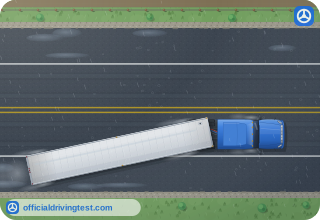
- Brake harder to straighten the trailer
- Turn the wheel sharply the other way
- Let up on the brakes
Show answer
Correct answer: Let up on the brakes
The trailer has no ABS and can still swing out. Easing off the brakes, if safe, helps you keep control.
Source: CDL manual, national model as printed by New Jersey, Sections 1 to 3 (July 2017)
-
What benefit do you get when only the trailer has ABS?
- The trailer has less tendency to swing wide
- The tractor is less likely to jackknife
- The tractor always keeps steering control
Show answer
Correct answer: The trailer has less tendency to swing wide
ABS on the trailer makes it less likely to swing out.
Source: CDL manual, national model as printed by New Jersey, Sections 1 to 3 (July 2017)
-
Only the trailer has ABS and the tractor starts to jackknife. What should you do if it is safe?
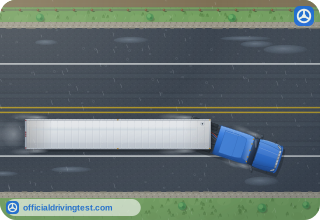
- Apply the brakes fully down
- Speed up to pull the trailer straight
- Let up on the brakes until control returns
Show answer
Correct answer: Let up on the brakes until control returns
With ABS only on the trailer, the tractor can still lose steering or jackknife. If safe, ease off the brakes until you regain control.
Source: CDL manual, national model as printed by New Jersey, Sections 1 to 3 (July 2017)
-
How much braking force should you use in a vehicle with ABS in a normal stop?
- Full force every time, for the ABS
- Only what is needed to stop safely
- Very light force, letting ABS do the work
Show answer
Correct answer: Only what is needed to stop safely
Brake the way you always have, using just the force needed to stop safely while staying in control.
Source: CDL manual, national model as printed by New Jersey, Sections 1 to 3 (July 2017)
-
While slowing a tractor-trailer with ABS, what should you keep doing?
- Watch the rig and back off if it is safe
- Hold the brake pedal at full pressure
- Pump the pedal quickly to help the ABS
Show answer
Correct answer: Watch the rig and back off if it is safe
Keep watching the whole combination and ease off the brakes when it is safe, to stay in control.
Source: CDL manual, national model as printed by New Jersey, Sections 1 to 3 (July 2017)
-
When may you fully apply the brakes in an emergency stop with ABS?
- When any single axle has working ABS
- When all axles have working ABS
- Only when the vehicle is completely empty
Show answer
Correct answer: When all axles have working ABS
The one exception to brake-as-usual: with working ABS on every axle, an emergency stop allows full brake application.
Source: CDL manual, national model as printed by New Jersey, Sections 1 to 3 (July 2017)
-
What color is the lamp that warns of an ABS problem?
- Red
- Blue
- Yellow
Show answer
Correct answer: Yellow
ABS vehicles use a yellow malfunction lamp to show that the system has a problem.
Source: CDL manual, national model as printed by New Jersey, Sections 1 to 3 (July 2017)
-
Your ABS stops working while you drive. What is the right approach?
- Drive normally and have it serviced soon
- Pump the pedal hard at every stop
- Park the vehicle since it has no brakes
Show answer
Correct answer: Drive normally and have it serviced soon
The normal brakes still work when ABS fails, so you drive and brake as usual and get the ABS repaired soon.
Source: CDL manual, national model as printed by New Jersey, Sections 1 to 3 (July 2017)
-
How should ABS change the way you choose speed and following distance?
- It lets you follow somewhat closer
- It does not change them at all
- It lets you drive a bit faster
Show answer
Correct answer: It does not change them at all
ABS gives no reason to speed up, tailgate or drive with less care.
Source: CDL manual, national model as printed by New Jersey, Sections 1 to 3 (July 2017)
-
Which kind of skid can ABS NOT prevent?
- A skid from locking wheels in hard braking
- A skid from spinning the drive wheels
- A jackknife started by over braking
Show answer
Correct answer: A skid from spinning the drive wheels
ABS stops brake-caused skids, but it cannot stop skids from spinning the drive wheels or from entering a turn too fast.
Source: CDL manual, national model as printed by New Jersey, Sections 1 to 3 (July 2017)
-
What does ABS reliably give you when you brake hard?
- A much shorter stopping distance
- More braking power than normal brakes
- Better control of the vehicle
Show answer
Correct answer: Better control of the vehicle
ABS helps you keep control, but it does not always make the stopping distance shorter.
Source: CDL manual, national model as printed by New Jersey, Sections 1 to 3 (July 2017)
-
A vehicle has worn, poorly kept brakes and ABS. What can you expect from the ABS?
- It will not make up for the weak brakes
- It will make up for the weak brakes
- It will warn you before the brakes fade
Show answer
Correct answer: It will not make up for the weak brakes
ABS cannot make up for bad brakes or poor brake upkeep, so the brakes must still be kept in good shape.
Source: CDL manual, national model as printed by New Jersey, Sections 1 to 3 (July 2017)
-
Which is the best safety feature a vehicle can have?
- Antilock brakes
- Air brakes on every axle
- A safe driver
Show answer
Correct answer: A safe driver
No equipment beats a safe driver, ABS included.
Source: CDL manual, national model as printed by New Jersey, Sections 1 to 3 (July 2017)
-
What is the right attitude toward ABS while on the road?
- Count on it to cover for hard braking
- Drive so you never have to depend on it
- Brake later, since the stop will be shorter
Show answer
Correct answer: Drive so you never have to depend on it
Drive so you never need ABS; if you do need it, it could help prevent a serious crash.
Source: CDL manual, national model as printed by New Jersey, Sections 1 to 3 (July 2017)
-
When does a skid happen?
- Only when the brakes lock the wheels
- The tires stop gripping the pavement
- Only when the drive wheels spin
Show answer
Correct answer: The tires stop gripping the pavement
A skid is the loss of tire grip on the road, and it can come from over-braking, over-steering, over-acceleration or too much speed.
Source: CDL manual, national model as printed by New Jersey, Sections 1 to 3 (July 2017)
-
Which cause of skids is hard braking that locks up the wheels?
- Over-acceleration
- Driving too fast
- Over-braking
Show answer
Correct answer: Over-braking
Over-braking locks the wheels, and locked wheels slide instead of gripping.
Source: CDL manual, national model as printed by New Jersey, Sections 1 to 3 (July 2017)