General Knowledge: Driving emergencies, ABS and skids — Part 1
Questions in this part include: “Which situation is called a vehicle emergency, as opposed to a traffic emergency?” · “When something blocks your path, how will you know which lane is free to steer into?”
Independent educational site · not affiliated with any government agency or DMV
Ready? Test yourself
Answer to start, or tap Start below:
Which situation is called a vehicle emergency, as opposed to a traffic emergency?
- Instant feedback with an explanation
- Every answer cites its source in the manual
- Your best score is saved on this device
- Keyboard: press 1 to 3 to answer and Enter for the next question
Questions are written in our own words from the CDL manual; they are not the real test's questions. With your state chosen, every answer gives its page in your state's CDL manual. Without a state, answers cite the CDL manual, national model as printed by New Jersey (July 2017).
All 18 questions in this practice test
Take the test above first, then use this list to study. Tap “Show answer” to see the correct answer and explanation.
Show the questions and answersHide the questions
-
Which situation is called a vehicle emergency, as opposed to a traffic emergency?
- Two vehicles are about to hit each other
- Heavy rain makes the road surface slippery
- A tire, a brake or another key part fails
Show answer
Correct answer: A tire, a brake or another key part fails
A vehicle emergency is a failure of the vehicle itself, such as tires or brakes. A traffic emergency is when two vehicles are about to collide.
Source: CDL manual, national model as printed by New Jersey, Sections 1 to 3 (July 2017)
-
There is not enough room to stop before an obstacle. Which action can usually get you clear of it faster?
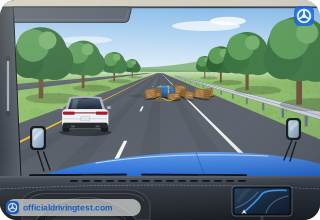
- Steering around it
- Stopping short of it with a hard brake
- Shifting to a lower gear to slow down
Show answer
Correct answer: Steering around it
A vehicle can almost always swerve around an obstacle faster than it can stop. Steering is often the safer choice when there is no room to stop.
Source: CDL manual, national model as printed by New Jersey, Sections 1 to 3 (July 2017)
-
Which vehicles may flip over when the driver swerves to miss an obstacle?
- Empty straight trucks with a short wheelbase
- Buses that carry only a light passenger load
- Top-heavy vehicles and multi-trailer tractors
Show answer
Correct answer: Top-heavy vehicles and multi-trailer tractors
Turning away from an obstacle is quick, but top-heavy vehicles and tractors with more than one trailer can roll over in the turn.
Source: CDL manual, national model as printed by New Jersey, Sections 1 to 3 (July 2017)
-
How can you be sure both of your hands are on the steering wheel when an emergency comes?
- Keep both hands on the wheel at all times
- Move them to the wheel as soon as you see danger
- Rest one hand on the gearshift and one on the wheel
Show answer
Correct answer: Keep both hands on the wheel at all times
A quick, safe turn needs a firm two-handed grip, and an emergency gives no time to reposition your hands. Keeping both hands on the wheel all the time solves this.
Source: CDL manual, national model as printed by New Jersey, Sections 1 to 3 (July 2017)
-
Why should you avoid braking while you make a quick emergency turn?
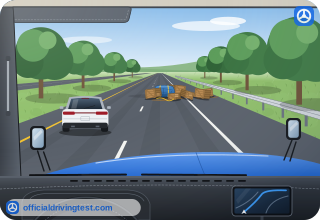
- The wheels can lock easily and the vehicle may skid
- The brakes will overheat during the turn
- The turn will become much wider than needed
Show answer
Correct answer: The wheels can lock easily and the vehicle may skid
Wheels lock very easily while turning. A vehicle with locked wheels can skid out of control.
Source: CDL manual, national model as printed by New Jersey, Sections 1 to 3 (July 2017)
-
In an emergency turn, what happens to the risk of a skid or rollover as you turn the wheel more sharply?
- The risk stays about the same
- The risk gets greater
- The risk gets smaller
Show answer
Correct answer: The risk gets greater
A sharper turn raises the chance of a skid or rollover. Turn only as much as needed to clear what is in your way.
Source: CDL manual, national model as printed by New Jersey, Sections 1 to 3 (July 2017)
-
After an emergency turn around an obstacle, what does counter-steering mean?
- Turning the wheel back the other way past the hazard
- Pumping the brake pedal to slow the vehicle down quickly
- Holding the wheel still until the vehicle comes to a stop
Show answer
Correct answer: Turning the wheel back the other way past the hazard
Counter-steering is turning the wheel back the other way after you pass the hazard. Emergency steering and counter-steering are two parts of one action.
Source: CDL manual, national model as printed by New Jersey, Sections 1 to 3 (July 2017)
-
Why must you be ready to counter-steer before you make an emergency turn?
- Otherwise the brakes will lock during the turn
- Otherwise you cannot do it quickly enough afterward
- Otherwise the trailer will swing into the next lane
Show answer
Correct answer: Otherwise you cannot do it quickly enough afterward
If you are not prepared in advance, the counter-steer will come too late. Plan the emergency turn and the turn back as one action.
Source: CDL manual, national model as printed by New Jersey, Sections 1 to 3 (July 2017)
-
A driver coming toward you has wandered into your lane. Which way is usually best to steer?
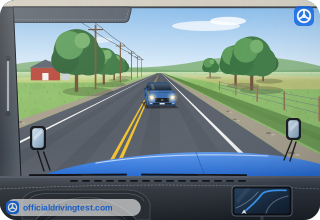
- To your left
- Straight ahead while braking hard
- To your right
Show answer
Correct answer: To your right
Steering right is best. A driver who notices the mistake will naturally move back into the proper lane.
Source: CDL manual, national model as printed by New Jersey, Sections 1 to 3 (July 2017)
-
When something blocks your path, how will you know which lane is free to steer into?
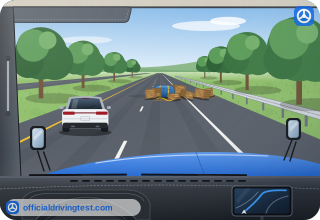
- By flashing your lights at the traffic next to you
- By slowing down until the other vehicles pass you
- By having checked your mirrors regularly as you drove
Show answer
Correct answer: By having checked your mirrors regularly as you drove
A driver who uses the mirrors all the time already knows which lane is empty and safe to use.
Source: CDL manual, national model as printed by New Jersey, Sections 1 to 3 (July 2017)
-
Your path is blocked and the shoulder is clear. Why may going right be the better choice?
- Traffic is more likely to be passing on your right side
- The shoulder is always wider than a traffic lane here
- Few drive on the shoulder but someone may pass left
Show answer
Correct answer: Few drive on the shoulder but someone may pass left
Few vehicles are on the shoulder, while another driver may be passing on your left. Your mirrors tell you which is the case.
Source: CDL manual, national model as printed by New Jersey, Sections 1 to 3 (July 2017)
-
You are blocked on both sides. What is the benefit of moving to the right?
- Your trailer will follow the tractor more closely
- You will be able to brake harder in the turn
- You will not push anyone into oncoming traffic
Show answer
Correct answer: You will not push anyone into oncoming traffic
A move to the right does not force another vehicle into an opposing lane, which could cause a head-on collision.
Source: CDL manual, national model as printed by New Jersey, Sections 1 to 3 (July 2017)
-
Compared with hitting another vehicle, how risky can it be to drive off the road in an emergency?
- Always more dangerous than a collision
- It may be less risky than a collision
- Just as risky as a collision in every case
Show answer
Correct answer: It may be less risky than a collision
In some emergencies, leaving the road is the safer choice compared with a collision with another vehicle.
Source: CDL manual, national model as printed by New Jersey, Sections 1 to 3 (July 2017)
-
What is true of most road shoulders when a large vehicle must leave the pavement?
- They are too soft to carry a large vehicle safely
- They carry only light cars and pickup trucks safely
- They are strong enough, so they make an escape route
Show answer
Correct answer: They are strong enough, so they make an escape route
Most shoulders can support the weight of a large vehicle, so they are usually an available escape route.
Source: CDL manual, national model as printed by New Jersey, Sections 1 to 3 (July 2017)
-
When you leave the road in an emergency, until what speed should you avoid braking if possible?
- About 10 mph
- About 20 mph
- About 30 mph
Show answer
Correct answer: About 20 mph
Hold off braking until you are down to about 20 mph, then press the pedal very softly so the vehicle does not skid on a loose surface.
Source: CDL manual, national model as printed by New Jersey, Sections 1 to 3 (July 2017)
-
Once your speed is down while you are off the pavement, how should you brake?
- Firmly, to stop before you reach any obstacle
- Very gently, to avoid a skid on the loose surface
- With quick pumps, to keep the wheels turning fast
Show answer
Correct answer: Very gently, to avoid a skid on the loose surface
On a loose surface hard braking can cause a skid, so brake very gently after the speed has dropped.
Source: CDL manual, national model as printed by New Jersey, Sections 1 to 3 (July 2017)
-
Which practice helps you keep control while you drive partly off the pavement?
- Put all the wheels on the loose edge of the road
- Steer back and forth between the pavement and the shoulder
- Keep one set of wheels on the paved part if you can
Show answer
Correct answer: Keep one set of wheels on the paved part if you can
Keeping one set of wheels on the pavement, when possible, helps maintain control of the vehicle.
Source: CDL manual, national model as printed by New Jersey, Sections 1 to 3 (July 2017)
-
The shoulder is clear after you leave the road. When should you pull back onto the pavement?
- As soon as your speed falls below 20 mph
- After you stop, signaling and checking mirrors
- Right away, at the first gap in traffic ahead
Show answer
Correct answer: After you stop, signaling and checking mirrors
Stay on the clear shoulder until the vehicle has stopped. Then signal and check your mirrors before you rejoin the road.
Source: CDL manual, national model as printed by New Jersey, Sections 1 to 3 (July 2017)