Combination Vehicles: Combination vehicle air brakes and ABS — Part 3
Questions in this part include: “Which units are not required to have spring brakes?” · “When does ABS take action?”
Independent educational site · not affiliated with any government agency or DMV
Ready? Test yourself
Answer to start, or tap Start below:
Which units are not required to have spring brakes?
- Instant feedback with an explanation
- Every answer cites its source in the manual
- Your best score is saved on this device
- Keyboard: press 1 to 3 to answer and Enter for the next question
Questions are written in our own words from the CDL manual; they are not the real test's questions. With your state chosen, every answer gives its page in your state's CDL manual. Without a state, answers cite the CDL manual, national model as printed by New Jersey (July 2017).
All 17 questions in this practice test
Take the test above first, then use this list to study. Tap “Show answer” to see the correct answer and explanation.
Show the questions and answersHide the questions
-
Which units are not required to have spring brakes?
- Trailers built before 1985, and converter dollies
- Trailers built before 1965, and converter dollies
- Trailers built before 1975, and converter dollies
Show answer
Correct answer: Trailers built before 1975, and converter dollies
Converter dollies, and trailers built before 1975, may lack spring brakes.
Source: CDL manual, national model as printed by New Jersey, Section 6 (July 2017)
-
On a trailer without spring brakes, what power source runs the emergency brakes?
- Air stored in the trailer air tank
- Springs inside the brake chambers
- Air supplied live from the tractor
Show answer
Correct answer: Air stored in the trailer air tank
Their emergency brakes depend on air kept in the trailer tank, which is why a leak matters.
Source: CDL manual, national model as printed by New Jersey, Section 6 (July 2017)
-
What does a trailer without spring brakes not have?
- A parking brake
- Any air tanks
- A service air-line
Show answer
Correct answer: A parking brake
These trailers have emergency brakes that work from tank air, but no parking brake, so chock the wheels when you park them.
Source: CDL manual, national model as printed by New Jersey, Section 6 (July 2017)
-
How long do the emergency brakes of a trailer without spring brakes keep holding?
- Until the tractor engine is restarted
- Only while the trailer tank keeps its air
- For as long as the wheels are chocked
Show answer
Correct answer: Only while the trailer tank keeps its air
The emergency brakes stay on only while the trailer tank keeps its air; once it leaks away the trailer can roll, so chock the wheels.
Source: CDL manual, national model as printed by New Jersey, Section 6 (July 2017)
-
When might a big service-line leak first show itself?
- When you start the engine
- When you apply the brakes
- When you push in the air supply knob
Show answer
Correct answer: When you apply the brakes
Pressing the brakes uses the air in the line, so the loss shows up quickly then and lowers tank pressure fast.
Source: CDL manual, national model as printed by New Jersey, Section 6 (July 2017)
-
Which build date makes ABS mandatory on trailers and converter dollies?
- March 1, 1988
- January 1, 2002
- March 1, 1998
Show answer
Correct answer: March 1, 1998
The ABS requirement applies from March 1, 1998. Some older units were fitted voluntarily.
Source: CDL manual, national model as printed by New Jersey, Section 6 (July 2017)
-
Where do you look for the ABS malfunction lamp on a trailer?
- Right side, at a front or rear corner
- Center of the rear bumper
- Left side, at a front or rear corner
Show answer
Correct answer: Left side, at a front or rear corner
Look at the left side of the trailer, at the front or the rear corner, for the yellow ABS warning lamp.
Source: CDL manual, national model as printed by New Jersey, Section 6 (July 2017)
-
How can you tell whether an older trailer has ABS?
- Look for a red lamp on the right side
- Look underneath for the ECU and sensor wires
- Check the trailer air tanks for a label
Show answer
Correct answer: Look underneath for the ECU and sensor wires
On older units the lamp may not settle it, so look underneath for the ECU and the sensor wires from the brakes.
Source: CDL manual, national model as printed by New Jersey, Section 6 (July 2017)
-
When does ABS take action?
- Whenever you touch the brake pedal
- Only when wheels are about to lock
- Whenever the trailer is empty
Show answer
Correct answer: Only when wheels are about to lock
ABS does nothing until a wheel is close to locking, so normal braking stays the same.
Source: CDL manual, national model as printed by New Jersey, Section 6 (July 2017)
-
What is the main gain from ABS in a hard stop?
- It makes the brakes stronger
- It always shortens the distance
- It helps you keep control
Show answer
Correct answer: It helps you keep control
ABS may not shorten the stop, but by preventing wheel lock-up it helps you stay in control.
Source: CDL manual, national model as printed by New Jersey, Section 6 (July 2017)
-
Only one axle of a rig has ABS. What can you expect?
- Some extra control while braking
- No benefit unless every axle has it
- Weaker brakes than without ABS
Show answer
Correct answer: Some extra control while braking
Even partial ABS, such as on the trailer only, adds control in braking.
Source: CDL manual, national model as printed by New Jersey, Section 6 (July 2017)
-
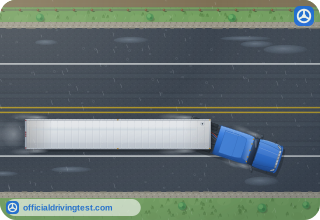
Only the trailer has ABS and the tractor starts to jackknife. What should you do?
- Brake harder so ABS takes over
- Apply only the trailer hand valve
- Ease off the brakes if it is safe
Show answer
Correct answer: Ease off the brakes if it is safe
ABS on the trailer does not stop a tractor jackknife, so release the brakes if you safely can until you regain control.
Source: CDL manual, national model as printed by New Jersey, Section 6 (July 2017)
-
With ABS, how much braking force should you apply?
- Full force on every stop
- Only enough to stop in control
- Half force first, then full force
Show answer
Correct answer: Only enough to stop in control
Apply only as much force as the stop needs and keep control.
Source: CDL manual, national model as printed by New Jersey, Section 6 (July 2017)
-
How should you change your braking style for a rig with ABS?
- Brake as you normally would
- Pump the pedal again and again
- Use one long, hard stomp each time
Show answer
Correct answer: Brake as you normally would
Brake as usual no matter where the ABS is fitted.
Source: CDL manual, national model as printed by New Jersey, Section 6 (July 2017)
-
While slowing a rig with ABS, what should you do to stay in control?
- Press harder as speed drops
- Shift to a higher gear
- Ease off the brakes if safe
Show answer
Correct answer: Ease off the brakes if safe
Watch the tractor and trailer as you slow and let up on the brakes if that is safe.
Source: CDL manual, national model as printed by New Jersey, Section 6 (July 2017)
-
Your ABS stops working. What should you do?
- Stop driving at once
- Drive normally and have it serviced soon
- Brake only with the trailer hand valve
Show answer
Correct answer: Drive normally and have it serviced soon
The regular brakes still work without ABS, so keep driving normally and have the system repaired soon.
Source: CDL manual, national model as printed by New Jersey, Section 6 (July 2017)
-
Does having ABS let you follow other vehicles more closely?
- No, keep your usual distance
- Yes, if the trailer has ABS
- Yes, but only when loaded
Show answer
Correct answer: No, keep your usual distance
ABS is no excuse to follow closer, drive faster or drive with less care.
Source: CDL manual, national model as printed by New Jersey, Section 6 (July 2017)