Combination Vehicles: Combination vehicle air brakes and ABS — Part 2
Questions in this part include: “What does the air supply knob do when the emergency line loses its pressure?” · “On an older trailer with no spring brakes, what is the danger of crossed air-lines?”
Independent educational site · not affiliated with any government agency or DMV
Ready? Test yourself
Answer to start, or tap Start below:
Which colors are commonly used to tell the emergency line from the service line?
- Instant feedback with an explanation
- Every answer cites its source in the manual
- Your best score is saved on this device
- Keyboard: press 1 to 3 to answer and Enter for the next question
Questions are written in our own words from the CDL manual; they are not the real test's questions. With your state chosen, every answer gives its page in your state's CDL manual. Without a state, answers cite the CDL manual, national model as printed by New Jersey (July 2017).
All 17 questions in this practice test
Take the test above first, then use this list to study. Tap “Show answer” to see the correct answer and explanation.
Show the questions and answersHide the questions
-
What does the air supply knob do when the emergency line loses its pressure?
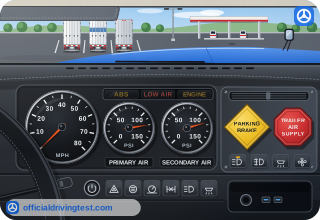
- It locks in place
- It changes color
- It pops out
Show answer
Correct answer: It pops out
The tractor protection valve closes, so the air supply knob pops out.
Source: CDL manual, national model as printed by New Jersey, Section 6 (July 2017)
-
Which colors are commonly used to tell the emergency line from the service line?
- Red for emergency, blue for service
- Blue for emergency, red for service
- Yellow for emergency, blue for service
Show answer
Correct answer: Red for emergency, blue for service
Red marks the emergency line and blue marks the service line, which helps prevent mix-ups.
Source: CDL manual, national model as printed by New Jersey, Section 6 (July 2017)
-
What are glad hands used for?
- Locking the trailer onto the fifth wheel
- Draining moisture from the trailer tanks
- Joining the air-lines from tractor to trailer
Show answer
Correct answer: Joining the air-lines from tractor to trailer
Glad hands are the couplers that join the tractor air-lines to the trailer air-lines.
Source: CDL manual, national model as printed by New Jersey, Section 6 (July 2017)
-
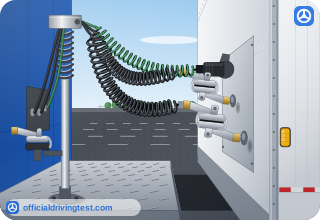
What should you do with glad hand couplers and seals before joining them?
- Oil them lightly
- Swap the seals each time
- Wipe them clean
Show answer
Correct answer: Wipe them clean
Clean the couplers and seals before connecting them, because keeping the air supply clean matters.
Source: CDL manual, national model as printed by New Jersey, Section 6 (July 2017)
-
How are the couplers held when you press two glad hand seals together?
- Lined up straight with each other
- At 45 degrees to each other
- At 90 degrees to each other
Show answer
Correct answer: At 90 degrees to each other
Press the seals together with the couplers at right angles, then turn the glad hand to lock the pair.
Source: CDL manual, national model as printed by New Jersey, Section 6 (July 2017)
-
Besides colors, what is sometimes used to help you join the right glad hands?
- Numbers painted on the hoses
- Differently sized couplers
- Metal tags naming each line
Show answer
Correct answer: Metal tags naming each line
Some lines carry metal tags stamped with the line name, which helps prevent crossing the lines.
Source: CDL manual, national model as printed by New Jersey, Section 6 (July 2017)
-
What happens when the service and emergency air-lines are crossed?
- The spring brakes release but the service brakes lock
- The trailer brakes work as usual using service air
- No supply air reaches the tanks, so spring brakes stay on
Show answer
Correct answer: No supply air reaches the tanks, so spring brakes stay on
Supply air goes to the service line, so the trailer tanks are not charged and the spring brakes have no air to release them.
Source: CDL manual, national model as printed by New Jersey, Section 6 (July 2017)
-
You push in the trailer air supply control, but the spring brakes stay on. What should you check?
- The trailer tank drain valves
- The air-line connections
- The shut-off valve on the last trailer
Show answer
Correct answer: The air-line connections
Spring brakes that stay on after supplying air can mean the air-lines are connected wrongly.
Source: CDL manual, national model as printed by New Jersey, Section 6 (July 2017)
-
On an older trailer with no spring brakes, what is the danger of crossed air-lines?
- You could drive off with no trailer brakes
- The trailer would refuse to move at all
- The trailer emergency brakes would lock on
Show answer
Correct answer: You could drive off with no trailer brakes
Crossed lines leave the trailer without brakes, so you could drive away and find you cannot brake it. Always test the trailer brakes first.
Source: CDL manual, national model as printed by New Jersey, Section 6 (July 2017)
-
After you apply the trailer brakes, how do you confirm they actually hold?
- Rock the trailer back and forth by hand
- Accelerate hard in a higher gear
- Tug gently against them in low gear
Show answer
Correct answer: Tug gently against them in low gear
A gentle pull in low gear shows whether the trailer brakes are really working before you drive off.
Source: CDL manual, national model as printed by New Jersey, Section 6 (July 2017)
-
Why are unused air hoses attached to dummy couplers?
- To stop the hoses from freezing
- To hold air in the tractor tanks
- To keep water and dirt out of them
Show answer
Correct answer: To keep water and dirt out of them
Dummy couplers cover the hose ends so water and dirt cannot get into the couplers and air-lines.
Source: CDL manual, national model as printed by New Jersey, Section 6 (July 2017)
-
Your rig has no dummy couplers. What can you sometimes do with the unused glad hands?
- Lock them to each other
- Hook them onto the trailer frame
- Push them into the trailer glad hands
Show answer
Correct answer: Lock them to each other
When there are no dummy couplers, glad hands can sometimes be joined together, depending on the couplings, to keep the air supply clean.
Source: CDL manual, national model as printed by New Jersey, Section 6 (July 2017)
-
What tells the relay valves how much pressure to send to the trailer brakes?
- Pressure in the emergency line
- The setting of the drain valves
- Pressure in the service line
Show answer
Correct answer: Pressure in the service line
The service line pressure is the signal, and the brake pedal or hand valve controls it.
Source: CDL manual, national model as printed by New Jersey, Section 6 (July 2017)
-
How often should you drain each trailer air tank?
- Once a week
- Once a month
- Every day
Show answer
Correct answer: Every day
Water and oil in the tanks can keep the brakes from working correctly, so drain them daily.
Source: CDL manual, national model as printed by New Jersey, Section 6 (July 2017)
-
Your tanks have automatic drains. What should you still do?
- Skip draining completely
- Open the drains yourself to check
- Replace the drains every year
Show answer
Correct answer: Open the drains yourself to check
Automatic drains remove most moisture, but you should still open each drain to be sure.
Source: CDL manual, national model as printed by New Jersey, Section 6 (July 2017)
-
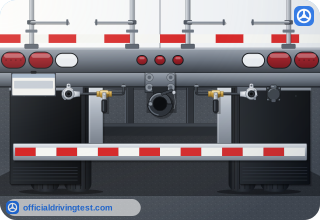
What are the shut-off valves at the back of a trailer used for?
- Draining water from the trailer air tanks
- Setting the trailer parking brakes
- Closing the air-lines when no trailer follows
Show answer
Correct answer: Closing the air-lines when no trailer follows
A trailer that can tow another has shut-off valves so its air-lines can be sealed when nothing is hitched behind it.
Source: CDL manual, national model as printed by New Jersey, Section 6 (July 2017)
-
In a multi-trailer rig, which shut-off valves must be closed?
- Those at the back of the first trailer
- Those between the tractor and the first trailer
- Those on the rear of the final trailer
Show answer
Correct answer: Those on the rear of the final trailer
Every shut-off valve is open except the one on the very last trailer, so air stays in the system instead of escaping at the rear.
Source: CDL manual, national model as printed by New Jersey, Section 6 (July 2017)