Combination Vehicles: Combination vehicle air brakes and ABS
The trailer hand valve, the tractor protection valve, the trailer air supply control, air lines and glad hands, trailer air tanks, shut-off valves and antilock brakes on trailers. Split into 3 shorter tests so you're not stuck in one long quiz.
Independent educational site · not affiliated with any government agency or DMV
Choose a part
Combination vehicle air brakes and ABS — Part 1
Questions in this part include: “For what purpose is the trailer hand valve meant to be used?”
Combination vehicle air brakes and ABS — Part 2
Questions in this part include: “What does the air supply knob do when the emergency line loses its pressure?”
Combination vehicle air brakes and ABS — Part 3
Questions in this part include: “Which units are not required to have spring brakes?”
Questions are written in our own words from the CDL manual; they are not the real test's questions. With your state chosen, every answer gives its page in your state's CDL manual. Without a state, answers cite the CDL manual, national model as printed by New Jersey (July 2017).
All 51 Combination vehicle air brakes and ABS questions with answers
Choose a part above to take a practice test, or study every question and answer here.
Show the questions and answersHide the questions
1Part 117 questions
-
For what purpose is the trailer hand valve meant to be used?
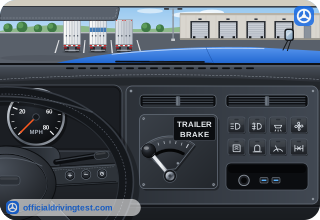
- Slowing the rig on a long downgrade
- Testing the trailer brakes
- Straightening out a trailer skid
Show answer
Correct answer: Testing the trailer brakes
The hand valve is a testing tool. During normal driving the foot brake is the control to use.
Source: CDL manual, national model as printed by New Jersey, Section 6 (July 2017)
-
Why should the trailer hand valve stay unused while you drive?
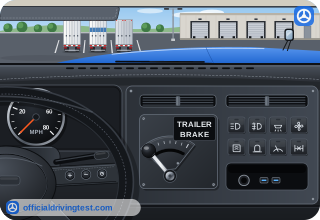
- It would drain the tractor air tanks
- It would close the tractor protection valve
- It could make the trailer skid
Show answer
Correct answer: It could make the trailer skid
Using only the trailer brakes can lock the trailer wheels and cause a skid.
Source: CDL manual, national model as printed by New Jersey, Section 6 (July 2017)
-
Which control applies every brake on a combination vehicle, trailers included?
- The trailer hand valve
- The trailer air supply knob
- The foot brake pedal
Show answer
Correct answer: The foot brake pedal
The foot brake feeds air to all brakes at once, so a skid or jackknife is much less likely than with the hand valve alone.
Source: CDL manual, national model as printed by New Jersey, Section 6 (July 2017)
-
A trailer has no spring brakes. Why is the hand valve a bad way to hold it while parked?
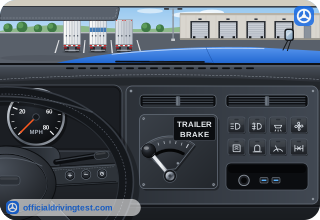
- The air could leak out and free the brakes
- The valve would wear out the relay valves
- The valve would lock the wheels for good
Show answer
Correct answer: The air could leak out and free the brakes
Always use the parking brakes when parked, and chock the wheels if the trailer has no spring brakes.
Source: CDL manual, national model as printed by New Jersey, Section 6 (July 2017)
-
You are leaving the rig for the night. Which control should hold it?
- The parking brakes
- The trailer hand valve
- The trailer air supply knob pushed in
Show answer
Correct answer: The parking brakes
Parking brakes are what hold a parked vehicle. Add wheel chocks if the trailer has no spring brakes.
Source: CDL manual, national model as printed by New Jersey, Section 6 (July 2017)
-
What is the job of the tractor protection valve if a trailer breaks away?
- Set the tractor parking brakes
- Keep air in the tractor brake system
- Send extra air to the trailer tanks
Show answer
Correct answer: Keep air in the tractor brake system
The valve seals off the tractor so its own brake air is not lost through the broken trailer connection.
Source: CDL manual, national model as printed by New Jersey, Section 6 (July 2017)
-
At about what air pressure does the tractor protection valve close on its own?
- 70 to 90 psi
- 5 to 15 psi
- 20 to 45 psi
Show answer
Correct answer: 20 to 45 psi
The valve shuts by itself when pressure falls into the 20 to 45 psi range.
Source: CDL manual, national model as printed by New Jersey, Section 6 (July 2017)
-
What does a closed tractor protection valve prevent?
- The trailer brakes from applying
- The tractor tanks from charging
- Air from leaving the tractor system
Show answer
Correct answer: Air from leaving the tractor system
Once closed, the valve blocks any air from leaving the tractor, so a trailer leak cannot drain the tractor brakes.
Source: CDL manual, national model as printed by New Jersey, Section 6 (July 2017)
-
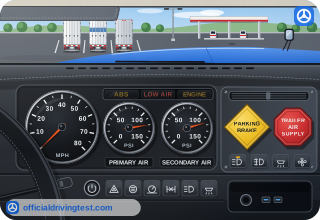
What does the trailer air supply control look like on a newer vehicle?
- A red eight-sided knob
- A yellow diamond-shaped knob
- A blue round knob
Show answer
Correct answer: A red eight-sided knob
It is a red eight-sided knob, and it works the tractor protection valve.
Source: CDL manual, national model as printed by New Jersey, Section 6 (July 2017)
-
What happens when you pull the trailer air supply knob out?
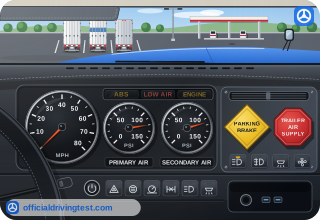
- More air is sent to the trailer service line
- Air is cut off; emergency brakes apply
- The trailer brakes are freed for towing
Show answer
Correct answer: Air is cut off; emergency brakes apply
Pulling the knob out closes the air to the trailer and puts on its emergency brakes. Pushing it in feeds the trailer with air.
Source: CDL manual, national model as printed by New Jersey, Section 6 (July 2017)
-
What may be true of tractor protection valve controls on older vehicles?
- They are always a red eight-sided knob
- They close at a higher pressure than newer ones
- They may not act on their own
Show answer
Correct answer: They may not act on their own
Older controls may not work automatically, and some are levers instead of knobs.
Source: CDL manual, national model as printed by New Jersey, Section 6 (July 2017)
-
An older vehicle has a lever instead of a knob. Which position do you use to tow a trailer?
- Emergency
- Service
- Normal
Show answer
Correct answer: Normal
Normal is the towing position. Emergency shuts the air off and puts on the trailer emergency brakes.
Source: CDL manual, national model as printed by New Jersey, Section 6 (July 2017)
-
Which two air-lines run between the units of a combination vehicle?
- Service line and parking line
- Service line and emergency line
- Emergency line and relay line
Show answer
Correct answer: Service line and emergency line
Each connection between units, such as tractor to trailer, carries a service line and an emergency line.
Source: CDL manual, national model as printed by New Jersey, Section 6 (July 2017)
-
What controls the pressure in the service air-line?
- The trailer air supply control
- The brake pedal or the trailer hand valve
- The drain valves on the trailer tanks
Show answer
Correct answer: The brake pedal or the trailer hand valve
The brake pedal and the trailer hand valve set how much pressure the service line carries.
Source: CDL manual, national model as printed by New Jersey, Section 6 (July 2017)
-
What do the relay valves on the service line give you?
- Faster filling of the trailer tanks
- Faster application of the trailer brakes
- Quicker closing of the tractor protection valve
Show answer
Correct answer: Faster application of the trailer brakes
Relay valves let the trailer brakes come on sooner than they would without them.
Source: CDL manual, national model as printed by New Jersey, Section 6 (July 2017)
-
What are the two jobs of the emergency (supply) air-line?
- Carry the foot brake signal and fill the trailer tanks
- Fill the trailer tanks and control the emergency brakes
- Run the service brakes and the tractor protection valve
Show answer
Correct answer: Fill the trailer tanks and control the emergency brakes
This line keeps the trailer tanks charged, and its pressure also decides whether the emergency brakes are on.
Source: CDL manual, national model as printed by New Jersey, Section 6 (July 2017)
-
What happens to the trailer brakes when the emergency line loses its pressure?
- The brakes release fully
- The emergency brakes come on
- Only the service brakes stay usable
Show answer
Correct answer: The emergency brakes come on
Pressure loss in the emergency line applies the trailer emergency brakes. A torn hose or a trailer breaking loose can cause it.
Source: CDL manual, national model as printed by New Jersey, Section 6 (July 2017)
2Part 217 questions
-
What does the air supply knob do when the emergency line loses its pressure?
- It locks in place
- It changes color
- It pops out
Show answer
Correct answer: It pops out
The tractor protection valve closes, so the air supply knob pops out.
Source: CDL manual, national model as printed by New Jersey, Section 6 (July 2017)
-
Which colors are commonly used to tell the emergency line from the service line?
- Red for emergency, blue for service
- Blue for emergency, red for service
- Yellow for emergency, blue for service
Show answer
Correct answer: Red for emergency, blue for service
Red marks the emergency line and blue marks the service line, which helps prevent mix-ups.
Source: CDL manual, national model as printed by New Jersey, Section 6 (July 2017)
-
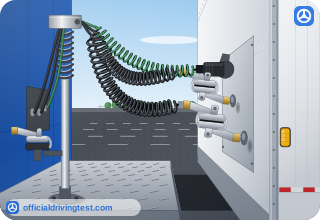
What are glad hands used for?
- Locking the trailer onto the fifth wheel
- Draining moisture from the trailer tanks
- Joining the air-lines from tractor to trailer
Show answer
Correct answer: Joining the air-lines from tractor to trailer
Glad hands are the couplers that join the tractor air-lines to the trailer air-lines.
Source: CDL manual, national model as printed by New Jersey, Section 6 (July 2017)
-
What should you do with glad hand couplers and seals before joining them?
- Oil them lightly
- Swap the seals each time
- Wipe them clean
Show answer
Correct answer: Wipe them clean
Clean the couplers and seals before connecting them, because keeping the air supply clean matters.
Source: CDL manual, national model as printed by New Jersey, Section 6 (July 2017)
-
How are the couplers held when you press two glad hand seals together?
- Lined up straight with each other
- At 45 degrees to each other
- At 90 degrees to each other
Show answer
Correct answer: At 90 degrees to each other
Press the seals together with the couplers at right angles, then turn the glad hand to lock the pair.
Source: CDL manual, national model as printed by New Jersey, Section 6 (July 2017)
-
Besides colors, what is sometimes used to help you join the right glad hands?
- Numbers painted on the hoses
- Differently sized couplers
- Metal tags naming each line
Show answer
Correct answer: Metal tags naming each line
Some lines carry metal tags stamped with the line name, which helps prevent crossing the lines.
Source: CDL manual, national model as printed by New Jersey, Section 6 (July 2017)
-
What happens when the service and emergency air-lines are crossed?
- The spring brakes release but the service brakes lock
- The trailer brakes work as usual using service air
- No supply air reaches the tanks, so spring brakes stay on
Show answer
Correct answer: No supply air reaches the tanks, so spring brakes stay on
Supply air goes to the service line, so the trailer tanks are not charged and the spring brakes have no air to release them.
Source: CDL manual, national model as printed by New Jersey, Section 6 (July 2017)
-
You push in the trailer air supply control, but the spring brakes stay on. What should you check?
- The trailer tank drain valves
- The air-line connections
- The shut-off valve on the last trailer
Show answer
Correct answer: The air-line connections
Spring brakes that stay on after supplying air can mean the air-lines are connected wrongly.
Source: CDL manual, national model as printed by New Jersey, Section 6 (July 2017)
-
On an older trailer with no spring brakes, what is the danger of crossed air-lines?
- You could drive off with no trailer brakes
- The trailer would refuse to move at all
- The trailer emergency brakes would lock on
Show answer
Correct answer: You could drive off with no trailer brakes
Crossed lines leave the trailer without brakes, so you could drive away and find you cannot brake it. Always test the trailer brakes first.
Source: CDL manual, national model as printed by New Jersey, Section 6 (July 2017)
-
After you apply the trailer brakes, how do you confirm they actually hold?
- Rock the trailer back and forth by hand
- Accelerate hard in a higher gear
- Tug gently against them in low gear
Show answer
Correct answer: Tug gently against them in low gear
A gentle pull in low gear shows whether the trailer brakes are really working before you drive off.
Source: CDL manual, national model as printed by New Jersey, Section 6 (July 2017)
-
Why are unused air hoses attached to dummy couplers?
- To stop the hoses from freezing
- To hold air in the tractor tanks
- To keep water and dirt out of them
Show answer
Correct answer: To keep water and dirt out of them
Dummy couplers cover the hose ends so water and dirt cannot get into the couplers and air-lines.
Source: CDL manual, national model as printed by New Jersey, Section 6 (July 2017)
-
Your rig has no dummy couplers. What can you sometimes do with the unused glad hands?
- Lock them to each other
- Hook them onto the trailer frame
- Push them into the trailer glad hands
Show answer
Correct answer: Lock them to each other
When there are no dummy couplers, glad hands can sometimes be joined together, depending on the couplings, to keep the air supply clean.
Source: CDL manual, national model as printed by New Jersey, Section 6 (July 2017)
-
What tells the relay valves how much pressure to send to the trailer brakes?
- Pressure in the emergency line
- The setting of the drain valves
- Pressure in the service line
Show answer
Correct answer: Pressure in the service line
The service line pressure is the signal, and the brake pedal or hand valve controls it.
Source: CDL manual, national model as printed by New Jersey, Section 6 (July 2017)
-
How often should you drain each trailer air tank?
- Once a week
- Once a month
- Every day
Show answer
Correct answer: Every day
Water and oil in the tanks can keep the brakes from working correctly, so drain them daily.
Source: CDL manual, national model as printed by New Jersey, Section 6 (July 2017)
-
Your tanks have automatic drains. What should you still do?
- Skip draining completely
- Open the drains yourself to check
- Replace the drains every year
Show answer
Correct answer: Open the drains yourself to check
Automatic drains remove most moisture, but you should still open each drain to be sure.
Source: CDL manual, national model as printed by New Jersey, Section 6 (July 2017)
-
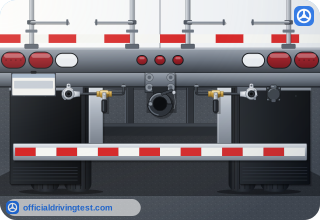
What are the shut-off valves at the back of a trailer used for?
- Draining water from the trailer air tanks
- Setting the trailer parking brakes
- Closing the air-lines when no trailer follows
Show answer
Correct answer: Closing the air-lines when no trailer follows
A trailer that can tow another has shut-off valves so its air-lines can be sealed when nothing is hitched behind it.
Source: CDL manual, national model as printed by New Jersey, Section 6 (July 2017)
-
In a multi-trailer rig, which shut-off valves must be closed?
- Those at the back of the first trailer
- Those between the tractor and the first trailer
- Those on the rear of the final trailer
Show answer
Correct answer: Those on the rear of the final trailer
Every shut-off valve is open except the one on the very last trailer, so air stays in the system instead of escaping at the rear.
Source: CDL manual, national model as printed by New Jersey, Section 6 (July 2017)
3Part 317 questions
-
Which units are not required to have spring brakes?
- Trailers built before 1985, and converter dollies
- Trailers built before 1965, and converter dollies
- Trailers built before 1975, and converter dollies
Show answer
Correct answer: Trailers built before 1975, and converter dollies
Converter dollies, and trailers built before 1975, may lack spring brakes.
Source: CDL manual, national model as printed by New Jersey, Section 6 (July 2017)
-
On a trailer without spring brakes, what power source runs the emergency brakes?
- Air stored in the trailer air tank
- Springs inside the brake chambers
- Air supplied live from the tractor
Show answer
Correct answer: Air stored in the trailer air tank
Their emergency brakes depend on air kept in the trailer tank, which is why a leak matters.
Source: CDL manual, national model as printed by New Jersey, Section 6 (July 2017)
-
What does a trailer without spring brakes not have?
- A parking brake
- Any air tanks
- A service air-line
Show answer
Correct answer: A parking brake
These trailers have emergency brakes that work from tank air, but no parking brake, so chock the wheels when you park them.
Source: CDL manual, national model as printed by New Jersey, Section 6 (July 2017)
-
How long do the emergency brakes of a trailer without spring brakes keep holding?
- Until the tractor engine is restarted
- Only while the trailer tank keeps its air
- For as long as the wheels are chocked
Show answer
Correct answer: Only while the trailer tank keeps its air
The emergency brakes stay on only while the trailer tank keeps its air; once it leaks away the trailer can roll, so chock the wheels.
Source: CDL manual, national model as printed by New Jersey, Section 6 (July 2017)
-
When might a big service-line leak first show itself?
- When you start the engine
- When you apply the brakes
- When you push in the air supply knob
Show answer
Correct answer: When you apply the brakes
Pressing the brakes uses the air in the line, so the loss shows up quickly then and lowers tank pressure fast.
Source: CDL manual, national model as printed by New Jersey, Section 6 (July 2017)
-
Which build date makes ABS mandatory on trailers and converter dollies?
- March 1, 1988
- January 1, 2002
- March 1, 1998
Show answer
Correct answer: March 1, 1998
The ABS requirement applies from March 1, 1998. Some older units were fitted voluntarily.
Source: CDL manual, national model as printed by New Jersey, Section 6 (July 2017)
-
Where do you look for the ABS malfunction lamp on a trailer?
- Right side, at a front or rear corner
- Center of the rear bumper
- Left side, at a front or rear corner
Show answer
Correct answer: Left side, at a front or rear corner
Look at the left side of the trailer, at the front or the rear corner, for the yellow ABS warning lamp.
Source: CDL manual, national model as printed by New Jersey, Section 6 (July 2017)
-
How can you tell whether an older trailer has ABS?
- Look for a red lamp on the right side
- Look underneath for the ECU and sensor wires
- Check the trailer air tanks for a label
Show answer
Correct answer: Look underneath for the ECU and sensor wires
On older units the lamp may not settle it, so look underneath for the ECU and the sensor wires from the brakes.
Source: CDL manual, national model as printed by New Jersey, Section 6 (July 2017)
-
When does ABS take action?
- Whenever you touch the brake pedal
- Only when wheels are about to lock
- Whenever the trailer is empty
Show answer
Correct answer: Only when wheels are about to lock
ABS does nothing until a wheel is close to locking, so normal braking stays the same.
Source: CDL manual, national model as printed by New Jersey, Section 6 (July 2017)
-
What is the main gain from ABS in a hard stop?
- It makes the brakes stronger
- It always shortens the distance
- It helps you keep control
Show answer
Correct answer: It helps you keep control
ABS may not shorten the stop, but by preventing wheel lock-up it helps you stay in control.
Source: CDL manual, national model as printed by New Jersey, Section 6 (July 2017)
-
Only one axle of a rig has ABS. What can you expect?
- Some extra control while braking
- No benefit unless every axle has it
- Weaker brakes than without ABS
Show answer
Correct answer: Some extra control while braking
Even partial ABS, such as on the trailer only, adds control in braking.
Source: CDL manual, national model as printed by New Jersey, Section 6 (July 2017)
-
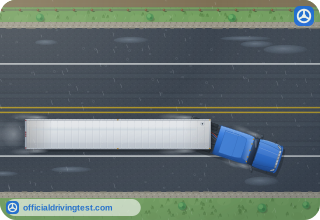
Only the trailer has ABS and the tractor starts to jackknife. What should you do?
- Brake harder so ABS takes over
- Apply only the trailer hand valve
- Ease off the brakes if it is safe
Show answer
Correct answer: Ease off the brakes if it is safe
ABS on the trailer does not stop a tractor jackknife, so release the brakes if you safely can until you regain control.
Source: CDL manual, national model as printed by New Jersey, Section 6 (July 2017)
-
With ABS, how much braking force should you apply?
- Full force on every stop
- Only enough to stop in control
- Half force first, then full force
Show answer
Correct answer: Only enough to stop in control
Apply only as much force as the stop needs and keep control.
Source: CDL manual, national model as printed by New Jersey, Section 6 (July 2017)
-
How should you change your braking style for a rig with ABS?
- Brake as you normally would
- Pump the pedal again and again
- Use one long, hard stomp each time
Show answer
Correct answer: Brake as you normally would
Brake as usual no matter where the ABS is fitted.
Source: CDL manual, national model as printed by New Jersey, Section 6 (July 2017)
-
While slowing a rig with ABS, what should you do to stay in control?
- Press harder as speed drops
- Shift to a higher gear
- Ease off the brakes if safe
Show answer
Correct answer: Ease off the brakes if safe
Watch the tractor and trailer as you slow and let up on the brakes if that is safe.
Source: CDL manual, national model as printed by New Jersey, Section 6 (July 2017)
-
Your ABS stops working. What should you do?
- Stop driving at once
- Drive normally and have it serviced soon
- Brake only with the trailer hand valve
Show answer
Correct answer: Drive normally and have it serviced soon
The regular brakes still work without ABS, so keep driving normally and have the system repaired soon.
Source: CDL manual, national model as printed by New Jersey, Section 6 (July 2017)
-
Does having ABS let you follow other vehicles more closely?
- No, keep your usual distance
- Yes, if the trailer has ABS
- Yes, but only when loaded
Show answer
Correct answer: No, keep your usual distance
ABS is no excuse to follow closer, drive faster or drive with less care.
Source: CDL manual, national model as printed by New Jersey, Section 6 (July 2017)