Combination Vehicles: Combination vehicle air brakes and ABS — Part 1
Questions in this part include: “For what purpose is the trailer hand valve meant to be used?” · “What does the trailer air supply control look like on a newer vehicle?”
Independent educational site · not affiliated with any government agency or DMV
Ready? Test yourself
Answer to start, or tap Start below:
Which control applies every brake on a combination vehicle, trailers included?
- Instant feedback with an explanation
- Every answer cites its source in the manual
- Your best score is saved on this device
- Keyboard: press 1 to 3 to answer and Enter for the next question
Questions are written in our own words from the CDL manual; they are not the real test's questions. With your state chosen, every answer gives its page in your state's CDL manual. Without a state, answers cite the CDL manual, national model as printed by New Jersey (July 2017).
All 17 questions in this practice test
Take the test above first, then use this list to study. Tap “Show answer” to see the correct answer and explanation.
Show the questions and answersHide the questions
-
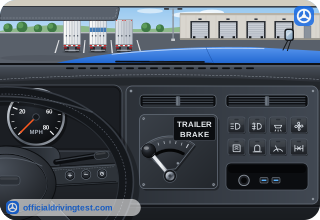
For what purpose is the trailer hand valve meant to be used?
- Slowing the rig on a long downgrade
- Testing the trailer brakes
- Straightening out a trailer skid
Show answer
Correct answer: Testing the trailer brakes
The hand valve is a testing tool. During normal driving the foot brake is the control to use.
Source: CDL manual, national model as printed by New Jersey, Section 6 (July 2017)
-
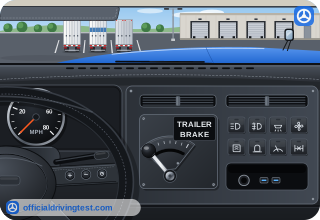
Why should the trailer hand valve stay unused while you drive?
- It would drain the tractor air tanks
- It would close the tractor protection valve
- It could make the trailer skid
Show answer
Correct answer: It could make the trailer skid
Using only the trailer brakes can lock the trailer wheels and cause a skid.
Source: CDL manual, national model as printed by New Jersey, Section 6 (July 2017)
-
Which control applies every brake on a combination vehicle, trailers included?
- The trailer hand valve
- The trailer air supply knob
- The foot brake pedal
Show answer
Correct answer: The foot brake pedal
The foot brake feeds air to all brakes at once, so a skid or jackknife is much less likely than with the hand valve alone.
Source: CDL manual, national model as printed by New Jersey, Section 6 (July 2017)
-
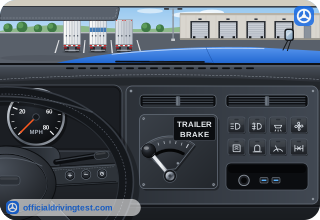
A trailer has no spring brakes. Why is the hand valve a bad way to hold it while parked?
- The air could leak out and free the brakes
- The valve would wear out the relay valves
- The valve would lock the wheels for good
Show answer
Correct answer: The air could leak out and free the brakes
Always use the parking brakes when parked, and chock the wheels if the trailer has no spring brakes.
Source: CDL manual, national model as printed by New Jersey, Section 6 (July 2017)
-
You are leaving the rig for the night. Which control should hold it?
- The parking brakes
- The trailer hand valve
- The trailer air supply knob pushed in
Show answer
Correct answer: The parking brakes
Parking brakes are what hold a parked vehicle. Add wheel chocks if the trailer has no spring brakes.
Source: CDL manual, national model as printed by New Jersey, Section 6 (July 2017)
-
What is the job of the tractor protection valve if a trailer breaks away?
- Set the tractor parking brakes
- Keep air in the tractor brake system
- Send extra air to the trailer tanks
Show answer
Correct answer: Keep air in the tractor brake system
The valve seals off the tractor so its own brake air is not lost through the broken trailer connection.
Source: CDL manual, national model as printed by New Jersey, Section 6 (July 2017)
-
At about what air pressure does the tractor protection valve close on its own?
- 70 to 90 psi
- 5 to 15 psi
- 20 to 45 psi
Show answer
Correct answer: 20 to 45 psi
The valve shuts by itself when pressure falls into the 20 to 45 psi range.
Source: CDL manual, national model as printed by New Jersey, Section 6 (July 2017)
-
What does a closed tractor protection valve prevent?
- The trailer brakes from applying
- The tractor tanks from charging
- Air from leaving the tractor system
Show answer
Correct answer: Air from leaving the tractor system
Once closed, the valve blocks any air from leaving the tractor, so a trailer leak cannot drain the tractor brakes.
Source: CDL manual, national model as printed by New Jersey, Section 6 (July 2017)
-
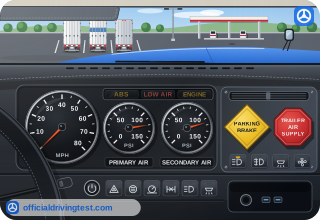
What does the trailer air supply control look like on a newer vehicle?
- A red eight-sided knob
- A yellow diamond-shaped knob
- A blue round knob
Show answer
Correct answer: A red eight-sided knob
It is a red eight-sided knob, and it works the tractor protection valve.
Source: CDL manual, national model as printed by New Jersey, Section 6 (July 2017)
-
What happens when you pull the trailer air supply knob out?
- More air is sent to the trailer service line
- Air is cut off; emergency brakes apply
- The trailer brakes are freed for towing
Show answer
Correct answer: Air is cut off; emergency brakes apply
Pulling the knob out closes the air to the trailer and puts on its emergency brakes. Pushing it in feeds the trailer with air.
Source: CDL manual, national model as printed by New Jersey, Section 6 (July 2017)
-
What may be true of tractor protection valve controls on older vehicles?
- They are always a red eight-sided knob
- They close at a higher pressure than newer ones
- They may not act on their own
Show answer
Correct answer: They may not act on their own
Older controls may not work automatically, and some are levers instead of knobs.
Source: CDL manual, national model as printed by New Jersey, Section 6 (July 2017)
-
An older vehicle has a lever instead of a knob. Which position do you use to tow a trailer?
- Emergency
- Service
- Normal
Show answer
Correct answer: Normal
Normal is the towing position. Emergency shuts the air off and puts on the trailer emergency brakes.
Source: CDL manual, national model as printed by New Jersey, Section 6 (July 2017)
-
Which two air-lines run between the units of a combination vehicle?
- Service line and parking line
- Service line and emergency line
- Emergency line and relay line
Show answer
Correct answer: Service line and emergency line
Each connection between units, such as tractor to trailer, carries a service line and an emergency line.
Source: CDL manual, national model as printed by New Jersey, Section 6 (July 2017)
-
What controls the pressure in the service air-line?
- The trailer air supply control
- The brake pedal or the trailer hand valve
- The drain valves on the trailer tanks
Show answer
Correct answer: The brake pedal or the trailer hand valve
The brake pedal and the trailer hand valve set how much pressure the service line carries.
Source: CDL manual, national model as printed by New Jersey, Section 6 (July 2017)
-
What do the relay valves on the service line give you?
- Faster filling of the trailer tanks
- Faster application of the trailer brakes
- Quicker closing of the tractor protection valve
Show answer
Correct answer: Faster application of the trailer brakes
Relay valves let the trailer brakes come on sooner than they would without them.
Source: CDL manual, national model as printed by New Jersey, Section 6 (July 2017)
-
What are the two jobs of the emergency (supply) air-line?
- Carry the foot brake signal and fill the trailer tanks
- Fill the trailer tanks and control the emergency brakes
- Run the service brakes and the tractor protection valve
Show answer
Correct answer: Fill the trailer tanks and control the emergency brakes
This line keeps the trailer tanks charged, and its pressure also decides whether the emergency brakes are on.
Source: CDL manual, national model as printed by New Jersey, Section 6 (July 2017)
-
What happens to the trailer brakes when the emergency line loses its pressure?
- The brakes release fully
- The emergency brakes come on
- Only the service brakes stay usable
Show answer
Correct answer: The emergency brakes come on
Pressure loss in the emergency line applies the trailer emergency brakes. A torn hose or a trailer breaking loose can cause it.
Source: CDL manual, national model as printed by New Jersey, Section 6 (July 2017)