Wisconsin: Sharing the road — Part 3 Practice Test
Questions in this part include: “What does keeping more distance between yourself and others give you?” · “Before passing a bicyclist, what should you wait for?”
Independent educational site · not affiliated with any government agency or DMV
Ready? Test yourself
Answer to start, or tap Start below:
What does keeping more distance between yourself and others give you?
- Instant feedback with an explanation
- Every answer cites its source in the manual
- Your best score is saved on this device
- Keyboard: press 1 to 4 to answer and Enter for the next question
Questions are original and based on the official manual "Wisconsin Motorists' Handbook" (2026 (BDS126)), Wisconsin Department of Transportation, Division of Motor Vehicles (DMV).
All 19 questions in this practice test
Take the test above first, then use this list to study. Tap “Show answer” to see the correct answer and explanation.
Show the questions and answersHide the questions
-
What does keeping more distance between yourself and others give you?
- A lower speed limit
- The right-of-way
- More room to pass
- More time to react
Show answer
Correct answer: More time to react
The more distance you keep from others, the more time you have to react.
Source: Wisconsin Motorists' Handbook (2026 (BDS126)), page 51 · Open this page in the manual (Manual page 51)
-
A school bus is stopped with its red lights flashing. How far from it must you stop?
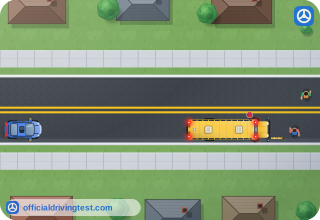
- At least 5 feet
- At least 10 feet
- At least 20 feet
- At least 50 feet
Show answer
Correct answer: At least 20 feet
You need to stop at least 20 feet from a school bus that has its red lights flashing.
Source: Wisconsin Motorists' Handbook (2026 (BDS126)), page 51 · Open this page in the manual (Manual page 51)
-
A school bus is stopped with its red lights flashing on an undivided road. When must you stop?
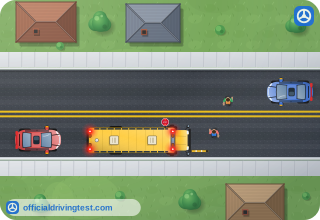
- Only when the bus is on your side of the road
- Whether the bus is on your side or the opposite side
- Only when the bus is on the opposite side
- Only if children are visible
Show answer
Correct answer: Whether the bus is on your side or the opposite side
You must stop whether the school bus is on your side of the road or the opposite side.
Source: Wisconsin Motorists' Handbook (2026 (BDS126)), page 51 · Open this page in the manual (Manual page 51)
-
When can you proceed after stopping for a school bus?
- As soon as the bus doors have closed
- Once the bus has started to move again
- After waiting one full minute at the bus
- Once its red lights stop flashing
Show answer
Correct answer: Once its red lights stop flashing
The handbook says you can proceed once the red lights on the school bus have stopped flashing.
Source: Wisconsin Motorists' Handbook (2026 (BDS126)), page 51 · Open this page in the manual (Manual page 51)
-
When do you not need to stop for a school bus with its red lights flashing?
- On any road when the bus is on the opposite side
- On any road with more than two lanes
- On a divided highway when you are not on the bus’s side
- On any road with a painted center line
Show answer
Correct answer: On a divided highway when you are not on the bus’s side
On a divided highway, a driver who is not on the side of the school bus does not need to stop.
Source: Wisconsin Motorists' Handbook (2026 (BDS126)), page 51 · Open this page in the manual (Manual page 51)
-
What is a divided highway?
- A highway with a barrier between opposing lanes
- A highway with a painted line between the lanes
- A highway with two or more lanes each way
- A highway with a shoulder on each side
Show answer
Correct answer: A highway with a barrier between opposing lanes
The handbook defines a divided highway as one with a barrier between lanes going opposite directions.
Source: Wisconsin Motorists' Handbook (2026 (BDS126)), page 51 · Open this page in the manual (Manual page 51)
-
Compared with most vehicles, how do motorcycles stop?
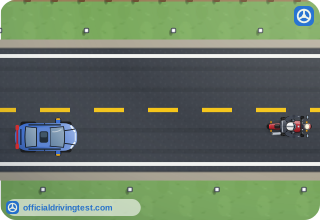
- They need more distance to stop
- They stop in the same distance
- They cannot stop quickly in traffic
- They can stop faster
Show answer
Correct answer: They can stop faster
Motorcycles are lightweight and can stop faster than most vehicles.
Source: Wisconsin Motorists' Handbook (2026 (BDS126)), page 51 · Open this page in the manual (Manual page 51)
-
What should you give motorcyclists, especially when you are following one?
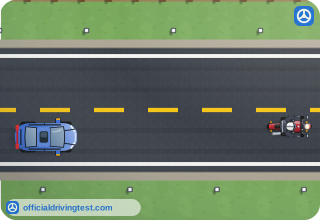
- A quick honk
- Extra room
- A flash of your high beams
- The same room as any vehicle
Show answer
Correct answer: Extra room
The handbook says to give motorcyclists extra room, especially when following one.
Source: Wisconsin Motorists' Handbook (2026 (BDS126)), page 51 · Open this page in the manual (Manual page 51)
-
What should you check before moving when sharing the road with motorcycles?
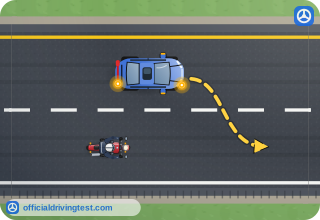
- Your blind spots
- Your fuel gauge
- Your hazard lights
- Your tire tread
Show answer
Correct answer: Your blind spots
The handbook says to be extra aware and check your blind spots before moving.
Source: Wisconsin Motorists' Handbook (2026 (BDS126)), page 51 · Open this page in the manual (Manual page 51)
-
How much of a traffic lane can bicyclists use?
- Only the right half
- Only the right three feet
- The whole lane
- Only the edge by the curb
Show answer
Correct answer: The whole lane
The handbook says bicyclists can use the whole traffic lane.
Source: Wisconsin Motorists' Handbook (2026 (BDS126)), page 52 · Open this page in the manual (Manual page 52)
-
Why should you not share a lane with a bicyclist?
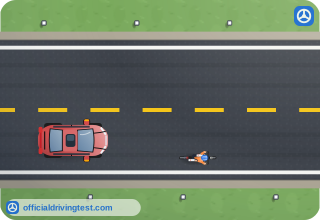
- They always travel faster than most cars
- They can move into your path without warning
- They must stop at every intersection they reach
- They are not allowed to use hand signals
Show answer
Correct answer: They can move into your path without warning
Bicyclists can move into your path quickly and without warning, so you should not share a lane with them.
Source: Wisconsin Motorists' Handbook (2026 (BDS126)), page 52 · Open this page in the manual (Manual page 52)
-
Before passing a bicyclist, what should you wait for?
- The bicyclist to stop
- The bicyclist to give a signal
- A green traffic light
- Oncoming traffic to clear
Show answer
Correct answer: Oncoming traffic to clear
The handbook says to wait for oncoming traffic to clear before passing a bicyclist.
Source: Wisconsin Motorists' Handbook (2026 (BDS126)), page 52 · Open this page in the manual (Manual page 52)
-
How much room should you give bicyclists when you pass?
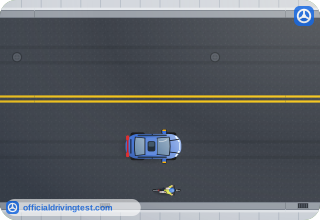
- At least one foot
- At least two feet
- At least three feet
- At least five feet
Show answer
Correct answer: At least three feet
The handbook says to give bicyclists at least three feet of room when you pass.
Source: Wisconsin Motorists' Handbook (2026 (BDS126)), page 52 · Open this page in the manual (Manual page 52)
-
Some bicyclists do not have reflectors or lights. What should you do around them?
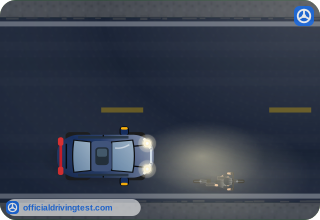
- Be watchful and alert
- Honk to warn them
- Flash your high beams at them
- Stay close behind them
Show answer
Correct answer: Be watchful and alert
Because some bicyclists have no reflectors or lights, you should be watchful and alert when moving around them.
Source: Wisconsin Motorists' Handbook (2026 (BDS126)), page 52 · Open this page in the manual (Manual page 52)
-
What are No-Zones?
- Areas where passing is not allowed
- Areas where bicycles are not allowed
- Areas where large vehicles cannot see you
- Areas where trucks must slow down
Show answer
Correct answer: Areas where large vehicles cannot see you
No-Zones are areas around large vehicles where the driver cannot see you.
Source: Wisconsin Motorists' Handbook (2026 (BDS126)), page 52 · Open this page in the manual (Manual page 52)
-
About how far behind a large truck is its No-Zone?
- About 50 feet
- About 200 feet
- About 100 feet
- About 300 feet
Show answer
Correct answer: About 200 feet
The No-Zone extends about 200 feet behind a large truck.
Source: Wisconsin Motorists' Handbook (2026 (BDS126)), page 52 · Open this page in the manual (Manual page 52)
-
About how far in front of a large truck is its No-Zone?
- About 5 feet
- About 10 feet
- About 50 feet
- About 20 feet
Show answer
Correct answer: About 20 feet
The No-Zone extends about 20 feet in front of a large truck.
Source: Wisconsin Motorists' Handbook (2026 (BDS126)), page 52 · Open this page in the manual (Manual page 52)
-
If you are in a large truck’s No-Zone, what should you do so the driver can see you?
- Stay where you are and honk
- Move closer to the truck
- Either speed up or drop back
- Flash your headlights at the truck
Show answer
Correct answer: Either speed up or drop back
The handbook says to either speed up or drop back so the other driver can see you.
Source: Wisconsin Motorists' Handbook (2026 (BDS126)), page 52 · Open this page in the manual (Manual page 52)
-
If you want to pass a large vehicle, what should you do about its blind spot?
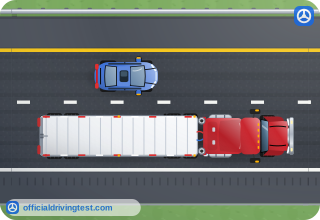
- Get out of it quickly
- Stay in it as you pass
- Slow down inside it
- Stop beside the vehicle
Show answer
Correct answer: Get out of it quickly
When passing a large vehicle, you should get out of its blind spot quickly.
Source: Wisconsin Motorists' Handbook (2026 (BDS126)), page 52 · Open this page in the manual (Manual page 52)