Wisconsin: Exam Simulator
65 random questions from every topic, like a mini exam.
Independent educational site · not affiliated with any government agency or DMV
Ready? Test yourself
Like the real test: first 15 road-sign questions, pass with 12 correct; then 50 questions, pass with 40 correct.
- Instant feedback with an explanation
- Every answer cites its source in the manual
- Your best score is saved on this device
- Keyboard: press 1 to 4 to answer and Enter for the next question
Questions are original and based on the official manual "Wisconsin Motorists' Handbook" (2026 (BDS126)), Wisconsin Department of Transportation, Division of Motor Vehicles (DMV).
Sample questions
The exam simulator picks 65 random questions from every topic each time you start. Here are a few examples.
Show the questions and answersHide the questions
-
What must anyone who drives on Wisconsin public roads have?
- A valid driver license
- A signed letter from a sponsor
- A copy of this handbook
- A passport
Show answer
Correct answer: A valid driver license
Wisconsin requires anyone who drives on its public roads to hold a valid driver license.
Source: Wisconsin Motorists' Handbook (2026 (BDS126)), page 1 · Open this page in the manual (Manual page 1)
-
When you adjust your seat and mirrors before driving, what should you make sure you can do?
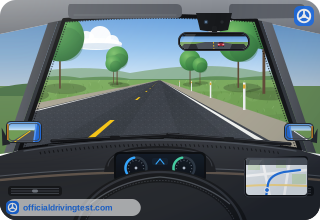
- Reach the glove box without leaning
- See out all your vehicle windows
- Hear traffic noise through closed windows
- See the rear tires in your mirrors
Show answer
Correct answer: See out all your vehicle windows
Along with adjusting the seat and mirrors, you should make sure you can see out all of the vehicle's windows.
Source: Wisconsin Motorists' Handbook (2026 (BDS126)), page 9 · Open this page in the manual (Manual page 9)
-
Besides telling you when you can pass, what do lines on the road tell you?
- Where the next intersection with a traffic light is
- Which lane currently has the least amount of traffic
- When there are curves and if you are close to a curb
- How fast the vehicle in front of you is traveling
Show answer
Correct answer: When there are curves and if you are close to a curb
Road lines show when you can pass, when there are curves on the road and if you are close to a curb.
Source: Wisconsin Motorists' Handbook (2026 (BDS126)), page 32 · Open this page in the manual (Manual page 32)
-
When you merge with traffic, what speed should you try to enter at?
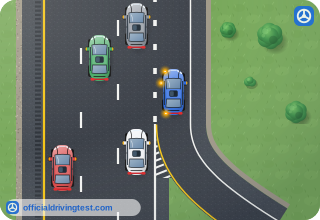
- A little slower than traffic so that others can pass you
- The same speed that the traffic is currently moving
- A little faster than traffic so that you get ahead
- The speed of the vehicle that is behind you
Show answer
Correct answer: The same speed that the traffic is currently moving
When merging, you should try to enter at the same speed that the traffic is currently moving.
Source: Wisconsin Motorists' Handbook (2026 (BDS126)), page 10 · Open this page in the manual (Manual page 10)
-
Where is a vehicle normally parked on the road?
- In the middle of the road beside the center line
- On the far-left side of the road
- On the side with the least traffic
- On the far-right side of the road
Show answer
Correct answer: On the far-right side of the road
You must park far enough from travel lanes not to interfere with traffic, which is normally on the far-right side.
Source: Wisconsin Motorists' Handbook (2026 (BDS126)), page 18 · Open this page in the manual (Manual page 18)
-
What shape are most warning signs?
- Eight-sided
- Downward triangle
- Diamond
- Round
Show answer
Correct answer: Diamond
Most warning signs are diamond shaped.
Source: Wisconsin Motorists' Handbook (2026 (BDS126)), page 22 · Open this page in the manual (Manual page 22)
-
What do warning signs tell you about?
- The rules of the road you must obey
- A special situation or a hazard ahead
- Directions and distances to cities
- Services such as hospitals nearby
Show answer
Correct answer: A special situation or a hazard ahead
Warning signs warn you about a special situation or a hazard that is ahead.
Source: Wisconsin Motorists' Handbook (2026 (BDS126)), page 22 · Open this page in the manual (Manual page 22)
-
A police officer, school crossing guard or other worker gives you directions that are different from the traffic light or sign on the road. What must you do?
- Follow the worker's directions
- Follow the traffic light or sign
- Wait for the signal to change
- Pull over until the worker leaves
Show answer
Correct answer: Follow the worker's directions
You must follow the directions of police, school crossing guards and other workers, even when they differ from the traffic light or sign on the road.
Source: Wisconsin Motorists' Handbook (2026 (BDS126)), page 22 · Open this page in the manual (Manual page 22)
-
What does "right-of-way" tell us?
- Which vehicle may drive faster
- Which lane to use at an intersection
- Who is at fault after a crash
- Who goes first and who must wait
Show answer
Correct answer: Who goes first and who must wait
Right-of-way decides who goes first and who must wait where vehicles or pedestrians meet.
Source: Wisconsin Motorists' Handbook (2026 (BDS126)), page 9 · Open this page in the manual (Manual page 9)
-
Which statement about trains at railroad crossings matches the handbook?
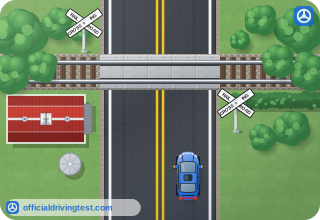
- Do not assume a train is not coming down the tracks
- You can assume no train is coming if you hear no horn
- You can assume no train is coming if the tracks look empty
- You can assume no train is coming if the crossing has no gate
Show answer
Correct answer: Do not assume a train is not coming down the tracks
You should never assume a train is not coming down the tracks.
Source: Wisconsin Motorists' Handbook (2026 (BDS126)), page 12 · Open this page in the manual (Manual page 12)