Wisconsin: Sharing the road — Part 1 Practice Test
Questions in this part include: “What should you try to do if you need to stop to pick up or let off passengers?” · “When may you use a paved shoulder to go around another vehicle?”
Independent educational site · not affiliated with any government agency or DMV
Ready? Test yourself
Answer to start, or tap Start below:
What should you try to do if you need to stop to pick up or let off passengers?
- Instant feedback with an explanation
- Every answer cites its source in the manual
- Your best score is saved on this device
- Keyboard: press 1 to 4 to answer and Enter for the next question
Questions are original and based on the official manual "Wisconsin Motorists' Handbook" (2026 (BDS126)), Wisconsin Department of Transportation, Division of Motor Vehicles (DMV).
All 19 questions in this practice test
Take the test above first, then use this list to study. Tap “Show answer” to see the correct answer and explanation.
Show the questions and answersHide the questions
-
Why should you give extra space to large vehicles?
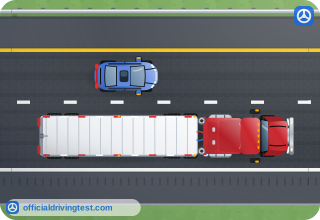
- So you can see around them and they can see you
- Because large vehicles always have the right-of-way
- Because large vehicles are not allowed to pass
- Because large vehicles must always travel in the left lane
Show answer
Correct answer: So you can see around them and they can see you
Extra space around large vehicles lets you see around them and lets them see you.
Source: Wisconsin Motorists' Handbook (2026 (BDS126)), page 12 · Open this page in the manual (Manual page 12)
-
A vehicle is driving right next to you on a roadway. What should you do when it is safe?
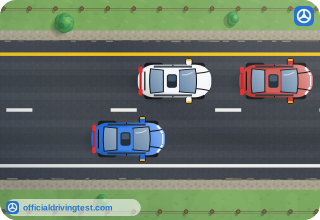
- Match its speed and stay beside it
- Sound your horn to make it move on
- Move ahead or move behind it
- Move closer to it to leave room on your other side
Show answer
Correct answer: Move ahead or move behind it
When it is safe, move ahead of or behind a vehicle that is next to you to keep space all around your vehicle.
Source: Wisconsin Motorists' Handbook (2026 (BDS126)), page 12 · Open this page in the manual (Manual page 12)
-
A driver cannot see behind their vehicle. What should you do?
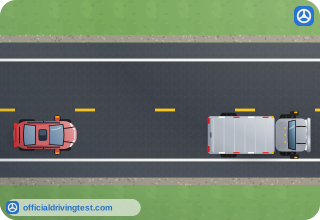
- Follow closely so the driver sees you
- Give extra space
- Honk to let the driver know you are there
- Pass quickly on the right
Show answer
Correct answer: Give extra space
You should give extra space to someone who cannot see behind their vehicle.
Source: Wisconsin Motorists' Handbook (2026 (BDS126)), page 13 · Open this page in the manual (Manual page 13)
-
What should you try to do if you need to stop to pick up or let off passengers?
- Find a safe place out of traffic
- Stop at the nearest intersection
- Stop in the lane so passengers can step off quickly
- Stop in the far-left lane with your hazard lights on
Show answer
Correct answer: Find a safe place out of traffic
You should try to find a safe place out of traffic when you stop to pick up or let off passengers.
Source: Wisconsin Motorists' Handbook (2026 (BDS126)), page 13 · Open this page in the manual (Manual page 13)
-
Why should you leave extra space to large vehicles such as trucks and buses when they turn?
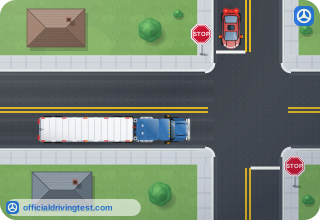
- They may cross the center line during a turn
- They are required to stop before every turn
- They must wait for you to pass before turning
- They are not allowed to turn at intersections
Show answer
Correct answer: They may cross the center line during a turn
Trucks and buses may cross the center line while turning, so you should leave them extra space.
Source: Wisconsin Motorists' Handbook (2026 (BDS126)), page 14 · Open this page in the manual (Manual page 14)
-
When may you use a paved shoulder to go around another vehicle?
- Whenever the vehicle ahead is traveling below the speed limit
- Whenever there is no oncoming traffic in the opposite lane
- Only when that vehicle is stopped or making a left turn
- Only when that vehicle is making a right turn
Show answer
Correct answer: Only when that vehicle is stopped or making a left turn
A paved shoulder may be used to go around someone only if they are stopped or making a left turn.
Source: Wisconsin Motorists' Handbook (2026 (BDS126)), page 17 · Open this page in the manual (Manual page 17)
-
On a multi-lane road, which lane is used for vehicles to go around slower ones?
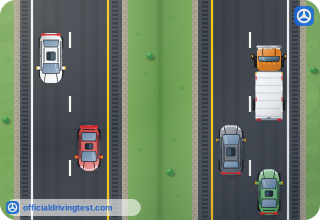
- The lane farthest on the right
- The middle lane only
- The paved shoulder only
- The lane farthest on the left
Show answer
Correct answer: The lane farthest on the left
The lane farthest on the left of a multi-lane road is used to go around slower vehicles.
Source: Wisconsin Motorists' Handbook (2026 (BDS126)), page 17 · Open this page in the manual (Manual page 17)
-
Why can passing a vehicle on its right cause a crash?
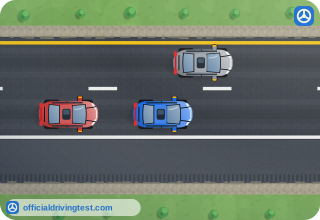
- The vehicle you pass must speed up to let you by
- The driver you pass might not be able to see you
- The paved shoulder is always closed to traffic
- Passing on the right is only possible above the speed limit
Show answer
Correct answer: The driver you pass might not be able to see you
A driver passed on the right might not see you, and this could cause a crash.
Source: Wisconsin Motorists' Handbook (2026 (BDS126)), page 17 · Open this page in the manual (Manual page 17)
-
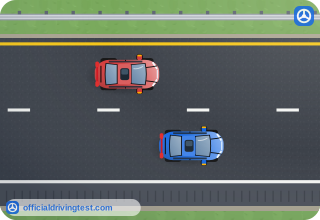
Someone is trying to pass you. What should you do?
- Speed up so that they cannot get ahead
- Flash your high beams at them
- Stay in your lane and slow down
- Move into the passing lane to make room
Show answer
Correct answer: Stay in your lane and slow down
When another driver is passing you, stay in your lane and slow down.
Source: Wisconsin Motorists' Handbook (2026 (BDS126)), page 17 · Open this page in the manual (Manual page 17)
-
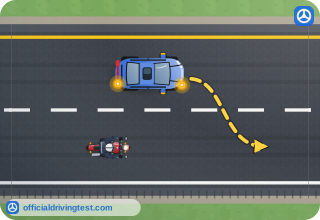
When you move to the right lane, which shoulder do you check over?
- Your left shoulder
- Neither shoulder, only the mirrors
- Your right shoulder
- Both shoulders at the same time
Show answer
Correct answer: Your right shoulder
You check over the shoulder in the direction you are changing lanes, so over your right shoulder when moving right.
Source: Wisconsin Motorists' Handbook (2026 (BDS126)), page 17 · Open this page in the manual (Manual page 17)
-
How should you move when you change lanes?
- Across all lanes at once if the road is clear
- Into the lane with the fastest traffic first
- Quickly, so that other drivers do not have to slow down
- One lane at a time
Show answer
Correct answer: One lane at a time
The handbook says to move one lane at a time when you change lanes.
Source: Wisconsin Motorists' Handbook (2026 (BDS126)), page 17 · Open this page in the manual (Manual page 17)
-
What are the areas you check over your shoulder, which you cannot see by only looking in your mirrors, called?
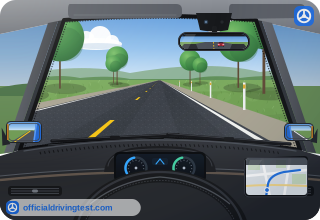
- Blind spots
- Passing zones
- Signal areas
- Mirror gaps
Show answer
Correct answer: Blind spots
The two areas you check over your shoulder before a lane change are called blind spots, and mirrors do not show them.
Source: Wisconsin Motorists' Handbook (2026 (BDS126)), page 17 · Open this page in the manual (Manual page 17)
-
How many vehicles should you pass at a time on the left side?
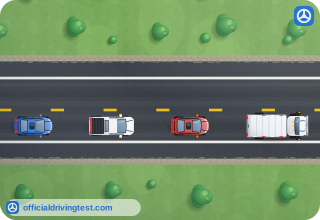
- As many as the passing lane has room for
- Only one vehicle
- Up to three, if the road is straight
- Two, if you stay under the speed limit
Show answer
Correct answer: Only one vehicle
There might not be enough time to pass several vehicles at once, so pass one vehicle at a time.
Source: Wisconsin Motorists' Handbook (2026 (BDS126)), page 18 · Open this page in the manual (Manual page 18)
-
After you pass another vehicle, what should you do?
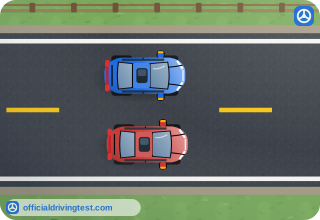
- Move safely back to your lane and not stay in the passing lane
- Stay in the passing lane to be ready for the next vehicle
- Stop on the shoulder to let the vehicle go by
- Slow down in the passing lane until traffic clears
Show answer
Correct answer: Move safely back to your lane and not stay in the passing lane
You should not stay in the passing lane but move safely back to your lane.
Source: Wisconsin Motorists' Handbook (2026 (BDS126)), page 18 · Open this page in the manual (Manual page 18)
-
When should you not pass a vehicle?
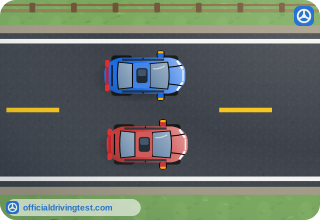
- When the vehicle you want to pass has its turn signal turned off
- When there is not enough room in front of the vehicle you want to pass
- When the vehicle you want to pass is a different color than yours
- When the vehicle you want to pass is traveling on a paved road
Show answer
Correct answer: When there is not enough room in front of the vehicle you want to pass
Do not pass a vehicle unless there is enough room in front of the vehicle you want to pass.
Source: Wisconsin Motorists' Handbook (2026 (BDS126)), page 18 · Open this page in the manual (Manual page 18)
-
Do other drivers have to move over to let you pass?
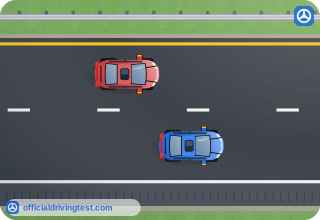
- Yes, if you signal before you start to pass
- Yes, if you are going faster than they are
- Yes, if you tap your horn to get their attention
- No, other vehicles do not have to move to let you pass
Show answer
Correct answer: No, other vehicles do not have to move to let you pass
Other vehicles do not have to move to let you pass.
Source: Wisconsin Motorists' Handbook (2026 (BDS126)), page 18 · Open this page in the manual (Manual page 18)
-
After passing a vehicle, when is it safe to return to the driving lane?
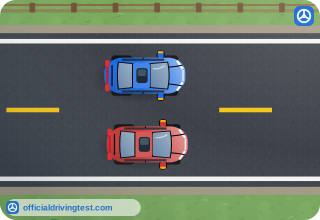
- As soon as your front bumper is even with the rear bumper of that vehicle
- Once the vehicle you passed has slowed below the speed limit
- Once both headlights of that vehicle show in your rearview mirror
- As soon as the vehicle you passed signals to let you in
Show answer
Correct answer: Once both headlights of that vehicle show in your rearview mirror
It is safe to return to the driving lane once both headlights of the passed vehicle show in your rearview mirror.
Source: Wisconsin Motorists' Handbook (2026 (BDS126)), page 18 · Open this page in the manual (Manual page 18)
-
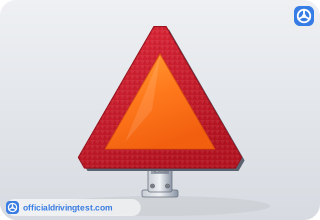
A vehicle ahead of you carries a triangle-shaped sign with reflective orange markings. Up to what speed could this vehicle travel?
- 35 mph
- 45 mph
- 25 mph
- 55 mph
Show answer
Correct answer: 25 mph
A vehicle with a Slow Moving Vehicle sign could travel at 25 mph or less.
Source: Wisconsin Motorists' Handbook (2026 (BDS126)), page 25 · Open this page in the manual (Manual page 25)
-
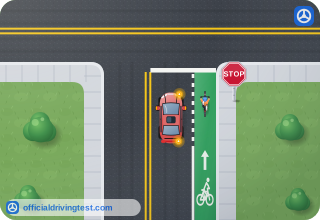
You need to turn across a reserved lane and a bicyclist is in the lane. What should you do?
- Pass the bicyclist and turn immediately
- Honk to make the bicyclist move over
- Move behind the bicyclist and turn once it is safe
- Stop in the lane until the bicyclist leaves it
Show answer
Correct answer: Move behind the bicyclist and turn once it is safe
With a bicyclist in the reserved lane, you move behind them and turn when it is safe.
Source: Wisconsin Motorists' Handbook (2026 (BDS126)), page 37 · Open this page in the manual (Manual page 37)