Wisconsin: Speed and space — Part 1 Practice Test
Questions in this part include: “To use the "Four Second Following Distance Rule", what do you first pick out?” · “Which statement about driving too fast or too slow is true?”
Independent educational site · not affiliated with any government agency or DMV
Ready? Test yourself
Answer to start, or tap Start below:
To use the "Four Second Following Distance Rule", what do you first pick out?
- Instant feedback with an explanation
- Every answer cites its source in the manual
- Your best score is saved on this device
- Keyboard: press 1 to 4 to answer and Enter for the next question
Questions are original and based on the official manual "Wisconsin Motorists' Handbook" (2026 (BDS126)), Wisconsin Department of Transportation, Division of Motor Vehicles (DMV).
All 21 questions in this practice test
Take the test above first, then use this list to study. Tap “Show answer” to see the correct answer and explanation.
Show the questions and answersHide the questions
-
When you use the "Four Second Following Distance Rule", what does it mean if you reach the object before you finish saying "one thousand four"?
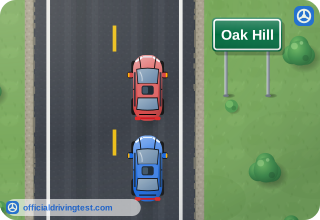
- You are going too slowly
- You are following at a safe distance
- You are going too fast
- You are driving in the wrong lane
Show answer
Correct answer: You are going too fast
If you reach the object before you finish counting to one thousand four, you are going too fast.
Source: Wisconsin Motorists' Handbook (2026 (BDS126)), page 10 · Open this page in the manual (Manual page 10)
-
To use the "Four Second Following Distance Rule", what do you first pick out?
- The brake lights of the vehicle that is ahead of you
- A stationary object as far ahead as you can clearly see
- A moving vehicle in the lane beside you
- The nearest line painted on the road surface
Show answer
Correct answer: A stationary object as far ahead as you can clearly see
You pick out a stationary object, such as a tree, sign or house, as far ahead as you can clearly see and then start counting.
Source: Wisconsin Motorists' Handbook (2026 (BDS126)), page 10 · Open this page in the manual (Manual page 10)
-
What should you do to the four-second count when there is an adverse condition such as heavier traffic, rain, snow or ice?
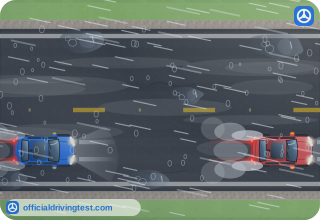
- Keep it at four seconds
- Subtract a second for every adverse condition
- Switch to a two-second count
- Add a second for every adverse condition
Show answer
Correct answer: Add a second for every adverse condition
The handbook says to add a second for every adverse condition such as heavier traffic, rain, snow or ice.
Source: Wisconsin Motorists' Handbook (2026 (BDS126)), page 10 · Open this page in the manual (Manual page 10)
-
What is a speed limit?
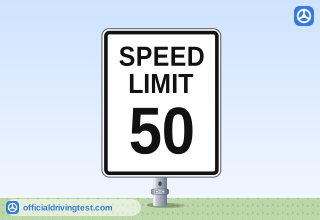
- The speed you should always drive in that area
- The average speed of other drivers in that area
- The slowest speed you are allowed to drive in that area
- The fastest speed you are allowed to drive in that area
Show answer
Correct answer: The fastest speed you are allowed to drive in that area
A speed limit is the fastest speed you are allowed to drive in the area you are in.
Source: Wisconsin Motorists' Handbook (2026 (BDS126)), page 10 · Open this page in the manual (Manual page 10)
-
What does the handbook say about driving over the speed limit in order to pass other vehicles?
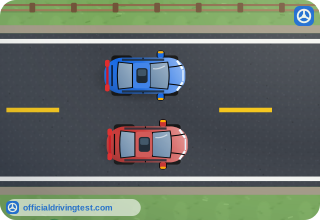
- You may do it if the road is clear
- You cannot do it
- You may do it on multi-lane roads
- You may do it for a short time
Show answer
Correct answer: You cannot do it
You cannot drive over the speed limit to pass other vehicles.
Source: Wisconsin Motorists' Handbook (2026 (BDS126)), page 10 · Open this page in the manual (Manual page 10)
-
On a multi-lane road, which lane should you drive in if you are driving slower than most traffic?
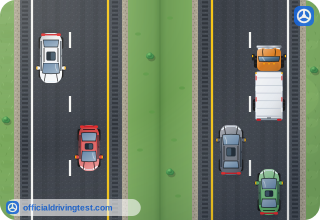
- The far-left lane
- The center lane
- The far-right lane
- Any lane with fewer vehicles
Show answer
Correct answer: The far-right lane
Drivers who are slower than most traffic should use the far-right lane of a multi-lane road.
Source: Wisconsin Motorists' Handbook (2026 (BDS126)), page 10 · Open this page in the manual (Manual page 10)
-
What does the handbook say about racing and driving recklessly?
- They are not allowed and are illegal
- They are allowed on roads with no posted limit
- They are allowed when no other traffic is present
- They are allowed only during daylight hours
Show answer
Correct answer: They are not allowed and are illegal
Racing and driving recklessly are not allowed and are illegal.
Source: Wisconsin Motorists' Handbook (2026 (BDS126)), page 10 · Open this page in the manual (Manual page 10)
-
Unless otherwise posted, what is the speed limit in residential areas?
- 15 mph
- 25 mph
- 30 mph
- 35 mph
Show answer
Correct answer: 25 mph
Unless a different limit is posted, the speed limit in residential areas is 25 miles per hour.
Source: Wisconsin Motorists' Handbook (2026 (BDS126)), page 10 · Open this page in the manual (Manual page 10)
-
What is the normal speed limit in a school zone when children are present?
- 20 mph
- 25 mph
- 30 mph
- 15 mph
Show answer
Correct answer: 15 mph
The normal speed limit in a school zone when children are present is 15 miles per hour.
Source: Wisconsin Motorists' Handbook (2026 (BDS126)), page 10 · Open this page in the manual (Manual page 10)
-
What is the maximum speed limit in outlying parts of cities and villages with no posted speed limit?
- 35 mph
- 25 mph
- 30 mph
- 40 mph
Show answer
Correct answer: 35 mph
The maximum speed limit in outlying parts of cities and villages with no posted limit is 35 mph.
Source: Wisconsin Motorists' Handbook (2026 (BDS126)), page 10 · Open this page in the manual (Manual page 10)
-
What may require you to drive slower than the speed limit?
- The number of passengers in your car
- The age of your vehicle
- Visibility and road conditions
- The type of fuel you use
Show answer
Correct answer: Visibility and road conditions
The speed limit is only the maximum, so poor visibility and road conditions may mean you need to go slower.
Source: Wisconsin Motorists' Handbook (2026 (BDS126)), page 10 · Open this page in the manual (Manual page 10)
-
Which statement about driving too fast or too slow is true?
- Only driving too fast could cause a crash or lead to a ticket
- Driving too slowly is never a reason for a police ticket
- Either one could cause a crash and get you a ticket from police
- Driving too slowly cannot cause a crash, but driving too fast can
Show answer
Correct answer: Either one could cause a crash and get you a ticket from police
Driving too slowly can make vehicles back up behind you and cause a crash, and in both cases you could be given a ticket.
Source: Wisconsin Motorists' Handbook (2026 (BDS126)), page 10 · Open this page in the manual (Manual page 10)
-
What does the handbook say to try to do with your speed compared with others on the road?
- Keep the same speed as the others
- Go a little faster than the others
- Go a little slower than the others
- Change your speed often to stay alert
Show answer
Correct answer: Keep the same speed as the others
The handbook advises trying to keep the same speed as others on the road.
Source: Wisconsin Motorists' Handbook (2026 (BDS126)), page 10 · Open this page in the manual (Manual page 10)
-
What does the handbook warn that passing other vehicles on the road could cause?
- A flat tire
- Engine overheating
- A lost parking space
- A crash
Show answer
Correct answer: A crash
The handbook warns that passing other vehicles on the road could cause a crash.
Source: Wisconsin Motorists' Handbook (2026 (BDS126)), page 10 · Open this page in the manual (Manual page 10)
-
What happens to the distance it takes to turn, slow or stop as your car goes faster?
- It decreases
- It increases
- It stays the same
- It changes only when turning
Show answer
Correct answer: It increases
The faster your car is going, the more distance it will take to turn, slow or stop.
Source: Wisconsin Motorists' Handbook (2026 (BDS126)), page 11 · Open this page in the manual (Manual page 11)
-
To have better control of your vehicle, how far ahead should you be able to see?
- 2 to 3 seconds ahead
- 4 to 6 seconds ahead
- 10 to 15 seconds ahead
- 20 to 30 seconds ahead
Show answer
Correct answer: 10 to 15 seconds ahead
The driver needs to be able to see 10 to 15 seconds ahead of the vehicle to keep better control.
Source: Wisconsin Motorists' Handbook (2026 (BDS126)), page 11 · Open this page in the manual (Manual page 11)
-
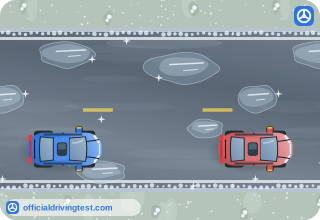
What does the handbook suggest if the roads are icy?
- Use cruise control to keep a steady speed
- Drive only on highways
- Drive with your hazard lights on
- Try to avoid driving
Show answer
Correct answer: Try to avoid driving
The handbook says to try to avoid driving if the roads are icy.
Source: Wisconsin Motorists' Handbook (2026 (BDS126)), page 11 · Open this page in the manual (Manual page 11)
-
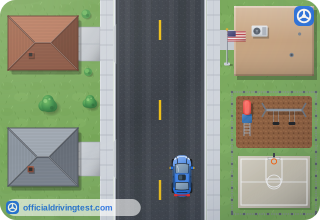
What should you do around schools, playgrounds and residential neighborhoods?
- Keep up with traffic
- Use your horn often
- Slow down
- Drive in the center of the road
Show answer
Correct answer: Slow down
Schools, playgrounds and residential neighborhoods are places where you should slow down.
Source: Wisconsin Motorists' Handbook (2026 (BDS126)), page 11 · Open this page in the manual (Manual page 11)
-
Why is it dangerous to stop your car with no warning?
- Your brake pads could overheat and stop working
- You could lose control or someone behind you could hit you
- Your engine could stall and your battery could run down
- Your tires could wear unevenly and lose pressure
Show answer
Correct answer: You could lose control or someone behind you could hit you
Stopping without warning could make you lose control of the car or cause someone behind you to hit you.
Source: Wisconsin Motorists' Handbook (2026 (BDS126)), page 12 · Open this page in the manual (Manual page 12)
-
How can you make a more gradual and safer stop?
- By braking hard at the last moment
- By following closer behind the vehicle ahead
- By stopping with no warning
- By slowing down earlier
Show answer
Correct answer: By slowing down earlier
Slowing down earlier makes the stop more gradual and safer.
Source: Wisconsin Motorists' Handbook (2026 (BDS126)), page 12 · Open this page in the manual (Manual page 12)
-
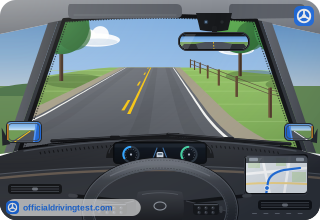
If you cannot see 10 to 15 seconds ahead, what must you do?
- Use your high beams
- Slow down
- Increase your speed
- Move to the shoulder
Show answer
Correct answer: Slow down
If you cannot see 10 to 15 seconds ahead, you must slow down to keep better control.
Source: Wisconsin Motorists' Handbook (2026 (BDS126)), page 12 · Open this page in the manual (Manual page 12)