Wisconsin: 30 Hardest Driving Test Questions
Questions that need a second thought, picked for close numbers, exceptions and easy-to-confuse rules. Take your time.
Independent educational site · not affiliated with any government agency or DMV
Ready? Test yourself
Answer to start, or tap Start below:
What is the legal alcohol concentration allowed for drivers under the age of 21 in Wisconsin?
- Instant feedback with an explanation
- Every answer cites its source in the manual
- Your best score is saved on this device
- Keyboard: press 1 to 4 to answer and Enter for the next question
Questions are original and based on the official manual "Wisconsin Motorists' Handbook" (2026 (BDS126)), Wisconsin Department of Transportation, Division of Motor Vehicles (DMV).
All 30 questions in this practice test
Take the test above first, then use this list to study. Tap “Show answer” to see the correct answer and explanation.
Show the questions and answersHide the questions
-
What is the legal alcohol concentration allowed for drivers under the age of 21 in Wisconsin?
- 0.02%
- 0.04%
- 0.00%
- 0.08%
Show answer
Correct answer: 0.00%
Drivers under 21 may not have any alcohol in their system while driving, so the limit is 0.00%.
Source: Wisconsin Motorists' Handbook (2026 (BDS126)), page 49 · Open this page in the manual (Manual page 49)
-
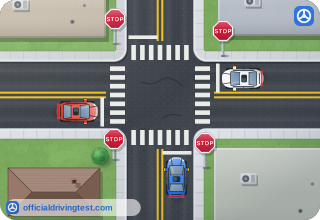
Two or more drivers arrive at a four-way stop at the same time. Who goes first?
- The driver on the left
- The driver on the right
- The driver going straight ahead
- The driver turning left
Show answer
Correct answer: The driver on the right
When drivers arrive at the stop at the same time, the driver on the right goes first.
Source: Wisconsin Motorists' Handbook (2026 (BDS126)), page 9 · Open this page in the manual (Manual page 9)
-
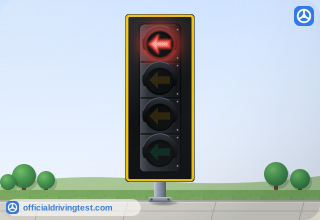
What must you do when facing a steady red arrow?
- Come to a full stop and wait for the light to turn green
- Come to a full stop, then proceed when it is safe to do so
- Slow down, then turn in the arrow's direction with caution
- Yield to oncoming and crossing traffic, then turn
Show answer
Correct answer: Come to a full stop and wait for the light to turn green
A steady red arrow means a full stop and waiting until the light turns green.
Source: Wisconsin Motorists' Handbook (2026 (BDS126)), page 32 · Open this page in the manual (Manual page 32)
-
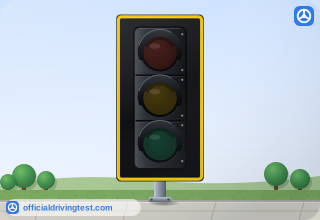
What should you do when a traffic light loses power or is not working right?
- Proceed as if the signal were a yield sign
- Proceed as if the signal were a stop sign
- Wait for the light to turn green
- Go through if there is no cross traffic in sight
Show answer
Correct answer: Proceed as if the signal were a stop sign
A signal that has no power or is not working right is treated like a stop sign.
Source: Wisconsin Motorists' Handbook (2026 (BDS126)), page 32 · Open this page in the manual (Manual page 32)
-
What is the maximum speed limit in outlying parts of cities and villages with no posted speed limit?
- 35 mph
- 25 mph
- 30 mph
- 40 mph
Show answer
Correct answer: 35 mph
The maximum speed limit in outlying parts of cities and villages with no posted limit is 35 mph.
Source: Wisconsin Motorists' Handbook (2026 (BDS126)), page 10 · Open this page in the manual (Manual page 10)
-
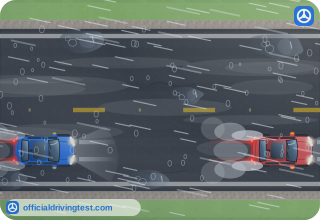
What should you do to the four-second count when there is an adverse condition such as heavier traffic, rain, snow or ice?
- Keep it at four seconds
- Subtract a second for every adverse condition
- Switch to a two-second count
- Add a second for every adverse condition
Show answer
Correct answer: Add a second for every adverse condition
The handbook says to add a second for every adverse condition such as heavier traffic, rain, snow or ice.
Source: Wisconsin Motorists' Handbook (2026 (BDS126)), page 10 · Open this page in the manual (Manual page 10)
-
How far away should you stop for a pedestrian using a guide dog or carrying a white cane?
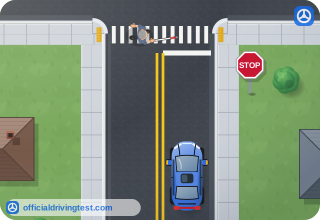
- At least five feet
- At least fifteen feet
- At least ten feet
- At least twenty-five feet
Show answer
Correct answer: At least ten feet
You should stop at least ten feet away and stay stopped until the person is off the roadway.
Source: Wisconsin Motorists' Handbook (2026 (BDS126)), page 9 · Open this page in the manual (Manual page 9)
-
When you finish parallel parking, how far should you be from the vehicles in front of you and behind you?
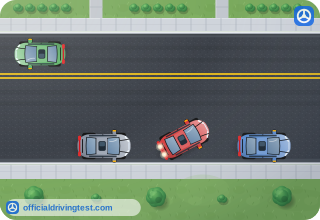
- At least 6 feet
- Exactly 1 foot
- At least 10 feet
- At least 2 feet
Show answer
Correct answer: At least 2 feet
You should be at least 2 feet away from the vehicle in front of you and behind you.
Source: Wisconsin Motorists' Handbook (2026 (BDS126)), page 20 · Open this page in the manual (Manual page 20)
-
How much longer than your vehicle should a parallel parking space be?
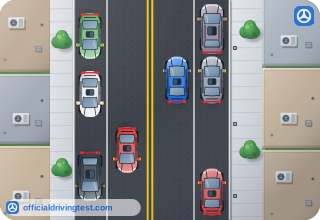
- About 1-2 feet longer
- About 10-12 feet longer
- About 3-6 feet longer
- Exactly as long as your vehicle
Show answer
Correct answer: About 3-6 feet longer
Look for a parking space that is about 3-6 feet longer than your vehicle.
Source: Wisconsin Motorists' Handbook (2026 (BDS126)), page 19 · Open this page in the manual (Manual page 19)
-
About how far before an intersection turn should you start signaling?
- About three seconds (about 100 feet)
- About one second (about 30 feet)
- About five seconds (about 250 feet)
- About ten seconds (about 500 feet)
Show answer
Correct answer: About three seconds (about 100 feet)
At an intersection you should start signaling about three seconds, or about 100 feet, before the turn.
Source: Wisconsin Motorists' Handbook (2026 (BDS126)), page 21 · Open this page in the manual (Manual page 21)
-
You turn from the middle lane at an intersection that has multiple turn lanes. Where do you need to end up?
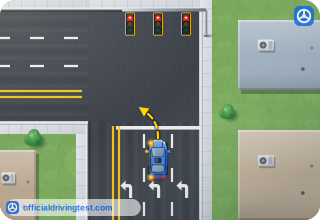
- In the left-most lane of the street you are turning onto
- In the lane nearest the right curb of the street you are turning onto
- In the middle lane of the street you are turning onto
- In whatever lane you were in before the intersection
Show answer
Correct answer: In the middle lane of the street you are turning onto
From the middle lane you need to end up in the middle lane of the street you are turning onto.
Source: Wisconsin Motorists' Handbook (2026 (BDS126)), page 16 · Open this page in the manual (Manual page 16)
-
Even if you have the right-of-way, what should you do before going through an intersection?
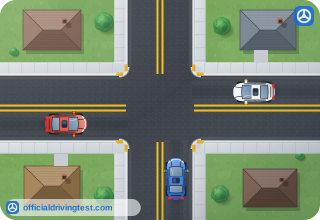
- Search right, left and right again
- Look straight ahead only
- Search left, right and left again
- Watch only the traffic signal ahead
Show answer
Correct answer: Search left, right and left again
Some drivers do not obey or notice signals or signs, so you should search left, right and left again even with the right-of-way.
Source: Wisconsin Motorists' Handbook (2026 (BDS126)), page 11 · Open this page in the manual (Manual page 11)
-
When may you cross a solid white line between lanes?
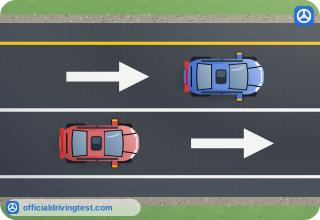
- Whenever it is safe, as with a white dashed line
- Only when passing a slower vehicle ahead of you
- Only when a police officer waves you across
- Only for a hazard or to turn just ahead
Show answer
Correct answer: Only for a hazard or to turn just ahead
A solid white line between lanes may be crossed only if there is a hazard or you are turning just ahead.
Source: Wisconsin Motorists' Handbook (2026 (BDS126)), page 34 · Open this page in the manual (Manual page 34)
-
In a shared center lane, when may you cross the solid yellow line?
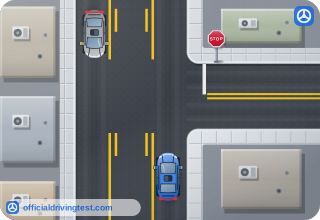
- When you want to make a left turn or a U-turn
- When you want to pass a slower vehicle
- When you want to turn right at the next intersection
- Never, because solid lines may not be crossed
Show answer
Correct answer: When you want to make a left turn or a U-turn
You may cross the solid line to make a left turn or U-turn, entering only when it is safe.
Source: Wisconsin Motorists' Handbook (2026 (BDS126)), page 36 · Open this page in the manual (Manual page 36)
-
At what amount of government property damage (for example signs or guard rails) do you need to report a crash to police?
- $200 or more
- $100 or more
- $500 or more
- $50 or more
Show answer
Correct answer: $200 or more
Damage of $200 or more to government property such as signs or guard rails must be reported to police.
Source: Wisconsin Motorists' Handbook (2026 (BDS126)), page 47 · Open this page in the manual (Manual page 47)
-
A reserved lane sign for buses and four-rider car pools shows 6AM–9AM and MON–FRI. When may a qualifying car pool use the lane?
- Between 6 a.m. and 9 a.m., every day of the week
- Any time of day, Monday through Friday
- Between 6 p.m. and 9 p.m., Monday through Friday
- Only between 6 a.m. and 9 a.m., Monday through Friday
Show answer
Correct answer: Only between 6 a.m. and 9 a.m., Monday through Friday
The sign limits use to the hours and days shown: 6 a.m. to 9 a.m., Monday through Friday.
Source: Wisconsin Motorists' Handbook (2026 (BDS126)), page 37 · Open this page in the manual (Manual page 37)
-
When you merge with traffic, what speed should you try to enter at?
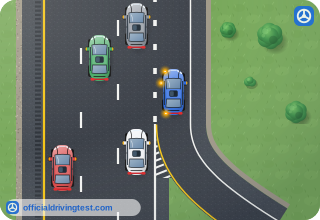
- A little slower than traffic so that others can pass you
- The same speed that the traffic is currently moving
- A little faster than traffic so that you get ahead
- The speed of the vehicle that is behind you
Show answer
Correct answer: The same speed that the traffic is currently moving
When merging, you should try to enter at the same speed that the traffic is currently moving.
Source: Wisconsin Motorists' Handbook (2026 (BDS126)), page 10 · Open this page in the manual (Manual page 10)
-
To have better control of your vehicle, how far ahead should you be able to see?
- 2 to 3 seconds ahead
- 4 to 6 seconds ahead
- 10 to 15 seconds ahead
- 20 to 30 seconds ahead
Show answer
Correct answer: 10 to 15 seconds ahead
The driver needs to be able to see 10 to 15 seconds ahead of the vehicle to keep better control.
Source: Wisconsin Motorists' Handbook (2026 (BDS126)), page 11 · Open this page in the manual (Manual page 11)
-
How often should you check your rearview mirror to see if someone is following too closely?
- Every 1 to 2 seconds
- Every 3 to 4 seconds
- Every 12 to 15 seconds
- Every 6 to 8 seconds
Show answer
Correct answer: Every 6 to 8 seconds
You should check your rearview mirror every 6 to 8 seconds to see if someone is tailgating.
Source: Wisconsin Motorists' Handbook (2026 (BDS126)), page 13 · Open this page in the manual (Manual page 13)
-
You must use your low beams when you cannot see a vehicle or person at what distance?
- 100 feet
- 500 feet
- 250 feet
- 1,000 feet
Show answer
Correct answer: 500 feet
You must use your low beams when you cannot see a vehicle or person 500 feet (about one block) away.
Source: Wisconsin Motorists' Handbook (2026 (BDS126)), page 21 · Open this page in the manual (Manual page 21)
-
A vehicle ahead of you carries a triangle-shaped sign with reflective orange markings. Up to what speed could this vehicle travel?
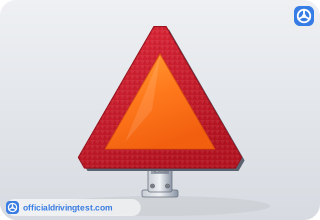
- 35 mph
- 45 mph
- 25 mph
- 55 mph
Show answer
Correct answer: 25 mph
A vehicle with a Slow Moving Vehicle sign could travel at 25 mph or less.
Source: Wisconsin Motorists' Handbook (2026 (BDS126)), page 25 · Open this page in the manual (Manual page 25)
-
How much room should you give snowplows when their lights are flashing red, amber or green?
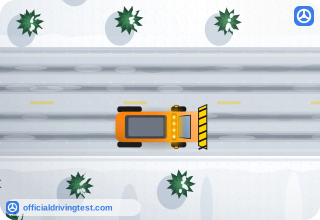
- At least 20 feet
- At least 100 feet
- At least 200 feet
- At least 500 feet
Show answer
Correct answer: At least 200 feet
Give snowplows at least 200 feet of room when their lights are flashing.
Source: Wisconsin Motorists' Handbook (2026 (BDS126)), page 45 · Open this page in the manual (Manual page 45)
-
About how far behind a large truck is its No-Zone?
- About 50 feet
- About 200 feet
- About 100 feet
- About 300 feet
Show answer
Correct answer: About 200 feet
The No-Zone extends about 200 feet behind a large truck.
Source: Wisconsin Motorists' Handbook (2026 (BDS126)), page 52 · Open this page in the manual (Manual page 52)
-
When may you use a paved shoulder to go around another vehicle?
- Whenever the vehicle ahead is traveling below the speed limit
- Whenever there is no oncoming traffic in the opposite lane
- Only when that vehicle is stopped or making a left turn
- Only when that vehicle is making a right turn
Show answer
Correct answer: Only when that vehicle is stopped or making a left turn
A paved shoulder may be used to go around someone only if they are stopped or making a left turn.
Source: Wisconsin Motorists' Handbook (2026 (BDS126)), page 17 · Open this page in the manual (Manual page 17)
-
At what amount of property damage do you need to report a crash to police?
- $2,500 or more
- $500 or more
- $5,000 or more
- $1,000 or more
Show answer
Correct answer: $1,000 or more
A crash with property damage of $1,000 or more must be reported to police.
Source: Wisconsin Motorists' Handbook (2026 (BDS126)), page 47 · Open this page in the manual (Manual page 47)
-
When may you use your cellphone while driving in a construction zone?
- Only to call for directions
- Only to report an emergency
- Only while moving under 15 mph
- Only to read a short text
Show answer
Correct answer: Only to report an emergency
In a construction zone you can use your cellphone only if you are reporting an emergency.
Source: Wisconsin Motorists' Handbook (2026 (BDS126)), page 26 · Open this page in the manual (Manual page 26)
-
During hours of darkness, who must be in the seat beside an instruction permit holder?
- Any licensed person with a valid regular license and two years of experience
- A licensed person age 18 with at least two years of experience
- Only a parent or guardian who is at least 19 years old
- A qualified instructor or a licensed person 25 with two years of experience
Show answer
Correct answer: A qualified instructor or a licensed person 25 with two years of experience
At night the handbook requires a qualified instructor or a licensed person 25 with at least two years of licensed driving experience in the seat beside you.
Source: Wisconsin Motorists' Handbook (2026 (BDS126)), page 5 · Open this page in the manual (Manual page 5)
-
What is the minimum age of a spouse who may ride as the licensed person with a probationary license holder under 18?
- 19 years old
- 16 years old
- 17 years old
- 20 years old
Show answer
Correct answer: 19 years old
A qualified instructor or a spouse who is 19 or older may ride as the licensed person.
Source: Wisconsin Motorists' Handbook (2026 (BDS126)), page 6 · Open this page in the manual (Manual page 6)
-
How long are the GDL restrictions required?
- The first six months, unless you turn 16 sooner
- The first year, unless you turn 21 sooner
- The first nine months, unless you turn 18 sooner
- The first three months, unless you turn 17 sooner
Show answer
Correct answer: The first nine months, unless you turn 18 sooner
The restrictions are required for the first nine months unless you turn 18 before then.
Source: Wisconsin Motorists' Handbook (2026 (BDS126)), page 6 · Open this page in the manual (Manual page 6)
-
Within any 12-month period, how many demerit points mean you will not be able to drive?
- 6 or more
- 8 or more
- 10 or more
- 12 or more
Show answer
Correct answer: 12 or more
Getting 12 or more demerit points within any 12-month period means you cannot drive.
Source: Wisconsin Motorists' Handbook (2026 (BDS126)), page 53 · Open this page in the manual (Manual page 53)