Wisconsin: Right-of-way, turning and passing — Part 3 Practice Test
Questions in this part include: “When may you turn left at a steady red light?” · “As you reach a roundabout, from which side do you yield to traffic that is already in the roundabout?”
Independent educational site · not affiliated with any government agency or DMV
Ready? Test yourself
Answer to start, or tap Start below:
When may you turn left at a steady red light?
- Instant feedback with an explanation
- Every answer cites its source in the manual
- Your best score is saved on this device
- Keyboard: press 1 to 4 to answer and Enter for the next question
Questions are original and based on the official manual "Wisconsin Motorists' Handbook" (2026 (BDS126)), Wisconsin Department of Transportation, Division of Motor Vehicles (DMV).
All 17 questions in this practice test
Take the test above first, then use this list to study. Tap “Show answer” to see the correct answer and explanation.
Show the questions and answersHide the questions
-
What is the last step of a Y-turn?
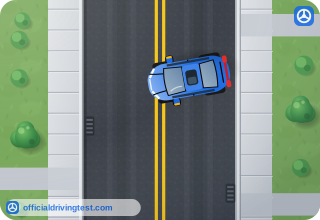
- Check traffic both ways, pull forward and proceed in your lane
- Signal right and back up once more to the first curb to start over
- Stop at the center line and wait for traffic to pass in both directions
- Turn on your hazard lights and drive to the next block
Show answer
Correct answer: Check traffic both ways, pull forward and proceed in your lane
The last step is to check traffic in both directions, pull forward and continue in your lane of traffic.
Source: Wisconsin Motorists' Handbook (2026 (BDS126)), page 17 · Open this page in the manual (Manual page 17)
-
When may you turn right at a steady red light?
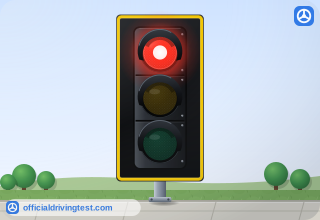
- After stopping, when it is safe and no sign prohibits it
- Only when a police officer waves you through the intersection
- Without stopping, as long as no vehicles are approaching
- Only after the cross traffic has had a green light
Show answer
Correct answer: After stopping, when it is safe and no sign prohibits it
A right turn on red is allowed after a full stop if it is safe and no sign prohibits it.
Source: Wisconsin Motorists' Handbook (2026 (BDS126)), page 32 · Open this page in the manual (Manual page 32)
-
When may you turn left at a steady red light?
- When turning from a two-way street onto a one-way street
- When no cross traffic is visible on any road
- When turning from a one-way street onto a one-way street
- When turning onto a street with a bike lane
Show answer
Correct answer: When turning from a one-way street onto a one-way street
A left turn on red is allowed only from a one-way street onto a one-way street.
Source: Wisconsin Motorists' Handbook (2026 (BDS126)), page 32 · Open this page in the manual (Manual page 32)
-
What must you do when turning on red?
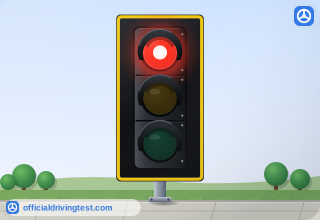
- Slow down, yield to cross traffic, then move into any open lane
- Stop first, yield to all traffic, then proceed staying in your lane
- Stop first, then enter whichever lane has the fewest vehicles
- Yield to cross traffic only, then turn without coming to a stop
Show answer
Correct answer: Stop first, yield to all traffic, then proceed staying in your lane
A turn on red starts with a stop, then you yield to all traffic and stay in your lane.
Source: Wisconsin Motorists' Handbook (2026 (BDS126)), page 32 · Open this page in the manual (Manual page 32)
-
You are stopped at a red light and it turns green. What must you do before going ahead?
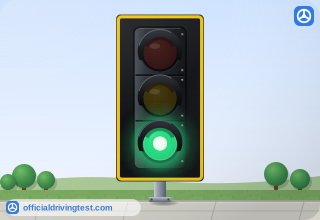
- Allow cross traffic to clear before going ahead
- Go ahead at once, since the green light gives you the right-of-way
- Flash your headlights so cross traffic knows you are going
- Check only for pedestrians, then go ahead
Show answer
Correct answer: Allow cross traffic to clear before going ahead
A driver who was stopped must let cross traffic clear before moving on a new green light.
Source: Wisconsin Motorists' Handbook (2026 (BDS126)), page 33 · Open this page in the manual (Manual page 33)
-
When you turn left on a steady green light, who has the right-of-way?
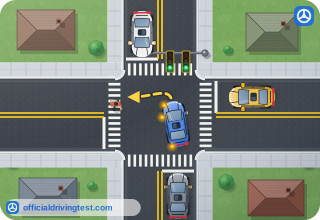
- You, because the light is green
- Vehicles behind you
- Oncoming traffic
- Vehicles parked along the curb
Show answer
Correct answer: Oncoming traffic
A steady green lets you turn left only when it is safe, and oncoming traffic has the right-of-way.
Source: Wisconsin Motorists' Handbook (2026 (BDS126)), page 33 · Open this page in the manual (Manual page 33)
-
In which direction does traffic move in a roundabout?
- Counterclockwise
- Clockwise
- Toward the center island only
- Whichever way the first driver goes
Show answer
Correct answer: Counterclockwise
Traffic in a roundabout moves counterclockwise.
Source: Wisconsin Motorists' Handbook (2026 (BDS126)), page 39 · Open this page in the manual (Manual page 39)
-
How does the handbook describe roundabouts compared with other traffic flow options?
- Safer but less efficient
- More efficient but less safe
- Safer and more efficient
- Equal in safety and efficiency
Show answer
Correct answer: Safer and more efficient
Roundabouts are described as a safer and more efficient traffic flow option.
Source: Wisconsin Motorists' Handbook (2026 (BDS126)), page 39 · Open this page in the manual (Manual page 39)
-
As you get to a roundabout, what tells you which lane you need to be in?
- The color of the curb
- The signs above you
- The vehicle in front of you
- A flashing light at the crosswalk
Show answer
Correct answer: The signs above you
The signs above you as you approach a roundabout show which lane you need to be in.
Source: Wisconsin Motorists' Handbook (2026 (BDS126)), page 39 · Open this page in the manual (Manual page 39)
-
As you reach a roundabout, from which side do you yield to traffic that is already in the roundabout?
- Traffic on your right
- Traffic behind you
- Traffic ahead of you in the same lane
- Traffic on your left
Show answer
Correct answer: Traffic on your left
As you reach a roundabout, you yield to traffic on your left that is already in the roundabout.
Source: Wisconsin Motorists' Handbook (2026 (BDS126)), page 39 · Open this page in the manual (Manual page 39)
-
As you reach a roundabout, which of these should you yield to?
- Semitrucks
- Vehicles waiting behind you
- Vehicles that have already exited
- Parked vehicles beside the road
Show answer
Correct answer: Semitrucks
The steps for approaching a roundabout include yielding to semitrucks.
Source: Wisconsin Motorists' Handbook (2026 (BDS126)), page 39 · Open this page in the manual (Manual page 39)
-
When should you enter a roundabout?
- Only after all traffic inside has left the roundabout
- When there is a safe gap in traffic
- As soon as you reach the crosswalk
- When the vehicle ahead of you has entered
Show answer
Correct answer: When there is a safe gap in traffic
You enter the roundabout when there is a safe gap in traffic.
Source: Wisconsin Motorists' Handbook (2026 (BDS126)), page 39 · Open this page in the manual (Manual page 39)
-
What should you do about your speed as you reach a roundabout and drive through it?
- Speed up so you can merge into a gap
- Keep the speed of the road you came from
- Stop completely at the entrance every time
- Slow down and keep your speed low
Show answer
Correct answer: Slow down and keep your speed low
The steps are to slow down as you reach the roundabout and keep your speed low inside it.
Source: Wisconsin Motorists' Handbook (2026 (BDS126)), page 39 · Open this page in the manual (Manual page 39)
-
If there is no traffic in the roundabout, what do you do when you reach it?
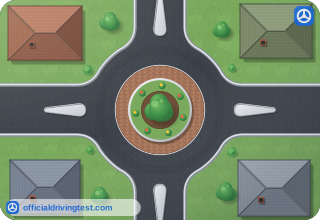
- You do not need to wait to enter
- Stop and wait for a count of three
- Wait until a vehicle comes up behind you
- Sound your horn before entering
Show answer
Correct answer: You do not need to wait to enter
When no traffic is in the roundabout, you do not need to wait to enter.
Source: Wisconsin Motorists' Handbook (2026 (BDS126)), page 39 · Open this page in the manual (Manual page 39)
-
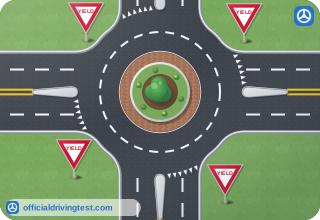
What does the handbook say about switching lanes while you are in a roundabout?
- Switch to the right lane before your exit
- Switch lanes when no vehicle is beside you
- Do not switch lanes
- Switch lanes whenever a slower vehicle is ahead
Show answer
Correct answer: Do not switch lanes
You stay in your lane; do not switch lanes while you are in the roundabout.
Source: Wisconsin Motorists' Handbook (2026 (BDS126)), page 39 · Open this page in the manual (Manual page 39)
-
As you reach your exit in a roundabout, which signal do you turn on?
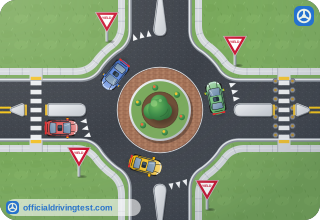
- Your left turn signal
- Your right turn signal
- Your hazard lights
- None until you have left the roundabout
Show answer
Correct answer: Your right turn signal
At your exit you turn on your right turn signal and exit.
Source: Wisconsin Motorists' Handbook (2026 (BDS126)), page 39 · Open this page in the manual (Manual page 39)
-
Before entering a two-lane roundabout, whose traffic do you yield to?
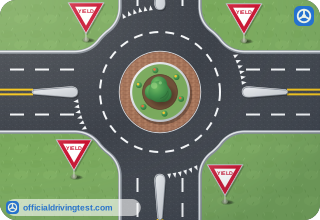
- All traffic in both lanes
- Only traffic in the lane you will use
- Only traffic in the left lane
- Only traffic that is about to exit
Show answer
Correct answer: All traffic in both lanes
In a two-lane roundabout you choose your lane and yield to all traffic in both lanes before entering.
Source: Wisconsin Motorists' Handbook (2026 (BDS126)), page 41 · Open this page in the manual (Manual page 41)