Wisconsin: Railroad crossings Practice Test
Railroad warning signs, crossbucks, flashing lights and gates, multiple tracks and reporting a problem.
Independent educational site · not affiliated with any government agency or DMV
Ready? Test yourself
Answer to start, or tap Start below:
Before you cross railroad tracks, what should you look ahead to see?
- Instant feedback with an explanation
- Every answer cites its source in the manual
- Your best score is saved on this device
- Keyboard: press 1 to 4 to answer and Enter for the next question
Questions are original and based on the official manual "Wisconsin Motorists' Handbook" (2026 (BDS126)), Wisconsin Department of Transportation, Division of Motor Vehicles (DMV).
All 23 questions in this practice test
Take the test above first, then use this list to study. Tap “Show answer” to see the correct answer and explanation.
Show the questions and answersHide the questions
-
Which statement about trains at railroad crossings matches the handbook?
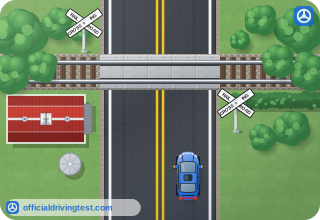
- Do not assume a train is not coming down the tracks
- You can assume no train is coming if you hear no horn
- You can assume no train is coming if the tracks look empty
- You can assume no train is coming if the crossing has no gate
Show answer
Correct answer: Do not assume a train is not coming down the tracks
You should never assume a train is not coming down the tracks.
Source: Wisconsin Motorists' Handbook (2026 (BDS126)), page 12 · Open this page in the manual (Manual page 12)
-
Before you cross railroad tracks, what should you look ahead to see?
- If the vehicle ahead of you has already crossed the tracks safely
- If there is room for your car on the opposite side of the crossing
- If the crossing has gates and flashing lights on both sides
- If the road beyond the tracks is paved or has a gravel surface
Show answer
Correct answer: If there is room for your car on the opposite side of the crossing
You should look ahead to see whether there is room for your car on the opposite side of the crossing.
Source: Wisconsin Motorists' Handbook (2026 (BDS126)), page 12 · Open this page in the manual (Manual page 12)
-
What do railroad crossing signs warn you of?
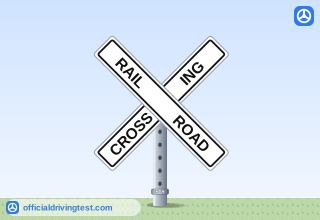
- A road is closed ahead
- The speed limit is about to change
- A train might be close
- A school zone is ahead
Show answer
Correct answer: A train might be close
Railroad crossing signs warn you that a train might be close.
Source: Wisconsin Motorists' Handbook (2026 (BDS126)), page 30 · Open this page in the manual (Manual page 30)
-
A train is coming and you think you have enough time to cross the tracks. What does the handbook say to do?
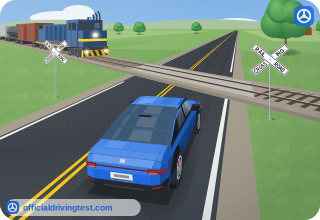
- Cross quickly if the gates are still up
- Never try to beat a train across the tracks
- Speed up so you clear the tracks sooner
- Shift to a lower gear and cross slowly
Show answer
Correct answer: Never try to beat a train across the tracks
The handbook says never to try to beat a train across the tracks.
Source: Wisconsin Motorists' Handbook (2026 (BDS126)), page 30 · Open this page in the manual (Manual page 30)
-
What does the handbook say about stopping at railroad tracks?
- Stop on the tracks only if traffic ahead is backed up
- Stop on the tracks to look both ways
- Stop on the tracks when the signs are not flashing
- Do not stop on the tracks
Show answer
Correct answer: Do not stop on the tracks
You must not stop on the tracks.
Source: Wisconsin Motorists' Handbook (2026 (BDS126)), page 30 · Open this page in the manual (Manual page 30)
-
What should you do if there is not room for your vehicle on the other side of railroad tracks?
- Do not cross the tracks
- Cross and stop just past the tracks
- Cross and stop on the tracks until traffic moves
- Cross if the signs are not flashing
Show answer
Correct answer: Do not cross the tracks
Do not cross the tracks if there is not room on the other side.
Source: Wisconsin Motorists' Handbook (2026 (BDS126)), page 30 · Open this page in the manual (Manual page 30)
-
What does the handbook say about shifting gears while crossing railroad tracks?
- Shift to a lower gear while on the tracks
- Shift to a higher gear to cross faster
- Do not shift gears while crossing
- Shift gears only if the vehicle slows on the tracks
Show answer
Correct answer: Do not shift gears while crossing
You should not shift gears while crossing the railroad tracks.
Source: Wisconsin Motorists' Handbook (2026 (BDS126)), page 30 · Open this page in the manual (Manual page 30)
-
What should you do before you cross railroad tracks, even if the railroad signs are not flashing?
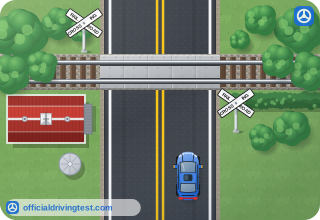
- Assume no train is coming and cross
- Look both ways
- Speed up to clear the tracks quickly
- Stop on the tracks to get a better view
Show answer
Correct answer: Look both ways
Before crossing you should look both ways, even when the signs are not flashing.
Source: Wisconsin Motorists' Handbook (2026 (BDS126)), page 30 · Open this page in the manual (Manual page 30)
-
What does a “Tracks out-of-service” sign across a railroad crossing sign mean?
- A train is stopped on the tracks ahead
- The crossing gate is broken
- Only slow trains use the tracks
- The tracks are no longer in use
Show answer
Correct answer: The tracks are no longer in use
A “Tracks out-of-service” sign means that the tracks are no longer in use.
Source: Wisconsin Motorists' Handbook (2026 (BDS126)), page 30 · Open this page in the manual (Manual page 30)
-
What does an “Exempt” sign at a railroad crossing mean?
- Certain vehicles are not required to stop before crossing
- The tracks ahead are no longer in use by any train
- Trains must give way to road traffic at this crossing
- The crossing gate is broken and cannot be trusted
Show answer
Correct answer: Certain vehicles are not required to stop before crossing
An “Exempt” sign means certain vehicles are not required to stop before crossing.
Source: Wisconsin Motorists' Handbook (2026 (BDS126)), page 30 · Open this page in the manual (Manual page 30)
-
How does the handbook describe trains?
- Small, light and slower than they seem
- Long, quiet and easy to hear
- Large, heavy and moving faster than they seem
- Heavy, but slow to start moving
Show answer
Correct answer: Large, heavy and moving faster than they seem
Trains are large, heavy and move faster than they seem, so do not take chances.
Source: Wisconsin Motorists' Handbook (2026 (BDS126)), page 30 · Open this page in the manual (Manual page 30)
-
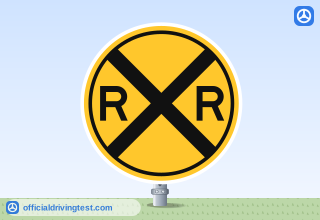
A round yellow sign has a black X with the letters R R. What does it tell you?
- The tracks ahead are no longer in use by any train
- Trains at this crossing must yield to road traffic
- A crossing gate is broken and should be reported at once
- There is a railroad crossing; be alert and watch for a train
Show answer
Correct answer: There is a railroad crossing; be alert and watch for a train
A round yellow railroad crossing warning sign with a black X means there is a railroad crossing ahead, so be alert and watch for a train.
Source: Wisconsin Motorists' Handbook (2026 (BDS126)), page 30 · Open this page in the manual (Manual page 30)
-
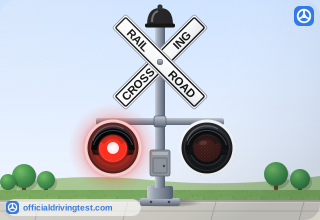
Blinking lights at a railroad crossing flash when a train is coming from which direction?
- Either direction
- Only from the right
- Only from the left
- Only the direction of your lane
Show answer
Correct answer: Either direction
The blinking lights flash when a train is coming on the tracks in either direction.
Source: Wisconsin Motorists' Handbook (2026 (BDS126)), page 30 · Open this page in the manual (Manual page 30)
-
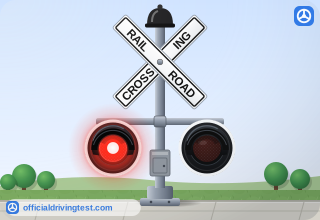
Blinking lights are flashing at a crossing with a crossbuck sign. When may you continue?
- When the first train has passed, even if the lights still flash
- When no train is in sight, even if the lights still flash
- When the lights stop flashing and the track is clear
- When you have slowed to a crawl and looked both ways
Show answer
Correct answer: When the lights stop flashing and the track is clear
You should wait until the lights stop flashing and the track is clear.
Source: Wisconsin Motorists' Handbook (2026 (BDS126)), page 30 · Open this page in the manual (Manual page 30)
-
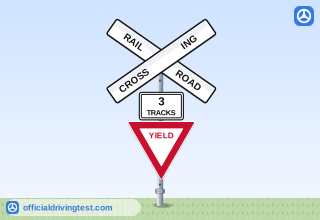
A white X-shaped crossbuck with a Yield sign posted below it means what?
- Trains must yield to road traffic
- Trains do not use these tracks
- Wait for a worker to wave you across
- You must yield to trains that are crossing
Show answer
Correct answer: You must yield to trains that are crossing
With a Yield sign below the crossbuck, you must yield to trains that are crossing.
Source: Wisconsin Motorists' Handbook (2026 (BDS126)), page 30 · Open this page in the manual (Manual page 30)
-
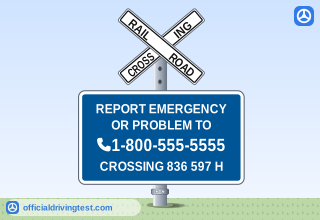
Where is the Report Problem or Emergency sign posted?
- Only at crossings with gates
- Only at crossings with more than one track
- At every highway-railroad crossing
- Only at crossings on state roads
Show answer
Correct answer: At every highway-railroad crossing
The sign is at every highway-railroad crossing.
Source: Wisconsin Motorists' Handbook (2026 (BDS126)), page 31 · Open this page in the manual (Manual page 31)
-
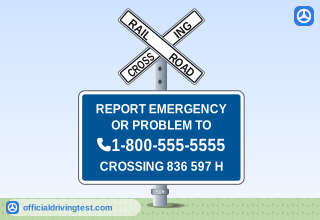
What is the phone number on the Report Problem or Emergency sign used for?
- Asking when the next train is due
- Reporting unsafe conditions
- Requesting a ride from the crossing
- Checking whether the tracks are in service
Show answer
Correct answer: Reporting unsafe conditions
The sign shows a phone number to report unsafe conditions at the crossing.
Source: Wisconsin Motorists' Handbook (2026 (BDS126)), page 31 · Open this page in the manual (Manual page 31)
-
Which is an example of something to report using the Report Problem or Emergency sign?
- A train moving slowly through the crossing
- A driver who stopped before the tracks
- A crossing with more than one track
- A vehicle stuck on the railroad tracks
Show answer
Correct answer: A vehicle stuck on the railroad tracks
The handbook gives a stuck vehicle on the tracks, or a railroad warning light that is not working, as examples.
Source: Wisconsin Motorists' Handbook (2026 (BDS126)), page 31 · Open this page in the manual (Manual page 31)
-
What does the handbook say about signs showing the number of tracks?
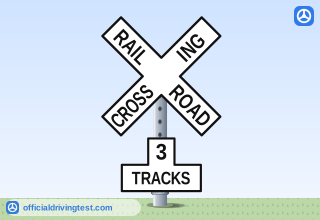
- Not all crossings with more than one track have them
- Every crossing with more than one track has one
- Only crossings with gates have one
- They are posted only where there are exactly two tracks
Show answer
Correct answer: Not all crossings with more than one track have them
Crossings with more than one track will often post such a sign, but not all do.
Source: Wisconsin Motorists' Handbook (2026 (BDS126)), page 31 · Open this page in the manual (Manual page 31)
-
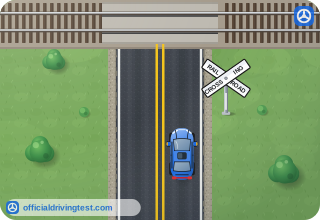
What is important to check before you cross railroad tracks?
- How many cars the train has
- Whether the train is electric
- Whether there is more than one track
- What time the next train is due
Show answer
Correct answer: Whether there is more than one track
There could be more than one track, so you must check before crossing.
Source: Wisconsin Motorists' Handbook (2026 (BDS126)), page 31 · Open this page in the manual (Manual page 31)
-
What should you wait for before crossing double railroad tracks?
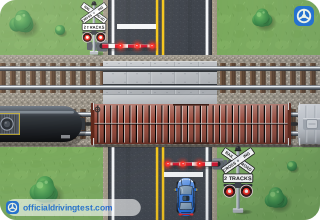
- Until the train's last car has just passed the crossing
- Until the train is far away so you can see the tracks are clear
- Until you can no longer hear the train
- Until the second track is the only one with a train on it
Show answer
Correct answer: Until the train is far away so you can see the tracks are clear
Wait until the train is far away so you can see that the tracks are clear.
Source: Wisconsin Motorists' Handbook (2026 (BDS126)), page 31 · Open this page in the manual (Manual page 31)
-
A train gate is lowering or raising at a railroad crossing. What does the handbook say?
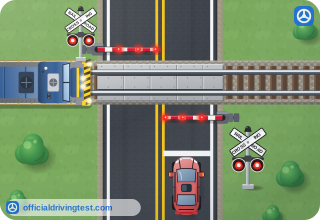
- Drive around it if you see no train
- Drive under it while it is raising
- Drive under it while it is lowering if you hurry
- Do not drive around the gate or under it
Show answer
Correct answer: Do not drive around the gate or under it
Do not drive around the gate or under a raising or lowering gate.
Source: Wisconsin Motorists' Handbook (2026 (BDS126)), page 31 · Open this page in the manual (Manual page 31)
-
A train gate has a bell or horn that sounds. When may you cross?
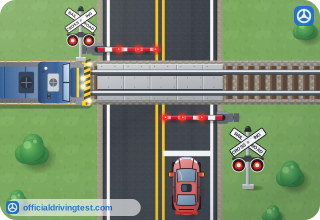
- Not until the bell or horn has stopped
- Once the gate arm has started to go up
- As soon as the horn sounds a second time
- When the train has slowed down
Show answer
Correct answer: Not until the bell or horn has stopped
Some gates have a horn and lights that sound, and you must not cross until the bell or horn has stopped.
Source: Wisconsin Motorists' Handbook (2026 (BDS126)), page 31 · Open this page in the manual (Manual page 31)