Wisconsin: Right-of-way, turning and passing
Who yields at intersections and roundabouts, left turns, U-turns and Y-turns, turn lanes, and passing safely. Split into 3 shorter tests so you're not stuck in one long quiz.
Independent educational site · not affiliated with any government agency or DMV
Choose a part
Right-of-way, turning and passing — Part 1
Questions in this part include: “What does "right-of-way" tell us?”
Right-of-way, turning and passing — Part 2
Questions in this part include: “As you prepare to turn left, where should you keep your vehicle?”
Right-of-way, turning and passing — Part 3
Questions in this part include: “When may you turn left at a steady red light?”
Questions are original and based on the official manual "Wisconsin Motorists' Handbook" (2026 (BDS126)), Wisconsin Department of Transportation, Division of Motor Vehicles (DMV).
All 53 Right-of-way, turning and passing questions with answers
Choose a part above to take a practice test, or study every question and answer here.
Show the questions and answersHide the questions
1Part 118 questions
-
What does "right-of-way" tell us?
- Which vehicle may drive faster
- Which lane to use at an intersection
- Who is at fault after a crash
- Who goes first and who must wait
Show answer
Correct answer: Who goes first and who must wait
Right-of-way decides who goes first and who must wait where vehicles or pedestrians meet.
Source: Wisconsin Motorists' Handbook (2026 (BDS126)), page 9 · Open this page in the manual (Manual page 9)
-
Where are vehicles or pedestrians likely to meet, so that right-of-way becomes important?
- Only where a traffic light is flashing
- Where there are no traffic signals or signs
- Only on roads with more than one lane
- Only at railroad crossings
Show answer
Correct answer: Where there are no traffic signals or signs
The handbook says vehicles and pedestrians are likely to meet where there are no traffic signals or signs.
Source: Wisconsin Motorists' Handbook (2026 (BDS126)), page 9 · Open this page in the manual (Manual page 9)
-
What must you always do to avoid hitting pedestrians, bicyclists and other vehicles?
- Speed up
- Sound your horn
- Yield
- Flash your lights
Show answer
Correct answer: Yield
You must always yield so that you do not hit pedestrians, bicyclists or other vehicles.
Source: Wisconsin Motorists' Handbook (2026 (BDS126)), page 9 · Open this page in the manual (Manual page 9)
-
You reach a four-way stop. Whom should you yield right-of-way to?
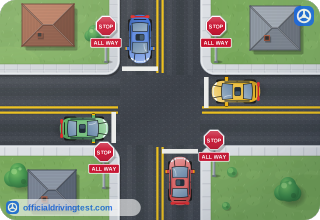
- The bicyclist or driver who arrives first
- The driver in the largest vehicle
- The driver with the most passengers
- The driver who is driving the fastest
Show answer
Correct answer: The bicyclist or driver who arrives first
At a four-way stop you yield to the bicyclist or driver who arrives first.
Source: Wisconsin Motorists' Handbook (2026 (BDS126)), page 9 · Open this page in the manual (Manual page 9)
-
Two or more drivers arrive at a four-way stop at the same time. Who goes first?
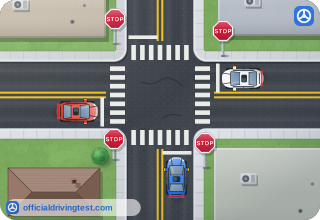
- The driver on the left
- The driver on the right
- The driver going straight ahead
- The driver turning left
Show answer
Correct answer: The driver on the right
When drivers arrive at the stop at the same time, the driver on the right goes first.
Source: Wisconsin Motorists' Handbook (2026 (BDS126)), page 9 · Open this page in the manual (Manual page 9)
-
You come to an intersection with no signals or traffic lights (an uncontrolled intersection). Whom should you yield right-of-way to?
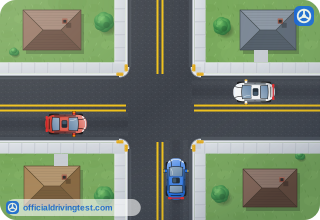
- Vehicles coming from the left
- Vehicles that are smaller than yours
- Vehicles that are traveling slower
- Vehicles coming from the right
Show answer
Correct answer: Vehicles coming from the right
At an uncontrolled intersection you should yield to vehicles coming from the right.
Source: Wisconsin Motorists' Handbook (2026 (BDS126)), page 9 · Open this page in the manual (Manual page 9)
-
You are entering a roundabout (traffic circle). Whom should you yield right-of-way to?
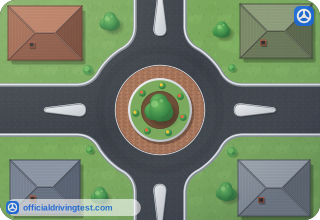
- Traffic that is already in the roundabout
- Vehicles waiting to enter behind you
- Vehicles waiting at the other entrances
- No one, because it has no stop sign
Show answer
Correct answer: Traffic that is already in the roundabout
You should yield to traffic that is already in the roundabout.
Source: Wisconsin Motorists' Handbook (2026 (BDS126)), page 9 · Open this page in the manual (Manual page 9)
-
At an uncontrolled T-intersection, whom should you yield right-of-way to?
- Parked vehicles
- Traffic behind you
- Cross traffic
- Only pedestrians
Show answer
Correct answer: Cross traffic
At an uncontrolled T-intersection you should yield to cross traffic.
Source: Wisconsin Motorists' Handbook (2026 (BDS126)), page 9 · Open this page in the manual (Manual page 9)
-
You are making a left turn or a U-turn. Whom should you yield right-of-way to?
- Vehicles behind you
- Parked vehicles
- Only pedestrians
- Approaching vehicles
Show answer
Correct answer: Approaching vehicles
When you make a left turn or a U-turn, you should yield to approaching vehicles.
Source: Wisconsin Motorists' Handbook (2026 (BDS126)), page 9 · Open this page in the manual (Manual page 9)
-
Which of these is included as an intersection?
- A railroad crossing
- A road shoulder
- A highway median
- A bridge deck
Show answer
Correct answer: A railroad crossing
Intersections include cross streets, driveways, parking lot entrances and railroad crossings.
Source: Wisconsin Motorists' Handbook (2026 (BDS126)), page 11 · Open this page in the manual (Manual page 11)
-
You cannot see across the intersection. What should you do?
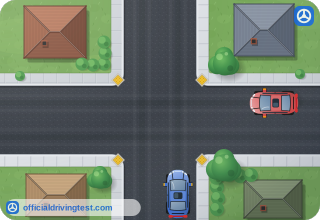
- Speed up to get through it quickly
- Stop in the crosswalk until you can see
- Honk and keep going
- Move forward with caution
Show answer
Correct answer: Move forward with caution
If you cannot see across the intersection, you should move forward with caution.
Source: Wisconsin Motorists' Handbook (2026 (BDS126)), page 11 · Open this page in the manual (Manual page 11)
-
Trees, buildings and parked vehicles block your view at an intersection. How should you approach it?
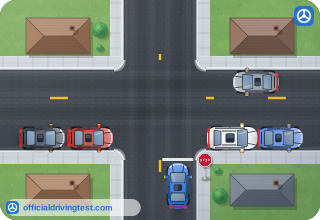
- At the speed of traffic
- At a slow pace
- In the far-left lane
- With your high beams on
Show answer
Correct answer: At a slow pace
An intersection with a blocked view should be approached at a slow pace.
Source: Wisconsin Motorists' Handbook (2026 (BDS126)), page 11 · Open this page in the manual (Manual page 11)
-
When is it most important to have control of your vehicle and be able to brake at an intersection?
- When there are no control signals or signs
- When a green traffic light controls it
- When a stop sign controls it
- When a police officer directs traffic
Show answer
Correct answer: When there are no control signals or signs
Control and the ability to brake matter most when there are no control signals or signs.
Source: Wisconsin Motorists' Handbook (2026 (BDS126)), page 11 · Open this page in the manual (Manual page 11)
-
Even if you have the right-of-way, what should you do before going through an intersection?
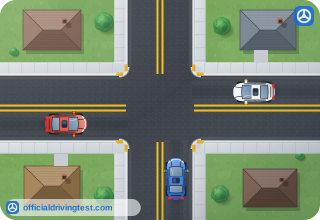
- Search right, left and right again
- Look straight ahead only
- Search left, right and left again
- Watch only the traffic signal ahead
Show answer
Correct answer: Search left, right and left again
Some drivers do not obey or notice signals or signs, so you should search left, right and left again even with the right-of-way.
Source: Wisconsin Motorists' Handbook (2026 (BDS126)), page 11 · Open this page in the manual (Manual page 11)
-
When you cross traffic and multi-lane roads, what must you make sure of?
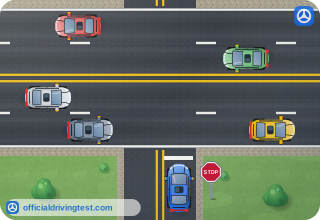
- No vehicle is parked within one block of the crossing
- Your turn signal has been on for ten seconds
- The vehicles in the first lane have already stopped
- There is enough room to get all the way across
Show answer
Correct answer: There is enough room to get all the way across
When crossing traffic or a multi-lane road, make sure there is enough room to get all the way across.
Source: Wisconsin Motorists' Handbook (2026 (BDS126)), page 13 · Open this page in the manual (Manual page 13)
-
What should you check before turning?
- Your mirrors, surroundings and blind spot
- Your mirrors, speedometer and fuel gauge
- Your horn, hazard lights and brake lights
- Your tire pressure, mirrors and wipers
Show answer
Correct answer: Your mirrors, surroundings and blind spot
Before turning you should check your mirrors, your surroundings and your blind spot.
Source: Wisconsin Motorists' Handbook (2026 (BDS126)), page 14 · Open this page in the manual (Manual page 14)
-
Besides staying in your lane and yielding the right-of-way, what is it important to do when you turn?
- Sound your horn as you turn
- Turn on your hazard lights
- Signal that you are going to turn
- Flash your high beams at oncoming vehicles
Show answer
Correct answer: Signal that you are going to turn
It is important to stay in your lane, signal that you are going to turn and yield the right-of-way.
Source: Wisconsin Motorists' Handbook (2026 (BDS126)), page 14 · Open this page in the manual (Manual page 14)
-
What does the handbook say about last-second changes when turning?
- They are safe if your turn signal is on
- They are allowed when no vehicles are behind you
- They are unsafe and could cause a crash
- They are required if you miss your turn
Show answer
Correct answer: They are unsafe and could cause a crash
Last-second changes are unsafe and could cause a crash.
Source: Wisconsin Motorists' Handbook (2026 (BDS126)), page 14 · Open this page in the manual (Manual page 14)
2Part 218 questions
-
When you are ready to turn onto a side road or a driveway, what should you check?
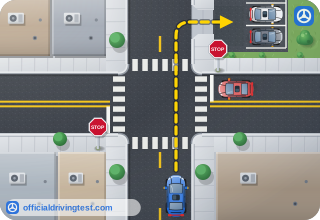
- Your mirrors and vehicles behind you
- Only the vehicles coming toward you
- Your fuel gauge and the vehicles beside you
- Only the pedestrians crossing in front of you
Show answer
Correct answer: Your mirrors and vehicles behind you
Before turning onto a side road or driveway, check your mirrors and the vehicles behind you.
Source: Wisconsin Motorists' Handbook (2026 (BDS126)), page 14 · Open this page in the manual (Manual page 14)
-
While you make a turn, what should you do about your lane?
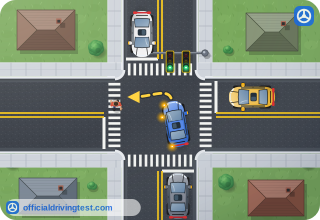
- Change lanes before the turn is finished if it is clear
- Move into whichever lane is open as you turn
- Use the next lane over to make the turn wider
- Stay in your lane and do not change lanes while turning
Show answer
Correct answer: Stay in your lane and do not change lanes while turning
You should stay in your lane during the turn and not change lanes while turning.
Source: Wisconsin Motorists' Handbook (2026 (BDS126)), page 14 · Open this page in the manual (Manual page 14)
-
What does the handbook say about crossing over the center line when you turn?
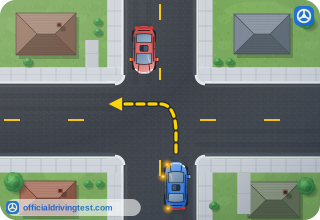
- You may cross it if no vehicles are near
- Do not cross over it
- You may cross it when turning left
- You may cross it when turning at an intersection
Show answer
Correct answer: Do not cross over it
The handbook says not to cross over the center line when you turn.
Source: Wisconsin Motorists' Handbook (2026 (BDS126)), page 14 · Open this page in the manual (Manual page 14)
-
As you prepare to turn left, where should you keep your vehicle?
- Close to the right edge of the road
- Near the curb on the right side
- Close to the center line
- In the middle of the oncoming lane
Show answer
Correct answer: Close to the center line
For a left turn you should keep close to the center line.
Source: Wisconsin Motorists' Handbook (2026 (BDS126)), page 14 · Open this page in the manual (Manual page 14)
-
When you turn left, where should you wait for traffic to pass?
- At the far side of the intersection
- Behind the crosswalk, outside the intersection
- In the lane used by oncoming traffic
- About halfway in the intersection
Show answer
Correct answer: About halfway in the intersection
For a left turn, slowly approach the intersection and wait about halfway in the intersection.
Source: Wisconsin Motorists' Handbook (2026 (BDS126)), page 14 · Open this page in the manual (Manual page 14)
-
While you wait about halfway in the intersection to turn left, what should you leave room for?
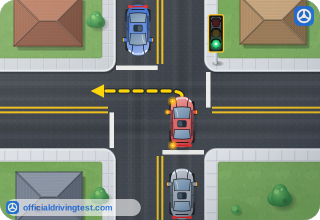
- Vehicles behind you to pass on your left
- Vehicles behind you to pull up beside you
- Cross traffic to pass behind you
- Oncoming traffic to turn in front of you
Show answer
Correct answer: Oncoming traffic to turn in front of you
You should leave room for oncoming traffic to turn in front of you.
Source: Wisconsin Motorists' Handbook (2026 (BDS126)), page 14 · Open this page in the manual (Manual page 14)
-
If you must wait for traffic to pass before turning left, what should you do with your steering wheel?
- Turn it to the left
- Keep it straight
- Turn it to the right
- Turn it halfway left
Show answer
Correct answer: Keep it straight
While waiting to turn left you should keep your steering wheel straight to keep you and others safe.
Source: Wisconsin Motorists' Handbook (2026 (BDS126)), page 14 · Open this page in the manual (Manual page 14)
-
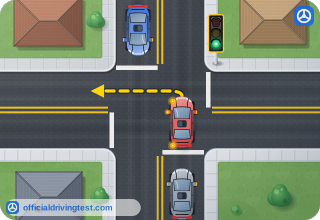
Why should you keep your wheels straight while you wait to turn left?
- It keeps your tires from wearing on one side of the tread
- It lets oncoming drivers see that you plan to go straight ahead
- If you are hit from behind, you will not be pushed into oncoming traffic
- It lets you start the turn faster when the traffic ahead clears
Show answer
Correct answer: If you are hit from behind, you will not be pushed into oncoming traffic
If your wheel is turned left and someone hits you from behind, you will be pushed into oncoming traffic.
Source: Wisconsin Motorists' Handbook (2026 (BDS126)), page 14 · Open this page in the manual (Manual page 14)
-
What is a U-turn?
- One smooth U-shaped motion that ends with you going the opposite way
- A turn made in several short moves, with a stop at each curb on the way
- A turn made only from the left lane of a one-way street at a signal
- Any left turn made at an intersection controlled by a traffic signal
Show answer
Correct answer: One smooth U-shaped motion that ends with you going the opposite way
A U-turn is a single smooth U-shaped motion that ends with you traveling the opposite way.
Source: Wisconsin Motorists' Handbook (2026 (BDS126)), page 15 · Open this page in the manual (Manual page 15)
-
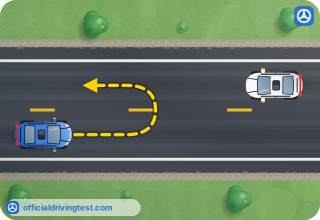
When may you make a U-turn on a rural two-lane highway?
- Only at a spot that is marked with a special U-turn sign
- Only when no vehicle can be seen in either direction for a mile
- When it is done safely and you do not interfere with traffic
- Never, because U-turns are not allowed on a rural two-lane highway
Show answer
Correct answer: When it is done safely and you do not interfere with traffic
A U-turn on a rural two-lane highway is allowed if it is done safely and does not interfere with traffic.
Source: Wisconsin Motorists' Handbook (2026 (BDS126)), page 15 · Open this page in the manual (Manual page 15)
-
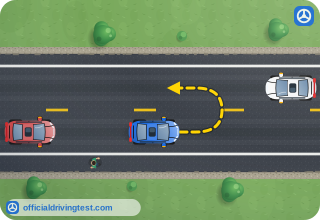
Before making a U-turn, what should you do?
- Check only your rearview mirror and then start the turn right away
- Check all mirrors and traffic, and look for a sign that bans U-turns
- Switch on your high beams so that other drivers can see you
- Tap your horn so that all the traffic stops to let you turn
Show answer
Correct answer: Check all mirrors and traffic, and look for a sign that bans U-turns
You should check all mirrors and traffic and look for any sign telling you not to make a U-turn.
Source: Wisconsin Motorists' Handbook (2026 (BDS126)), page 15 · Open this page in the manual (Manual page 15)
-
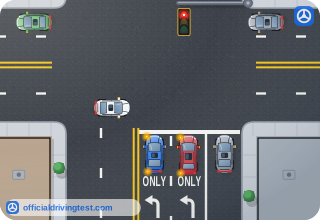
You start a turn from the left-most lane of a road that has more than one turn lane. Which lane should you end up in?
- The right-most lane of the street you are turning onto
- Whichever lane of the new street has the least traffic
- Any lane of the new street as long as you signal first
- The left-most lane of the street you are turning onto
Show answer
Correct answer: The left-most lane of the street you are turning onto
If you start turning from the left-most lane, you should end up in the left-most lane.
Source: Wisconsin Motorists' Handbook (2026 (BDS126)), page 16 · Open this page in the manual (Manual page 16)
-
You turn from the middle lane at an intersection that has multiple turn lanes. Where do you need to end up?
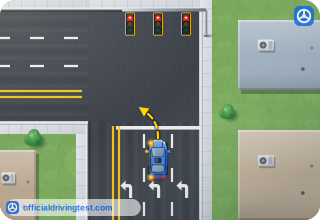
- In the left-most lane of the street you are turning onto
- In the lane nearest the right curb of the street you are turning onto
- In the middle lane of the street you are turning onto
- In whatever lane you were in before the intersection
Show answer
Correct answer: In the middle lane of the street you are turning onto
From the middle lane you need to end up in the middle lane of the street you are turning onto.
Source: Wisconsin Motorists' Handbook (2026 (BDS126)), page 16 · Open this page in the manual (Manual page 16)
-
From which lane must you turn right off a four-lane roadway?
- The lane nearest the right curb or edge of the roadway
- The lane nearest the center line of the roadway
- Any lane, as long as you signal before the turn
- The middle lane, so that you can see both ways
Show answer
Correct answer: The lane nearest the right curb or edge of the roadway
To turn right off a four-lane roadway you must turn from the lane nearest the right curb or edge.
Source: Wisconsin Motorists' Handbook (2026 (BDS126)), page 16 · Open this page in the manual (Manual page 16)
-
When should a Y-turn be used?
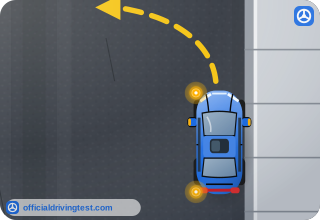
- On a freeway, after you miss your exit and cannot go on
- On any wide street where U-turns are not posted
- Only on a divided highway that has a wide median
- Only in residential areas, on streets too narrow for a U-turn
Show answer
Correct answer: Only in residential areas, on streets too narrow for a U-turn
A Y-turn is only for residential areas on streets that are too narrow for a U-turn.
Source: Wisconsin Motorists' Handbook (2026 (BDS126)), page 17 · Open this page in the manual (Manual page 17)
-
What is the first step of a Y-turn?
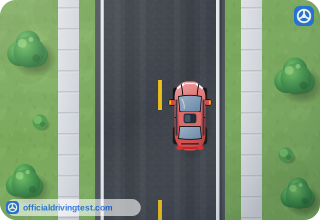
- Signal left, check traffic and your mirrors, pull to the center line and stop
- Signal right, check traffic and your mirrors, pull as far right as possible and stop
- Turn on your hazard lights and back up toward the right curb
- Turn left across the street without stopping at the right curb
Show answer
Correct answer: Signal right, check traffic and your mirrors, pull as far right as possible and stop
The first step is to signal right, check traffic to the right and in your mirrors, pull as far right as possible and stop.
Source: Wisconsin Motorists' Handbook (2026 (BDS126)), page 17 · Open this page in the manual (Manual page 17)
-
In the second step of a Y-turn, what do you do after you signal left and check your blind spot?
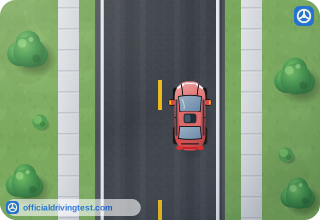
- Turn right and drive forward along the same curb
- Turn left to the opposite curb and stop
- Pull forward into your lane of traffic
- Back up along the curb to the car behind you
Show answer
Correct answer: Turn left to the opposite curb and stop
After signaling left and checking your blind spot, you turn left to the opposite curb and stop.
Source: Wisconsin Motorists' Handbook (2026 (BDS126)), page 17 · Open this page in the manual (Manual page 17)
-
While reversing during a Y-turn, where do you look?
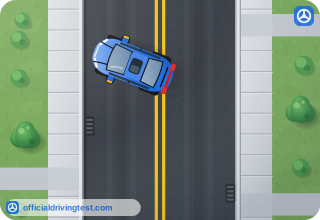
- Over your left shoulder only
- Only into your rearview mirror
- At the curb you are leaving
- Behind you, over your right shoulder
Show answer
Correct answer: Behind you, over your right shoulder
In the third step you look behind you over your right shoulder and reverse enough to be able to move forward again.
Source: Wisconsin Motorists' Handbook (2026 (BDS126)), page 17 · Open this page in the manual (Manual page 17)
3Part 317 questions
-
What is the last step of a Y-turn?
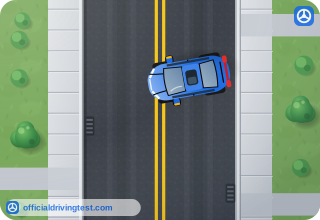
- Check traffic both ways, pull forward and proceed in your lane
- Signal right and back up once more to the first curb to start over
- Stop at the center line and wait for traffic to pass in both directions
- Turn on your hazard lights and drive to the next block
Show answer
Correct answer: Check traffic both ways, pull forward and proceed in your lane
The last step is to check traffic in both directions, pull forward and continue in your lane of traffic.
Source: Wisconsin Motorists' Handbook (2026 (BDS126)), page 17 · Open this page in the manual (Manual page 17)
-
When may you turn right at a steady red light?
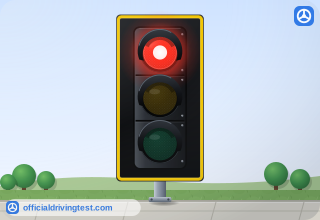
- After stopping, when it is safe and no sign prohibits it
- Only when a police officer waves you through the intersection
- Without stopping, as long as no vehicles are approaching
- Only after the cross traffic has had a green light
Show answer
Correct answer: After stopping, when it is safe and no sign prohibits it
A right turn on red is allowed after a full stop if it is safe and no sign prohibits it.
Source: Wisconsin Motorists' Handbook (2026 (BDS126)), page 32 · Open this page in the manual (Manual page 32)
-
When may you turn left at a steady red light?
- When turning from a two-way street onto a one-way street
- When no cross traffic is visible on any road
- When turning from a one-way street onto a one-way street
- When turning onto a street with a bike lane
Show answer
Correct answer: When turning from a one-way street onto a one-way street
A left turn on red is allowed only from a one-way street onto a one-way street.
Source: Wisconsin Motorists' Handbook (2026 (BDS126)), page 32 · Open this page in the manual (Manual page 32)
-
What must you do when turning on red?
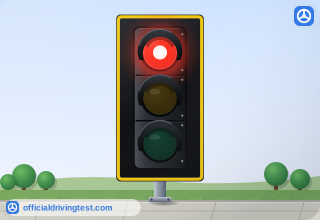
- Slow down, yield to cross traffic, then move into any open lane
- Stop first, yield to all traffic, then proceed staying in your lane
- Stop first, then enter whichever lane has the fewest vehicles
- Yield to cross traffic only, then turn without coming to a stop
Show answer
Correct answer: Stop first, yield to all traffic, then proceed staying in your lane
A turn on red starts with a stop, then you yield to all traffic and stay in your lane.
Source: Wisconsin Motorists' Handbook (2026 (BDS126)), page 32 · Open this page in the manual (Manual page 32)
-
You are stopped at a red light and it turns green. What must you do before going ahead?
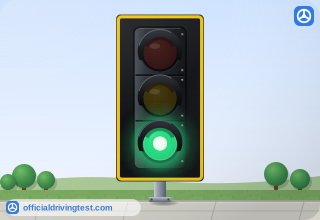
- Allow cross traffic to clear before going ahead
- Go ahead at once, since the green light gives you the right-of-way
- Flash your headlights so cross traffic knows you are going
- Check only for pedestrians, then go ahead
Show answer
Correct answer: Allow cross traffic to clear before going ahead
A driver who was stopped must let cross traffic clear before moving on a new green light.
Source: Wisconsin Motorists' Handbook (2026 (BDS126)), page 33 · Open this page in the manual (Manual page 33)
-
When you turn left on a steady green light, who has the right-of-way?
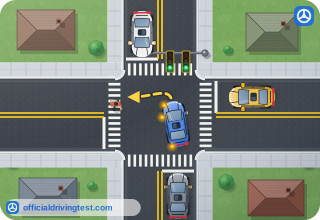
- You, because the light is green
- Vehicles behind you
- Oncoming traffic
- Vehicles parked along the curb
Show answer
Correct answer: Oncoming traffic
A steady green lets you turn left only when it is safe, and oncoming traffic has the right-of-way.
Source: Wisconsin Motorists' Handbook (2026 (BDS126)), page 33 · Open this page in the manual (Manual page 33)
-
In which direction does traffic move in a roundabout?
- Counterclockwise
- Clockwise
- Toward the center island only
- Whichever way the first driver goes
Show answer
Correct answer: Counterclockwise
Traffic in a roundabout moves counterclockwise.
Source: Wisconsin Motorists' Handbook (2026 (BDS126)), page 39 · Open this page in the manual (Manual page 39)
-
How does the handbook describe roundabouts compared with other traffic flow options?
- Safer but less efficient
- More efficient but less safe
- Safer and more efficient
- Equal in safety and efficiency
Show answer
Correct answer: Safer and more efficient
Roundabouts are described as a safer and more efficient traffic flow option.
Source: Wisconsin Motorists' Handbook (2026 (BDS126)), page 39 · Open this page in the manual (Manual page 39)
-
As you get to a roundabout, what tells you which lane you need to be in?
- The color of the curb
- The signs above you
- The vehicle in front of you
- A flashing light at the crosswalk
Show answer
Correct answer: The signs above you
The signs above you as you approach a roundabout show which lane you need to be in.
Source: Wisconsin Motorists' Handbook (2026 (BDS126)), page 39 · Open this page in the manual (Manual page 39)
-
As you reach a roundabout, from which side do you yield to traffic that is already in the roundabout?
- Traffic on your right
- Traffic behind you
- Traffic ahead of you in the same lane
- Traffic on your left
Show answer
Correct answer: Traffic on your left
As you reach a roundabout, you yield to traffic on your left that is already in the roundabout.
Source: Wisconsin Motorists' Handbook (2026 (BDS126)), page 39 · Open this page in the manual (Manual page 39)
-
As you reach a roundabout, which of these should you yield to?
- Semitrucks
- Vehicles waiting behind you
- Vehicles that have already exited
- Parked vehicles beside the road
Show answer
Correct answer: Semitrucks
The steps for approaching a roundabout include yielding to semitrucks.
Source: Wisconsin Motorists' Handbook (2026 (BDS126)), page 39 · Open this page in the manual (Manual page 39)
-
When should you enter a roundabout?
- Only after all traffic inside has left the roundabout
- When there is a safe gap in traffic
- As soon as you reach the crosswalk
- When the vehicle ahead of you has entered
Show answer
Correct answer: When there is a safe gap in traffic
You enter the roundabout when there is a safe gap in traffic.
Source: Wisconsin Motorists' Handbook (2026 (BDS126)), page 39 · Open this page in the manual (Manual page 39)
-
What should you do about your speed as you reach a roundabout and drive through it?
- Speed up so you can merge into a gap
- Keep the speed of the road you came from
- Stop completely at the entrance every time
- Slow down and keep your speed low
Show answer
Correct answer: Slow down and keep your speed low
The steps are to slow down as you reach the roundabout and keep your speed low inside it.
Source: Wisconsin Motorists' Handbook (2026 (BDS126)), page 39 · Open this page in the manual (Manual page 39)
-
If there is no traffic in the roundabout, what do you do when you reach it?
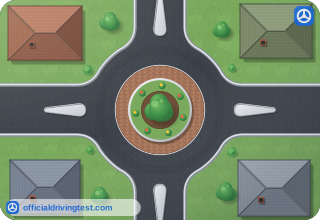
- You do not need to wait to enter
- Stop and wait for a count of three
- Wait until a vehicle comes up behind you
- Sound your horn before entering
Show answer
Correct answer: You do not need to wait to enter
When no traffic is in the roundabout, you do not need to wait to enter.
Source: Wisconsin Motorists' Handbook (2026 (BDS126)), page 39 · Open this page in the manual (Manual page 39)
-
What does the handbook say about switching lanes while you are in a roundabout?
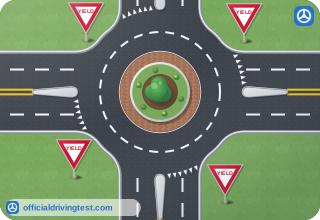
- Switch to the right lane before your exit
- Switch lanes when no vehicle is beside you
- Do not switch lanes
- Switch lanes whenever a slower vehicle is ahead
Show answer
Correct answer: Do not switch lanes
You stay in your lane; do not switch lanes while you are in the roundabout.
Source: Wisconsin Motorists' Handbook (2026 (BDS126)), page 39 · Open this page in the manual (Manual page 39)
-
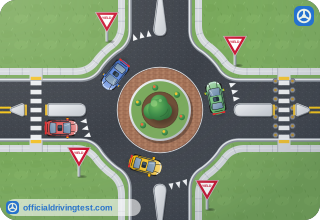
As you reach your exit in a roundabout, which signal do you turn on?
- Your left turn signal
- Your right turn signal
- Your hazard lights
- None until you have left the roundabout
Show answer
Correct answer: Your right turn signal
At your exit you turn on your right turn signal and exit.
Source: Wisconsin Motorists' Handbook (2026 (BDS126)), page 39 · Open this page in the manual (Manual page 39)
-
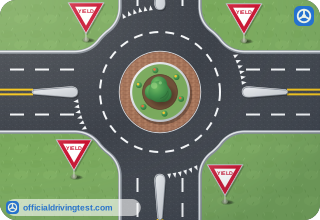
Before entering a two-lane roundabout, whose traffic do you yield to?
- All traffic in both lanes
- Only traffic in the lane you will use
- Only traffic in the left lane
- Only traffic that is about to exit
Show answer
Correct answer: All traffic in both lanes
In a two-lane roundabout you choose your lane and yield to all traffic in both lanes before entering.
Source: Wisconsin Motorists' Handbook (2026 (BDS126)), page 41 · Open this page in the manual (Manual page 41)