Wisconsin: Right-of-way, turning and passing — Part 1 Practice Test
Questions in this part include: “What does "right-of-way" tell us?” · “Which of these is included as an intersection?”
Independent educational site · not affiliated with any government agency or DMV
Ready? Test yourself
Answer to start, or tap Start below:
What does "right-of-way" tell us?
- Instant feedback with an explanation
- Every answer cites its source in the manual
- Your best score is saved on this device
- Keyboard: press 1 to 4 to answer and Enter for the next question
Questions are original and based on the official manual "Wisconsin Motorists' Handbook" (2026 (BDS126)), Wisconsin Department of Transportation, Division of Motor Vehicles (DMV).
All 18 questions in this practice test
Take the test above first, then use this list to study. Tap “Show answer” to see the correct answer and explanation.
Show the questions and answersHide the questions
-
What does "right-of-way" tell us?
- Which vehicle may drive faster
- Which lane to use at an intersection
- Who is at fault after a crash
- Who goes first and who must wait
Show answer
Correct answer: Who goes first and who must wait
Right-of-way decides who goes first and who must wait where vehicles or pedestrians meet.
Source: Wisconsin Motorists' Handbook (2026 (BDS126)), page 9 · Open this page in the manual (Manual page 9)
-
Where are vehicles or pedestrians likely to meet, so that right-of-way becomes important?
- Only where a traffic light is flashing
- Where there are no traffic signals or signs
- Only on roads with more than one lane
- Only at railroad crossings
Show answer
Correct answer: Where there are no traffic signals or signs
The handbook says vehicles and pedestrians are likely to meet where there are no traffic signals or signs.
Source: Wisconsin Motorists' Handbook (2026 (BDS126)), page 9 · Open this page in the manual (Manual page 9)
-
What must you always do to avoid hitting pedestrians, bicyclists and other vehicles?
- Speed up
- Sound your horn
- Yield
- Flash your lights
Show answer
Correct answer: Yield
You must always yield so that you do not hit pedestrians, bicyclists or other vehicles.
Source: Wisconsin Motorists' Handbook (2026 (BDS126)), page 9 · Open this page in the manual (Manual page 9)
-
You reach a four-way stop. Whom should you yield right-of-way to?
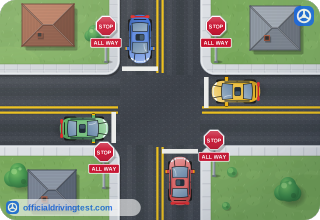
- The bicyclist or driver who arrives first
- The driver in the largest vehicle
- The driver with the most passengers
- The driver who is driving the fastest
Show answer
Correct answer: The bicyclist or driver who arrives first
At a four-way stop you yield to the bicyclist or driver who arrives first.
Source: Wisconsin Motorists' Handbook (2026 (BDS126)), page 9 · Open this page in the manual (Manual page 9)
-
Two or more drivers arrive at a four-way stop at the same time. Who goes first?
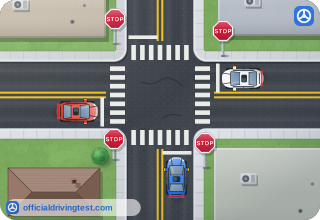
- The driver on the left
- The driver on the right
- The driver going straight ahead
- The driver turning left
Show answer
Correct answer: The driver on the right
When drivers arrive at the stop at the same time, the driver on the right goes first.
Source: Wisconsin Motorists' Handbook (2026 (BDS126)), page 9 · Open this page in the manual (Manual page 9)
-
You come to an intersection with no signals or traffic lights (an uncontrolled intersection). Whom should you yield right-of-way to?
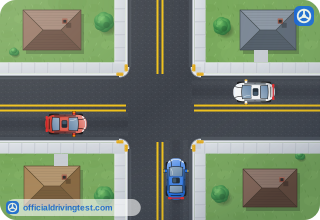
- Vehicles coming from the left
- Vehicles that are smaller than yours
- Vehicles that are traveling slower
- Vehicles coming from the right
Show answer
Correct answer: Vehicles coming from the right
At an uncontrolled intersection you should yield to vehicles coming from the right.
Source: Wisconsin Motorists' Handbook (2026 (BDS126)), page 9 · Open this page in the manual (Manual page 9)
-
You are entering a roundabout (traffic circle). Whom should you yield right-of-way to?
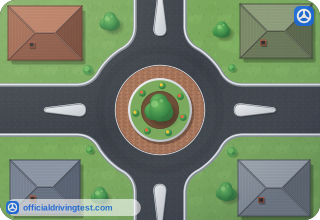
- Traffic that is already in the roundabout
- Vehicles waiting to enter behind you
- Vehicles waiting at the other entrances
- No one, because it has no stop sign
Show answer
Correct answer: Traffic that is already in the roundabout
You should yield to traffic that is already in the roundabout.
Source: Wisconsin Motorists' Handbook (2026 (BDS126)), page 9 · Open this page in the manual (Manual page 9)
-
At an uncontrolled T-intersection, whom should you yield right-of-way to?
- Parked vehicles
- Traffic behind you
- Cross traffic
- Only pedestrians
Show answer
Correct answer: Cross traffic
At an uncontrolled T-intersection you should yield to cross traffic.
Source: Wisconsin Motorists' Handbook (2026 (BDS126)), page 9 · Open this page in the manual (Manual page 9)
-
You are making a left turn or a U-turn. Whom should you yield right-of-way to?
- Vehicles behind you
- Parked vehicles
- Only pedestrians
- Approaching vehicles
Show answer
Correct answer: Approaching vehicles
When you make a left turn or a U-turn, you should yield to approaching vehicles.
Source: Wisconsin Motorists' Handbook (2026 (BDS126)), page 9 · Open this page in the manual (Manual page 9)
-
Which of these is included as an intersection?
- A railroad crossing
- A road shoulder
- A highway median
- A bridge deck
Show answer
Correct answer: A railroad crossing
Intersections include cross streets, driveways, parking lot entrances and railroad crossings.
Source: Wisconsin Motorists' Handbook (2026 (BDS126)), page 11 · Open this page in the manual (Manual page 11)
-
You cannot see across the intersection. What should you do?
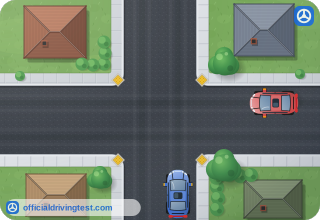
- Speed up to get through it quickly
- Stop in the crosswalk until you can see
- Honk and keep going
- Move forward with caution
Show answer
Correct answer: Move forward with caution
If you cannot see across the intersection, you should move forward with caution.
Source: Wisconsin Motorists' Handbook (2026 (BDS126)), page 11 · Open this page in the manual (Manual page 11)
-
Trees, buildings and parked vehicles block your view at an intersection. How should you approach it?
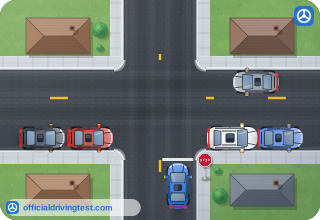
- At the speed of traffic
- At a slow pace
- In the far-left lane
- With your high beams on
Show answer
Correct answer: At a slow pace
An intersection with a blocked view should be approached at a slow pace.
Source: Wisconsin Motorists' Handbook (2026 (BDS126)), page 11 · Open this page in the manual (Manual page 11)
-
When is it most important to have control of your vehicle and be able to brake at an intersection?
- When there are no control signals or signs
- When a green traffic light controls it
- When a stop sign controls it
- When a police officer directs traffic
Show answer
Correct answer: When there are no control signals or signs
Control and the ability to brake matter most when there are no control signals or signs.
Source: Wisconsin Motorists' Handbook (2026 (BDS126)), page 11 · Open this page in the manual (Manual page 11)
-
Even if you have the right-of-way, what should you do before going through an intersection?
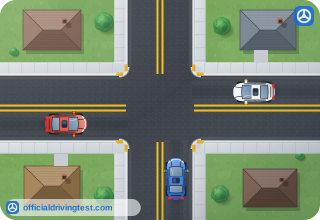
- Search right, left and right again
- Look straight ahead only
- Search left, right and left again
- Watch only the traffic signal ahead
Show answer
Correct answer: Search left, right and left again
Some drivers do not obey or notice signals or signs, so you should search left, right and left again even with the right-of-way.
Source: Wisconsin Motorists' Handbook (2026 (BDS126)), page 11 · Open this page in the manual (Manual page 11)
-
When you cross traffic and multi-lane roads, what must you make sure of?
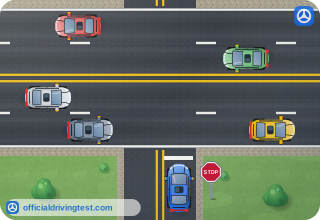
- No vehicle is parked within one block of the crossing
- Your turn signal has been on for ten seconds
- The vehicles in the first lane have already stopped
- There is enough room to get all the way across
Show answer
Correct answer: There is enough room to get all the way across
When crossing traffic or a multi-lane road, make sure there is enough room to get all the way across.
Source: Wisconsin Motorists' Handbook (2026 (BDS126)), page 13 · Open this page in the manual (Manual page 13)
-
What should you check before turning?
- Your mirrors, surroundings and blind spot
- Your mirrors, speedometer and fuel gauge
- Your horn, hazard lights and brake lights
- Your tire pressure, mirrors and wipers
Show answer
Correct answer: Your mirrors, surroundings and blind spot
Before turning you should check your mirrors, your surroundings and your blind spot.
Source: Wisconsin Motorists' Handbook (2026 (BDS126)), page 14 · Open this page in the manual (Manual page 14)
-
Besides staying in your lane and yielding the right-of-way, what is it important to do when you turn?
- Sound your horn as you turn
- Turn on your hazard lights
- Signal that you are going to turn
- Flash your high beams at oncoming vehicles
Show answer
Correct answer: Signal that you are going to turn
It is important to stay in your lane, signal that you are going to turn and yield the right-of-way.
Source: Wisconsin Motorists' Handbook (2026 (BDS126)), page 14 · Open this page in the manual (Manual page 14)
-
What does the handbook say about last-second changes when turning?
- They are safe if your turn signal is on
- They are allowed when no vehicles are behind you
- They are unsafe and could cause a crash
- They are required if you miss your turn
Show answer
Correct answer: They are unsafe and could cause a crash
Last-second changes are unsafe and could cause a crash.
Source: Wisconsin Motorists' Handbook (2026 (BDS126)), page 14 · Open this page in the manual (Manual page 14)