Vermont: Hazardous conditions and crashes — Part 4 Practice Test
Questions in this part include: “What is a driver involved in a crash required by law to do?” · “After a crash with no injuries, damage over what amount requires a written report to the Department of Motor Vehicles?”
Independent educational site · not affiliated with any government agency or DMV
Ready? Test yourself
- Instant feedback with an explanation
- Every answer cites its source in the manual
- Your best score is saved on this device
- Keyboard: press 1 to 4 to answer and Enter for the next question
Questions are original and based on the official manual "Vermont Driver's Manual" (2025 edition (VN-007 07/2024)), Vermont Department of Motor Vehicles.
All 18 questions in this practice test
Take the test above first, then use this list to study. Tap “Show answer” to see the correct answer and explanation.
Show the questions and answersHide the questions
-
What is a driver involved in a crash required by law to do?
- Drive on quickly to avoid a second crash
- Call the insurance company before anything else
- Wait for the other driver to leave
- Stop and give any assistance reasonably necessary
Show answer
Correct answer: Stop and give any assistance reasonably necessary
The manual says a driver in a crash must stop and give any reasonably necessary assistance.
Source: Vermont Driver's Manual (2025 edition (VN-007 07/2024)), page 58 · Open this page in the manual (Manual page 58)
-
After a crash, what does the manual say to do with the involved vehicles if possible?
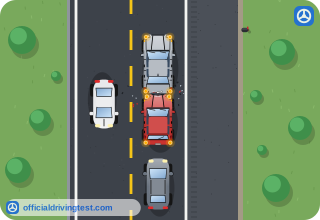
- Leave them where they stopped until help arrives
- Move them onto the shoulder, out of the lanes
- Turn them around to face oncoming traffic
- Tow them away before the police arrive
Show answer
Correct answer: Move them onto the shoulder, out of the lanes
Moving vehicles to the shoulder reduces the chance of someone else crashing into them.
Source: Vermont Driver's Manual (2025 edition (VN-007 07/2024)), page 58 · Open this page in the manual (Manual page 58)
-
At a crash scene, what should you do if someone is injured?
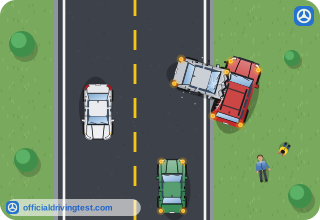
- Move the person to your vehicle
- Wait until the police pass by
- Call 911
- Drive the person home
Show answer
Correct answer: Call 911
The manual says to call 911 if someone is injured.
Source: Vermont Driver's Manual (2025 edition (VN-007 07/2024)), page 58 · Open this page in the manual (Manual page 58)
-
Why does the manual say to leave an injured person where they are?
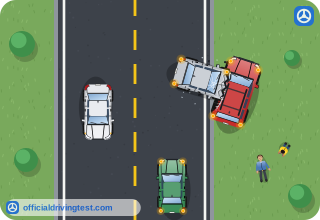
- You may injure the person more by moving them
- The person will be able to walk after a few minutes
- The police will not be able to find the person
- The person is better off in the road
Show answer
Correct answer: You may injure the person more by moving them
Moving an injured person the wrong way can cause more injury, so the manual says to leave them where they are.
Source: Vermont Driver's Manual (2025 edition (VN-007 07/2024)), page 58 · Open this page in the manual (Manual page 58)
-
What should you do for an injured person at a crash scene besides calling 911?
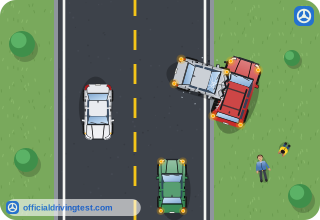
- Keep the person warm and calm
- Give the person food and water
- Have the person walk around
- Cover the person’s face
Show answer
Correct answer: Keep the person warm and calm
The manual says to keep the injured person warm and calm while waiting for help.
Source: Vermont Driver's Manual (2025 edition (VN-007 07/2024)), page 58 · Open this page in the manual (Manual page 58)
-
What does the manual say about a police officer who responds to a crash scene?
- The police will decide who pays for damages
- The police will always side with the driver who stopped first
- The police will not take sides for one driver or the other
- The police will not respond to a 911 call
Show answer
Correct answer: The police will not take sides for one driver or the other
The manual says the officer obtains the facts and will not take sides.
Source: Vermont Driver's Manual (2025 edition (VN-007 07/2024)), page 58 · Open this page in the manual (Manual page 58)
-
Which items will you have to show to the police officer at a crash scene?
- Your license and a written statement from the other driver
- Your license, proof of valid registration and insurance
- Your license and your inspection sticker only
- Your registration and your birth certificate
Show answer
Correct answer: Your license, proof of valid registration and insurance
At a crash scene you must show the police your license, proof of valid registration and insurance.
Source: Vermont Driver's Manual (2025 edition (VN-007 07/2024)), page 58 · Open this page in the manual (Manual page 58)
-
At a crash scene, to whom else must you show your license?
- Only the other driver involved in the crash
- Only the police officer who responds to it
- Only witnesses who stop at the crash scene
- Anyone injured or whose property was damaged
Show answer
Correct answer: Anyone injured or whose property was damaged
The manual says you must also show your license to anyone who is injured or whose property is damaged.
Source: Vermont Driver's Manual (2025 edition (VN-007 07/2024)), page 58 · Open this page in the manual (Manual page 58)
-
If you hit a parked vehicle, cause damage, and cannot find the owner, what must you do?
- Leave without doing anything if the damage is small
- Leave your name, address and phone number on or in it
- Wait one hour for the owner and then drive away
- Report it to the DMV and not leave a note
Show answer
Correct answer: Leave your name, address and phone number on or in it
You must leave a note with your name, address and phone number in or on the vehicle so the owner knows whom to contact.
Source: Vermont Driver's Manual (2025 edition (VN-007 07/2024)), page 58 · Open this page in the manual (Manual page 58)
-
After a crash, when must you make a written report to the Department of Motor Vehicles if any person has been injured?
- Within 24 hours
- Within 7 days
- Within 30 days
- Within 72 hours
Show answer
Correct answer: Within 72 hours
If anyone is injured or damage is over $3,000, you must send a written report to the DMV within 72 hours.
Source: Vermont Driver's Manual (2025 edition (VN-007 07/2024)), page 58 · Open this page in the manual (Manual page 58)
-
After a crash with no injuries, damage over what amount requires a written report to the Department of Motor Vehicles?
- $3,000
- $500
- $1,000
- $5,000
Show answer
Correct answer: $3,000
A written report to the DMV is required if any person is injured or if the damage is over $3,000.
Source: Vermont Driver's Manual (2025 edition (VN-007 07/2024)), page 58 · Open this page in the manual (Manual page 58)
-
According to the manual, why are crash reports made?
- They set insurance rates for drivers
- They decide which driver loses the license
- They help the state improve roadways
- They replace the need to call the police
Show answer
Correct answer: They help the state improve roadways
The manual says crash reports help the state improve roadways.
Source: Vermont Driver's Manual (2025 edition (VN-007 07/2024)), page 58 · Open this page in the manual (Manual page 58)
-
Where can you get a Vermont Crash Report, according to the manual?
- At any post office in Vermont
- At any town clerk’s office in Vermont
- At any inspection station in Vermont
- At any Vermont Police Department
Show answer
Correct answer: At any Vermont Police Department
The manual says a crash report is available at any Vermont Police Department or from the DMV.
Source: Vermont Driver's Manual (2025 edition (VN-007 07/2024)), page 58 · Open this page in the manual (Manual page 58)
-
What can mile markers be used for after a crash outside a city?
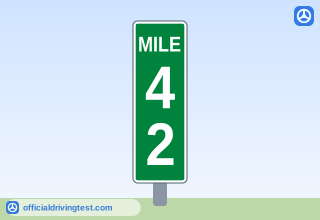
- To pinpoint the exact location of the crash scene
- To measure how fast each vehicle was traveling
- To work out which driver was at fault
- To estimate how much damage the vehicles took
Show answer
Correct answer: To pinpoint the exact location of the crash scene
Mile markers help identify the exact spot of a crash, and that information helps the police when you report it.
Source: Vermont Driver's Manual (2025 edition (VN-007 07/2024)), page 59 · Open this page in the manual (Manual page 59)
-
If you have a crash with another vehicle, what does the other driver have the right to see?
- Your medical records and employment history
- Your driving record and past crash reports
- Your license, registration and insurance information
- Your vehicle's inspection and repair history
Show answer
Correct answer: Your license, registration and insurance information
After a crash with another vehicle, the other driver is entitled to see your license, registration and insurance information.
Source: Vermont Driver's Manual (2025 edition (VN-007 07/2024)), page 59 · Open this page in the manual (Manual page 59)
-
Where must a Vermont driver report a crash that happened in another state?
- In Vermont only, because the driver is licensed there
- In the state where the crash happened
- Only in the state where the vehicle is registered
- Crashes in other states do not have to be reported
Show answer
Correct answer: In the state where the crash happened
A Vermont driver's crash in another state must be reported in the state where the crash happened.
Source: Vermont Driver's Manual (2025 edition (VN-007 07/2024)), page 59 · Open this page in the manual (Manual page 59)
-
After a crash with another vehicle, which information should you get from the other driver?
- Name, address and Social Security number
- Name, employer and insurance policy cost
- Name, phone number and date of birth
- Name, address, license and registration numbers
Show answer
Correct answer: Name, address, license and registration numbers
The manual lists the other driver's name, address, license number and registration number as details to get at a crash scene.
Source: Vermont Driver's Manual (2025 edition (VN-007 07/2024)), page 59 · Open this page in the manual (Manual page 59)
-
After a crash, whose names and addresses is it also good to get, besides the other driver's?
- Only the police officers who come to the crash scene
- Only the passengers who were riding in your own vehicle
- The tow truck driver and the shop that repairs your car
- The other vehicle's occupants and all persons who saw it
Show answer
Correct answer: The other vehicle's occupants and all persons who saw it
Besides the other driver, it is good to get names and addresses of the other vehicle's occupants and of everyone who saw the crash.
Source: Vermont Driver's Manual (2025 edition (VN-007 07/2024)), page 59 · Open this page in the manual (Manual page 59)