Vermont: Emergency vehicles and work zones — Part 1 Practice Test
Questions in this part include: “What does the manual say to show the officer when requested during a police stop?” · “According to the manual, where should a traffic offense be addressed instead of at the roadside?”
Independent educational site · not affiliated with any government agency or DMV
Ready? Test yourself
- Instant feedback with an explanation
- Every answer cites its source in the manual
- Your best score is saved on this device
- Keyboard: press 1 to 4 to answer and Enter for the next question
Questions are original and based on the official manual "Vermont Driver's Manual" (2025 edition (VN-007 07/2024)), Vermont Department of Motor Vehicles.
All 22 questions in this practice test
Take the test above first, then use this list to study. Tap “Show answer” to see the correct answer and explanation.
Show the questions and answersHide the questions
-
You are not yet in the roundabout when an emergency vehicle approaches. What should you do?
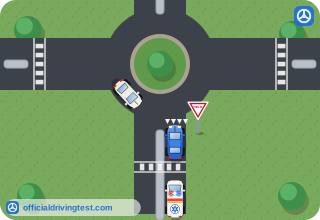
- Enter and drive through to the next exit
- Stop inside the roundabout
- Pull over and let the emergency vehicle pass
- Speed up and enter before it arrives
Show answer
Correct answer: Pull over and let the emergency vehicle pass
If you are not already in the roundabout, you pull over and let the emergency vehicle pass.
Source: Vermont Driver's Manual (2025 edition (VN-007 07/2024)), page 30 · Open this page in the manual (Manual page 30)
-
You are already in the roundabout when an emergency vehicle approaches. When should you pull over?
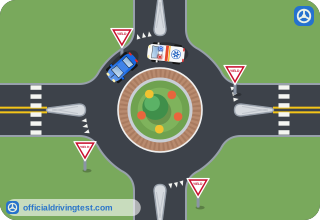
- Right away, where you are in the circle
- After you have safely exited the roundabout
- Only after the vehicle passes you in the circle
- At the next entrance after the circle
Show answer
Correct answer: After you have safely exited the roundabout
If you are already in the roundabout, you pull over once you have safely exited it.
Source: Vermont Driver's Manual (2025 edition (VN-007 07/2024)), page 30 · Open this page in the manual (Manual page 30)
-
How will police vehicles attempting to stop drivers signal them?
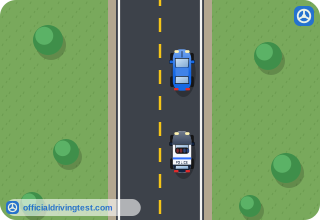
- By sounding the horn and flashing the headlights only
- By using a loudspeaker or a spotlight only
- By flashing the brake lights several times
- By turning on flashing lights, or flashing lights and a siren
Show answer
Correct answer: By turning on flashing lights, or flashing lights and a siren
Police vehicles stop drivers by turning on flashing lights, or flashing lights and a siren.
Source: Vermont Driver's Manual (2025 edition (VN-007 07/2024)), page 30 · Open this page in the manual (Manual page 30)
-
When a police vehicle signals you to stop, where should you stop?
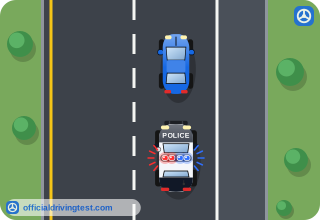
- As close as you safely can to the right side of the road
- In the center median of the divided highway ahead
- In the middle of the next intersection
- In the lane you are in, wherever you are
Show answer
Correct answer: As close as you safely can to the right side of the road
You drive as close as you safely can to the right side of the road.
Source: Vermont Driver's Manual (2025 edition (VN-007 07/2024)), page 30 · Open this page in the manual (Manual page 30)
-
When signaled to stop by police, where must you NOT stop?
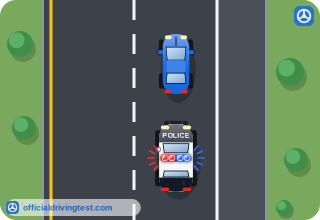
- On the right side of the road
- Safely at the right edge of the road
- In an intersection
- Right where the officer can see the car
Show answer
Correct answer: In an intersection
You must not stop in an intersection or pull into the center median of a divided highway.
Source: Vermont Driver's Manual (2025 edition (VN-007 07/2024)), page 30 · Open this page in the manual (Manual page 30)
-
During a police stop, what should you do with your safety belt?
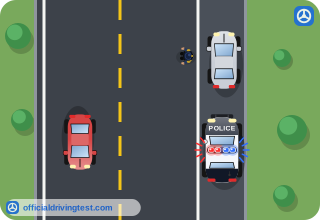
- Unfasten it as soon as you stop
- Keep it fastened until the officer has seen you wearing it
- Unfasten it when the officer walks up to the car
- Keep it unfastened so you can step out of the car quickly
Show answer
Correct answer: Keep it fastened until the officer has seen you wearing it
Keep your safety belt fastened until the officer has seen you wearing it.
Source: Vermont Driver's Manual (2025 edition (VN-007 07/2024)), page 30 · Open this page in the manual (Manual page 30)
-
During a police stop, what should you do about your movements and those of your passengers?
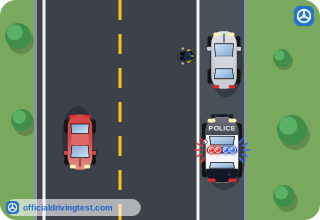
- Move around to find your documents quickly
- Reach toward the glove box right away
- Have passengers get out of the vehicle
- Limit them
Show answer
Correct answer: Limit them
The manual tells you to limit your movements and those of any passengers.
Source: Vermont Driver's Manual (2025 edition (VN-007 07/2024)), page 30 · Open this page in the manual (Manual page 30)
-
What does the manual say to show the officer when requested during a police stop?
- Your license, vehicle registration and proof of insurance
- Your license, vehicle registration and a second photo ID
- Your license, proof of insurance and the vehicle title
- Only your license and your vehicle registration
Show answer
Correct answer: Your license, vehicle registration and proof of insurance
You show your license, vehicle registration and proof of insurance when the officer requests them.
Source: Vermont Driver's Manual (2025 edition (VN-007 07/2024)), page 30 · Open this page in the manual (Manual page 30)
-
During a police stop, what should you do unless the officer asks otherwise?
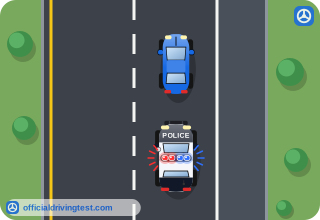
- Get out and walk to the police vehicle
- Get out and stand at the back of your vehicle
- Stay in your vehicle
- Get out and open the hood
Show answer
Correct answer: Stay in your vehicle
You stay in your vehicle and do not get out unless requested, for your safety and the officer’s.
Source: Vermont Driver's Manual (2025 edition (VN-007 07/2024)), page 30 · Open this page in the manual (Manual page 30)
-
If you are stopped by police in a dimly lit area, what should you do after stopping and before the officer approaches?
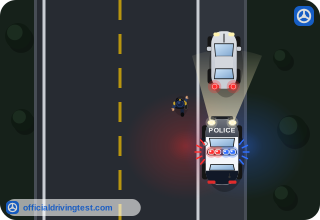
- Turn off all the lights
- Turn on the vehicle’s interior lights
- Flash your high beams
- Get out and wave to the officer
Show answer
Correct answer: Turn on the vehicle’s interior lights
In a dimly lit area, turn on the interior lights after stopping and before the officer approaches.
Source: Vermont Driver's Manual (2025 edition (VN-007 07/2024)), page 30 · Open this page in the manual (Manual page 30)
-
According to the manual, where should a traffic offense be addressed instead of at the roadside?
- At the scene, with the officer
- On the way to the police station
- Before the officer reaches your window
- In court
Show answer
Correct answer: In court
The roadside is not the place to argue a traffic offense; there is time to address it in court.
Source: Vermont Driver's Manual (2025 edition (VN-007 07/2024)), page 30 · Open this page in the manual (Manual page 30)
-
You see or hear a vehicle with flashing blue or red lights and/or a siren approaching from any direction. What does the law say you must do?
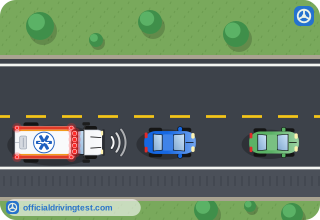
- Pull over to the right side of the road and stop
- Slow down and keep driving in your lane
- Pull over to the left side of the road and stop
- Speed up to get out of its way
Show answer
Correct answer: Pull over to the right side of the road and stop
The law says you must pull over to the right side of the road and stop.
Source: Vermont Driver's Manual (2025 edition (VN-007 07/2024)), page 31 · Open this page in the manual (Manual page 31)
-
How long must you remain stopped after pulling over for an emergency or law enforcement vehicle with flashing lights or a siren?
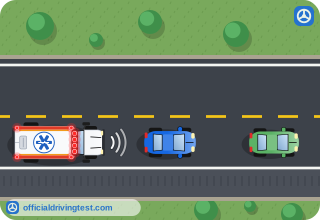
- Until its siren stops
- For at least one minute
- Until the vehicle has gone by
- Until you can no longer see its lights
Show answer
Correct answer: Until the vehicle has gone by
You must remain stopped until the emergency or law enforcement vehicle has gone by.
Source: Vermont Driver's Manual (2025 edition (VN-007 07/2024)), page 31 · Open this page in the manual (Manual page 31)
-
You see a stopped police vehicle with flashing blue lights, or a stopped emergency vehicle with flashing red lights. What must you always do?
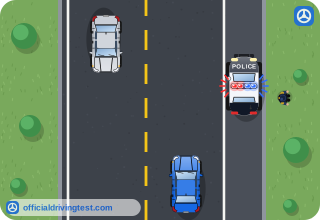
- Stop behind it until it leaves
- Proceed with caution (slow down)
- Drive past it at your normal speed
- Sound your horn as you pass
Show answer
Correct answer: Proceed with caution (slow down)
You must always proceed with caution and slow down when you approach these stopped vehicles.
Source: Vermont Driver's Manual (2025 edition (VN-007 07/2024)), page 31 · Open this page in the manual (Manual page 31)
-
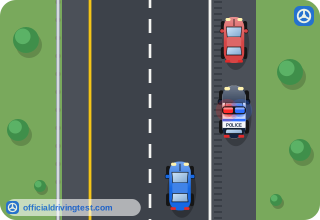
On a four-lane highway such as an Interstate, what does the law require when you approach a stopped police or emergency vehicle with flashing lights?
- A full stop behind the vehicle
- Driving on the shoulder
- An increase in speed to pass it quickly
- A lane change, if you can do so safely
Show answer
Correct answer: A lane change, if you can do so safely
On a four-lane highway the law also requires you to make a lane change if you can do so safely.
Source: Vermont Driver's Manual (2025 edition (VN-007 07/2024)), page 31 · Open this page in the manual (Manual page 31)
-
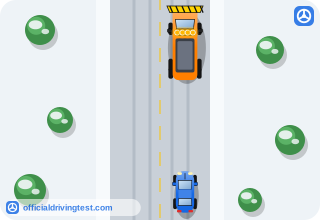
What does the law require when you approach a state, city or town maintenance vehicle working on a highway, such as a snowplow with flashing lights?
- Yield the right of way and proceed with caution
- Pass it as quickly as possible
- Stop until it leaves the highway
- Follow it closely until it turns off the road
Show answer
Correct answer: Yield the right of way and proceed with caution
Drivers must yield the right of way to maintenance vehicles working on a highway and proceed with caution.
Source: Vermont Driver's Manual (2025 edition (VN-007 07/2024)), page 31 · Open this page in the manual (Manual page 31)
-
What color flashing lights do towing and repair vehicles usually have?
- Blue
- Red
- Amber
- White
Show answer
Correct answer: Amber
Towing and repair vehicles usually have amber-colored flashing lights, and you use the same caution as for other stopped emergency vehicles.
Source: Vermont Driver's Manual (2025 edition (VN-007 07/2024)), page 31 · Open this page in the manual (Manual page 31)
-
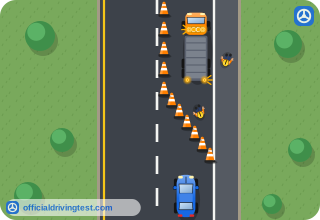
What is a work zone?
- Any road where the speed limit has been lowered
- A stretch of road that is closed to every kind of vehicle until crews finish
- A lane reserved only for road crews and their equipment
- An area along a highway with construction, maintenance, or utility work
Show answer
Correct answer: An area along a highway with construction, maintenance, or utility work
A work zone is an area along a highway where construction, maintenance, or utility work takes place.
Source: Vermont Driver's Manual (2025 edition (VN-007 07/2024)), page 35 · Open this page in the manual (Manual page 35)
-
A work zone may be stationary, or it may be what?
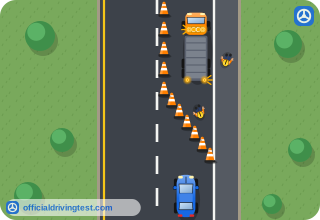
- A mobile operation that moves down the road slowly
- A lane that is closed only at night for utility crews
- A fixed area that is marked only by flashing lights
- A permanent lane reserved for road crews and equipment
Show answer
Correct answer: A mobile operation that moves down the road slowly
Work such as line striping, mowing, and snow removal can move slowly down the road as a mobile work zone.
Source: Vermont Driver's Manual (2025 edition (VN-007 07/2024)), page 35 · Open this page in the manual (Manual page 35)
-
Where do many work zone crashes occur, according to the manual?
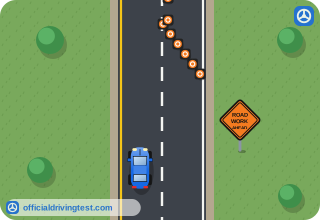
- Inside the work area, right beside the workers
- After the work area, where drivers speed up again once they are past it
- Before the actual work area, where drivers are slowing down or merging
- At the spot where the flaggers are posted
Show answer
Correct answer: Before the actual work area, where drivers are slowing down or merging
Many crashes happen before the work area itself, where drivers slow down or merge.
Source: Vermont Driver's Manual (2025 edition (VN-007 07/2024)), page 35 · Open this page in the manual (Manual page 35)
-
When approaching a work zone, when should you merge into the appropriate lane?
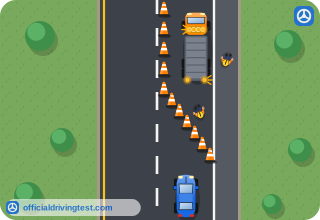
- At the last moment, right at the lane closure
- As soon as it is safe to do so
- Only when all traffic has come to a stop
- After you have passed the first work zone sign
Show answer
Correct answer: As soon as it is safe to do so
Merge into the appropriate lane as soon as it is safe, which is the courteous thing to do.
Source: Vermont Driver's Manual (2025 edition (VN-007 07/2024)), page 35 · Open this page in the manual (Manual page 35)
-
What type of crash is most common in work zones?
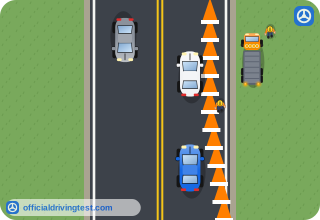
- Head-on crashes
- Crashes with workers on foot
- Side-impact crashes at intersections
- Rear end crashes
Show answer
Correct answer: Rear end crashes
Most work zone crashes are rear end crashes caused by driving too fast and following too closely.
Source: Vermont Driver's Manual (2025 edition (VN-007 07/2024)), page 35 · Open this page in the manual (Manual page 35)