Vermont: Hazardous conditions and crashes — Part 3 Practice Test
Questions in this part include: “At night, what should you turn on so work crews or rescuers can see you if you are stranded?” · “What does the manual say it is a good idea to do to learn how your vehicle handles on icy or snowy surfaces?”
Independent educational site · not affiliated with any government agency or DMV
Ready? Test yourself
- Instant feedback with an explanation
- Every answer cites its source in the manual
- Your best score is saved on this device
- Keyboard: press 1 to 4 to answer and Enter for the next question
Questions are original and based on the official manual "Vermont Driver's Manual" (2025 edition (VN-007 07/2024)), Vermont Department of Motor Vehicles.
All 18 questions in this practice test
Take the test above first, then use this list to study. Tap “Show answer” to see the correct answer and explanation.
Show the questions and answersHide the questions
-
When stranded in a blizzard, what should you drink to avoid dehydration, and what should you not drink?
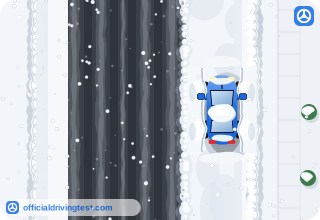
- Drink alcohol to stay warm
- Drink nothing until you are rescued
- Drink fluids, but not alcohol
- Drink only coffee or hot tea
Show answer
Correct answer: Drink fluids, but not alcohol
The manual says to drink fluids to avoid dehydration but not to drink alcohol.
Source: Vermont Driver's Manual (2025 edition (VN-007 07/2024)), page 47 · Open this page in the manual (Manual page 47)
-
At night, what should you turn on so work crews or rescuers can see you if you are stranded?
- The high beams
- The inside light
- The windshield wipers
- The radio
Show answer
Correct answer: The inside light
Turning on the inside light at night helps work crews and rescuers see you.
Source: Vermont Driver's Manual (2025 edition (VN-007 07/2024)), page 47 · Open this page in the manual (Manual page 47)
-
If stranded in a remote area, how can you attract the attention of rescue personnel searching by airplane?
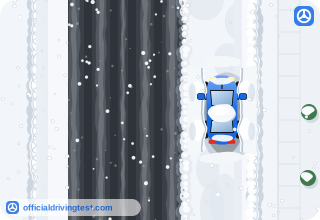
- Light a large fire in the open area next to the road
- Drive in large circles in an open field at night
- Keep the headlights on during the day
- Stomp HELP or SOS in an open area and line it with rocks
Show answer
Correct answer: Stomp HELP or SOS in an open area and line it with rocks
The manual says to stomp large block letters spelling HELP or SOS in an open area and line them with rocks or tree limbs.
Source: Vermont Driver's Manual (2025 edition (VN-007 07/2024)), page 47 · Open this page in the manual (Manual page 47)
-
According to the manual, what causes most skids?
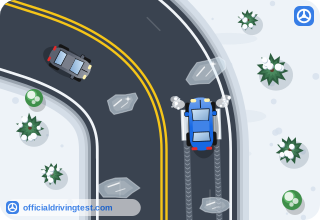
- The driver's failure to react in time to adjust speed to road conditions
- Brakes that are applied too gently on dry pavement
- Tires that are inflated more than the owner's manual allows
- Other drivers who cut in front of your vehicle at a short distance
Show answer
Correct answer: The driver's failure to react in time to adjust speed to road conditions
Most skids happen because the driver does not react in time to change the vehicle's speed to suit snow, ice, rain, gravel or wet leaves.
Source: Vermont Driver's Manual (2025 edition (VN-007 07/2024)), page 48 · Open this page in the manual (Manual page 48)
-
Which kind of vehicle may give you no warning that a skid is beginning?
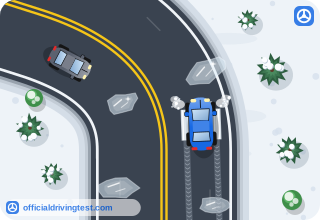
- A rear-wheel drive vehicle
- A vehicle with stability control
- A front-wheel drive vehicle
- A vehicle with anti-lock brakes
Show answer
Correct answer: A front-wheel drive vehicle
In a rear-wheel drive vehicle you can usually feel the start of a skid, but a front-wheel drive vehicle may give no such warning.
Source: Vermont Driver's Manual (2025 edition (VN-007 07/2024)), page 48 · Open this page in the manual (Manual page 48)
-
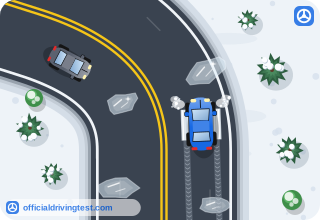
Front-wheel drive vehicles handle better in snow. What does the manual say about their traction?
- It is flawless, so a skid cannot occur
- It is not flawless, and skids can occur unexpectedly
- It is better than that of any other vehicle on ice
- It works only when the road surface is dry
Show answer
Correct answer: It is not flawless, and skids can occur unexpectedly
Front-wheel drive vehicles handle better in snow, but their traction is not flawless and skids can still happen without warning.
Source: Vermont Driver's Manual (2025 edition (VN-007 07/2024)), page 48 · Open this page in the manual (Manual page 48)
-
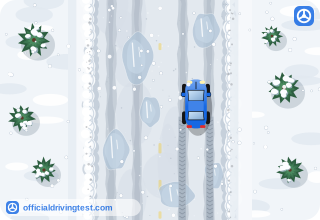
What should you do first to slow down on a slippery road?
- Press the brake pedal firmly
- Shift the vehicle into neutral
- Pump the brake pedal several times
- Take your foot off the gas pedal
Show answer
Correct answer: Take your foot off the gas pedal
Taking your foot off the gas pedal lowers your speed and helps keep the vehicle under control on a slippery road.
Source: Vermont Driver's Manual (2025 edition (VN-007 07/2024)), page 48 · Open this page in the manual (Manual page 48)
-
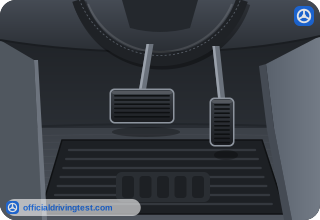
On a slippery road, you have taken your foot off the gas pedal and need to slow down more. How should you use the brakes?
- Press them quickly and release them quickly
- Gently squeeze them with slow, steady pressure
- Pump them rapidly until the vehicle stops
- Hold them down hard until the wheels lock
Show answer
Correct answer: Gently squeeze them with slow, steady pressure
If you need to slow down more, the manual says to gently squeeze the brakes with slow, steady pressure and let the wheels keep rolling.
Source: Vermont Driver's Manual (2025 edition (VN-007 07/2024)), page 48 · Open this page in the manual (Manual page 48)
-
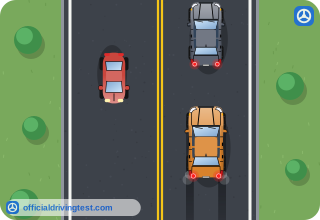
On a slippery road, what should you do if the wheels start to lock up while you are braking?
- Press the brake pedal harder
- Shift into a higher gear
- Ease off the brake pedal
- Turn the steering wheel sharply to the right
Show answer
Correct answer: Ease off the brake pedal
When the wheels begin to lock up, easing off the brake pedal lets them keep rolling.
Source: Vermont Driver's Manual (2025 edition (VN-007 07/2024)), page 48 · Open this page in the manual (Manual page 48)
-
As you slow down on a slippery road, what may also be helpful?
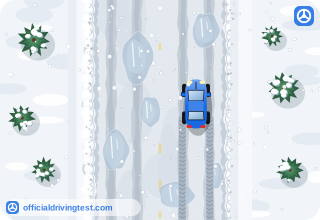
- Shifting into a lower gear
- Shifting into a higher gear
- Switching on the cruise control
- Shifting the vehicle into neutral
Show answer
Correct answer: Shifting into a lower gear
The manual says that shifting into a lower gear may also help as you slow down on a slippery road.
Source: Vermont Driver's Manual (2025 edition (VN-007 07/2024)), page 48 · Open this page in the manual (Manual page 48)
-
How should you brake in a vehicle that has anti-lock brakes on a slippery road?
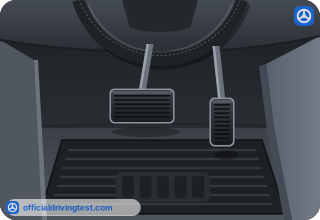
- Use steady brake pressure and do not pump the brakes
- Pump the brakes several times a second
- Release the brake pedal whenever it vibrates
- Alternate between the brake and the gas pedal
Show answer
Correct answer: Use steady brake pressure and do not pump the brakes
With anti-lock brakes you apply steady pressure; pumping the brakes is not the right method.
Source: Vermont Driver's Manual (2025 edition (VN-007 07/2024)), page 48 · Open this page in the manual (Manual page 48)
-
What is the best way to recover from a skid in both front-wheel and rear-wheel drive vehicles?
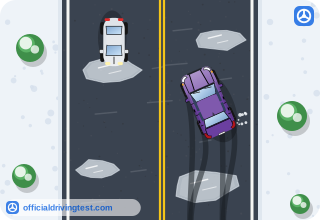
- Brake firmly and hold the pedal down
- Accelerate hard to regain traction
- Steer in the direction you want to go
- Take your hands off the steering wheel
Show answer
Correct answer: Steer in the direction you want to go
The best recovery is the same for front-wheel and rear-wheel drive vehicles: steer in the direction you want the vehicle to go.
Source: Vermont Driver's Manual (2025 edition (VN-007 07/2024)), page 48 · Open this page in the manual (Manual page 48)
-
What happens if you hit the brakes during a skid?
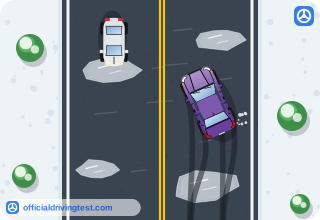
- It stops the skid sooner
- It will just make the skid worse
- It has no effect on the skid
- It helps only in a rear-wheel drive vehicle
Show answer
Correct answer: It will just make the skid worse
Hitting the brakes makes a skid worse, so you should steer instead.
Source: Vermont Driver's Manual (2025 edition (VN-007 07/2024)), page 48 · Open this page in the manual (Manual page 48)
-
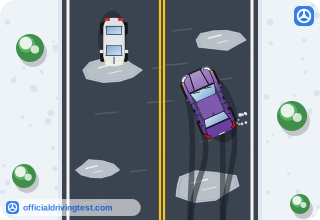
After a skid begins, what might you have to do to get your vehicle completely under control?
- Press the brake pedal repeatedly
- Shift into neutral and coast
- Switch off the engine
- Steer left and right a few times
Show answer
Correct answer: Steer left and right a few times
You may need to steer left and right a few times before the vehicle is fully under control.
Source: Vermont Driver's Manual (2025 edition (VN-007 07/2024)), page 48 · Open this page in the manual (Manual page 48)
-
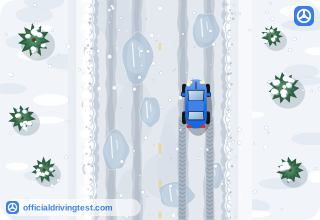
What does the manual say about stability control and similar vehicle improvements?
- They let you ignore road and weather conditions
- They make braking unnecessary on slippery roads
- They work only when the road is covered with ice
- They may help, but cannot replace driver caution
Show answer
Correct answer: They may help, but cannot replace driver caution
Stability control may help, but it is not a substitute for driver caution.
Source: Vermont Driver's Manual (2025 edition (VN-007 07/2024)), page 48 · Open this page in the manual (Manual page 48)
-
What does the manual say it is a good idea to do to learn how your vehicle handles on icy or snowy surfaces?
- Drive on an interstate at a low speed
- Practice on a busy street with an experienced driver
- Go to an empty parking lot
- Practice on a rural road during the first snowfall
Show answer
Correct answer: Go to an empty parking lot
An empty parking lot is a safe place to learn how your vehicle handles on ice or snow.
Source: Vermont Driver's Manual (2025 edition (VN-007 07/2024)), page 48 · Open this page in the manual (Manual page 48)
-
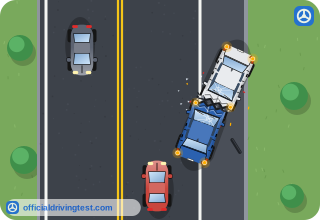
According to the manual, what causes most crashes?
- Poor decisions made by drivers
- Vehicle equipment failures
- Bad weather
- Poorly marked roads
Show answer
Correct answer: Poor decisions made by drivers
The manual says poor decisions made by drivers cause most crashes.
Source: Vermont Driver's Manual (2025 edition (VN-007 07/2024)), page 58 · Open this page in the manual (Manual page 58)
-
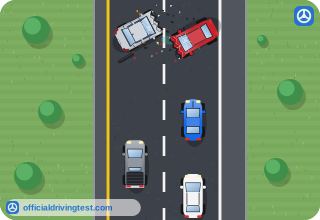
Which of these is an example of a poor decision that causes crashes?
- Checking your mirrors and blind spots
- Yielding the right-of-way
- Driving too close to the vehicle in front
- Driving only when well rested
Show answer
Correct answer: Driving too close to the vehicle in front
The manual lists driving too close to the vehicle in front among the poor decisions that cause crashes.
Source: Vermont Driver's Manual (2025 edition (VN-007 07/2024)), page 58 · Open this page in the manual (Manual page 58)