Tennessee: Speed and space — Part 5 Practice Test
Questions in this part include: “According to the winter driving tips, when should you always use headlights to help others see you?” · “In the manual's five tips, what does "Leave Yourself an Out" tell you to do?”
Independent educational site · not affiliated with any government agency or DMV
Ready? Test yourself
- Instant feedback with an explanation
- Every answer cites its source in the manual
- Your best score is saved on this device
- Keyboard: press 1 to 4 to answer and Enter for the next question
Questions are original and based on the official manual "Tennessee Comprehensive Driver License Manual" (March 2025 printing), Tennessee Department of Safety and Homeland Security.
All 20 questions in this practice test
Take the test above first, then use this list to study. Tap “Show answer” to see the correct answer and explanation.
Show the questions and answersHide the questions
-
According to the winter driving tips, when should you always use headlights to help others see you?
- Only when snow is actually falling
- Only when driving on the interstate
- Only between sunset and sunrise
- When weather restricts your visibility
Show answer
Correct answer: When weather restricts your visibility
Headlights help others see you whenever atmospheric or other weather conditions restrict visibility.
Source: Tennessee Comprehensive Driver License Manual (March 2025 printing), page 78 · Open this page in the manual (Manual page 78)
-
When is a good outside rearview mirror especially helpful in winter?
- When the back window glass tends to fog over
- When the road ahead is completely dry
- When you are parking in a dark garage
- When you are driving on the interstate
Show answer
Correct answer: When the back window glass tends to fog over
A good outside mirror helps when the back window fogs over.
Source: Tennessee Comprehensive Driver License Manual (March 2025 printing), page 78 · Open this page in the manual (Manual page 78)
-
On ice or snow, how should you start your car?
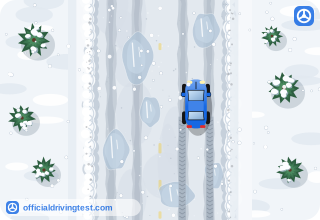
- Quickly, to build momentum
- With the wheels turned sharply
- Slowly, avoiding wheel spin
- In the highest gear available
Show answer
Correct answer: Slowly, avoiding wheel spin
Overpowering and spinning the wheels reduces traction, so you start slowly.
Source: Tennessee Comprehensive Driver License Manual (March 2025 printing), page 78 · Open this page in the manual (Manual page 78)
-
How should you keep your speed on ice or snow?
- As fast as the traffic around you
- As slow as the car will go
- Changing often to match traffic
- Steady and slow, but not too slow
Show answer
Correct answer: Steady and slow, but not too slow
The manual says to keep your speed steady and slow, but not too slow.
Source: Tennessee Comprehensive Driver License Manual (March 2025 printing), page 78 · Open this page in the manual (Manual page 78)
-
In deeper snow, what is it often necessary to do?
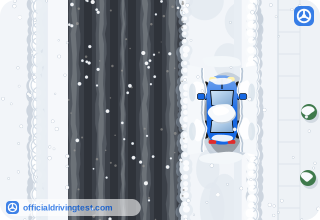
- Use the car's momentum to keep moving
- Stop frequently to rest the engine
- Keep the front wheels turned sharply
- Drive in the highest gear
Show answer
Correct answer: Use the car's momentum to keep moving
In deeper snow, momentum helps keep the car moving.
Source: Tennessee Comprehensive Driver License Manual (March 2025 printing), page 78 · Open this page in the manual (Manual page 78)
-
Which helps improve steering ability on ice and snow?
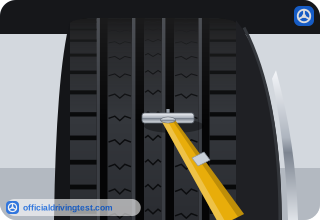
- Slightly underinflated front tires
- Worn tread on the front wheels
- Good treads on the front wheels
- Wider headlight beams at night
Show answer
Correct answer: Good treads on the front wheels
The manual recommends good treads on the front wheels to improve steering, and says snow tires are helpful.
Source: Tennessee Comprehensive Driver License Manual (March 2025 printing), page 78 · Open this page in the manual (Manual page 78)
-
At 20 M.P.H., low traction can increase stopping distance to about how much?
- About 50 feet
- 200 feet or more
- About 100 feet
- About 20 feet
Show answer
Correct answer: 200 feet or more
Low traction makes stopping difficult; at 20 miles per hour the stopping distance can reach 200 feet or more.
Source: Tennessee Comprehensive Driver License Manual (March 2025 printing), page 78 · Open this page in the manual (Manual page 78)
-
What can continuous hard braking on snow and ice cause?
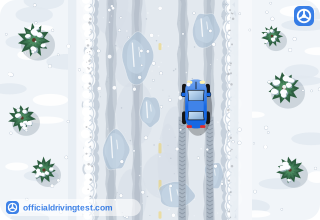
- Locked front brakes and a loss of steering
- Locked rear brakes and a faster stop
- A better grip on the road
- Warmer brakes that melt the ice
Show answer
Correct answer: Locked front brakes and a loss of steering
Continuous hard braking can lock the front brakes so you lose steering, so keep a safe speed to avoid excessive braking.
Source: Tennessee Comprehensive Driver License Manual (March 2025 printing), page 78 · Open this page in the manual (Manual page 78)
-
Why can a car that has already crossed an icy part of the road and stopped be a danger to you?
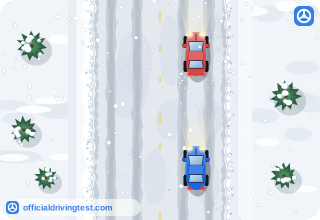
- Its tires may throw ice onto your windshield
- Its driver may be unable to see in the mirror
- Ice behind it can make you skid into its rear
- Its exhaust may make the road wet
Show answer
Correct answer: Ice behind it can make you skid into its rear
A long patch of ice behind the stopped car can make you skid into it.
Source: Tennessee Comprehensive Driver License Manual (March 2025 printing), page 78 · Open this page in the manual (Manual page 78)
-
On packed snow and ice in stop-and-go traffic, what may help you avoid the slickest surface?
- Following exactly in the tracks of the car ahead
- Steering to one side or the other of the packed section
- Driving in the middle of the packed section
- Braking hard before entering the packed section
Show answer
Correct answer: Steering to one side or the other of the packed section
Packed snow becomes extremely slippery from many sliding wheels, and steering to one side of it helps avoid the slickest part.
Source: Tennessee Comprehensive Driver License Manual (March 2025 printing), page 78 · Open this page in the manual (Manual page 78)
-
In the manual's five tips, what does "Leave Yourself an Out" tell you to do?
- Keep a vehicle close behind you at all times for protection
- Keep space in front and on at least one side to escape conflict
- Stay in the left lane so you can leave the road quickly
- Drive close to the vehicle ahead so you can follow its path
Show answer
Correct answer: Keep space in front and on at least one side to escape conflict
Leaving yourself an out means keeping open space ahead and to at least one side so you can escape a conflict.
Source: Tennessee Comprehensive Driver License Manual (March 2025 printing), page 92 · Open this page in the manual (Manual page 92)
-
What does the manual say "defensive driving" means?
- Driving well below the speed limit on every road at all times and staying in the left lane
- Being aware of conditions, planning ahead and anticipating dangers to avoid contact
- Reacting to a hazard only after another vehicle has come close to your vehicle
- Avoiding every road that has heavy traffic, pedestrians or bicyclists
Show answer
Correct answer: Being aware of conditions, planning ahead and anticipating dangers to avoid contact
Defensive driving is constant awareness, planning ahead and anticipating dangers so you take the right action and do not touch any obstacle or vehicle.
Source: Tennessee Comprehensive Driver License Manual (March 2025 printing), page 93 · Open this page in the manual (Manual page 93)
-
Which following-distance rule does the manual say to always use?
- The one-second rule
- The six-second rule
- The eight-second rule
- The two-second rule
Show answer
Correct answer: The two-second rule
The manual tells drivers to always use the two-second rule and to test their following distance with a count.
Source: Tennessee Comprehensive Driver License Manual (March 2025 printing), page 93 · Open this page in the manual (Manual page 93)
-
You test your following distance by picking a stationary object ahead and counting "1,001, 1,002." What does it mean if you reach that point before you finish the count?
- You are following too closely and should slow down
- You are following at a safe distance and can keep your speed
- You should speed up to match the vehicle ahead
- You should move into the left lane at once
Show answer
Correct answer: You are following too closely and should slow down
Reaching the object before the count ends means you are too close, so you should slow down to lengthen the gap.
Source: Tennessee Comprehensive Driver License Manual (March 2025 printing), page 93 · Open this page in the manual (Manual page 93)
-
In general, how far ahead do defensive drivers try to focus their eyes?
- 3 to 5 seconds
- 10 to 15 seconds
- 30 to 40 seconds
- 1 to 2 seconds
Show answer
Correct answer: 10 to 15 seconds
Defensive drivers look about 10 to 15 seconds ahead, roughly one city block, to see things early.
Source: Tennessee Comprehensive Driver License Manual (March 2025 printing), page 93 · Open this page in the manual (Manual page 93)
-
According to the manual, what causes rear-end crashes?
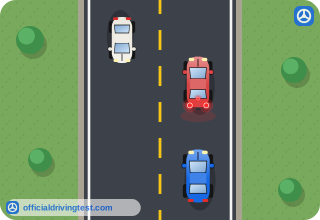
- Following too closely to stop before hitting the vehicle ahead
- Signaling too early before you slow down on the road
- Keeping a steady speed on a road with little traffic
- Leaving a large space between you and the vehicle ahead
Show answer
Correct answer: Following too closely to stop before hitting the vehicle ahead
Rear-end crashes happen when drivers tailgate and cannot stop in time when the vehicle ahead slows or stops.
Source: Tennessee Comprehensive Driver License Manual (March 2025 printing), page 94 · Open this page in the manual (Manual page 94)
-
What does the manual call the best way to keep a safety cushion ahead of your vehicle?
- Following the basic 1-Second Rule
- Following the basic 6-Second Rule
- Following the basic 2-Second Rule
- Following the vehicle ahead by one car length
Show answer
Correct answer: Following the basic 2-Second Rule
The manual says the best way to keep space ahead is the basic 2-Second Rule.
Source: Tennessee Comprehensive Driver License Manual (March 2025 printing), page 94 · Open this page in the manual (Manual page 94)
-
You are being tailgated and the road has a right lane. What does the manual say to do?
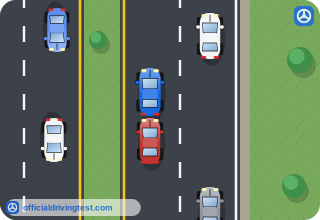
- Slow down quickly to discourage the tailgater
- Speed up to stay ahead of the tailgater
- Move into the left lane and stop
- Move over to the right
Show answer
Correct answer: Move over to the right
If there is a right lane, moving over lets the tailgater go by.
Source: Tennessee Comprehensive Driver License Manual (March 2025 printing), page 94 · Open this page in the manual (Manual page 94)
-
You are being tailgated and there is no right lane. What does the manual say to do?
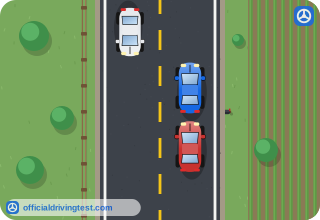
- When the road is clear and passing is legal, slowly reduce speed
- Brake hard right away so the tailgater has to drop back
- Speed up to a higher speed until the tailgater gives up
- Drive onto the shoulder and stop until the tailgater passes
Show answer
Correct answer: When the road is clear and passing is legal, slowly reduce speed
Slowly reducing speed when the road is clear and passing is legal encourages the tailgater to drive around you.
Source: Tennessee Comprehensive Driver License Manual (March 2025 printing), page 94 · Open this page in the manual (Manual page 94)
-
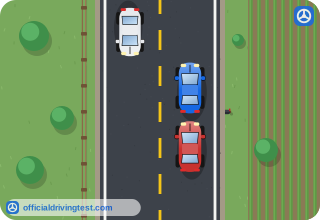
Why does the manual say you should never slow down quickly to discourage a tailgater?
- It is against the law in every situation
- It damages the brakes of both vehicles
- It only increases your risk of being hit from behind
- It causes the tailgater to pass on the right
Show answer
Correct answer: It only increases your risk of being hit from behind
Braking suddenly in front of a tailgater only raises your chance of being hit from behind.
Source: Tennessee Comprehensive Driver License Manual (March 2025 printing), page 94 · Open this page in the manual (Manual page 94)