Tennessee: Speed and space — Part 2 Practice Test
Questions in this part include: “What does "covering the brake" mean?” · “What is the average reaction time given in the manual?”
Independent educational site · not affiliated with any government agency or DMV
Ready? Test yourself
- Instant feedback with an explanation
- Every answer cites its source in the manual
- Your best score is saved on this device
- Keyboard: press 1 to 4 to answer and Enter for the next question
Questions are original and based on the official manual "Tennessee Comprehensive Driver License Manual" (March 2025 printing), Tennessee Department of Safety and Homeland Security.
All 20 questions in this practice test
Take the test above first, then use this list to study. Tap “Show answer” to see the correct answer and explanation.
Show the questions and answersHide the questions
-
What does "covering the brake" mean?
- Hovering your foot over the brake or between the brake and gas pedals
- Resting your foot lightly on the brake pedal while driving
- Pressing the brake and gas pedals at the same time
- Applying the parking brake before a stop
Show answer
Correct answer: Hovering your foot over the brake or between the brake and gas pedals
Covering the brake means your foot hovers over the brake, or between the brake and gas pedals, to respond more quickly.
Source: Tennessee Comprehensive Driver License Manual (March 2025 printing), page 48 · Open this page in the manual (Manual page 48)
-
Why is "riding the brake" not a safe practice?
- It makes the engine overheat and stall during turns
- It locks the steering wheel when going uphill
- It wears the brakes and falsely suggests you are stopping
- It makes the brake lights go dark for others
Show answer
Correct answer: It wears the brakes and falsely suggests you are stopping
Keeping your foot resting or slightly pressed on the brake wears the brake system and can mislead other drivers.
Source: Tennessee Comprehensive Driver License Manual (March 2025 printing), page 48 · Open this page in the manual (Manual page 48)
-
According to Tennessee law, how closely may the driver of a motor vehicle follow another vehicle?
- No closer than 100 feet at any speed on any highway
- No more closely than is reasonable and prudent
- No closer than one car length for every 10 m.p.h. of speed
- No closer than two car lengths on any road at any speed
Show answer
Correct answer: No more closely than is reasonable and prudent
The law quoted in the manual bars following more closely than is reasonable and prudent, considering speed, traffic and road condition.
Source: Tennessee Comprehensive Driver License Manual (March 2025 printing), page 48 · Open this page in the manual (Manual page 48)
-
Why do many drivers who follow too closely (tailgate) not see as well as they should?
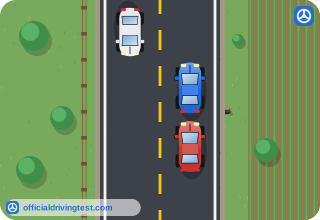
- Their headlights shine into the mirror of the car ahead
- Their windshield fogs over from the other car's exhaust
- The road surface hides the lane lines from them
- The vehicle ahead blocks their view of traffic and road conditions
Show answer
Correct answer: The vehicle ahead blocks their view of traffic and road conditions
Tailgaters have their view of traffic and road conditions blocked by the vehicle ahead, and most rear-end crashes are caused by tailgating.
Source: Tennessee Comprehensive Driver License Manual (March 2025 printing), page 48 · Open this page in the manual (Manual page 48)
-
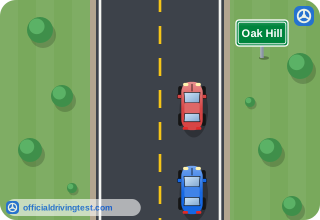
In the two-second rule, what should you NOT do before you finish counting to at least "one-thousand-two"?
- Pass the car that is ahead of you
- Apply your brakes for the stop sign
- Change to another lane of traffic
- Reach the same spot the car ahead passed
Show answer
Correct answer: Reach the same spot the car ahead passed
If you reach the same stationary point before counting to at least one-thousand-two, you are following too closely.
Source: Tennessee Comprehensive Driver License Manual (March 2025 printing), page 49 · Open this page in the manual (Manual page 49)
-
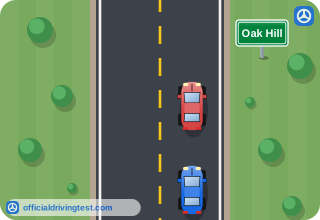
If you find that you are following too closely using the two-second rule, what should you do?
- Speed up to pass the vehicle ahead
- Slow down slightly, then check again
- Flash your brake lights at the vehicle ahead
- Move onto the shoulder and stop
Show answer
Correct answer: Slow down slightly, then check again
Slow down slightly to widen the space, pick another spot and repeat the check until you are following no closer than two seconds.
Source: Tennessee Comprehensive Driver License Manual (March 2025 printing), page 49 · Open this page in the manual (Manual page 49)
-
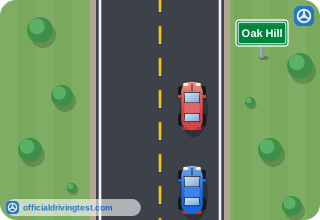
In the two-second rule, what do you count after the car ahead passes a stationary point such as a sign post or utility pole?
- The number of cars between you and the spot
- The seconds it takes the car ahead to stop
- The seconds it takes you to reach the same spot
- The number of lanes at the spot
Show answer
Correct answer: The seconds it takes you to reach the same spot
You count the seconds from when the car ahead passes a fixed point until you reach it.
Source: Tennessee Comprehensive Driver License Manual (March 2025 printing), page 48 · Open this page in the manual (Manual page 48)
-
Which of these is one of the three steps in stopping a vehicle?
- Perception time
- Signal time
- Steering time
- Parking time
Show answer
Correct answer: Perception time
The three steps in stopping are perception time, reaction time and braking time.
Source: Tennessee Comprehensive Driver License Manual (March 2025 printing), page 49 · Open this page in the manual (Manual page 49)
-
What is "reaction time" in stopping a vehicle?
- The time it takes to see and recognize a danger
- The time it takes the car to stop once you brake
- Time from perception of danger to the start of braking
- The time you need to turn on your hazard lights
Show answer
Correct answer: Time from perception of danger to the start of braking
Reaction time runs from when you perceive the danger until you start braking; the average is two-thirds of a second.
Source: Tennessee Comprehensive Driver License Manual (March 2025 printing), page 49 · Open this page in the manual (Manual page 49)
-
What is the average reaction time given in the manual?
- 2/3 of a second
- 1/2 of a second
- 1 second
- 1 1/2 seconds
Show answer
Correct answer: 2/3 of a second
The manual gives the average reaction time as two-thirds of a second.
Source: Tennessee Comprehensive Driver License Manual (March 2025 printing), page 49 · Open this page in the manual (Manual page 49)
-
What does braking time depend on?
- Only the weight and height of the driver in the seat
- The color and texture of the road surface paint
- Only the speed limit posted on the road ahead
- The type and condition of the brakes, and vehicle speed
Show answer
Correct answer: The type and condition of the brakes, and vehicle speed
Braking time depends on the type and condition of the brakes and on the vehicle's speed.
Source: Tennessee Comprehensive Driver License Manual (March 2025 printing), page 49 · Open this page in the manual (Manual page 49)
-
Which of these can affect how far it takes you to stop?
- The age of the driver's license
- The vehicle's weight when loaded or towing
- The number of lanes at the next intersection
- The brand of the vehicle's radio
Show answer
Correct answer: The vehicle's weight when loaded or towing
Stopping distance varies with road and pavement, tires and brakes, shock absorbers, and vehicle weight when loaded or towing.
Source: Tennessee Comprehensive Driver License Manual (March 2025 printing), page 49 · Open this page in the manual (Manual page 49)
-
In the manual's example of driving at 70 m.p.h., how far will you have traveled before you even start to brake when a deer appears?
- 100 feet
- 128 feet
- 290 feet
- 418 feet
Show answer
Correct answer: 128 feet
Seeing the deer and moving your foot to the brake takes 1.16 seconds, during which you travel 128 feet.
Source: Tennessee Comprehensive Driver License Manual (March 2025 printing), page 49 · Open this page in the manual (Manual page 49)
-
In the manual's example, what is the braking distance at 70 m.p.h. on a good road in good weather?
- 128 feet
- 215 feet
- 367 feet
- 290 feet
Show answer
Correct answer: 290 feet
At 70 m.p.h. on a good road in good weather, the braking distance is 290 feet.
Source: Tennessee Comprehensive Driver License Manual (March 2025 printing), page 49 · Open this page in the manual (Manual page 49)
-
In the manual's 70 m.p.h. example, what is your total stopping distance?
- 418 feet
- 290 feet
- 128 feet
- 200 feet
Show answer
Correct answer: 418 feet
Adding the distance before braking and the braking distance gives a total of 418 feet, nearly 150 yards.
Source: Tennessee Comprehensive Driver License Manual (March 2025 printing), page 49 · Open this page in the manual (Manual page 49)
-
When stopped behind another vehicle at an intersection, how much "gap" space does the manual's rule of thumb suggest?
- One full car length behind it at all times
- Enough to see the other vehicle's rear window
- Enough to see its license plate and/or back tire
- Only a few inches between the two bumpers
Show answer
Correct answer: Enough to see its license plate and/or back tire
The gap gives a safety zone if the other vehicle rolls back or stalls, and a way out in an emergency.
Source: Tennessee Comprehensive Driver License Manual (March 2025 printing), page 50 · Open this page in the manual (Manual page 50)
-
What does the manual say about weaving from lane to lane by passing on the left, moving back right and passing again?
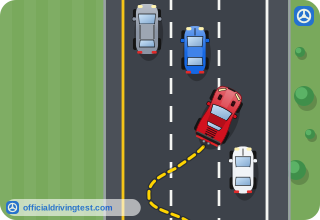
- It is allowed only on roads with three or more lanes
- It is safe when you check your mirrors each time
- It is extremely dangerous
- It is a safe way to move faster than traffic
Show answer
Correct answer: It is extremely dangerous
Weaving between lanes to move faster than the flow of traffic is extremely dangerous.
Source: Tennessee Comprehensive Driver License Manual (March 2025 printing), page 63 · Open this page in the manual (Manual page 63)
-
Another driver begins to pass you. What does the manual say about your speed?
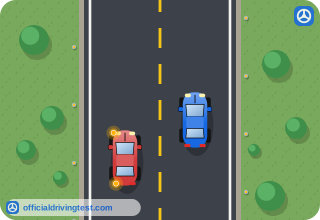
- Speed up to keep the other driver from passing
- Maintain your speed; do not speed up
- Slow down at once to half your speed
- Brake firmly as soon as the car is beside you
Show answer
Correct answer: Maintain your speed; do not speed up
You should keep your speed steady and never speed up to stop the other driver from passing.
Source: Tennessee Comprehensive Driver License Manual (March 2025 printing), page 63 · Open this page in the manual (Manual page 63)
-
All you can see of the truck or bus ahead of you are its back doors. What does that tell you about your following distance?
- You are following at the ideal distance
- You are following too closely
- You are too far back to be seen
- You are allowed to follow this closely
Show answer
Correct answer: You are following too closely
Seeing only the back doors means you are following too closely and greatly increase your chance of a rear-end collision.
Source: Tennessee Comprehensive Driver License Manual (March 2025 printing), page 64 · Open this page in the manual (Manual page 64)
-
While passing another vehicle, what does the manual say about the posted speed limit?
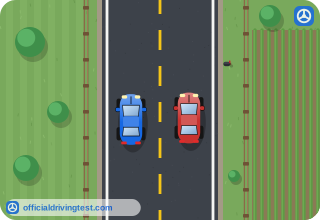
- It is illegal to exceed it even when passing
- You may exceed it briefly to complete a pass
- You may exceed it by 5 mph when passing
- You may exceed it only when passing trucks
Show answer
Correct answer: It is illegal to exceed it even when passing
The posted limit still applies while you pass; exceeding it is illegal even when passing other vehicles.
Source: Tennessee Comprehensive Driver License Manual (March 2025 printing), page 64 · Open this page in the manual (Manual page 64)