Tennessee: Speed and space
Tennessee speed laws, school zones, stopping distance, the two-second rule, scanning ahead and driving at night and in bad weather. Split into 6 shorter tests so you're not stuck in one long quiz.
Independent educational site · not affiliated with any government agency or DMV
Choose a part
Speed and space — Part 1
Questions in this part include: “Which of these can a speed control sign show?”
StartSpeed and space — Part 2
Questions in this part include: “What does "covering the brake" mean?”
StartSpeed and space — Part 3
Questions in this part include: “On the interstate, at least how far behind the vehicle in front of you should you stay?”
StartSpeed and space — Part 4
Questions in this part include: “Which parts of the road tend to freeze before the rest of the road?”
StartSpeed and space — Part 5
Questions in this part include: “According to the winter driving tips, when should you always use headlights to help others see you?”
StartSpeed and space — Part 6
Questions in this part include: “What does the manual say about passing and the speed limit?”
StartAll 119 Speed and space questions with answers
Choose a part above to take a practice test, or study every question and answer here.
Show the questions and answersHide the questions
-
Which of these can a speed control sign show?
- The number of lanes ahead
- Where passing is allowed
- The distance to the next exit
- The minimum speed required
Show answer
Correct answer: The minimum speed required
Speed control signs show the maximum speed allowed, the minimum speed required or a change in the speed limit.
Source: Tennessee Comprehensive Driver License Manual (March 2025 printing), page 37 · Open this page in the manual (Manual page 37)
-
Where is a school speed limit sign with flashing yellow lights used?
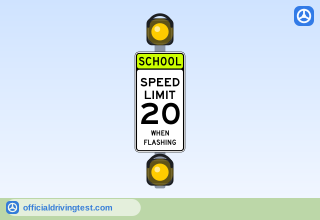
- Where children are in walking distance of school
- Only right in front of a school entrance
- Only on roads that have a school bus stop
- Wherever a crossing guard is on duty
Show answer
Correct answer: Where children are in walking distance of school
This school speed sign is used whenever children are within walking distance of a school, since they may be crossing on their way to or from school.
Source: Tennessee Comprehensive Driver License Manual (March 2025 printing), page 37 · Open this page in the manual (Manual page 37)
-
What controls a school speed limit sign that flashes yellow lights?
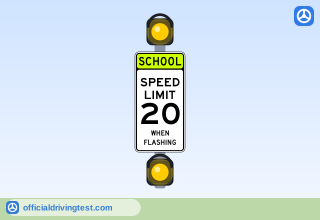
- A crossing guard
- A motion sensor
- A time clock
- The school bus driver
Show answer
Correct answer: A time clock
This school zone sign runs on a time clock, flashing yellow lights while it lights up the speed limit.
Source: Tennessee Comprehensive Driver License Manual (March 2025 printing), page 37 · Open this page in the manual (Manual page 37)
-
Under normal driving conditions, what is against the law when a minimum speed limit is posted?
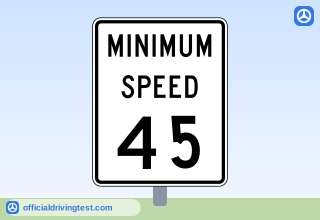
- Driving at exactly the posted minimum speed
- Driving slower than the posted minimum speed
- Driving faster than the posted minimum speed
- Changing lanes at the posted minimum speed
Show answer
Correct answer: Driving slower than the posted minimum speed
It is against the law to drive slower than the posted minimum speed under normal driving conditions, though bad weather, heavy traffic or a bad road are exceptions.
Source: Tennessee Comprehensive Driver License Manual (March 2025 printing), page 46 · Open this page in the manual (Manual page 46)
-
When may you drive more slowly than the posted minimum speed?
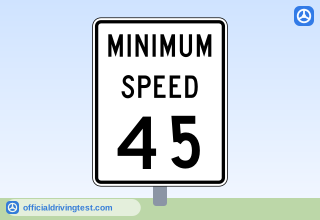
- Whenever you are in the right lane
- Whenever you are driving at night
- Whenever you are driving a larger vehicle
- In bad weather, heavy traffic or on a bad road
Show answer
Correct answer: In bad weather, heavy traffic or on a bad road
The manual allows driving below the minimum speed in bad weather, heavy traffic or on a bad road.
Source: Tennessee Comprehensive Driver License Manual (March 2025 printing), page 46 · Open this page in the manual (Manual page 46)
-
If there is no posted minimum speed, what is still against the law?
- Driving below 55 m.p.h. on any road
- Driving below 45 m.p.h. on a two-lane road
- Driving below the speed of the car ahead
- Driving so slowly that you block traffic
Show answer
Correct answer: Driving so slowly that you block traffic
Even with no posted minimum, it is against the law to drive so slowly that you block traffic.
Source: Tennessee Comprehensive Driver License Manual (March 2025 printing), page 46 · Open this page in the manual (Manual page 46)
-
You are considered to be driving a slow-moving vehicle if you travel at a speed that is at least how far below the lawful maximum speed?
- 5 miles per hour
- 10 miles per hour
- 15 miles per hour
- 20 miles per hour
Show answer
Correct answer: 10 miles per hour
A rate of speed 10 miles per hour or more below the lawful maximum makes you a slow-moving vehicle.
Source: Tennessee Comprehensive Driver License Manual (March 2025 printing), page 46 · Open this page in the manual (Manual page 46)
-
How many vehicles lined up behind you means you should turn or pull off the roadway as soon as you can do so safely?
- Two or more
- Three or more
- Five or more
- Eight or more
Show answer
Correct answer: Five or more
If five or more vehicles are lined up behind you, turn or pull off the roadway as soon as it is safe.
Source: Tennessee Comprehensive Driver License Manual (March 2025 printing), page 46 · Open this page in the manual (Manual page 46)
-
What does the manual say about the Basic Speed Rule (BSR)?
- A general safety principle that limits speed to conditions
- A Tennessee law that sets one exact speed limit for every road
- A Tennessee law that applies only on interstate highways
- A safety rule that applies only when driving at night
Show answer
Correct answer: A general safety principle that limits speed to conditions
The BSR does not set an exact speed; it teaches that the speed you may drive is limited by current conditions, though it is a general safety principle rather than a Tennessee law.
Source: Tennessee Comprehensive Driver License Manual (March 2025 printing), page 46 · Open this page in the manual (Manual page 46)
-
According to the Basic Speed Rule, a posted limit of 65 m.p.h. is too fast in which situation?
- Driving on a dry, straight highway at noon
- Driving on an empty interstate in clear weather
- Driving behind a vehicle that is also going 65 m.p.h.
- Driving at night on a two-lane state highway in rain or fog
Show answer
Correct answer: Driving at night on a two-lane state highway in rain or fog
The manual's example is a two-lane state highway at night in rain or fog, where 65 m.p.h. is too fast for the conditions.
Source: Tennessee Comprehensive Driver License Manual (March 2025 printing), page 46 · Open this page in the manual (Manual page 46)
-
Under the Basic Speed Rule, how must your speed be adjusted to conditions?
- So you always match the fastest car nearby
- So you can stop within a clear distance ahead
- So you stay exactly at the posted limit
- So you travel below 45 m.p.h.
Show answer
Correct answer: So you can stop within a clear distance ahead
The rule says speed must be adjusted so you can stop within a clear distance ahead.
Source: Tennessee Comprehensive Driver License Manual (March 2025 printing), page 46 · Open this page in the manual (Manual page 46)
-
Unless otherwise posted, what is the speed limit on primary and secondary state and federal highways in Tennessee?
- 45 m.p.h.
- 55 m.p.h.
- 65 m.p.h.
- 70 m.p.h.
Show answer
Correct answer: 55 m.p.h.
Unless a different speed is posted, the limit on primary and secondary state and federal highways is 55 m.p.h.
Source: Tennessee Comprehensive Driver License Manual (March 2025 printing), page 47 · Open this page in the manual (Manual page 47)
-
What is the maximum speed set by Tennessee law for interstate highways?
- 65 m.p.h.
- 75 m.p.h.
- 55 m.p.h.
- 70 m.p.h.
Show answer
Correct answer: 70 m.p.h.
The maximum for interstate highways is 70 m.p.h., though not every section allows it.
Source: Tennessee Comprehensive Driver License Manual (March 2025 printing), page 47 · Open this page in the manual (Manual page 47)
-
How low may the limit be set on some interstate sections in larger, congested urban areas?
- 55 m.p.h.
- 35 m.p.h.
- 45 m.p.h.
- 60 m.p.h.
Show answer
Correct answer: 55 m.p.h.
Variable limits mean an interstate limit can be as low as 55 m.p.h. in larger urban areas with more traffic congestion.
Source: Tennessee Comprehensive Driver License Manual (March 2025 printing), page 47 · Open this page in the manual (Manual page 47)
-
When should the maximum interstate speed limit be driven?
- Whenever the road is dry
- At all times unless it is night
- Only in ideal driving conditions
- Whenever other traffic is slower
Show answer
Correct answer: Only in ideal driving conditions
The maximum limit should be driven only in ideal conditions, and you must adjust your speed to the conditions.
Source: Tennessee Comprehensive Driver License Manual (March 2025 printing), page 47 · Open this page in the manual (Manual page 47)
-
Which of these has the authority to set speed limits for the roadways under its control?
- Only the state
- The state, counties and municipalities
- Only the federal government
- Only the local police departments
Show answer
Correct answer: The state, counties and municipalities
The state, counties and municipalities each set limits on the roadways they control, so limits can change.
Source: Tennessee Comprehensive Driver License Manual (March 2025 printing), page 47 · Open this page in the manual (Manual page 47)
-
By law, how is exceeding the school zone speed limit considered?
- Careless driving only
- A parking violation
- A warning-only offense
- Reckless driving
Show answer
Correct answer: Reckless driving
The manual says exceeding the school zone speed limit is by law considered to be reckless driving.
Source: Tennessee Comprehensive Driver License Manual (March 2025 printing), page 47 · Open this page in the manual (Manual page 47)
-
When are school zone speed limits regulated?
- Only on school days between 6 a.m. and 6 p.m. each day
- When children are going to or from school or at recess
- Only when a school bus is stopped nearby
- Only on weekends and holidays
Show answer
Correct answer: When children are going to or from school or at recess
School zone limits apply when children are going to or from the school or during a recess hour.
Source: Tennessee Comprehensive Driver License Manual (March 2025 printing), page 47 · Open this page in the manual (Manual page 47)
-
In everyday braking, such as for speed zone changes or merging traffic, how should you apply the brakes?
- Quickly and firmly
- In short, hard taps
- At the last moment
- Slowly and evenly
Show answer
Correct answer: Slowly and evenly
Gradual pressure applied slowly and evenly avoids skidding, and starting early warns the cars behind you.
Source: Tennessee Comprehensive Driver License Manual (March 2025 printing), page 48 · Open this page in the manual (Manual page 48)
-
Why can braking too strongly or quickly be dangerous?
- It always damages the brake lights
- You could skid and lose control of your vehicle
- It automatically locks the steering wheel
- It cancels your turn signal
Show answer
Correct answer: You could skid and lose control of your vehicle
If you brake too strong or quickly, you could skid and lose control.
Source: Tennessee Comprehensive Driver License Manual (March 2025 printing), page 48 · Open this page in the manual (Manual page 48)
-
What does "covering the brake" mean?
- Hovering your foot over the brake or between the brake and gas pedals
- Resting your foot lightly on the brake pedal while driving
- Pressing the brake and gas pedals at the same time
- Applying the parking brake before a stop
Show answer
Correct answer: Hovering your foot over the brake or between the brake and gas pedals
Covering the brake means your foot hovers over the brake, or between the brake and gas pedals, to respond more quickly.
Source: Tennessee Comprehensive Driver License Manual (March 2025 printing), page 48 · Open this page in the manual (Manual page 48)
-
Why is "riding the brake" not a safe practice?
- It makes the engine overheat and stall during turns
- It locks the steering wheel when going uphill
- It wears the brakes and falsely suggests you are stopping
- It makes the brake lights go dark for others
Show answer
Correct answer: It wears the brakes and falsely suggests you are stopping
Keeping your foot resting or slightly pressed on the brake wears the brake system and can mislead other drivers.
Source: Tennessee Comprehensive Driver License Manual (March 2025 printing), page 48 · Open this page in the manual (Manual page 48)
-
According to Tennessee law, how closely may the driver of a motor vehicle follow another vehicle?
- No closer than 100 feet at any speed on any highway
- No more closely than is reasonable and prudent
- No closer than one car length for every 10 m.p.h. of speed
- No closer than two car lengths on any road at any speed
Show answer
Correct answer: No more closely than is reasonable and prudent
The law quoted in the manual bars following more closely than is reasonable and prudent, considering speed, traffic and road condition.
Source: Tennessee Comprehensive Driver License Manual (March 2025 printing), page 48 · Open this page in the manual (Manual page 48)
-
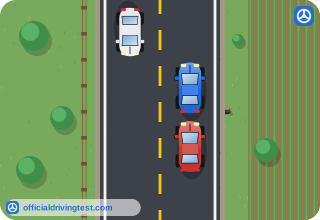
Why do many drivers who follow too closely (tailgate) not see as well as they should?
- Their headlights shine into the mirror of the car ahead
- Their windshield fogs over from the other car's exhaust
- The road surface hides the lane lines from them
- The vehicle ahead blocks their view of traffic and road conditions
Show answer
Correct answer: The vehicle ahead blocks their view of traffic and road conditions
Tailgaters have their view of traffic and road conditions blocked by the vehicle ahead, and most rear-end crashes are caused by tailgating.
Source: Tennessee Comprehensive Driver License Manual (March 2025 printing), page 48 · Open this page in the manual (Manual page 48)
-
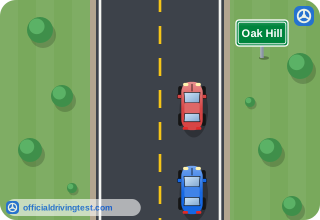
In the two-second rule, what should you NOT do before you finish counting to at least "one-thousand-two"?
- Pass the car that is ahead of you
- Apply your brakes for the stop sign
- Change to another lane of traffic
- Reach the same spot the car ahead passed
Show answer
Correct answer: Reach the same spot the car ahead passed
If you reach the same stationary point before counting to at least one-thousand-two, you are following too closely.
Source: Tennessee Comprehensive Driver License Manual (March 2025 printing), page 49 · Open this page in the manual (Manual page 49)
-
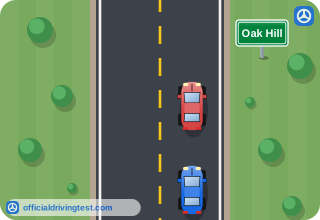
If you find that you are following too closely using the two-second rule, what should you do?
- Speed up to pass the vehicle ahead
- Slow down slightly, then check again
- Flash your brake lights at the vehicle ahead
- Move onto the shoulder and stop
Show answer
Correct answer: Slow down slightly, then check again
Slow down slightly to widen the space, pick another spot and repeat the check until you are following no closer than two seconds.
Source: Tennessee Comprehensive Driver License Manual (March 2025 printing), page 49 · Open this page in the manual (Manual page 49)
-
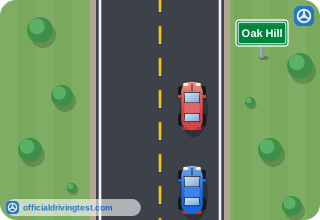
In the two-second rule, what do you count after the car ahead passes a stationary point such as a sign post or utility pole?
- The number of cars between you and the spot
- The seconds it takes the car ahead to stop
- The seconds it takes you to reach the same spot
- The number of lanes at the spot
Show answer
Correct answer: The seconds it takes you to reach the same spot
You count the seconds from when the car ahead passes a fixed point until you reach it.
Source: Tennessee Comprehensive Driver License Manual (March 2025 printing), page 48 · Open this page in the manual (Manual page 48)
-
Which of these is one of the three steps in stopping a vehicle?
- Perception time
- Signal time
- Steering time
- Parking time
Show answer
Correct answer: Perception time
The three steps in stopping are perception time, reaction time and braking time.
Source: Tennessee Comprehensive Driver License Manual (March 2025 printing), page 49 · Open this page in the manual (Manual page 49)
-
What is "reaction time" in stopping a vehicle?
- The time it takes to see and recognize a danger
- The time it takes the car to stop once you brake
- Time from perception of danger to the start of braking
- The time you need to turn on your hazard lights
Show answer
Correct answer: Time from perception of danger to the start of braking
Reaction time runs from when you perceive the danger until you start braking; the average is two-thirds of a second.
Source: Tennessee Comprehensive Driver License Manual (March 2025 printing), page 49 · Open this page in the manual (Manual page 49)
-
What is the average reaction time given in the manual?
- 2/3 of a second
- 1/2 of a second
- 1 second
- 1 1/2 seconds
Show answer
Correct answer: 2/3 of a second
The manual gives the average reaction time as two-thirds of a second.
Source: Tennessee Comprehensive Driver License Manual (March 2025 printing), page 49 · Open this page in the manual (Manual page 49)
-
What does braking time depend on?
- Only the weight and height of the driver in the seat
- The color and texture of the road surface paint
- Only the speed limit posted on the road ahead
- The type and condition of the brakes, and vehicle speed
Show answer
Correct answer: The type and condition of the brakes, and vehicle speed
Braking time depends on the type and condition of the brakes and on the vehicle's speed.
Source: Tennessee Comprehensive Driver License Manual (March 2025 printing), page 49 · Open this page in the manual (Manual page 49)
-
Which of these can affect how far it takes you to stop?
- The age of the driver's license
- The vehicle's weight when loaded or towing
- The number of lanes at the next intersection
- The brand of the vehicle's radio
Show answer
Correct answer: The vehicle's weight when loaded or towing
Stopping distance varies with road and pavement, tires and brakes, shock absorbers, and vehicle weight when loaded or towing.
Source: Tennessee Comprehensive Driver License Manual (March 2025 printing), page 49 · Open this page in the manual (Manual page 49)
-
In the manual's example of driving at 70 m.p.h., how far will you have traveled before you even start to brake when a deer appears?
- 100 feet
- 128 feet
- 290 feet
- 418 feet
Show answer
Correct answer: 128 feet
Seeing the deer and moving your foot to the brake takes 1.16 seconds, during which you travel 128 feet.
Source: Tennessee Comprehensive Driver License Manual (March 2025 printing), page 49 · Open this page in the manual (Manual page 49)
-
In the manual's example, what is the braking distance at 70 m.p.h. on a good road in good weather?
- 128 feet
- 215 feet
- 367 feet
- 290 feet
Show answer
Correct answer: 290 feet
At 70 m.p.h. on a good road in good weather, the braking distance is 290 feet.
Source: Tennessee Comprehensive Driver License Manual (March 2025 printing), page 49 · Open this page in the manual (Manual page 49)
-
In the manual's 70 m.p.h. example, what is your total stopping distance?
- 418 feet
- 290 feet
- 128 feet
- 200 feet
Show answer
Correct answer: 418 feet
Adding the distance before braking and the braking distance gives a total of 418 feet, nearly 150 yards.
Source: Tennessee Comprehensive Driver License Manual (March 2025 printing), page 49 · Open this page in the manual (Manual page 49)
-
When stopped behind another vehicle at an intersection, how much "gap" space does the manual's rule of thumb suggest?
- One full car length behind it at all times
- Enough to see the other vehicle's rear window
- Enough to see its license plate and/or back tire
- Only a few inches between the two bumpers
Show answer
Correct answer: Enough to see its license plate and/or back tire
The gap gives a safety zone if the other vehicle rolls back or stalls, and a way out in an emergency.
Source: Tennessee Comprehensive Driver License Manual (March 2025 printing), page 50 · Open this page in the manual (Manual page 50)
-
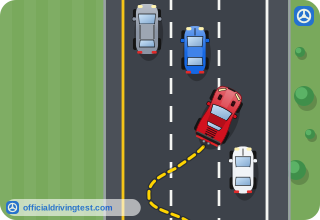
What does the manual say about weaving from lane to lane by passing on the left, moving back right and passing again?
- It is allowed only on roads with three or more lanes
- It is safe when you check your mirrors each time
- It is extremely dangerous
- It is a safe way to move faster than traffic
Show answer
Correct answer: It is extremely dangerous
Weaving between lanes to move faster than the flow of traffic is extremely dangerous.
Source: Tennessee Comprehensive Driver License Manual (March 2025 printing), page 63 · Open this page in the manual (Manual page 63)
-
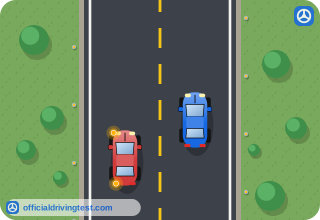
Another driver begins to pass you. What does the manual say about your speed?
- Speed up to keep the other driver from passing
- Maintain your speed; do not speed up
- Slow down at once to half your speed
- Brake firmly as soon as the car is beside you
Show answer
Correct answer: Maintain your speed; do not speed up
You should keep your speed steady and never speed up to stop the other driver from passing.
Source: Tennessee Comprehensive Driver License Manual (March 2025 printing), page 63 · Open this page in the manual (Manual page 63)
-
All you can see of the truck or bus ahead of you are its back doors. What does that tell you about your following distance?
- You are following at the ideal distance
- You are following too closely
- You are too far back to be seen
- You are allowed to follow this closely
Show answer
Correct answer: You are following too closely
Seeing only the back doors means you are following too closely and greatly increase your chance of a rear-end collision.
Source: Tennessee Comprehensive Driver License Manual (March 2025 printing), page 64 · Open this page in the manual (Manual page 64)
-
While passing another vehicle, what does the manual say about the posted speed limit?
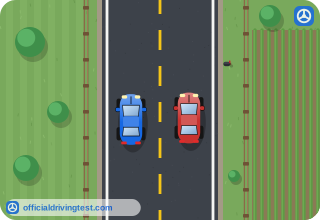
- It is illegal to exceed it even when passing
- You may exceed it briefly to complete a pass
- You may exceed it by 5 mph when passing
- You may exceed it only when passing trucks
Show answer
Correct answer: It is illegal to exceed it even when passing
The posted limit still applies while you pass; exceeding it is illegal even when passing other vehicles.
Source: Tennessee Comprehensive Driver License Manual (March 2025 printing), page 64 · Open this page in the manual (Manual page 64)
-
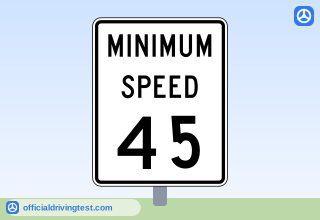
What does the manual advise if you cannot or do not wish to drive at or above the minimum speed limit?
- Drive on the paved shoulder
- Do not use the interstate
- Use the far left lane
- Drive in the HOV lane
Show answer
Correct answer: Do not use the interstate
A driver who cannot or will not keep at least the minimum speed should not use the interstate at all.
Source: Tennessee Comprehensive Driver License Manual (March 2025 printing), page 68 · Open this page in the manual (Manual page 68)
-
On the interstate, at least how far behind the vehicle in front of you should you stay?
- One second
- Half a second
- Two seconds
- One and a half seconds
Show answer
Correct answer: Two seconds
The manual says to stay at least two seconds behind the vehicle ahead on the interstate, and to leave more space in some conditions.
Source: Tennessee Comprehensive Driver License Manual (March 2025 printing), page 69 · Open this page in the manual (Manual page 69)
-
Other traffic on the interstate is going faster than the posted speed. What does the manual say?
- Match their speed so you do not block the flow
- You may exceed the limit by up to 5 mph
- Do not exceed the posted speed to stay with the flow
- Move to the left lane and keep up with them
Show answer
Correct answer: Do not exceed the posted speed to stay with the flow
Try to keep pace with traffic, but do not let other drivers lure you into going over the posted speed just to stay with the flow.
Source: Tennessee Comprehensive Driver License Manual (March 2025 printing), page 69 · Open this page in the manual (Manual page 69)
-
What does the manual say about driving too slowly on the interstate?
- It is against the law because it is dangerous
- It is the safest way to drive in the right lane
- It is allowed if you turn on your flashers
- It is allowed in the left lane at any time
Show answer
Correct answer: It is against the law because it is dangerous
Driving too slowly on the interstate is illegal because it is dangerous; a slowpoke can be as reckless as a speeder.
Source: Tennessee Comprehensive Driver License Manual (March 2025 printing), page 69 · Open this page in the manual (Manual page 69)
-
According to the manual, what is the cause of many multiple-car collisions on the interstate?
- Signaling too early
- Using the HOV lane
- Following too closely
- Keeping to the right lane
Show answer
Correct answer: Following too closely
Following too closely causes many multiple-car collisions, and higher interstate speeds call for even greater distances between cars.
Source: Tennessee Comprehensive Driver License Manual (March 2025 printing), page 71 · Open this page in the manual (Manual page 71)
-
How do higher interstate speeds affect the space you need between cars?
- They allow shorter gaps because traffic is smoother
- They require greater distances between cars
- They make no difference if your brakes are good
- They matter only in rain or at night
Show answer
Correct answer: They require greater distances between cars
Higher speeds increase the danger, so they require greater distances between cars.
Source: Tennessee Comprehensive Driver License Manual (March 2025 printing), page 71 · Open this page in the manual (Manual page 71)
-
What is the basic rule for safe night driving?
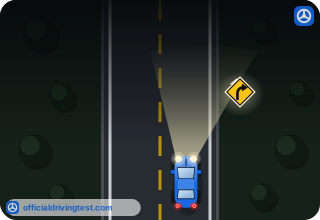
- Never outrun your headlights
- Always keep your high beams on
- Drive at the same speed as in daylight
- Stay close behind the vehicle ahead
Show answer
Correct answer: Never outrun your headlights
Your range of visibility at night is limited by your headlights, so you must be able to stop within the distance they light up.
Source: Tennessee Comprehensive Driver License Manual (March 2025 printing), page 74 · Open this page in the manual (Manual page 74)
-
At night, your stopping distance should be:
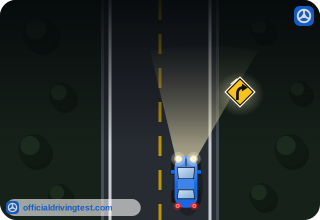
- Greater than your sight distance
- The same as your daytime stopping distance
- Less than your sight distance
- Measured only by how bright your high beams are
Show answer
Correct answer: Less than your sight distance
If you can see only so far, you must be able to stop within that distance; otherwise you will reach what you see too late.
Source: Tennessee Comprehensive Driver License Manual (March 2025 printing), page 74 · Open this page in the manual (Manual page 74)
-
Looking directly into oncoming headlights can cause what?
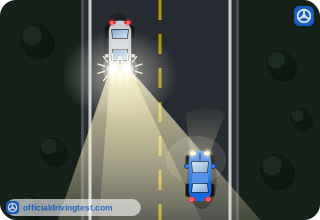
- Momentary blindness from the glare
- Better night vision afterward
- A longer range of visibility
- Faster reaction times
Show answer
Correct answer: Momentary blindness from the glare
The glare of oncoming headlights can blind you for a moment, so you should avoid looking straight into them.
Source: Tennessee Comprehensive Driver License Manual (March 2025 printing), page 74 · Open this page in the manual (Manual page 74)
-
To avoid the glare of oncoming lights at night, what should you watch and use as a steering guide?
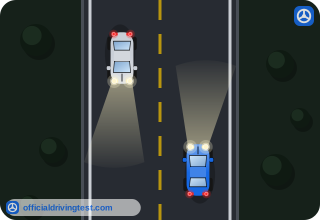
- The left edge of the road
- The right edge of the road
- The center of the road
- The oncoming car's headlights
Show answer
Correct answer: The right edge of the road
Watching the right edge of the road, or the white line, keeps your eyes away from the glare while you steer.
Source: Tennessee Comprehensive Driver License Manual (March 2025 printing), page 74 · Open this page in the manual (Manual page 74)
-
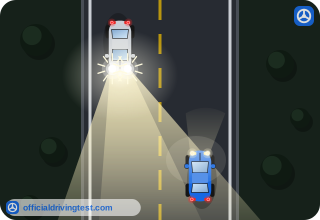
What is meant by glare recovery time?
- Time for your headlights to reach full brightness after switching on
- Time your eyes need to adjust when you first enter a dark tunnel
- Time before a bright windshield reflection fades from the mirror
- Time for your eye's pupil to readjust after oncoming headlights pass
Show answer
Correct answer: Time for your eye's pupil to readjust after oncoming headlights pass
After a bright oncoming light passes, the pupil needs time to readjust to dimmer light, and that delay is glare recovery time.
Source: Tennessee Comprehensive Driver License Manual (March 2025 printing), page 74 · Open this page in the manual (Manual page 74)
-
Glare recovery problems are generally more acute in which drivers?
- Older drivers and those in poor physical condition
- Drivers who have held a license for under a year
- Drivers who only drive during the daytime
- Drivers who wear sunglasses at night
Show answer
Correct answer: Older drivers and those in poor physical condition
The manual says glare recovery is generally harder for older drivers and for people in poor physical condition.
Source: Tennessee Comprehensive Driver License Manual (March 2025 printing), page 74 · Open this page in the manual (Manual page 74)
-
Which ability is impaired after dark?
- Depth perception
- Hearing ability
- Sense of balance
- Muscle strength
Show answer
Correct answer: Depth perception
The manual says depth perception, color recognition and peripheral vision are impaired after dark.
Source: Tennessee Comprehensive Driver License Manual (March 2025 printing), page 74 · Open this page in the manual (Manual page 74)
-
At night, where should you glance to look for dark shapes on the roadway?
- Directly at the hood of your car
- At the headlights of oncoming vehicles
- Well in front of your headlight beams
- Only at the rearview mirror
Show answer
Correct answer: Well in front of your headlight beams
Dark objects on the road are easier to catch if you look beyond your beams, which gives more time to react.
Source: Tennessee Comprehensive Driver License Manual (March 2025 printing), page 74 · Open this page in the manual (Manual page 74)
-
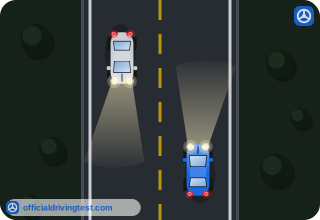
Why should you glance periodically to the right and left when driving at night?
- To make sure your high beams are aimed correctly
- To find the edge of the pavement and oncoming vehicles
- To look for road signs painted in dark colors
- To keep your eyes from becoming tired
Show answer
Correct answer: To find the edge of the pavement and oncoming vehicles
Glancing to each side shows where the pavement ends and where oncoming vehicles are.
Source: Tennessee Comprehensive Driver License Manual (March 2025 printing), page 74 · Open this page in the manual (Manual page 74)
-
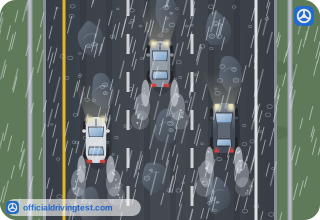
How does the manual compare wet pavement with icy pavement?
- Wet pavement is always safer
- Wet pavement is slippery only at night
- Wet pavement can be just as treacherous
- Wet pavement is not slippery if tires are good
Show answer
Correct answer: Wet pavement can be just as treacherous
Wet pavement can be as treacherous as ice, so you should always reduce your speed in wet weather.
Source: Tennessee Comprehensive Driver License Manual (March 2025 printing), page 75 · Open this page in the manual (Manual page 75)
-
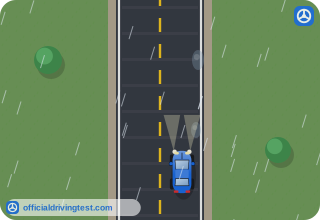
When is the pavement particularly treacherous in rain?
- After it has rained for several hours
- When it first begins to rain
- When the sun comes out after rain
- Right after the road has dried
Show answer
Correct answer: When it first begins to rain
When rain first begins, dirt and oil mix with the water and the road is at its most slippery.
Source: Tennessee Comprehensive Driver License Manual (March 2025 printing), page 75 · Open this page in the manual (Manual page 75)
-
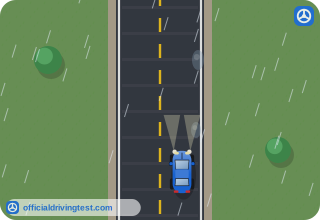
What makes the road greasy when rain first begins to fall?
- Salt spread on the road earlier
- Water freezing on the pavement
- Tire rubber melting in the heat
- Dirt and oil mixing with the water
Show answer
Correct answer: Dirt and oil mixing with the water
Accumulated dirt and oil mix with the new rain and form a greasy film that gives tires little grip.
Source: Tennessee Comprehensive Driver License Manual (March 2025 printing), page 75 · Open this page in the manual (Manual page 75)
-
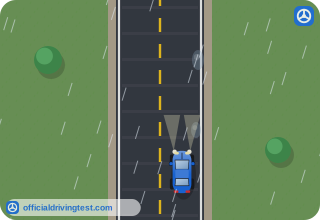
If rain starts on a hot day, why can the pavement be very slippery for the first few minutes?
- Hot tires lose their grip on wet asphalt
- Rainwater evaporates and leaves a film of salt
- Heat brings oil in the asphalt to the surface
- Hot air makes the water freeze on contact
Show answer
Correct answer: Heat brings oil in the asphalt to the surface
Heat pushes oil in the asphalt up to the surface, making the road extremely slippery until the oil washes off.
Source: Tennessee Comprehensive Driver License Manual (March 2025 printing), page 75 · Open this page in the manual (Manual page 75)
-
When you drive in inclement weather or fog, what should you do about your speed?
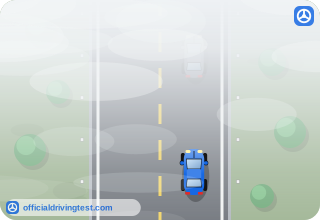
- Reduce it to make up for the reduced visibility
- Keep it the same to avoid being rear-ended
- Increase it to leave the area sooner
- Match the speed of the fastest vehicle nearby
Show answer
Correct answer: Reduce it to make up for the reduced visibility
Poor visibility gives you less time to see hazards, so you slow down to compensate.
Source: Tennessee Comprehensive Driver License Manual (March 2025 printing), page 75 · Open this page in the manual (Manual page 75)
-
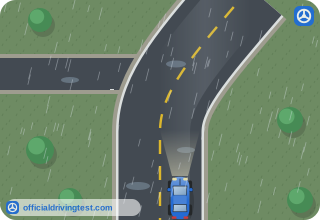
In rainy weather, how should you signal turns and lane changes?
- At the last moment
- Only when others are near
- Not at all if wipers are on
- Early
Show answer
Correct answer: Early
Rainy weather calls for an early signal for all turns and lane changes.
Source: Tennessee Comprehensive Driver License Manual (March 2025 printing), page 75 · Open this page in the manual (Manual page 75)
-
In rainy weather, how should you brake before a stop?
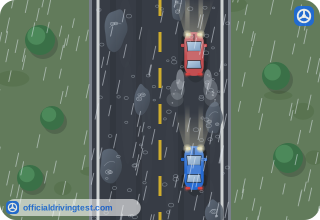
- Well in advance, to warn following drivers
- Suddenly, to clear water from the brake pads
- Only at the last moment, with firm pressure
- Only after you have passed the stop line
Show answer
Correct answer: Well in advance, to warn following drivers
Braking well ahead tells the drivers behind you that you intend to stop.
Source: Tennessee Comprehensive Driver License Manual (March 2025 printing), page 75 · Open this page in the manual (Manual page 75)
-
What is the manual's best advice about driving in fog or smoke?
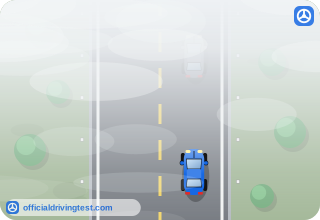
- Drive faster to get through it
- Follow the vehicle ahead closely
- Don't drive in it
- Use your high beams
Show answer
Correct answer: Don't drive in it
The manual says the best decision is not to drive in fog or smoke, and gives precautions only for those who must.
Source: Tennessee Comprehensive Driver License Manual (March 2025 printing), page 75 · Open this page in the manual (Manual page 75)
-
When driving in fog, what should you do about crossing traffic?
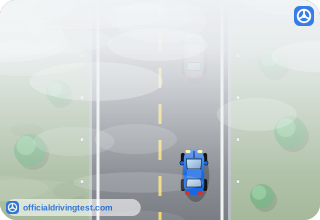
- Avoid it unless absolutely necessary
- Cross it at higher speed to clear it sooner
- Cross it only after turning on your high beams
- Cross it as soon as the car ahead has crossed
Show answer
Correct answer: Avoid it unless absolutely necessary
Crossing traffic is risky in fog, so you avoid it unless there is no alternative.
Source: Tennessee Comprehensive Driver License Manual (March 2025 printing), page 75 · Open this page in the manual (Manual page 75)
-
When driving in fog, what should you do about passing?
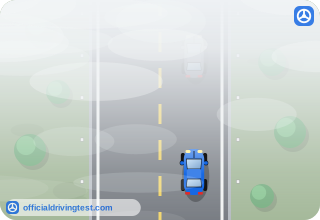
- Pass quickly on the left
- Avoid passing
- Pass only on curves
- Pass only when you see taillights
Show answer
Correct answer: Avoid passing
In fog you should be patient, stay to the right and avoid passing.
Source: Tennessee Comprehensive Driver License Manual (March 2025 printing), page 75 · Open this page in the manual (Manual page 75)
-
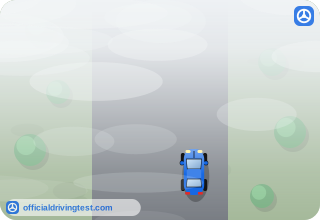
In fog, when may you stop on a roadway?
- Whenever visibility drops
- Whenever another vehicle stops ahead
- Only when absolutely necessary
- Whenever your wipers need adjusting
Show answer
Correct answer: Only when absolutely necessary
Stopping on a roadway in fog is dangerous, so it is done only when it cannot be avoided.
Source: Tennessee Comprehensive Driver License Manual (March 2025 printing), page 75 · Open this page in the manual (Manual page 75)
-
Which parts of the road tend to freeze before the rest of the road?
- Divided highways
- Long straight highways
- Roads with sunny exposure
- Bridges and overpasses
Show answer
Correct answer: Bridges and overpasses
Bridges and overpasses can hide ice and tend to freeze before the rest of the road does.
Source: Tennessee Comprehensive Driver License Manual (March 2025 printing), page 75 · Open this page in the manual (Manual page 75)
-
On cold, wet days, which areas freeze first and dry out last?
- Sunny stretches on top of hills
- Wide open sections of road with no trees
- Shaded spots from trees or buildings
- Spots right beside the guardrails
Show answer
Correct answer: Shaded spots from trees or buildings
Shade from trees or buildings can hide ice, and those spots freeze first and dry out last.
Source: Tennessee Comprehensive Driver License Manual (March 2025 printing), page 75 · Open this page in the manual (Manual page 75)
-
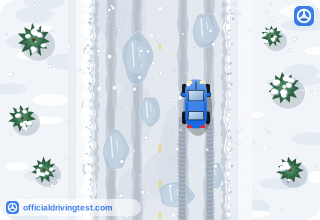
Close to the freezing point, the road is icy and may be:
- Less slippery than at colder temperatures
- More slippery than at colder temperatures
- No more slippery than dry pavement
- Slippery only on bridges
Show answer
Correct answer: More slippery than at colder temperatures
The manual warns that near freezing the icy road can be more slippery than when it is colder.
Source: Tennessee Comprehensive Driver License Manual (March 2025 printing), page 76 · Open this page in the manual (Manual page 76)
-
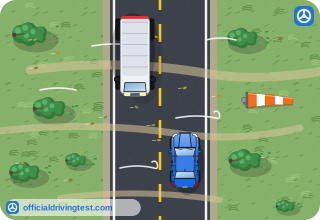
What can you do to gain more control of your vehicle in a strong wind?
- Speed up
- Drive closer to the center line
- Turn on your high beams
- Slow down
Show answer
Correct answer: Slow down
Slowing down gives you more control in strong winds.
Source: Tennessee Comprehensive Driver License Manual (March 2025 printing), page 77 · Open this page in the manual (Manual page 77)
-
What should you watch for when approaching an open space after driving in a protected area?
- Crosswinds that can push you to the side or middle
- Slippery spots where the shade ends and the sun begins
- Deer that move between the protected and open areas
- Drivers who suddenly slow to look at the open area
Show answer
Correct answer: Crosswinds that can push you to the side or middle
Moving from a protected area into the open can expose you to crosswinds that push your vehicle sideways.
Source: Tennessee Comprehensive Driver License Manual (March 2025 printing), page 77 · Open this page in the manual (Manual page 77)
-
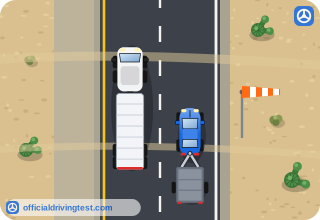
If you are pulling a trailer, what may a strong wind cause your vehicle to do?
- Speed up
- Sway
- Stall
- Overheat
Show answer
Correct answer: Sway
The wind may make the vehicle sway, so you must be ready to correct your steering.
Source: Tennessee Comprehensive Driver License Manual (March 2025 printing), page 77 · Open this page in the manual (Manual page 77)
-
When driving into a strong head wind, what may you need to do?
- Brake more often
- Drive in a lower gear only
- Open your windows
- Accelerate more
Show answer
Correct answer: Accelerate more
A head wind is blowing toward your vehicle, so you may need more acceleration, and steering will be harder.
Source: Tennessee Comprehensive Driver License Manual (March 2025 printing), page 77 · Open this page in the manual (Manual page 77)
-
A strong tailwind will increase your speed, so what should you do?
- Decelerate and begin braking earlier to stop
- Brake later because the car is lighter
- Speed up to stay ahead of the wind
- Keep your braking distance the same as normal
Show answer
Correct answer: Decelerate and begin braking earlier to stop
The tailwind pushes you forward, so you need to slow down and start braking sooner.
Source: Tennessee Comprehensive Driver License Manual (March 2025 printing), page 77 · Open this page in the manual (Manual page 77)
-
Which vehicles are more difficult to control in strong winds?
- Heavy trucks only
- Vehicles with new tires
- Lightweight vehicles
- Vehicles with antilock brakes
Show answer
Correct answer: Lightweight vehicles
Along with campers and trailers, lightweight vehicles are harder to control in strong winds.
Source: Tennessee Comprehensive Driver License Manual (March 2025 printing), page 77 · Open this page in the manual (Manual page 77)
-
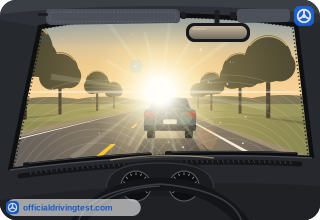
What can reduce glare when you drive toward the sun?
- Switching on your parking lights
- Sunglasses, clean windows and sun visors
- Driving with your high beams on
- Keeping your windows slightly fogged
Show answer
Correct answer: Sunglasses, clean windows and sun visors
Bright early-morning or late-afternoon sun can be cut by sunglasses, clean glass and the visors.
Source: Tennessee Comprehensive Driver License Manual (March 2025 printing), page 77 · Open this page in the manual (Manual page 77)
-
If the sun is behind you, what problem may oncoming drivers have?
- They may not see your turn signals or your car
- They may think your headlights are on high beam
- They may mistake you for an emergency vehicle
- They may not hear your horn
Show answer
Correct answer: They may not see your turn signals or your car
The sun in their eyes means oncoming drivers may not be able to see your signals or your car.
Source: Tennessee Comprehensive Driver License Manual (March 2025 printing), page 77 · Open this page in the manual (Manual page 77)
-
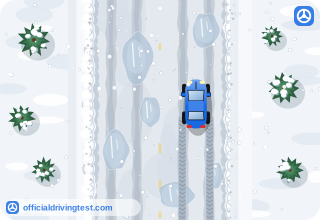
Which is one of the three big errors of most drivers in snow and ice?
- Following too far behind others
- Driving with the heater off
- Using low-beam headlights
- Over-braking and sliding the wheels
Show answer
Correct answer: Over-braking and sliding the wheels
The big errors are over-powering and spinning the wheels, over-braking and sliding them, and over-steering and skidding them.
Source: Tennessee Comprehensive Driver License Manual (March 2025 printing), page 77 · Open this page in the manual (Manual page 77)
-
In winter weather, which windows should you clear of snow, ice or frost before driving?
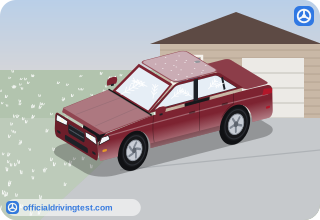
- All windows
- The windshield only
- The windshield and driver's window only
- The front windows only
Show answer
Correct answer: All windows
The manual says to clear snow, ice or frost from all windows before driving.
Source: Tennessee Comprehensive Driver License Manual (March 2025 printing), page 77 · Open this page in the manual (Manual page 77)
-
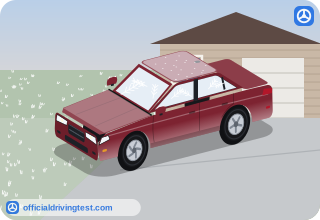
A good ice scraper with a brush is used to remove snow, frost and ice from which parts of the vehicle?
- The windshield, hood and roof only
- Windows, lights, signals and outside mirrors
- Windows, tires, bumpers and the license plate
- Windows and mirrors only
Show answer
Correct answer: Windows, lights, signals and outside mirrors
The manual lists the windows, headlights, brake lights, turn signals and outside mirrors.
Source: Tennessee Comprehensive Driver License Manual (March 2025 printing), page 77 · Open this page in the manual (Manual page 77)
-
According to the winter driving tips, when should you always use headlights to help others see you?
- Only when snow is actually falling
- Only when driving on the interstate
- Only between sunset and sunrise
- When weather restricts your visibility
Show answer
Correct answer: When weather restricts your visibility
Headlights help others see you whenever atmospheric or other weather conditions restrict visibility.
Source: Tennessee Comprehensive Driver License Manual (March 2025 printing), page 78 · Open this page in the manual (Manual page 78)
-
When is a good outside rearview mirror especially helpful in winter?
- When the back window glass tends to fog over
- When the road ahead is completely dry
- When you are parking in a dark garage
- When you are driving on the interstate
Show answer
Correct answer: When the back window glass tends to fog over
A good outside mirror helps when the back window fogs over.
Source: Tennessee Comprehensive Driver License Manual (March 2025 printing), page 78 · Open this page in the manual (Manual page 78)
-
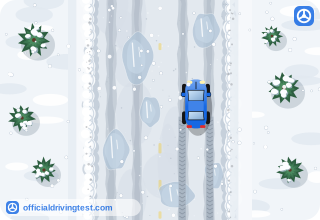
On ice or snow, how should you start your car?
- Quickly, to build momentum
- With the wheels turned sharply
- Slowly, avoiding wheel spin
- In the highest gear available
Show answer
Correct answer: Slowly, avoiding wheel spin
Overpowering and spinning the wheels reduces traction, so you start slowly.
Source: Tennessee Comprehensive Driver License Manual (March 2025 printing), page 78 · Open this page in the manual (Manual page 78)
-
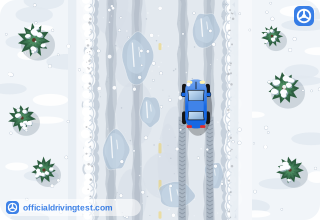
How should you keep your speed on ice or snow?
- As fast as the traffic around you
- As slow as the car will go
- Changing often to match traffic
- Steady and slow, but not too slow
Show answer
Correct answer: Steady and slow, but not too slow
The manual says to keep your speed steady and slow, but not too slow.
Source: Tennessee Comprehensive Driver License Manual (March 2025 printing), page 78 · Open this page in the manual (Manual page 78)
-
In deeper snow, what is it often necessary to do?
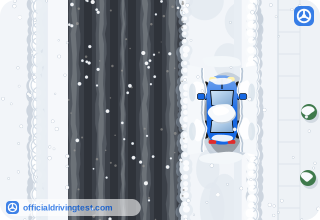
- Use the car's momentum to keep moving
- Stop frequently to rest the engine
- Keep the front wheels turned sharply
- Drive in the highest gear
Show answer
Correct answer: Use the car's momentum to keep moving
In deeper snow, momentum helps keep the car moving.
Source: Tennessee Comprehensive Driver License Manual (March 2025 printing), page 78 · Open this page in the manual (Manual page 78)
-
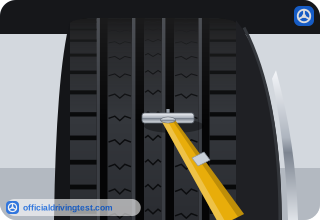
Which helps improve steering ability on ice and snow?
- Slightly underinflated front tires
- Worn tread on the front wheels
- Good treads on the front wheels
- Wider headlight beams at night
Show answer
Correct answer: Good treads on the front wheels
The manual recommends good treads on the front wheels to improve steering, and says snow tires are helpful.
Source: Tennessee Comprehensive Driver License Manual (March 2025 printing), page 78 · Open this page in the manual (Manual page 78)
-
At 20 M.P.H., low traction can increase stopping distance to about how much?
- About 50 feet
- 200 feet or more
- About 100 feet
- About 20 feet
Show answer
Correct answer: 200 feet or more
Low traction makes stopping difficult; at 20 miles per hour the stopping distance can reach 200 feet or more.
Source: Tennessee Comprehensive Driver License Manual (March 2025 printing), page 78 · Open this page in the manual (Manual page 78)
-
What can continuous hard braking on snow and ice cause?
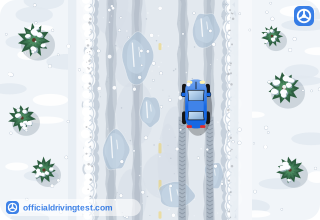
- Locked front brakes and a loss of steering
- Locked rear brakes and a faster stop
- A better grip on the road
- Warmer brakes that melt the ice
Show answer
Correct answer: Locked front brakes and a loss of steering
Continuous hard braking can lock the front brakes so you lose steering, so keep a safe speed to avoid excessive braking.
Source: Tennessee Comprehensive Driver License Manual (March 2025 printing), page 78 · Open this page in the manual (Manual page 78)
-
Why can a car that has already crossed an icy part of the road and stopped be a danger to you?
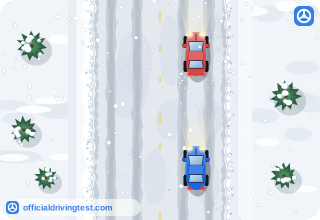
- Its tires may throw ice onto your windshield
- Its driver may be unable to see in the mirror
- Ice behind it can make you skid into its rear
- Its exhaust may make the road wet
Show answer
Correct answer: Ice behind it can make you skid into its rear
A long patch of ice behind the stopped car can make you skid into it.
Source: Tennessee Comprehensive Driver License Manual (March 2025 printing), page 78 · Open this page in the manual (Manual page 78)
-
On packed snow and ice in stop-and-go traffic, what may help you avoid the slickest surface?
- Following exactly in the tracks of the car ahead
- Steering to one side or the other of the packed section
- Driving in the middle of the packed section
- Braking hard before entering the packed section
Show answer
Correct answer: Steering to one side or the other of the packed section
Packed snow becomes extremely slippery from many sliding wheels, and steering to one side of it helps avoid the slickest part.
Source: Tennessee Comprehensive Driver License Manual (March 2025 printing), page 78 · Open this page in the manual (Manual page 78)
-
In the manual's five tips, what does "Leave Yourself an Out" tell you to do?
- Keep a vehicle close behind you at all times for protection
- Keep space in front and on at least one side to escape conflict
- Stay in the left lane so you can leave the road quickly
- Drive close to the vehicle ahead so you can follow its path
Show answer
Correct answer: Keep space in front and on at least one side to escape conflict
Leaving yourself an out means keeping open space ahead and to at least one side so you can escape a conflict.
Source: Tennessee Comprehensive Driver License Manual (March 2025 printing), page 92 · Open this page in the manual (Manual page 92)
-
What does the manual say "defensive driving" means?
- Driving well below the speed limit on every road at all times and staying in the left lane
- Being aware of conditions, planning ahead and anticipating dangers to avoid contact
- Reacting to a hazard only after another vehicle has come close to your vehicle
- Avoiding every road that has heavy traffic, pedestrians or bicyclists
Show answer
Correct answer: Being aware of conditions, planning ahead and anticipating dangers to avoid contact
Defensive driving is constant awareness, planning ahead and anticipating dangers so you take the right action and do not touch any obstacle or vehicle.
Source: Tennessee Comprehensive Driver License Manual (March 2025 printing), page 93 · Open this page in the manual (Manual page 93)
-
Which following-distance rule does the manual say to always use?
- The one-second rule
- The six-second rule
- The eight-second rule
- The two-second rule
Show answer
Correct answer: The two-second rule
The manual tells drivers to always use the two-second rule and to test their following distance with a count.
Source: Tennessee Comprehensive Driver License Manual (March 2025 printing), page 93 · Open this page in the manual (Manual page 93)
-
You test your following distance by picking a stationary object ahead and counting "1,001, 1,002." What does it mean if you reach that point before you finish the count?
- You are following too closely and should slow down
- You are following at a safe distance and can keep your speed
- You should speed up to match the vehicle ahead
- You should move into the left lane at once
Show answer
Correct answer: You are following too closely and should slow down
Reaching the object before the count ends means you are too close, so you should slow down to lengthen the gap.
Source: Tennessee Comprehensive Driver License Manual (March 2025 printing), page 93 · Open this page in the manual (Manual page 93)
-
In general, how far ahead do defensive drivers try to focus their eyes?
- 3 to 5 seconds
- 10 to 15 seconds
- 30 to 40 seconds
- 1 to 2 seconds
Show answer
Correct answer: 10 to 15 seconds
Defensive drivers look about 10 to 15 seconds ahead, roughly one city block, to see things early.
Source: Tennessee Comprehensive Driver License Manual (March 2025 printing), page 93 · Open this page in the manual (Manual page 93)
-
According to the manual, what causes rear-end crashes?
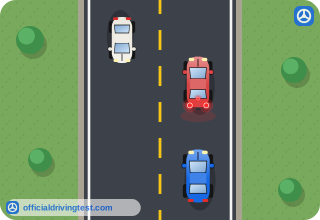
- Following too closely to stop before hitting the vehicle ahead
- Signaling too early before you slow down on the road
- Keeping a steady speed on a road with little traffic
- Leaving a large space between you and the vehicle ahead
Show answer
Correct answer: Following too closely to stop before hitting the vehicle ahead
Rear-end crashes happen when drivers tailgate and cannot stop in time when the vehicle ahead slows or stops.
Source: Tennessee Comprehensive Driver License Manual (March 2025 printing), page 94 · Open this page in the manual (Manual page 94)
-
What does the manual call the best way to keep a safety cushion ahead of your vehicle?
- Following the basic 1-Second Rule
- Following the basic 6-Second Rule
- Following the basic 2-Second Rule
- Following the vehicle ahead by one car length
Show answer
Correct answer: Following the basic 2-Second Rule
The manual says the best way to keep space ahead is the basic 2-Second Rule.
Source: Tennessee Comprehensive Driver License Manual (March 2025 printing), page 94 · Open this page in the manual (Manual page 94)
-
You are being tailgated and the road has a right lane. What does the manual say to do?
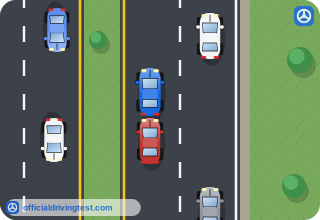
- Slow down quickly to discourage the tailgater
- Speed up to stay ahead of the tailgater
- Move into the left lane and stop
- Move over to the right
Show answer
Correct answer: Move over to the right
If there is a right lane, moving over lets the tailgater go by.
Source: Tennessee Comprehensive Driver License Manual (March 2025 printing), page 94 · Open this page in the manual (Manual page 94)
-
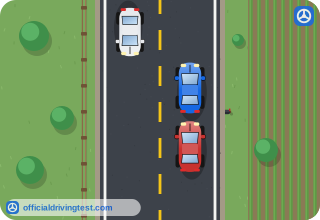
You are being tailgated and there is no right lane. What does the manual say to do?
- When the road is clear and passing is legal, slowly reduce speed
- Brake hard right away so the tailgater has to drop back
- Speed up to a higher speed until the tailgater gives up
- Drive onto the shoulder and stop until the tailgater passes
Show answer
Correct answer: When the road is clear and passing is legal, slowly reduce speed
Slowly reducing speed when the road is clear and passing is legal encourages the tailgater to drive around you.
Source: Tennessee Comprehensive Driver License Manual (March 2025 printing), page 94 · Open this page in the manual (Manual page 94)
-
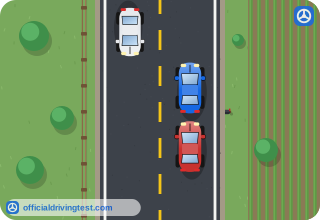
Why does the manual say you should never slow down quickly to discourage a tailgater?
- It is against the law in every situation
- It damages the brakes of both vehicles
- It only increases your risk of being hit from behind
- It causes the tailgater to pass on the right
Show answer
Correct answer: It only increases your risk of being hit from behind
Braking suddenly in front of a tailgater only raises your chance of being hit from behind.
Source: Tennessee Comprehensive Driver License Manual (March 2025 printing), page 94 · Open this page in the manual (Manual page 94)
-
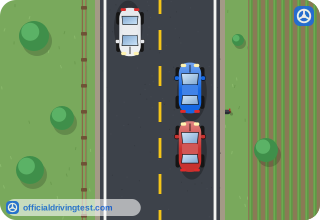
How can you help keep a driver behind you at a safe distance?
- Change lanes often so the driver cannot follow you
- Keep a steady speed and signal early before you slow or turn
- Drive close to the center line of the road
- Turn on hazard flashers whenever you slow down
Show answer
Correct answer: Keep a steady speed and signal early before you slow or turn
A steady speed and early signals give the driver behind you time to react.
Source: Tennessee Comprehensive Driver License Manual (March 2025 printing), page 94 · Open this page in the manual (Manual page 94)
-
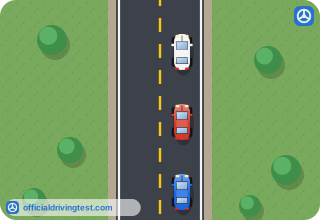
As a general rule, how many vehicles should you pass at one time?
- Two vehicles at a time
- As many as the road allows
- Only one vehicle at a time
- Up to three vehicles at a time
Show answer
Correct answer: Only one vehicle at a time
The manual's general rule is to pass only one vehicle at a time.
Source: Tennessee Comprehensive Driver License Manual (March 2025 printing), page 94 · Open this page in the manual (Manual page 94)
-
What does the manual say about passing and the speed limit?
- You may exceed the speed limit by 5 mph while passing
- Passing does not entitle you to exceed the speed limit
- You may exceed the limit if the road is clear
- Passing is allowed at any speed on a two-lane road
Show answer
Correct answer: Passing does not entitle you to exceed the speed limit
The manual states that passing does not give you the right to go over the speed limit.
Source: Tennessee Comprehensive Driver License Manual (March 2025 printing), page 94 · Open this page in the manual (Manual page 94)
-
At 55 M.P.H., about how long does the manual say you need to complete the pass of a single vehicle?
- About three seconds
- About five seconds
- About twenty seconds
- About ten seconds
Show answer
Correct answer: About ten seconds
The manual says a pass at 55 M.P.H. takes about ten seconds, so you need a ten-second gap in oncoming traffic and enough sight distance.
Source: Tennessee Comprehensive Driver License Manual (March 2025 printing), page 94 · Open this page in the manual (Manual page 94)
-
According to the manual, you should NOT pass unless what is true?
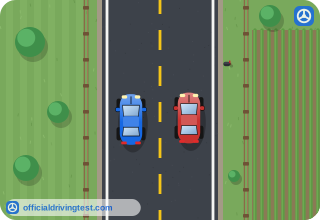
- You have enough room to return to your lane
- The vehicle ahead is a large truck
- You have flashed your headlights twice
- The vehicle ahead is below 55 M.P.H.
Show answer
Correct answer: You have enough room to return to your lane
The manual says not to pass without enough space to get back into your lane.
Source: Tennessee Comprehensive Driver License Manual (March 2025 printing), page 94 · Open this page in the manual (Manual page 94)
-
After passing, when does the manual say it is safest to return to the driving lane?
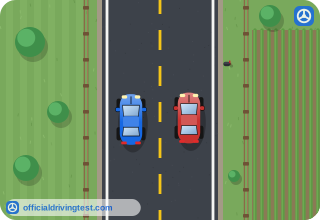
- As soon as your front bumper passes the other vehicle
- After you honk to warn the other driver
- When you see both its headlights in your rearview mirror
- When you see one headlight in your side mirror
Show answer
Correct answer: When you see both its headlights in your rearview mirror
Waiting until both headlights show in the rearview mirror helps you leave enough room to return to your lane.
Source: Tennessee Comprehensive Driver License Manual (March 2025 printing), page 94 · Open this page in the manual (Manual page 94)
-
When finishing a pass, what should you not count on other drivers to do?
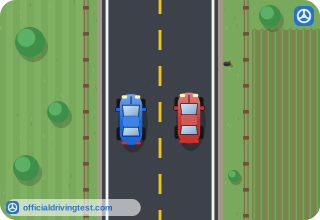
- Move onto the shoulder
- Make room for you
- Increase their speed
- Flash their headlights at you
Show answer
Correct answer: Make room for you
You need to have enough room behind the vehicle you passed so you can return safely; do not depend on others to make room.
Source: Tennessee Comprehensive Driver License Manual (March 2025 printing), page 94 · Open this page in the manual (Manual page 94)
-
Another driver passes you without enough room. What does the manual say to do?
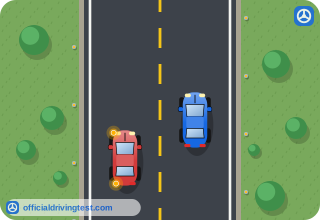
- Speed up to stay beside the passing driver
- Move toward the center line to block the vehicle
- Slow down and allow room for it to return to the lane
- Follow the passing driver as closely as possible
Show answer
Correct answer: Slow down and allow room for it to return to the lane
The manual says not to make a situation worse: slow down and leave room for the passing driver to return safely.
Source: Tennessee Comprehensive Driver License Manual (March 2025 printing), page 95 · Open this page in the manual (Manual page 95)
-
What minimum space cushion should you keep between your car and the vehicle ahead so that you have an emergency out available?
- At least two seconds
- At least one second
- About one car length
- About half a second
Show answer
Correct answer: At least two seconds
Keeping at least a two second cushion gives you room for an emergency out.
Source: Tennessee Comprehensive Driver License Manual (March 2025 printing), page 97 · Open this page in the manual (Manual page 97)
-
For which of these road conditions does the manual say you must slow down to be safe?
- A straight, dry road
- A road with fresh paint on the edge lines
- A sharp curve or a rough or damaged road
- A road with light traffic and good visibility
Show answer
Correct answer: A sharp curve or a rough or damaged road
You must slow down for a sharp curve or when the road is rough or damaged.
Source: Tennessee Comprehensive Driver License Manual (March 2025 printing), page 101 · Open this page in the manual (Manual page 101)
-
Which of these is listed as a factor in how traffic conditions vary?
- The color of the vehicles
- The price of fuel
- The number of passengers riding in each vehicle on the road
- Volume of vehicles, such as rush hour, mid-day or night
Show answer
Correct answer: Volume of vehicles, such as rush hour, mid-day or night
The manual lists volume of vehicles, traffic control devices, work zones, road type, weather and speed limits.
Source: Tennessee Comprehensive Driver License Manual (March 2025 printing), page 101 · Open this page in the manual (Manual page 101)
-
According to the manual, when do collisions involving multiple vehicles often happen?
- When all drivers move at the same speed
- When drivers keep a two second cushion behind the vehicle ahead
- When drivers go faster or slower than other traffic
- When drivers signal early
Show answer
Correct answer: When drivers go faster or slower than other traffic
Vehicles moving the same way at the same speed cannot hit each other, so differing speeds cause collisions.
Source: Tennessee Comprehensive Driver License Manual (March 2025 printing), page 101 · Open this page in the manual (Manual page 101)
-
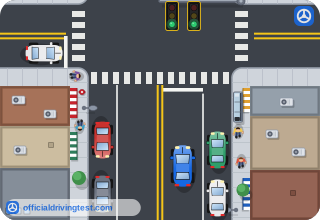
Wherever people or traffic gather, what is limited?
- Your room to maneuver
- Your need to use signals
- Your ability to see signs
- The number of lanes
Show answer
Correct answer: Your room to maneuver
In a crowded space your room to maneuver is limited, so you need to lower your speed to have time to react.
Source: Tennessee Comprehensive Driver License Manual (March 2025 printing), page 101 · Open this page in the manual (Manual page 101)
-
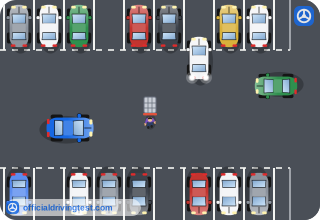
Why may you need to lower your speed in shopping centers, parking lots and downtown areas?
- Speed limits there are always lower than on other roads and strictly enforced
- Pedestrians always have the right of way there
- Traffic signals there are timed to slow drivers
- Vehicles and people stop, start and move in different directions quickly and randomly
Show answer
Correct answer: Vehicles and people stop, start and move in different directions quickly and randomly
These are busy areas where vehicles and people move unpredictably.
Source: Tennessee Comprehensive Driver License Manual (March 2025 printing), page 101 · Open this page in the manual (Manual page 101)
-
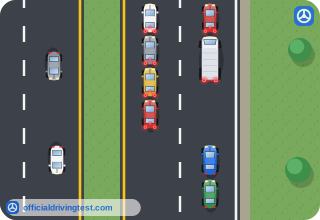
If you see brake lights coming on several vehicles ahead of you, what may you need to do?
- Change lanes immediately
- Adjust your speed for the traffic conditions
- Sound your horn
- Move closer to the vehicle ahead to see better
Show answer
Correct answer: Adjust your speed for the traffic conditions
Brake lights on several vehicles ahead are a sign to adjust speed for traffic.
Source: Tennessee Comprehensive Driver License Manual (March 2025 printing), page 101 · Open this page in the manual (Manual page 101)
-
What do rush hours often bring?
- Heavy traffic and drivers who always seem to be in a hurry
- Lighter traffic and drivers who are never in a hurry
- Fewer vehicles on the road
- Lower speed limits on all roads
Show answer
Correct answer: Heavy traffic and drivers who always seem to be in a hurry
Rush hours often have heavy traffic and hurried drivers.
Source: Tennessee Comprehensive Driver License Manual (March 2025 printing), page 101 · Open this page in the manual (Manual page 101)
-
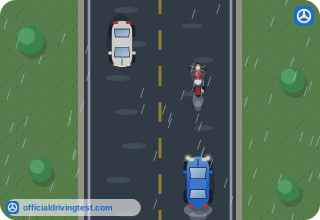
The road is wet and slippery. What should you allow for a motorcyclist?
- Less following distance
- The same following distance
- More following distance
- No following distance at all
Show answer
Correct answer: More following distance
Bad weather and slippery surfaces cause greater problems for motorcyclists than for cars.
Source: Tennessee Comprehensive Driver License Manual (March 2025 printing), page 107 · Open this page in the manual (Manual page 107)
-
How does the stopping distance of an RV compare with a car?
- It is shorter, because RVs are larger
- It is longer, because RVs are heavier
- It is the same
- It depends only on the color
Show answer
Correct answer: It is longer, because RVs are heavier
RVs are heavier than cars and need a longer stopping distance.
Source: Tennessee Comprehensive Driver License Manual (March 2025 printing), page 115 · Open this page in the manual (Manual page 115)
-
What following distance does the manual list for Phase Two practice?
- 1-second following distances
- 6-second following distances
- Safe 2-second following distances
- One car length at any speed
Show answer
Correct answer: Safe 2-second following distances
In Phase Two the new driver practices keeping a safe two-second following distance.
Source: Tennessee Comprehensive Driver License Manual (March 2025 printing), page 117 · Open this page in the manual (Manual page 117)