Tennessee: Speed and space — Part 4 Practice Test
Questions in this part include: “Which parts of the road tend to freeze before the rest of the road?” · “When driving into a strong head wind, what may you need to do?”
Independent educational site · not affiliated with any government agency or DMV
Ready? Test yourself
- Instant feedback with an explanation
- Every answer cites its source in the manual
- Your best score is saved on this device
- Keyboard: press 1 to 4 to answer and Enter for the next question
Questions are original and based on the official manual "Tennessee Comprehensive Driver License Manual" (March 2025 printing), Tennessee Department of Safety and Homeland Security.
All 20 questions in this practice test
Take the test above first, then use this list to study. Tap “Show answer” to see the correct answer and explanation.
Show the questions and answersHide the questions
-
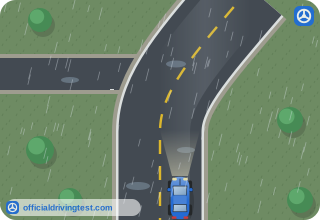
In rainy weather, how should you signal turns and lane changes?
- At the last moment
- Only when others are near
- Not at all if wipers are on
- Early
Show answer
Correct answer: Early
Rainy weather calls for an early signal for all turns and lane changes.
Source: Tennessee Comprehensive Driver License Manual (March 2025 printing), page 75 · Open this page in the manual (Manual page 75)
-
In rainy weather, how should you brake before a stop?
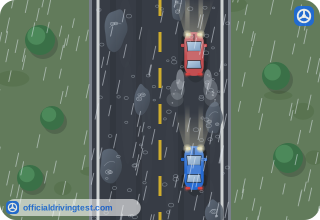
- Well in advance, to warn following drivers
- Suddenly, to clear water from the brake pads
- Only at the last moment, with firm pressure
- Only after you have passed the stop line
Show answer
Correct answer: Well in advance, to warn following drivers
Braking well ahead tells the drivers behind you that you intend to stop.
Source: Tennessee Comprehensive Driver License Manual (March 2025 printing), page 75 · Open this page in the manual (Manual page 75)
-
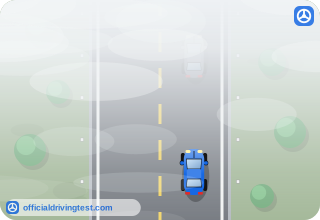
What is the manual's best advice about driving in fog or smoke?
- Drive faster to get through it
- Follow the vehicle ahead closely
- Don't drive in it
- Use your high beams
Show answer
Correct answer: Don't drive in it
The manual says the best decision is not to drive in fog or smoke, and gives precautions only for those who must.
Source: Tennessee Comprehensive Driver License Manual (March 2025 printing), page 75 · Open this page in the manual (Manual page 75)
-
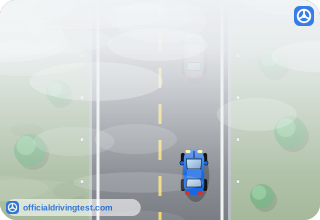
When driving in fog, what should you do about crossing traffic?
- Avoid it unless absolutely necessary
- Cross it at higher speed to clear it sooner
- Cross it only after turning on your high beams
- Cross it as soon as the car ahead has crossed
Show answer
Correct answer: Avoid it unless absolutely necessary
Crossing traffic is risky in fog, so you avoid it unless there is no alternative.
Source: Tennessee Comprehensive Driver License Manual (March 2025 printing), page 75 · Open this page in the manual (Manual page 75)
-
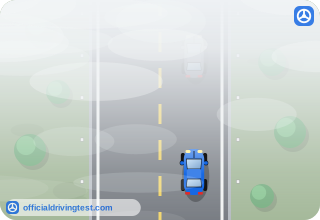
When driving in fog, what should you do about passing?
- Pass quickly on the left
- Avoid passing
- Pass only on curves
- Pass only when you see taillights
Show answer
Correct answer: Avoid passing
In fog you should be patient, stay to the right and avoid passing.
Source: Tennessee Comprehensive Driver License Manual (March 2025 printing), page 75 · Open this page in the manual (Manual page 75)
-
In fog, when may you stop on a roadway?
- Whenever visibility drops
- Whenever another vehicle stops ahead
- Only when absolutely necessary
- Whenever your wipers need adjusting
Show answer
Correct answer: Only when absolutely necessary
Stopping on a roadway in fog is dangerous, so it is done only when it cannot be avoided.
Source: Tennessee Comprehensive Driver License Manual (March 2025 printing), page 75 · Open this page in the manual (Manual page 75)
-
Which parts of the road tend to freeze before the rest of the road?
- Divided highways
- Long straight highways
- Roads with sunny exposure
- Bridges and overpasses
Show answer
Correct answer: Bridges and overpasses
Bridges and overpasses can hide ice and tend to freeze before the rest of the road does.
Source: Tennessee Comprehensive Driver License Manual (March 2025 printing), page 75 · Open this page in the manual (Manual page 75)
-
On cold, wet days, which areas freeze first and dry out last?
- Sunny stretches on top of hills
- Wide open sections of road with no trees
- Shaded spots from trees or buildings
- Spots right beside the guardrails
Show answer
Correct answer: Shaded spots from trees or buildings
Shade from trees or buildings can hide ice, and those spots freeze first and dry out last.
Source: Tennessee Comprehensive Driver License Manual (March 2025 printing), page 75 · Open this page in the manual (Manual page 75)
-
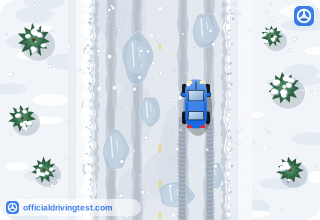
Close to the freezing point, the road is icy and may be:
- Less slippery than at colder temperatures
- More slippery than at colder temperatures
- No more slippery than dry pavement
- Slippery only on bridges
Show answer
Correct answer: More slippery than at colder temperatures
The manual warns that near freezing the icy road can be more slippery than when it is colder.
Source: Tennessee Comprehensive Driver License Manual (March 2025 printing), page 76 · Open this page in the manual (Manual page 76)
-
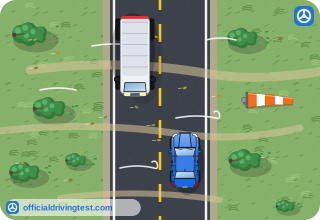
What can you do to gain more control of your vehicle in a strong wind?
- Speed up
- Drive closer to the center line
- Turn on your high beams
- Slow down
Show answer
Correct answer: Slow down
Slowing down gives you more control in strong winds.
Source: Tennessee Comprehensive Driver License Manual (March 2025 printing), page 77 · Open this page in the manual (Manual page 77)
-
What should you watch for when approaching an open space after driving in a protected area?
- Crosswinds that can push you to the side or middle
- Slippery spots where the shade ends and the sun begins
- Deer that move between the protected and open areas
- Drivers who suddenly slow to look at the open area
Show answer
Correct answer: Crosswinds that can push you to the side or middle
Moving from a protected area into the open can expose you to crosswinds that push your vehicle sideways.
Source: Tennessee Comprehensive Driver License Manual (March 2025 printing), page 77 · Open this page in the manual (Manual page 77)
-
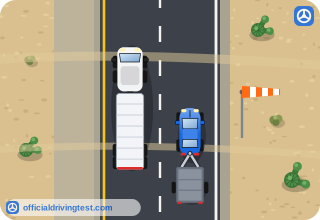
If you are pulling a trailer, what may a strong wind cause your vehicle to do?
- Speed up
- Sway
- Stall
- Overheat
Show answer
Correct answer: Sway
The wind may make the vehicle sway, so you must be ready to correct your steering.
Source: Tennessee Comprehensive Driver License Manual (March 2025 printing), page 77 · Open this page in the manual (Manual page 77)
-
When driving into a strong head wind, what may you need to do?
- Brake more often
- Drive in a lower gear only
- Open your windows
- Accelerate more
Show answer
Correct answer: Accelerate more
A head wind is blowing toward your vehicle, so you may need more acceleration, and steering will be harder.
Source: Tennessee Comprehensive Driver License Manual (March 2025 printing), page 77 · Open this page in the manual (Manual page 77)
-
A strong tailwind will increase your speed, so what should you do?
- Decelerate and begin braking earlier to stop
- Brake later because the car is lighter
- Speed up to stay ahead of the wind
- Keep your braking distance the same as normal
Show answer
Correct answer: Decelerate and begin braking earlier to stop
The tailwind pushes you forward, so you need to slow down and start braking sooner.
Source: Tennessee Comprehensive Driver License Manual (March 2025 printing), page 77 · Open this page in the manual (Manual page 77)
-
Which vehicles are more difficult to control in strong winds?
- Heavy trucks only
- Vehicles with new tires
- Lightweight vehicles
- Vehicles with antilock brakes
Show answer
Correct answer: Lightweight vehicles
Along with campers and trailers, lightweight vehicles are harder to control in strong winds.
Source: Tennessee Comprehensive Driver License Manual (March 2025 printing), page 77 · Open this page in the manual (Manual page 77)
-
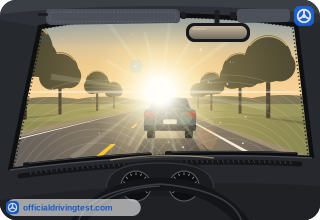
What can reduce glare when you drive toward the sun?
- Switching on your parking lights
- Sunglasses, clean windows and sun visors
- Driving with your high beams on
- Keeping your windows slightly fogged
Show answer
Correct answer: Sunglasses, clean windows and sun visors
Bright early-morning or late-afternoon sun can be cut by sunglasses, clean glass and the visors.
Source: Tennessee Comprehensive Driver License Manual (March 2025 printing), page 77 · Open this page in the manual (Manual page 77)
-
If the sun is behind you, what problem may oncoming drivers have?
- They may not see your turn signals or your car
- They may think your headlights are on high beam
- They may mistake you for an emergency vehicle
- They may not hear your horn
Show answer
Correct answer: They may not see your turn signals or your car
The sun in their eyes means oncoming drivers may not be able to see your signals or your car.
Source: Tennessee Comprehensive Driver License Manual (March 2025 printing), page 77 · Open this page in the manual (Manual page 77)
-
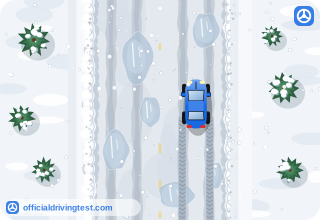
Which is one of the three big errors of most drivers in snow and ice?
- Following too far behind others
- Driving with the heater off
- Using low-beam headlights
- Over-braking and sliding the wheels
Show answer
Correct answer: Over-braking and sliding the wheels
The big errors are over-powering and spinning the wheels, over-braking and sliding them, and over-steering and skidding them.
Source: Tennessee Comprehensive Driver License Manual (March 2025 printing), page 77 · Open this page in the manual (Manual page 77)
-
In winter weather, which windows should you clear of snow, ice or frost before driving?
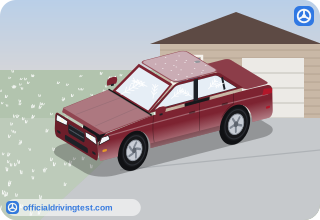
- All windows
- The windshield only
- The windshield and driver's window only
- The front windows only
Show answer
Correct answer: All windows
The manual says to clear snow, ice or frost from all windows before driving.
Source: Tennessee Comprehensive Driver License Manual (March 2025 printing), page 77 · Open this page in the manual (Manual page 77)
-
A good ice scraper with a brush is used to remove snow, frost and ice from which parts of the vehicle?
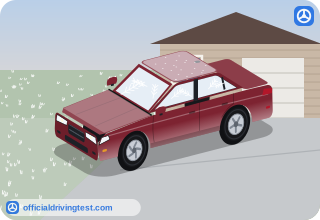
- The windshield, hood and roof only
- Windows, lights, signals and outside mirrors
- Windows, tires, bumpers and the license plate
- Windows and mirrors only
Show answer
Correct answer: Windows, lights, signals and outside mirrors
The manual lists the windows, headlights, brake lights, turn signals and outside mirrors.
Source: Tennessee Comprehensive Driver License Manual (March 2025 printing), page 77 · Open this page in the manual (Manual page 77)