Tennessee: Speed and space — Part 3 Practice Test
Questions in this part include: “On the interstate, at least how far behind the vehicle in front of you should you stay?” · “How do higher interstate speeds affect the space you need between cars?”
Independent educational site · not affiliated with any government agency or DMV
Ready? Test yourself
- Instant feedback with an explanation
- Every answer cites its source in the manual
- Your best score is saved on this device
- Keyboard: press 1 to 4 to answer and Enter for the next question
Questions are original and based on the official manual "Tennessee Comprehensive Driver License Manual" (March 2025 printing), Tennessee Department of Safety and Homeland Security.
All 20 questions in this practice test
Take the test above first, then use this list to study. Tap “Show answer” to see the correct answer and explanation.
Show the questions and answersHide the questions
-
What does the manual advise if you cannot or do not wish to drive at or above the minimum speed limit?
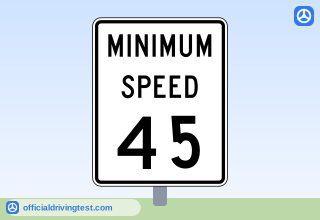
- Drive on the paved shoulder
- Do not use the interstate
- Use the far left lane
- Drive in the HOV lane
Show answer
Correct answer: Do not use the interstate
A driver who cannot or will not keep at least the minimum speed should not use the interstate at all.
Source: Tennessee Comprehensive Driver License Manual (March 2025 printing), page 68 · Open this page in the manual (Manual page 68)
-
On the interstate, at least how far behind the vehicle in front of you should you stay?
- One second
- Half a second
- Two seconds
- One and a half seconds
Show answer
Correct answer: Two seconds
The manual says to stay at least two seconds behind the vehicle ahead on the interstate, and to leave more space in some conditions.
Source: Tennessee Comprehensive Driver License Manual (March 2025 printing), page 69 · Open this page in the manual (Manual page 69)
-
Other traffic on the interstate is going faster than the posted speed. What does the manual say?
- Match their speed so you do not block the flow
- You may exceed the limit by up to 5 mph
- Do not exceed the posted speed to stay with the flow
- Move to the left lane and keep up with them
Show answer
Correct answer: Do not exceed the posted speed to stay with the flow
Try to keep pace with traffic, but do not let other drivers lure you into going over the posted speed just to stay with the flow.
Source: Tennessee Comprehensive Driver License Manual (March 2025 printing), page 69 · Open this page in the manual (Manual page 69)
-
What does the manual say about driving too slowly on the interstate?
- It is against the law because it is dangerous
- It is the safest way to drive in the right lane
- It is allowed if you turn on your flashers
- It is allowed in the left lane at any time
Show answer
Correct answer: It is against the law because it is dangerous
Driving too slowly on the interstate is illegal because it is dangerous; a slowpoke can be as reckless as a speeder.
Source: Tennessee Comprehensive Driver License Manual (March 2025 printing), page 69 · Open this page in the manual (Manual page 69)
-
According to the manual, what is the cause of many multiple-car collisions on the interstate?
- Signaling too early
- Using the HOV lane
- Following too closely
- Keeping to the right lane
Show answer
Correct answer: Following too closely
Following too closely causes many multiple-car collisions, and higher interstate speeds call for even greater distances between cars.
Source: Tennessee Comprehensive Driver License Manual (March 2025 printing), page 71 · Open this page in the manual (Manual page 71)
-
How do higher interstate speeds affect the space you need between cars?
- They allow shorter gaps because traffic is smoother
- They require greater distances between cars
- They make no difference if your brakes are good
- They matter only in rain or at night
Show answer
Correct answer: They require greater distances between cars
Higher speeds increase the danger, so they require greater distances between cars.
Source: Tennessee Comprehensive Driver License Manual (March 2025 printing), page 71 · Open this page in the manual (Manual page 71)
-
What is the basic rule for safe night driving?
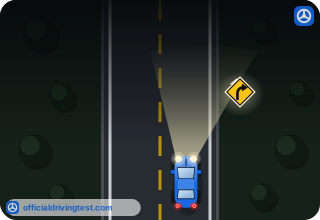
- Never outrun your headlights
- Always keep your high beams on
- Drive at the same speed as in daylight
- Stay close behind the vehicle ahead
Show answer
Correct answer: Never outrun your headlights
Your range of visibility at night is limited by your headlights, so you must be able to stop within the distance they light up.
Source: Tennessee Comprehensive Driver License Manual (March 2025 printing), page 74 · Open this page in the manual (Manual page 74)
-
At night, your stopping distance should be:
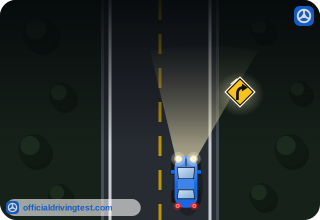
- Greater than your sight distance
- The same as your daytime stopping distance
- Less than your sight distance
- Measured only by how bright your high beams are
Show answer
Correct answer: Less than your sight distance
If you can see only so far, you must be able to stop within that distance; otherwise you will reach what you see too late.
Source: Tennessee Comprehensive Driver License Manual (March 2025 printing), page 74 · Open this page in the manual (Manual page 74)
-
Looking directly into oncoming headlights can cause what?
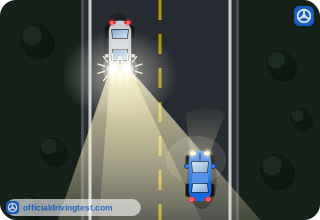
- Momentary blindness from the glare
- Better night vision afterward
- A longer range of visibility
- Faster reaction times
Show answer
Correct answer: Momentary blindness from the glare
The glare of oncoming headlights can blind you for a moment, so you should avoid looking straight into them.
Source: Tennessee Comprehensive Driver License Manual (March 2025 printing), page 74 · Open this page in the manual (Manual page 74)
-
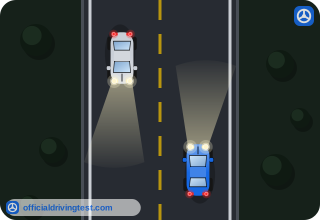
To avoid the glare of oncoming lights at night, what should you watch and use as a steering guide?
- The left edge of the road
- The right edge of the road
- The center of the road
- The oncoming car's headlights
Show answer
Correct answer: The right edge of the road
Watching the right edge of the road, or the white line, keeps your eyes away from the glare while you steer.
Source: Tennessee Comprehensive Driver License Manual (March 2025 printing), page 74 · Open this page in the manual (Manual page 74)
-
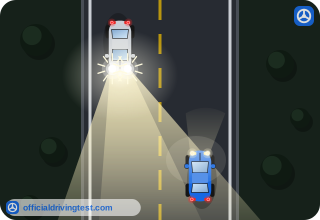
What is meant by glare recovery time?
- Time for your headlights to reach full brightness after switching on
- Time your eyes need to adjust when you first enter a dark tunnel
- Time before a bright windshield reflection fades from the mirror
- Time for your eye's pupil to readjust after oncoming headlights pass
Show answer
Correct answer: Time for your eye's pupil to readjust after oncoming headlights pass
After a bright oncoming light passes, the pupil needs time to readjust to dimmer light, and that delay is glare recovery time.
Source: Tennessee Comprehensive Driver License Manual (March 2025 printing), page 74 · Open this page in the manual (Manual page 74)
-
Glare recovery problems are generally more acute in which drivers?
- Older drivers and those in poor physical condition
- Drivers who have held a license for under a year
- Drivers who only drive during the daytime
- Drivers who wear sunglasses at night
Show answer
Correct answer: Older drivers and those in poor physical condition
The manual says glare recovery is generally harder for older drivers and for people in poor physical condition.
Source: Tennessee Comprehensive Driver License Manual (March 2025 printing), page 74 · Open this page in the manual (Manual page 74)
-
Which ability is impaired after dark?
- Depth perception
- Hearing ability
- Sense of balance
- Muscle strength
Show answer
Correct answer: Depth perception
The manual says depth perception, color recognition and peripheral vision are impaired after dark.
Source: Tennessee Comprehensive Driver License Manual (March 2025 printing), page 74 · Open this page in the manual (Manual page 74)
-
At night, where should you glance to look for dark shapes on the roadway?
- Directly at the hood of your car
- At the headlights of oncoming vehicles
- Well in front of your headlight beams
- Only at the rearview mirror
Show answer
Correct answer: Well in front of your headlight beams
Dark objects on the road are easier to catch if you look beyond your beams, which gives more time to react.
Source: Tennessee Comprehensive Driver License Manual (March 2025 printing), page 74 · Open this page in the manual (Manual page 74)
-
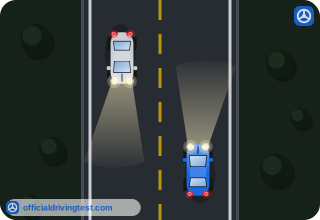
Why should you glance periodically to the right and left when driving at night?
- To make sure your high beams are aimed correctly
- To find the edge of the pavement and oncoming vehicles
- To look for road signs painted in dark colors
- To keep your eyes from becoming tired
Show answer
Correct answer: To find the edge of the pavement and oncoming vehicles
Glancing to each side shows where the pavement ends and where oncoming vehicles are.
Source: Tennessee Comprehensive Driver License Manual (March 2025 printing), page 74 · Open this page in the manual (Manual page 74)
-
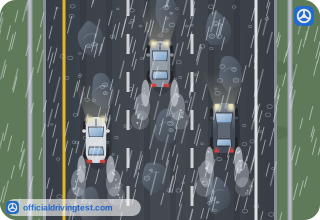
How does the manual compare wet pavement with icy pavement?
- Wet pavement is always safer
- Wet pavement is slippery only at night
- Wet pavement can be just as treacherous
- Wet pavement is not slippery if tires are good
Show answer
Correct answer: Wet pavement can be just as treacherous
Wet pavement can be as treacherous as ice, so you should always reduce your speed in wet weather.
Source: Tennessee Comprehensive Driver License Manual (March 2025 printing), page 75 · Open this page in the manual (Manual page 75)
-
When is the pavement particularly treacherous in rain?
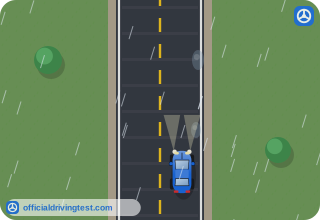
- After it has rained for several hours
- When it first begins to rain
- When the sun comes out after rain
- Right after the road has dried
Show answer
Correct answer: When it first begins to rain
When rain first begins, dirt and oil mix with the water and the road is at its most slippery.
Source: Tennessee Comprehensive Driver License Manual (March 2025 printing), page 75 · Open this page in the manual (Manual page 75)
-
What makes the road greasy when rain first begins to fall?
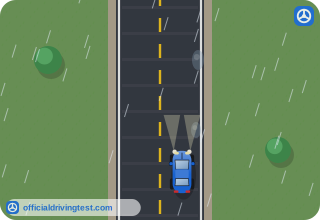
- Salt spread on the road earlier
- Water freezing on the pavement
- Tire rubber melting in the heat
- Dirt and oil mixing with the water
Show answer
Correct answer: Dirt and oil mixing with the water
Accumulated dirt and oil mix with the new rain and form a greasy film that gives tires little grip.
Source: Tennessee Comprehensive Driver License Manual (March 2025 printing), page 75 · Open this page in the manual (Manual page 75)
-
If rain starts on a hot day, why can the pavement be very slippery for the first few minutes?
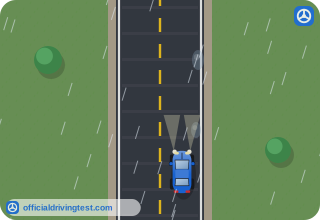
- Hot tires lose their grip on wet asphalt
- Rainwater evaporates and leaves a film of salt
- Heat brings oil in the asphalt to the surface
- Hot air makes the water freeze on contact
Show answer
Correct answer: Heat brings oil in the asphalt to the surface
Heat pushes oil in the asphalt up to the surface, making the road extremely slippery until the oil washes off.
Source: Tennessee Comprehensive Driver License Manual (March 2025 printing), page 75 · Open this page in the manual (Manual page 75)
-
When you drive in inclement weather or fog, what should you do about your speed?
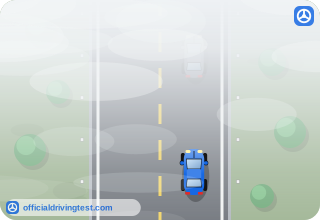
- Reduce it to make up for the reduced visibility
- Keep it the same to avoid being rear-ended
- Increase it to leave the area sooner
- Match the speed of the fastest vehicle nearby
Show answer
Correct answer: Reduce it to make up for the reduced visibility
Poor visibility gives you less time to see hazards, so you slow down to compensate.
Source: Tennessee Comprehensive Driver License Manual (March 2025 printing), page 75 · Open this page in the manual (Manual page 75)