Tennessee: Vehicle controls and signals — Using Your Turn Signals Practice Test
Questions in this part include: “When should you signal while moving forward, according to the steps listed for moving forward?” · “Why should you signal every time you change direction, even if you do not see anyone else around?”
Independent educational site · not affiliated with any government agency or DMV
Ready? Test yourself
- Instant feedback with an explanation
- Every answer cites its source in the manual
- Your best score is saved on this device
- Keyboard: press 1 to 4 to answer and Enter for the next question
Questions are original and based on the official manual "Tennessee Comprehensive Driver License Manual" (March 2025 printing), Tennessee Department of Safety and Homeland Security.
All 16 questions in this practice test
Take the test above first, then use this list to study. Tap “Show answer” to see the correct answer and explanation.
Show the questions and answersHide the questions
-
When should you signal while moving forward, according to the steps listed for moving forward?
- If you are pulling away from a curb
- Only if you are backing out
- Only at night
- Only if another car is behind you
Show answer
Correct answer: If you are pulling away from a curb
One of the steps for moving forward is to signal if you are pulling away from a curb.
Source: Tennessee Comprehensive Driver License Manual (March 2025 printing), page 29 · Open this page in the manual (Manual page 29)
-
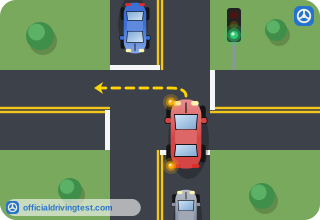
Does using your turn signal give you the right-of-way?
- Yes, over vehicles on your right
- Yes, over oncoming traffic
- No, signaling does not give you the right-of-way
- Yes, if you signal at least 50 feet before the turn
Show answer
Correct answer: No, signaling does not give you the right-of-way
A signal only tells others your intentions; it does not give you the right-of-way.
Source: Tennessee Comprehensive Driver License Manual (March 2025 printing), page 55 · Open this page in the manual (Manual page 55)
-
Which of these is a time when the manual says you should always use turn signals?
- Driving straight through an intersection on green
- Pulling away from a parked position along the curb
- Continuing straight in your lane with no traffic around
- Passing a driveway on your right
Show answer
Correct answer: Pulling away from a parked position along the curb
You should signal when pulling away from a parked position, among other times such as changing lanes and turning.
Source: Tennessee Comprehensive Driver License Manual (March 2025 printing), page 55 · Open this page in the manual (Manual page 55)
-
What should you keep clean and free from dust, dirt, ice or snow so that other drivers can see your signal?
- The inside rear-view mirror only
- The license plate only
- The front and rear turn signal lights
- The fog lights only
Show answer
Correct answer: The front and rear turn signal lights
Front and rear turn signal lights must be clean and free from dust, dirt, ice or snow so they can be seen.
Source: Tennessee Comprehensive Driver License Manual (March 2025 printing), page 55 · Open this page in the manual (Manual page 55)
-
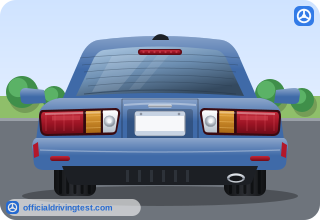
Why should you turn off your turn signal after using it?
- An unintended signal still means “turn” to other drivers
- It wears out the turn signal bulbs much more quickly than usual
- It drains the battery faster than the headlights do
- It is always required to be off while moving in a straight line
Show answer
Correct answer: An unintended signal still means “turn” to other drivers
A signal left on still tells others you are turning, so they may pull out in front of you.
Source: Tennessee Comprehensive Driver License Manual (March 2025 printing), page 55 · Open this page in the manual (Manual page 55)
-
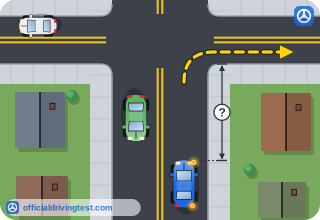
How far before a turn must you turn on your turn signal lights?
- At least 25 feet
- At least 100 feet
- At least 200 feet
- At least 50 feet
Show answer
Correct answer: At least 50 feet
The manual requires turn signal lights to be on at least 50 feet before the turn.
Source: Tennessee Comprehensive Driver License Manual (March 2025 printing), page 56 · Open this page in the manual (Manual page 56)
-
Which of these is a wrong use of your turn signals?
- Signaling before re-entering traffic from a parked position at the curb
- Signaling the driver behind you to come around and pass
- Signaling every time you change direction even if no one is around
- Signaling before changing lanes on a straight road
Show answer
Correct answer: Signaling the driver behind you to come around and pass
Signals should only show when YOU plan to turn or change lanes; using them to wave a driver past is misleading.
Source: Tennessee Comprehensive Driver License Manual (March 2025 printing), page 56 · Open this page in the manual (Manual page 56)
-
You see a driver ahead of you signaling a turn. What should you do with your own signals?
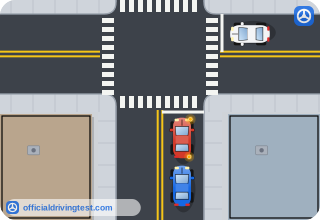
- Turn on your signals to warn the drivers behind you
- Not turn on your signals unless you also plan to turn
- Flash your brake lights twice and then signal
- Turn on your signals to match the driver ahead
Show answer
Correct answer: Not turn on your signals unless you also plan to turn
Relaying another driver’s turn intention is misleading; your brake lights are enough to warn those behind.
Source: Tennessee Comprehensive Driver License Manual (March 2025 printing), page 56 · Open this page in the manual (Manual page 56)
-
You are parked at a curb and about to re-enter traffic. How long should you signal?
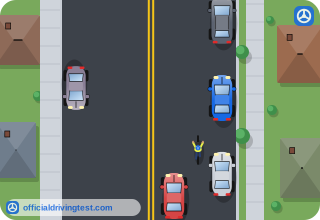
- Only until your vehicle has started to move away from the curb
- For exactly 50 feet, and not a second longer than that
- Long enough to alert oncoming traffic that you are pulling out
- Only if you can see a vehicle approaching from behind you
Show answer
Correct answer: Long enough to alert oncoming traffic that you are pulling out
The signal should last long enough to warn oncoming traffic that you are leaving the parked position.
Source: Tennessee Comprehensive Driver License Manual (March 2025 printing), page 56 · Open this page in the manual (Manual page 56)
-
You plan to turn beyond an intersection. When should you begin signaling?
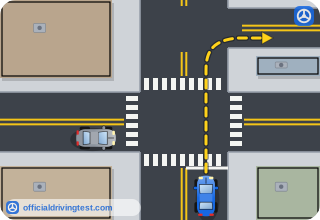
- Not until you are in the intersection
- As soon as you approach the intersection
- At least 200 feet before the intersection
- Only after you have passed the intersection
Show answer
Correct answer: Not until you are in the intersection
Signaling earlier may make another driver think you will turn at the intersection and pull into your path.
Source: Tennessee Comprehensive Driver License Manual (March 2025 printing), page 56 · Open this page in the manual (Manual page 56)
-
Why should you signal every time you change direction, even if you do not see anyone else around?
- Signals are required to be on at all times in traffic
- Signaling turns on the brake lights
- It makes other drivers move over
- The car you do not see is the most dangerous
Show answer
Correct answer: The car you do not see is the most dangerous
Signal even when no one seems to be around because the car you do not see is the most dangerous one.
Source: Tennessee Comprehensive Driver License Manual (March 2025 printing), page 56 · Open this page in the manual (Manual page 56)
-
What should you use to indicate your exit from a roundabout?
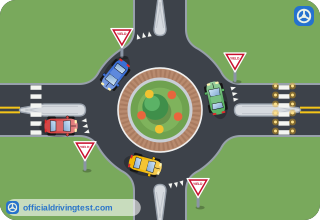
- Your right turn signal
- Your left turn signal
- Your horn
- Your hazard lights
Show answer
Correct answer: Your right turn signal
You always signal your exit from a roundabout with your right turn signal.
Source: Tennessee Comprehensive Driver License Manual (March 2025 printing), page 59 · Open this page in the manual (Manual page 59)
-
Before you change lanes to pass on the left, what should you do?
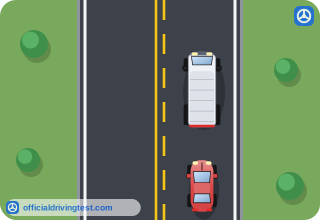
- Signal your move and check your rearview and side-view mirrors
- Sound your horn and then speed up to pass it
- Flash your high beams and then move over at once
- Move into the left lane first, then signal your move
Show answer
Correct answer: Signal your move and check your rearview and side-view mirrors
You signal your intended move to the left and check your rearview and side-view mirrors before changing lanes.
Source: Tennessee Comprehensive Driver License Manual (March 2025 printing), page 62 · Open this page in the manual (Manual page 62)
-
After you return to your lane from a pass, what should you be sure to do?
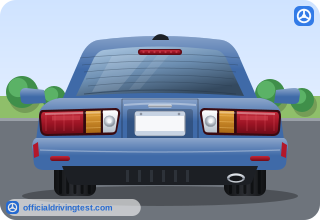
- Cancel your signal so it is not left flashing
- Leave your signal on until the next intersection
- Flash your brake lights to thank the driver
- Sound your horn twice as a courtesy
Show answer
Correct answer: Cancel your signal so it is not left flashing
You cancel the signal light so you are not driving with your right turn signal flashing.
Source: Tennessee Comprehensive Driver License Manual (March 2025 printing), page 62 · Open this page in the manual (Manual page 62)
-
Among the manual's tips for safe interstate driving, when should you signal your intentions?
- Only when cars are near
- As you begin to move
- Only when moving left
- Always, well in advance
Show answer
Correct answer: Always, well in advance
A safe interstate driver always signals well in advance so others know what is coming.
Source: Tennessee Comprehensive Driver License Manual (March 2025 printing), page 71 · Open this page in the manual (Manual page 71)
-
When does the manual say you should use your turn signals?
- Any time you plan to change directions, even on an empty road
- Only when another vehicle is close enough to see your signal
- Only when you turn at an intersection on a busy road
- Only when you change lanes on a road with several lanes
Show answer
Correct answer: Any time you plan to change directions, even on an empty road
Signal whenever you change directions, such as changing lanes, turning, entering an interstate or pulling away from a curb, even on an empty road.
Source: Tennessee Comprehensive Driver License Manual (March 2025 printing), page 94 · Open this page in the manual (Manual page 94)