Tennessee: Vehicle controls and signals
Getting ready to drive, steering, backing and stopping, turn and hand signals, headlights, and keeping your vehicle safe to drive. Split into 11 shorter tests so you're not stuck in one long quiz.
Independent educational site · not affiliated with any government agency or DMV
Choose a part
Vehicle controls and signals — Pre-Trip Vehicle Inspection: Required Equipment
Questions in this part include: “What must the vehicle you bring for the road test meet?”
StartVehicle controls and signals — Seat, Mirrors and Getting Ready to Drive
Questions in this part include: “Before you get into the vehicle, what does the manual say to look for as you check around the outside?”
StartVehicle controls and signals — Starting the Vehicle Engine and Gears
Questions in this part include: “What must you make sure of before starting any manual transmission vehicle?”
StartVehicle controls and signals — Steering the Vehicle
Questions in this part include: “How should you hold the steering wheel when you begin driving?”
StartVehicle controls and signals — Backing, Moving Forward and Stopping
Questions in this part include: “When backing, which way do you turn the wheel to back to the right?”
StartVehicle controls and signals — Carbon Monoxide, Exhaust and Engine Care
Questions in this part include: “What is every vehicle required to have to prevent excessive or unusual noises and polluting smoke?”
StartVehicle controls and signals — Headlights and Lighting Rules
Questions in this part include: “Your high beams are on and an oncoming vehicle is within what distance before you must dim them?”
StartVehicle controls and signals — Using Your Turn Signals
Questions in this part include: “When should you signal while moving forward, according to the steps listed for moving forward?”
StartVehicle controls and signals — Hand Signals, Brake Lights and the Horn
Questions in this part include: “On which motor vehicles is a horn required?”
StartVehicle controls and signals — Brakes, Antilock Brakes and Vehicle Checks
Questions in this part include: “By law, what two methods of applying the brakes must all automobiles have?”
StartVehicle controls and signals — Tires, Windshield and Windows
Questions in this part include: “Why should you keep the inside of your windows clean, especially if anyone using the vehicle smokes?”
StartAll 189 Vehicle controls and signals questions with answers
Choose a part above to take a practice test, or study every question and answer here.
Show the questions and answersHide the questions
-
What must the vehicle you bring for the road test meet?
- Only the requirements printed in the vehicle’s owner’s manual and warranty
- All Tennessee motor vehicle registration (valid tags) and safety law requirements
- Only the examiner’s personal preferences
- Only the insurance company’s requirements
Show answer
Correct answer: All Tennessee motor vehicle registration (valid tags) and safety law requirements
The vehicle must meet the state registration (valid tags) and safety law requirements and have equipment in proper working order.
Source: Tennessee Comprehensive Driver License Manual (March 2025 printing), page 22 · Open this page in the manual (Manual page 22)
-
By law, what two methods of applying the brakes must all automobiles have?
- A regular foot brake and a parking brake
- A foot brake and a hand throttle
- A foot brake only
- A parking brake and an engine brake
Show answer
Correct answer: A regular foot brake and a parking brake
Automobiles must have two separate ways to apply the brakes: a regular foot brake and a parking brake.
Source: Tennessee Comprehensive Driver License Manual (March 2025 printing), page 22 · Open this page in the manual (Manual page 22)
-
How many white headlights must a motor vehicle have?
- Exactly two
- At least one but no more than three
- At least two but no more than four
- At least four but no more than six
Show answer
Correct answer: At least two but no more than four
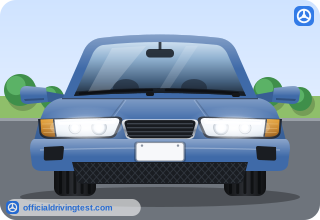
Motor vehicles must have at least two headlights but no more than four white headlights.
Source: Tennessee Comprehensive Driver License Manual (March 2025 printing), page 22 · Open this page in the manual (Manual page 22)
-
What lights must a passenger vehicle have at the rear?
- A rear license light, one red tail light, and one red brake light
- A rear license light, two red tail lights, and two red brake lights
- A rear license light, two white tail lights and two red brake lights
- One red tail light and one red brake light
Show answer
Correct answer: A rear license light, two red tail lights, and two red brake lights
Passenger vehicles must have a rear license light, two red tail lights, and two red brake lights.
Source: Tennessee Comprehensive Driver License Manual (March 2025 printing), page 22 · Open this page in the manual (Manual page 22)
-
A vehicle with a windshield should have 2 wipers unless 1 wiper cleans to within what distance of the inside of the windshield?
- 3 inches
- 6 inches
- 12 inches
- 1 inch
Show answer
Correct answer: 1 inch
The manual says every vehicle with a windshield should have 2 wipers, unless 1 wiper cleans to within 1 inch.
Source: Tennessee Comprehensive Driver License Manual (March 2025 printing), page 22 · Open this page in the manual (Manual page 22)
-
What must applicants be able to demonstrate about the windshield defroster and fan control?
- How to ‘defog’ the windshield
- How to melt snow from the roof
- How to clean the rear window with the washer
- How to turn the heater off completely
Show answer
Correct answer: How to ‘defog’ the windshield
Applicants need to demonstrate how to defog the windshield.
Source: Tennessee Comprehensive Driver License Manual (March 2025 printing), page 22 · Open this page in the manual (Manual page 22)
-
What must the vehicle have regarding rearview mirrors?
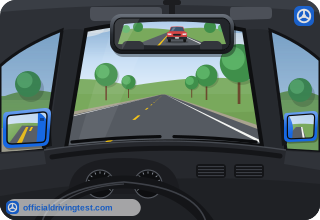
- Two inside rearview mirrors and one outside mirror, all required
- At least one mirror, even if it interferes with the driver’s rear view
- At least one mirror that does not interfere with the driver’s rear view
- A mirror attached only to the windshield, with no side mirrors
Show answer
Correct answer: At least one mirror that does not interfere with the driver’s rear view
The vehicle must have at least one rearview mirror that does not interfere with the driver’s view to the rear.
Source: Tennessee Comprehensive Driver License Manual (March 2025 printing), page 22 · Open this page in the manual (Manual page 22)
-
Applicants with certain vision or hearing impairments are also required to have what on the vehicle?
- A rear window defroster only
- Two outside rearview mirrors
- A second horn
- A backup camera
Show answer
Correct answer: Two outside rearview mirrors
For applicants with certain vision or hearing impairments, two outside rearview mirrors are also required.
Source: Tennessee Comprehensive Driver License Manual (March 2025 printing), page 22 · Open this page in the manual (Manual page 22)
-
On which motor vehicles is a horn required?
- Only vehicles driven on interstates
- Only passenger cars
- Only vehicles more than ten years old
- All motor vehicles
Show answer
Correct answer: All motor vehicles
A horn is required on all motor vehicles.
Source: Tennessee Comprehensive Driver License Manual (March 2025 printing), page 22 · Open this page in the manual (Manual page 22)
-
What is unlawful regarding the windshield of a motor vehicle?
- Driving with a windshield so cracked, or covered with steam or frost, that clear vision is prevented
- Driving with a windshield that has any small chip or crack in it, even if you can see
- Driving with a windshield that is wet from rain, even if the wipers are working
- Driving with a clean windshield during the day, even when the sun is bright
Show answer
Correct answer: Driving with a windshield so cracked, or covered with steam or frost, that clear vision is prevented
It is unlawful to drive with a windshield so cracked or covered with steam or frost that clear vision is prevented.
Source: Tennessee Comprehensive Driver License Manual (March 2025 printing), page 23 · Open this page in the manual (Manual page 23)
-
In which directions is clear vision for the driver required?
- To the front only
- To the front and rear only
- To the front, rear and both sides
- To the front and the left side only
Show answer
Correct answer: To the front, rear and both sides
Clear vision is required to the front, rear and both sides.
Source: Tennessee Comprehensive Driver License Manual (March 2025 printing), page 23 · Open this page in the manual (Manual page 23)
-
What is the rule on tinting material on the windshield of a motor vehicle?
- Tint is allowed on the lower half of the windshield
- No tinting material may be affixed to the windshield
- Tint is allowed if it transmits 35% of light
- Tint is allowed only on the top 5 inches
Show answer
Correct answer: No tinting material may be affixed to the windshield
No tinting material may be affixed to the windshield of any motor vehicle.
Source: Tennessee Comprehensive Driver License Manual (March 2025 printing), page 23 · Open this page in the manual (Manual page 23)
-
On a passenger car, no window material may transmit less than what percentage of visible light?
- 15%
- 25%
- 50%
- 35%
Show answer
Correct answer: 35%
No material that transmits less than 35% of visible light may be attached to any window of a passenger car.
Source: Tennessee Comprehensive Driver License Manual (March 2025 printing), page 23 · Open this page in the manual (Manual page 23)
-
For a multi-purpose vehicle, which windows are exempt from the tint standard?
- All windows behind the front seat
- The rear window only
- The windshield
- The windows immediately to the left and right of the driver
Show answer
Correct answer: All windows behind the front seat
On multi-purpose vehicles, all windows behind the front seat are exempt, while the windows next to the driver must comply as for passenger vehicles.
Source: Tennessee Comprehensive Driver License Manual (March 2025 printing), page 23 · Open this page in the manual (Manual page 23)
-
What is every vehicle required to have to prevent excessive or unusual noises and polluting smoke?
- A catalytic heater
- A sound-absorbing roof
- A muffler
- A noise-limit sticker
Show answer
Correct answer: A muffler
Every vehicle must be equipped with a muffler.
Source: Tennessee Comprehensive Driver License Manual (March 2025 printing), page 23 · Open this page in the manual (Manual page 23)
-
How must the driver door and the passenger door open?
- From the inside only, never from the outside
- From both the inside and the outside
- From the outside only, never from the inside
- Only with a key or a remote
Show answer
Correct answer: From both the inside and the outside
Both doors must open from the inside and the outside.
Source: Tennessee Comprehensive Driver License Manual (March 2025 printing), page 23 · Open this page in the manual (Manual page 23)
-
Passenger cars must have bumpers within what range from the ground?
- 6 to 12 inches
- 10 to 18 inches
- 20 to 28 inches
- 14 to 22 inches
Show answer
Correct answer: 14 to 22 inches
Passenger cars must have bumpers within a range of 14 to 22 inches from the ground.
Source: Tennessee Comprehensive Driver License Manual (March 2025 printing), page 23 · Open this page in the manual (Manual page 23)
-
4x4 recreational vehicles must have bumpers within what range from the ground?
- 14 to 31 inches
- 10 to 18 inches
- 16 to 24 inches
- 20 to 36 inches
Show answer
Correct answer: 14 to 31 inches
4x4 recreational vehicles must have bumpers within a range of 14 to 31 inches from the ground.
Source: Tennessee Comprehensive Driver License Manual (March 2025 printing), page 23 · Open this page in the manual (Manual page 23)
-
Why must every vehicle have a working speedometer?
- To count the miles driven for the registration
- To signal when the engine overheats
- To gauge vehicle speed
- To record the speed of other vehicles
Show answer
Correct answer: To gauge vehicle speed
A working speedometer is required in order to gauge vehicle speed.
Source: Tennessee Comprehensive Driver License Manual (March 2025 printing), page 23 · Open this page in the manual (Manual page 23)
-
Before you get into the vehicle, what does the manual say to look for as you check around the outside?
- Small children, pets and any other sort of obstruction
- Only other moving vehicles close to your car
- Only the license plate and registration sticker
- Only the fuel level and the oil level
Show answer
Correct answer: Small children, pets and any other sort of obstruction
The manual tells you to walk around the vehicle and look for small children, pets and any other obstruction before getting in.
Source: Tennessee Comprehensive Driver License Manual (March 2025 printing), page 27 · Open this page in the manual (Manual page 27)
-
When you check the condition of the vehicle before driving, the manual lists the windows, lights, body damage and tires. What else does it list?
- The mileage shown on the odometer
- The color of the paint
- Potential fluid leaks
- Whether the radio works
Show answer
Correct answer: Potential fluid leaks
The condition check covers windows, lights, body damage, tire condition and potential fluid leaks.
Source: Tennessee Comprehensive Driver License Manual (March 2025 printing), page 27 · Open this page in the manual (Manual page 27)
-
After you enter the vehicle and place the key in the ignition, what does the manual say to do with the doors?
- Leave them unlocked
- Lock them
- Open them slightly
- Lock only the passenger doors
Show answer
Correct answer: Lock them
The pre-drive steps are to enter the vehicle, place the key in the ignition and lock the doors.
Source: Tennessee Comprehensive Driver License Manual (March 2025 printing), page 27 · Open this page in the manual (Manual page 27)
-
What does the manual say about knowing where the horn, turn signals, four-way flashers, headlights and wiper controls are located?
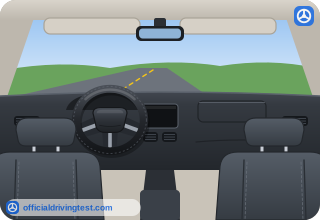
- Learn them only after you have driven for a few weeks
- Learn only the controls needed for the road you are on
- Learn them only if the vehicle has a manual transmission
- Know where they are even if you do not need them at the moment
Show answer
Correct answer: Know where they are even if you do not need them at the moment
The manual says to know the location of these controls even when there is no need to use them right then.
Source: Tennessee Comprehensive Driver License Manual (March 2025 printing), page 27 · Open this page in the manual (Manual page 27)
-
What does the manual say about driving with the seat in a reclined or semi-reclined position?
- It is acceptable on long trips if you feel tired
- It is fine as long as you wear your safety belt
- It is safe on interstates where traffic moves steadily
- Do not do it, because it reduces vision and the ability to react
Show answer
Correct answer: Do not do it, because it reduces vision and the ability to react
A reclined seat is dangerous: it limits what you can see and slows your reaction in an emergency.
Source: Tennessee Comprehensive Driver License Manual (March 2025 printing), page 27 · Open this page in the manual (Manual page 27)
-
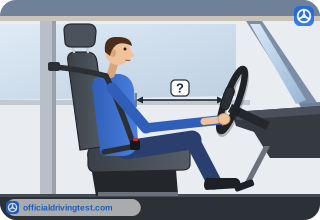
About how far back from the steering wheel should your body be, with or without an air bag?
- 3 to 5 inches
- 10 to 12 inches
- 14 to 16 inches
- 20 to 24 inches
Show answer
Correct answer: 10 to 12 inches
The manual puts the driver's body about 10 to 12 inches back from the steering wheel.
Source: Tennessee Comprehensive Driver License Manual (March 2025 printing), page 27 · Open this page in the manual (Manual page 27)
-
Why does the manual warn against sitting too close to the steering wheel?
- The air bag would not be able to inflate at all when the crash happens
- The seat belt would not lock properly in a crash
- An air bag could hit your chin or face and cause head or neck injuries
- It would make your turn signals hard to reach while you steer
Show answer
Correct answer: An air bag could hit your chin or face and cause head or neck injuries
Sitting closer than about 10 to 12 inches risks serious head or neck injuries from an air bag striking the chin or face.
Source: Tennessee Comprehensive Driver License Manual (March 2025 printing), page 27 · Open this page in the manual (Manual page 27)
-
When your foot moves from the accelerator to the brake, what should your heel do?
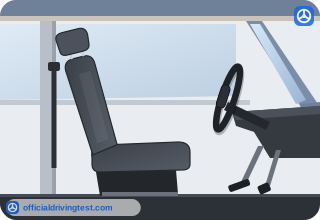
- Stay on the floor
- Rest on the accelerator
- Lift off the floor
- Rest on the brake
Show answer
Correct answer: Stay on the floor
The manual says your foot should move smoothly between the pedals while the heel is kept on the floor.
Source: Tennessee Comprehensive Driver License Manual (March 2025 printing), page 27 · Open this page in the manual (Manual page 27)
-
When you adjust your seat, what does the manual say about the pedals?
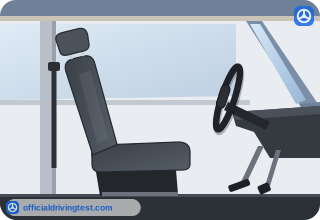
- They should be reachable only with your toes
- They must be easily reached
- They should need a full stretch of your legs
- They should sit just under your knees
Show answer
Correct answer: They must be easily reached
The manual says the pedals must be easily reached when you set the seat's distance.
Source: Tennessee Comprehensive Driver License Manual (March 2025 printing), page 27 · Open this page in the manual (Manual page 27)
-
The top of the steering wheel should be no higher than:
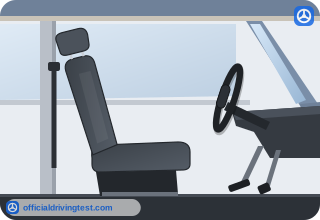
- Your chin
- The top of your head
- The level of your eyes
- The top of your shoulders
Show answer
Correct answer: The top of your shoulders
The manual says the top of the steering wheel should be no higher than the top of the shoulders.
Source: Tennessee Comprehensive Driver License Manual (March 2025 printing), page 27 · Open this page in the manual (Manual page 27)
-
To what level should seat head restraints be adjusted?
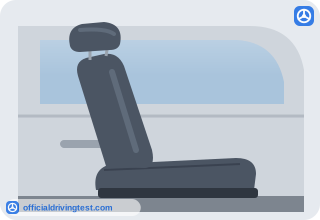
- Even with the back of your head
- Even with the top of your shoulders
- Level with the base of your neck
- Even with your eyes and eyebrows
Show answer
Correct answer: Even with the back of your head
The manual says to adjust head restraints to a level even with the back of the head.
Source: Tennessee Comprehensive Driver License Manual (March 2025 printing), page 27 · Open this page in the manual (Manual page 27)
-
What are head restraints designed to prevent?
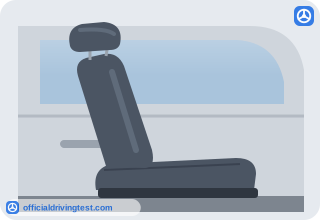
- Glare from the rear window
- Injury from a side-impact crash
- Whiplash if you are hit from behind
- Your seat from sliding backward
Show answer
Correct answer: Whiplash if you are hit from behind
Head restraints are designed to prevent whiplash when the vehicle is hit from behind.
Source: Tennessee Comprehensive Driver License Manual (March 2025 printing), page 27 · Open this page in the manual (Manual page 27)
-
When should you adjust your mirrors in relation to your seat?
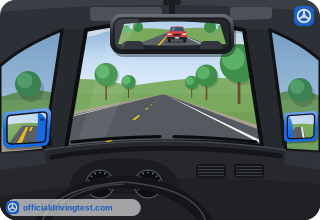
- Before the seat is adjusted
- While the vehicle is moving in traffic
- After the seat is adjusted correctly
- Only after driving a few blocks
Show answer
Correct answer: After the seat is adjusted correctly
Mirrors are adjusted after the seat is correct, and always before driving.
Source: Tennessee Comprehensive Driver License Manual (March 2025 printing), page 27 · Open this page in the manual (Manual page 27)
-
How must all three of the rear view mirrors be adjusted?
- So that they give the widest possible view
- So that they show mostly the sides of your own car
- So that they show only the road directly behind
- So that blind spots are covered by the outside mirrors only
Show answer
Correct answer: So that they give the widest possible view
The mirrors must give the widest possible view while keeping blind spots to a minimum.
Source: Tennessee Comprehensive Driver License Manual (March 2025 printing), page 27 · Open this page in the manual (Manual page 27)
-
How should you adjust the inside rearview mirror?
- To frame the right side window
- To show only the road surface
- To point at the rear bumper
- To frame the rear window
Show answer
Correct answer: To frame the rear window
The inside rearview mirror is adjusted so that it frames the rear window.
Source: Tennessee Comprehensive Driver License Manual (March 2025 printing), page 27 · Open this page in the manual (Manual page 27)
-
To get the smallest blind spot at the right side of the car, what should you see in the inside mirror?
- The whole right rear window and door
- Only the edge of the right rear window post
- Only the rear bumper of your car
- The left rear window post
Show answer
Correct answer: Only the edge of the right rear window post
Turning the inside mirror so only the edge of the right rear window post shows gives the smallest blind spot on the right.
Source: Tennessee Comprehensive Driver License Manual (March 2025 printing), page 27 · Open this page in the manual (Manual page 27)
-
You adjust the driver's side-view mirror with your head against the left side window. How should the mirror be set?
- So you can just barely see the side of your car in the part nearest the window
- So you can see a large part of the side of your car in the mirror
- So you cannot see any part of your own car in the mirror at all
- So you see only the road behind your rear wheel in the mirror
Show answer
Correct answer: So you can just barely see the side of your car in the part nearest the window
The left mirror is set so only a sliver of your car's side shows in the part of the mirror closest to the window.
Source: Tennessee Comprehensive Driver License Manual (March 2025 printing), page 27 · Open this page in the manual (Manual page 27)
-
To adjust the passenger's side-view mirror, where should you position your head?
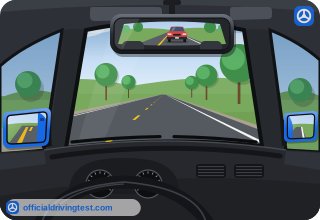
- Against the right side window
- Just above the steering wheel
- Just above the center console
- Leaning over the back seat
Show answer
Correct answer: Just above the center console
For the right side mirror you sit upright and put your head just above the center console.
Source: Tennessee Comprehensive Driver License Manual (March 2025 printing), page 27 · Open this page in the manual (Manual page 27)
-
After adjusting your mirrors, you lean slightly backward and see more than a glimpse of the rear corners of your vehicle in the outside mirrors. What should you do?
- Adjust the outside mirrors inward
- Adjust the outside mirrors outward
- Leave them where they are
- Tilt the outside mirrors toward the ground
Show answer
Correct answer: Adjust the outside mirrors outward
Seeing more than a glimpse of the vehicle's rear corners means the outside mirrors should be adjusted outward.
Source: Tennessee Comprehensive Driver License Manual (March 2025 printing), page 27 · Open this page in the manual (Manual page 27)
-
To check your mirror position, a car passes you on the left. As it leaves the view of the inside mirror, what should you see?
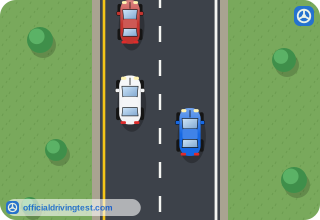
- Its rear bumper in the outside left mirror
- Its front bumper in the outside right mirror
- Nothing until it is beside your door
- Its front bumper in the outside left mirror
Show answer
Correct answer: Its front bumper in the outside left mirror
With correct settings, a car passing on the left should appear in the outside left mirror as it leaves the inside mirror.
Source: Tennessee Comprehensive Driver License Manual (March 2025 printing), page 27 · Open this page in the manual (Manual page 27)
-
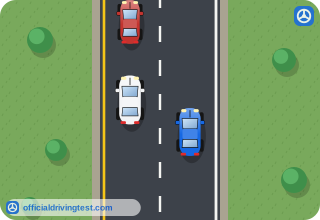
Even with properly adjusted mirrors, what should you always do when you want to turn or change lanes?
- Rely on the outside mirrors alone
- Check only the inside mirror
- Sound the horn instead of looking
- Turn your head and check blind spots
Show answer
Correct answer: Turn your head and check blind spots
Mirrors cannot eliminate all blind spots, so you must turn your head and look before any lateral move.
Source: Tennessee Comprehensive Driver License Manual (March 2025 printing), page 27 · Open this page in the manual (Manual page 27)
-
In which position should the gearshift selector be before you start an automatic transmission vehicle?
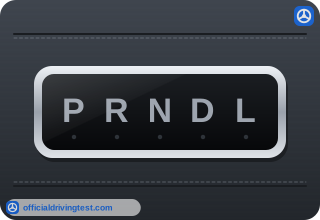
- DRIVE
- REVERSE
- PARK
- L (low)
Show answer
Correct answer: PARK
For automatic transmissions the selector goes in PARK, with your foot on the brake, before starting.
Source: Tennessee Comprehensive Driver License Manual (March 2025 printing), page 28 · Open this page in the manual (Manual page 28)
-
In which position should the gearshift be before you start a vehicle with a manual (standard) transmission?
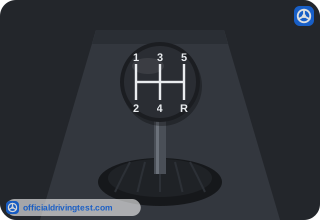
- NEUTRAL
- PARK
- REVERSE
- First gear
Show answer
Correct answer: NEUTRAL
For manual or standard transmissions the gearshift goes in NEUTRAL, with your foot on the brake, before starting.
Source: Tennessee Comprehensive Driver License Manual (March 2025 printing), page 28 · Open this page in the manual (Manual page 28)
-
What must you make sure of before starting any manual transmission vehicle?
- That the parking brake is off
- That the parking brake is on
- That the parking brake is half released
- That the headlights are on high beam
Show answer
Correct answer: That the parking brake is on
The manual says to make sure the parking brake is on before starting a manual transmission vehicle.
Source: Tennessee Comprehensive Driver License Manual (March 2025 printing), page 28 · Open this page in the manual (Manual page 28)
-
In a vehicle with a manual transmission, what must be depressed before the vehicle will start?
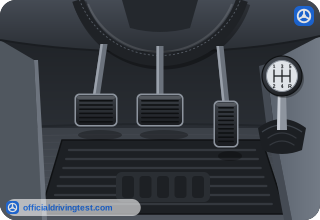
- The accelerator pedal
- The parking brake release
- The headlight dimmer switch
- The clutch
Show answer
Correct answer: The clutch
A manual transmission vehicle will not start until the clutch is depressed.
Source: Tennessee Comprehensive Driver License Manual (March 2025 printing), page 28 · Open this page in the manual (Manual page 28)
-
After you turn the key to "on," what should you check for warnings or alerts?
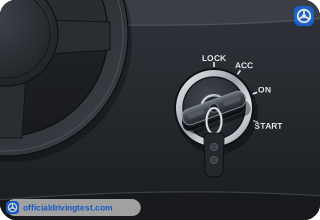
- Dash lights and instruments
- The tread depth of the tires
- The position of the outside mirrors
- The seat adjustment
Show answer
Correct answer: Dash lights and instruments
The manual says to check the dash lights and instruments (ABS, air bags, fuel level and so on) for warnings or alerts.
Source: Tennessee Comprehensive Driver License Manual (March 2025 printing), page 28 · Open this page in the manual (Manual page 28)
-
Which headlights does the manual say to turn on when starting the vehicle, particularly at night or in bad weather?
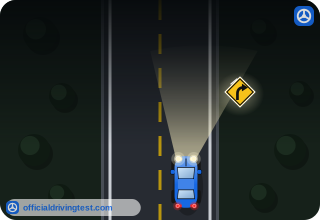
- High-beam headlights
- Fog lights only
- Low-beam headlights
- Parking lights only
Show answer
Correct answer: Low-beam headlights
The manual says to turn on low-beam headlights, particularly at night or in bad weather.
Source: Tennessee Comprehensive Driver License Manual (March 2025 printing), page 28 · Open this page in the manual (Manual page 28)
-
In normal daylight, how far away are vehicles visible when their headlights are on, compared with headlights off?
- The same distance
- Half the distance
- Twice the distance
- Three times the distance
Show answer
Correct answer: Twice the distance
The manual notes that in normal daylight vehicles are visible at twice the distance when headlights are on.
Source: Tennessee Comprehensive Driver License Manual (March 2025 printing), page 28 · Open this page in the manual (Manual page 28)
-
Some newer automatic cars have an "O" gear selection for overdrive. When is it for use?
- On interstates or other expressways with very little stop and go traffic
- On steep mountain grades where the vehicle needs engine braking
- At slow speeds on icy or other slippery roads
- For emergency deceleration after a brake failure
Show answer
Correct answer: On interstates or other expressways with very little stop and go traffic
Overdrive is meant for interstates or other expressways where there is very little stop and go traffic.
Source: Tennessee Comprehensive Driver License Manual (March 2025 printing), page 28 · Open this page in the manual (Manual page 28)
-
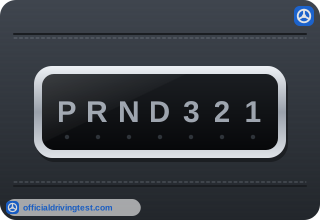
Which situation does the manual list for using the lower gears ("L," "2" or "1") of an automatic transmission?
- Normal city driving
- Accelerating onto an expressway
- Backing out of a driveway
- Driving down steep mountain grades
Show answer
Correct answer: Driving down steep mountain grades
The lower gears are generally used only in special situations such as steep mountain grades, slow driving on slippery roads and brake failure.
Source: Tennessee Comprehensive Driver License Manual (March 2025 printing), page 28 · Open this page in the manual (Manual page 28)
-
With a standard (manual) transmission, what can the driver use, rather than brakes, to help slow down the vehicle?
- Neutral
- Gears
- The clutch held down
- The parking brake
Show answer
Correct answer: Gears
A driver with a standard transmission can use the gears instead of the brakes to help slow down.
Source: Tennessee Comprehensive Driver License Manual (March 2025 printing), page 28 · Open this page in the manual (Manual page 28)
-
In a vehicle with a standard transmission, at what speed should you hold the clutch pedal all the way down as you come to a stop?
- When speed drops below 10 MPH
- When speed drops below 5 MPH
- When speed drops below 20 MPH
- When speed drops below 25 MPH
Show answer
Correct answer: When speed drops below 10 MPH
The manual says to hold the clutch all the way down when starting, when shifting and when speed drops below 10 MPH while coming to a stop.
Source: Tennessee Comprehensive Driver License Manual (March 2025 printing), page 28 · Open this page in the manual (Manual page 28)
-
What does it mean to "ride the clutch"?
- Pressing the clutch all the way to the floor before every turn signal
- Shifting gears without using the accelerator pedal
- Driving with your foot resting on the clutch pedal when it is not needed
- Keeping the vehicle in a low gear on every hill
Show answer
Correct answer: Driving with your foot resting on the clutch pedal when it is not needed
Riding the clutch means keeping your foot on the clutch pedal when you are not changing gears, which the manual says not to do.
Source: Tennessee Comprehensive Driver License Manual (March 2025 printing), page 28 · Open this page in the manual (Manual page 28)
-
The manual says coasting with the gears in neutral is:
- Allowed on downgrades
- Illegal
- Allowed on interstates
- Recommended to save fuel
Show answer
Correct answer: Illegal
The manual states that coasting with the gears in neutral is illegal.
Source: Tennessee Comprehensive Driver License Manual (March 2025 printing), page 28 · Open this page in the manual (Manual page 28)
-
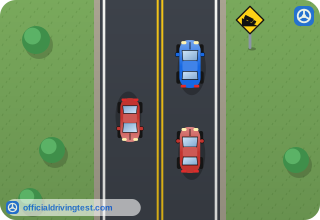
What should you do when going down steep hills in a vehicle with a standard transmission?
- Shift into neutral and coast down
- Hold the clutch pedal down all the way
- Shift into the highest gear available
- Place the vehicle in a lower gear
Show answer
Correct answer: Place the vehicle in a lower gear
The manual says to place the vehicle in a lower gear when going down steep hills.
Source: Tennessee Comprehensive Driver License Manual (March 2025 printing), page 28 · Open this page in the manual (Manual page 28)
-
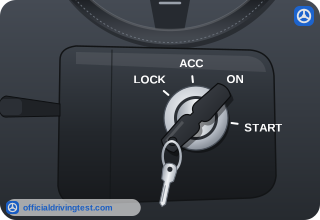
What is the basic rule for a driver operating a vehicle with a steering wheel interlock system?
- Never turn the ignition to the on position when the vehicle is parked
- Always turn the ignition to lock before applying the brakes
- Never use the turn signals while the wheel is turning
- Never turn the ignition to the lock position when the vehicle is in motion
Show answer
Correct answer: Never turn the ignition to the lock position when the vehicle is in motion
Turning the ignition to lock while moving locks the steering wheel, and control of the vehicle will be lost.
Source: Tennessee Comprehensive Driver License Manual (March 2025 printing), page 28 · Open this page in the manual (Manual page 28)
-
How should you hold the steering wheel when you begin driving?
- With one hand on the wheel and the other free for controls
- With a relaxed grip and BOTH hands on the wheel
- With one hand while the other arm rests on the door
- With both hands, as tightly as you can
Show answer
Correct answer: With a relaxed grip and BOTH hands on the wheel
The manual says to use a relaxed grip and always drive with both hands on the wheel.
Source: Tennessee Comprehensive Driver License Manual (March 2025 printing), page 28 · Open this page in the manual (Manual page 28)
-
What does a firm (but not tight) grip on the steering wheel allow you to do?
- Steer with only one finger
- Turn without moving your arms at all
- "Feel" the road (vibrations, etc.) better
- Avoid using the turn signal
Show answer
Correct answer: "Feel" the road (vibrations, etc.) better
A firm but not tight grip lets you feel vibrations from the road better.
Source: Tennessee Comprehensive Driver License Manual (March 2025 printing), page 28 · Open this page in the manual (Manual page 28)
-
Why does the manual warn against driving with your elbow or arm propped on the door or out the window?
- You will not have full control of the steering wheel
- It drains the battery of the vehicle quickly
- It blocks the view in the outside mirror
- It makes the turn signals hard to reach
Show answer
Correct answer: You will not have full control of the steering wheel
With an arm on the door or out the window you won't have full control of the wheel, and a sideswipe could take off the arm.
Source: Tennessee Comprehensive Driver License Manual (March 2025 printing), page 28 · Open this page in the manual (Manual page 28)
-
When steering, where should you always look?
- At the hood of your car
- Where you want to go
- At the steering wheel
- At the nearest vehicle
Show answer
Correct answer: Where you want to go
The manual says to always look where you want to go, which tells your brain what to do with your hands.
Source: Tennessee Comprehensive Driver License Manual (March 2025 printing), page 28 · Open this page in the manual (Manual page 28)
-
Looking at the steering wheel as a clock face, where does the manual say to place your hands?
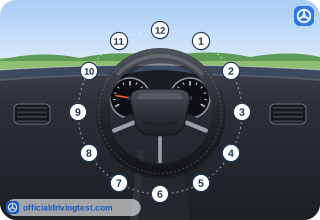
- Left hand at 10 o'clock and right hand at 2 o'clock
- Left hand at 11 o'clock and right hand at 1 o'clock
- Left hand at 7 o'clock and right hand at 5 o'clock
- Left hand at 9 o'clock and right hand at 3 o'clock
Show answer
Correct answer: Left hand at 9 o'clock and right hand at 3 o'clock
The manual places the left hand at 9 o'clock and the right hand at 3 o'clock, which helps avoid injury from air bag deployment.
Source: Tennessee Comprehensive Driver License Manual (March 2025 printing), page 28 · Open this page in the manual (Manual page 28)
-
When the palm of your hand reaches the top of the steering wheel, how should your arm be?
- With a slight bend in the elbow
- With the elbow locked straight
- With the arm fully extended
- With the elbow pressed against your ribs
Show answer
Correct answer: With a slight bend in the elbow
The manual says to have a slight bend in the elbow and never to sit with elbows locked in a stiff-arm position.
Source: Tennessee Comprehensive Driver License Manual (March 2025 printing), page 28 · Open this page in the manual (Manual page 28)
-
What is the term for reversing the hand and arm movements you made during a turn when you come out of the turn?
- Push-pull steering
- Hand-over-hand steering
- Countersteering
- Wheel slipping
Show answer
Correct answer: Countersteering
Reversing the hand and arm movements coming out of a turn is called countersteering; it makes turns smooth and helps in skids.
Source: Tennessee Comprehensive Driver License Manual (March 2025 printing), page 28 · Open this page in the manual (Manual page 28)
-
Which of these is OK while you are turning the steering wheel?
- Crossing your arms
- Resting your elbow on the door
- Crossing your wrists
- Letting the wheel slip through your fingers
Show answer
Correct answer: Crossing your wrists
The manual says it is OK to cross wrists, but not arms, because clothing and jewelry may interfere and air bag injuries would be worse.
Source: Tennessee Comprehensive Driver License Manual (March 2025 printing), page 28 · Open this page in the manual (Manual page 28)
-
Which steering method does the manual recommend for normal everyday driving?
- Push-Pull
- Hand-over-Hand
- One hand at the top of the wheel
- Palm-to-palm
Show answer
Correct answer: Push-Pull
The Push-Pull method is recommended because it keeps both hands on the wheel and slows down turning movements.
Source: Tennessee Comprehensive Driver License Manual (March 2025 printing), page 29 · Open this page in the manual (Manual page 29)
-
When turning with the Hand-over-Hand method, what should you be careful to do?
- Keep your speed up
- Use only your right hand
- Turn the wheel only a quarter turn
- Keep your speed down
Show answer
Correct answer: Keep your speed down
The manual warns to be careful to keep speed down when using the Hand-over-Hand method.
Source: Tennessee Comprehensive Driver License Manual (March 2025 printing), page 29 · Open this page in the manual (Manual page 29)
-
Which steering method allows quicker wheel movement but leaves times when only one hand is on the wheel?
- Push-Pull
- Hand-over-Hand
- Countersteering
- Palm-to-palm
Show answer
Correct answer: Hand-over-Hand
The Hand-over-Hand method allows quicker wheel movement, but only one hand is on the wheel at times.
Source: Tennessee Comprehensive Driver License Manual (March 2025 printing), page 29 · Open this page in the manual (Manual page 29)
-
In a Push-Pull left turn, to about what position do you pull the wheel down with your left hand?
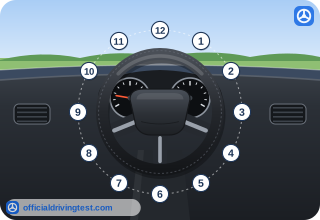
- 7 o'clock
- 6 o'clock
- 10 o'clock
- 12 o'clock
Show answer
Correct answer: 7 o'clock
For a left turn you pull down with the left hand to about 7 o'clock, then push up with the right hand to about 1 o'clock.
Source: Tennessee Comprehensive Driver License Manual (March 2025 printing), page 29 · Open this page in the manual (Manual page 29)
-
In a Hand-over-Hand right turn, where do you grasp the outside of the rim with your right hand, palm down?
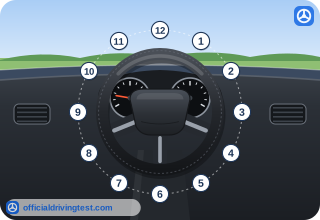
- At the 7 o'clock position
- At the 9 o'clock position
- At the 1 o'clock position
- At the 11 o'clock position
Show answer
Correct answer: At the 1 o'clock position
The manual says to lean forward and grasp the rim at the 1 o'clock position with the right hand, palm down, and pull to 5 o'clock.
Source: Tennessee Comprehensive Driver License Manual (March 2025 printing), page 29 · Open this page in the manual (Manual page 29)
-
When using the Hand-over-Hand method, where do you return your hands before you straighten out?
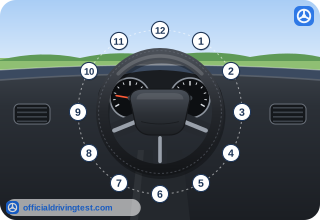
- To the 12 o'clock position, together
- To the original 9 and 3 o'clock positions
- To the 6 and 12 o'clock positions
- To the 10 and 2 o'clock positions
Show answer
Correct answer: To the original 9 and 3 o'clock positions
Before straightening out, you return your hands to the original 9 and 3 o'clock positions and then counter-steer.
Source: Tennessee Comprehensive Driver License Manual (March 2025 printing), page 29 · Open this page in the manual (Manual page 29)
-
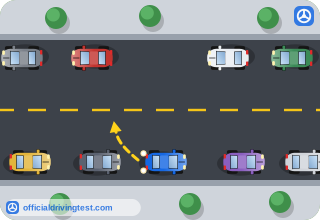
Which is a common mistake new drivers make when backing?
- Looking over the shoulder through the rear window
- Keeping a slow speed
- Continuing to look to the rear until stopped
- Moving too fast
Show answer
Correct answer: Moving too fast
Common backing mistakes are moving too fast, giving too much steering input and turning the wheel the wrong way.
Source: Tennessee Comprehensive Driver License Manual (March 2025 printing), page 29 · Open this page in the manual (Manual page 29)
-
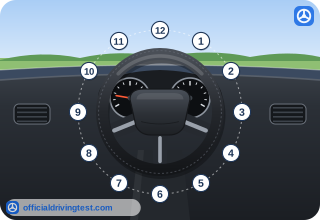
When backing, at which position on the steering wheel do you grasp it with your left hand?
- 3 o'clock
- 6 o'clock
- 9 o'clock
- 12 o'clock
Show answer
Correct answer: 12 o'clock
When backing, the left hand grasps the steering wheel at the 12 o'clock position.
Source: Tennessee Comprehensive Driver License Manual (March 2025 printing), page 29 · Open this page in the manual (Manual page 29)
-
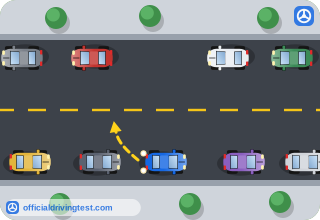
How does the manual say to look when backing?
- Only in the inside rearview mirror, without turning your head
- Over your shoulder through the rear window for a safe, clear path
- Only in the outside mirrors on both sides
- Straight ahead, then glance back once or twice
Show answer
Correct answer: Over your shoulder through the rear window for a safe, clear path
The manual says to look over your shoulder through the rear window for a safe, clear path.
Source: Tennessee Comprehensive Driver License Manual (March 2025 printing), page 29 · Open this page in the manual (Manual page 29)
-
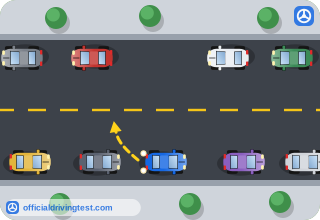
What speed does the manual say to use when backing?
- A moderate speed so that you can finish the maneuver quickly
- The speed of the traffic behind you
- Idle speed or gentle, smooth acceleration, keeping a slow speed
- A fast, steady speed
Show answer
Correct answer: Idle speed or gentle, smooth acceleration, keeping a slow speed
Backing is done at idle speed or with gentle, smooth acceleration, keeping a slow speed.
Source: Tennessee Comprehensive Driver License Manual (March 2025 printing), page 29 · Open this page in the manual (Manual page 29)
-
When backing, which way do you turn the wheel to back to the right?
- To the right
- To the left
- Straight ahead
- It does not matter
Show answer
Correct answer: To the right
The manual says to turn the wheel to the right to back to the right and to the left to back to the left.
Source: Tennessee Comprehensive Driver License Manual (March 2025 printing), page 29 · Open this page in the manual (Manual page 29)
-
When backing, how long should you continue looking to the rear?
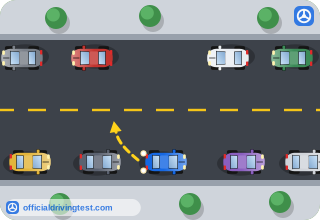
- Until you have moved one car length
- Until you come to a complete stop
- Only for the first few feet
- Until the vehicle clears the curb
Show answer
Correct answer: Until you come to a complete stop
The manual says to continue looking to the rear until coming to a complete stop.
Source: Tennessee Comprehensive Driver License Manual (March 2025 printing), page 29 · Open this page in the manual (Manual page 29)
-
When moving forward, how far ahead should you look?
- About one car length
- Half a block
- About 20 feet
- At least one block
Show answer
Correct answer: At least one block
The manual says to look at least one block ahead and steer toward a reference point.
Source: Tennessee Comprehensive Driver License Manual (March 2025 printing), page 29 · Open this page in the manual (Manual page 29)
-
When should you signal while moving forward, according to the steps listed for moving forward?
- If you are pulling away from a curb
- Only if you are backing out
- Only at night
- Only if another car is behind you
Show answer
Correct answer: If you are pulling away from a curb
One of the steps for moving forward is to signal if you are pulling away from a curb.
Source: Tennessee Comprehensive Driver License Manual (March 2025 printing), page 29 · Open this page in the manual (Manual page 29)
-
How should you press the brake pedal to make a smooth stop?
- With quick, repeated taps on the pedal
- With full force right away
- With steady pressure, without stomping on it
- With your left foot only
Show answer
Correct answer: With steady pressure, without stomping on it
The manual says to press down with steady pressure for a smooth stop and not to stomp on the brake pedal.
Source: Tennessee Comprehensive Driver License Manual (March 2025 printing), page 29 · Open this page in the manual (Manual page 29)
-
What is true of carbon monoxide gas from a car engine?
- It has a strong smell of gasoline that warns you in time
- It is visible as white smoke from the exhaust
- It is harmless in a closed car
- It can kill, and it has no taste, no smell and cannot be seen
Show answer
Correct answer: It can kill, and it has no taste, no smell and cannot be seen
Carbon monoxide can kill, and you cannot taste, smell or see it.
Source: Tennessee Comprehensive Driver License Manual (March 2025 printing), page 29 · Open this page in the manual (Manual page 29)
-
In which situation does carbon monoxide generally leak into a vehicle?
- When the tires are low on air pressure
- When the exhaust system is not working properly
- When the headlights are turned on at night
- When the radio is playing loudly
Show answer
Correct answer: When the exhaust system is not working properly
The manual says it generally leaks with the heater running, a faulty exhaust system or heavy traffic fumes.
Source: Tennessee Comprehensive Driver License Manual (March 2025 printing), page 29 · Open this page in the manual (Manual page 29)
-
Which action helps you avoid carbon monoxide poisoning?
- Having the exhaust system checked regularly
- Running the engine in a closed garage to warm it
- Opening the fresh-air vent in congested traffic
- Using the heater in a parked car with the windows closed
Show answer
Correct answer: Having the exhaust system checked regularly
The manual lists regular exhaust system checks as a way to avoid carbon monoxide poisoning.
Source: Tennessee Comprehensive Driver License Manual (March 2025 printing), page 30 · Open this page in the manual (Manual page 30)
-
To avoid carbon monoxide poisoning, what should you be alert for?
- A squealing noise from the brakes
- Dash lights that flicker at night
- Unusual roars from under the car
- A rattling noise in the trunk area
Show answer
Correct answer: Unusual roars from under the car
The manual says to be alert for unusual roars from under the car, which can signal an exhaust problem.
Source: Tennessee Comprehensive Driver License Manual (March 2025 printing), page 30 · Open this page in the manual (Manual page 30)
-
Where should you never let the engine run, to avoid carbon monoxide poisoning?
- In an open driveway
- In a closed garage
- On a paved parking lot
- On a gravel shoulder
Show answer
Correct answer: In a closed garage
The manual says never to let the engine run in a closed garage.
Source: Tennessee Comprehensive Driver License Manual (March 2025 printing), page 30 · Open this page in the manual (Manual page 30)
-
In a parked car with the windows closed, what does the manual say not to use to avoid carbon monoxide poisoning?
- The radio
- The four-way hazard flashers
- The dome light
- The heater or air conditioner
Show answer
Correct answer: The heater or air conditioner
Using the heater or air conditioner in a parked car with the windows closed can expose you to carbon monoxide.
Source: Tennessee Comprehensive Driver License Manual (March 2025 printing), page 30 · Open this page in the manual (Manual page 30)
-
What does the manual say to do with the fresh-air vent in congested traffic to avoid carbon monoxide poisoning?
- Open it fully
- Leave it half open
- Set it to defrost
- Close it
Show answer
Correct answer: Close it
In congested traffic the fresh-air vent should be closed so fumes from other vehicles stay out.
Source: Tennessee Comprehensive Driver License Manual (March 2025 printing), page 30 · Open this page in the manual (Manual page 30)
-
While traveling down a grade, which action must you NEVER do?
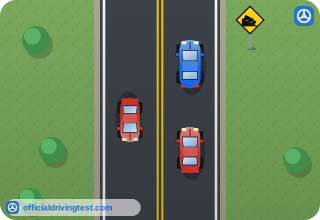
- Keep the vehicle in gear while moving
- Use the regular brakes to slow down
- Stay in the right lane the whole way
- Coast with the transmission in neutral
Show answer
Correct answer: Coast with the transmission in neutral
Coasting in neutral (or with the clutch pedal pressed down in a manual car) reduces the driver's control of the vehicle.
Source: Tennessee Comprehensive Driver License Manual (March 2025 printing), page 45 · Open this page in the manual (Manual page 45)
-
During what period must a car's headlights be turned on at night?
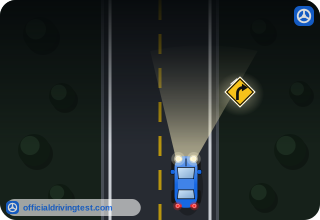
- From sunset until sunrise only
- 1 hour after sunset until 1 hour before sunrise
- From 6 p.m. until 6 a.m.
- 30 minutes after sunset until 30 minutes before sunrise
Show answer
Correct answer: 30 minutes after sunset until 30 minutes before sunrise
The night-use rule runs from 30 minutes after sunset until 30 minutes before sunrise.
Source: Tennessee Comprehensive Driver License Manual (March 2025 printing), page 45 · Open this page in the manual (Manual page 45)
-
Besides at night, when must your headlights be on during the day?
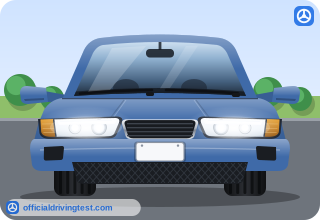
- Only when you are driving on an interstate highway
- When you cannot see people or vehicles clearly 200 feet ahead
- Only when it is raining hard enough to flood the road
- Only when you are driving through a school zone area
Show answer
Correct answer: When you cannot see people or vehicles clearly 200 feet ahead
Headlights are required whenever daylight is too poor to see people or vehicles clearly at 200 feet, and when rain, mist, snow or other precipitation requires constant wiper use.
Source: Tennessee Comprehensive Driver License Manual (March 2025 printing), page 45 · Open this page in the manual (Manual page 45)
-
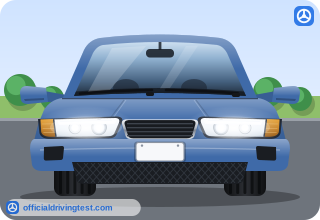
Which weather condition requires your headlights to be on?
- Any day when the temperature is below freezing
- Any day with a cloud cover over the hills
- Rain, mist or snow needing constant use of the wipers
- Any day when you are driving more than 25 miles from home
Show answer
Correct answer: Rain, mist or snow needing constant use of the wipers
Using headlights whenever the wipers must run constantly is a Tennessee law, not just a safety habit.
Source: Tennessee Comprehensive Driver License Manual (March 2025 printing), page 45 · Open this page in the manual (Manual page 45)
-
Your high beams are on and an oncoming vehicle is within what distance before you must dim them?
- 500 feet
- 200 feet
- 1,000 feet
- 750 feet
Show answer
Correct answer: 500 feet
You must lower the beam when an oncoming vehicle is within 500 feet, roughly one city block.
Source: Tennessee Comprehensive Driver License Manual (March 2025 printing), page 45 · Open this page in the manual (Manual page 45)
-
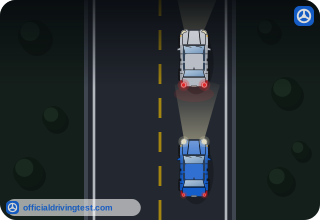
With your high beams on, when are you required to dim them while following another vehicle?
- Only when you are within 100 feet of the vehicle ahead
- Only when the vehicle ahead is a motorcycle
- When you are within 500 feet of the vehicle ahead
- Only when the vehicle ahead brakes
Show answer
Correct answer: When you are within 500 feet of the vehicle ahead
The dimming rule also applies when following another vehicle within 500 feet, because glare in the rear view mirror can blind that driver.
Source: Tennessee Comprehensive Driver License Manual (March 2025 printing), page 45 · Open this page in the manual (Manual page 45)
-
What does the law require of a vehicle stopped or parked on a road or shoulder when visibility is limited?
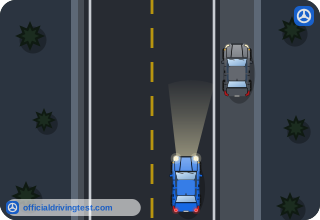
- It must have its parking lights on
- It must have its high beams on
- It must have its fog lights on alone
- It must have its interior light on
Show answer
Correct answer: It must have its parking lights on
A vehicle stopped or parked on a road or shoulder must show its parking lights when limited visibility conditions exist.
Source: Tennessee Comprehensive Driver License Manual (March 2025 printing), page 45 · Open this page in the manual (Manual page 45)
-
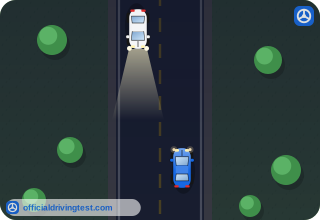
Why is it a problem to drive at night or in bad weather with only your parking lights on?
- They are too bright and blind oncoming drivers
- They drain the battery too quickly while driving
- They hide your brake lights from drivers behind you
- Their small size may make others think you are farther away
Show answer
Correct answer: Their small size may make others think you are farther away
Parking lights are small, so they can make a vehicle look farther away; using them alone when visibility is limited is unsafe and against the law.
Source: Tennessee Comprehensive Driver License Manual (March 2025 printing), page 45 · Open this page in the manual (Manual page 45)
-
Besides having them on by themselves, when is it illegal to have auxiliary lights or fog lights on?
- Only on interstate highways when it is raining
- When you are required to dim high beam headlights
- Only when the road is dry and traffic is light
- Only during daylight hours on country roads
Show answer
Correct answer: When you are required to dim high beam headlights
The manual says it is illegal to use auxiliary or fog lights alone, or on when you must dim your high beams, because they make it hard for oncoming drivers to see.
Source: Tennessee Comprehensive Driver License Manual (March 2025 printing), page 45 · Open this page in the manual (Manual page 45)
-
Since January 1, 2018, steady-burning lights that show to the front of a vehicle operated in Tennessee must be which color or colors?
- Red or white
- White or amber
- Blue or white
- Any color if it is not flashing
Show answer
Correct answer: White or amber
No vehicle may have steady-burning front lights in any color other than white or amber, or any combination other than white and amber, with exceptions for certain vehicles.
Source: Tennessee Comprehensive Driver License Manual (March 2025 printing), page 45 · Open this page in the manual (Manual page 45)
-
Which flashing lights may display to the front of a vehicle operated in Tennessee?
- Any flashing lights in white or amber
- Any flashing lights that are not red
- Flashing lights in any one color
- Only factory installed emergency flashers
Show answer
Correct answer: Only factory installed emergency flashers
Flashing lights of any color that show to the front are not allowed, other than factory installed emergency flashers, with exceptions for certain vehicles.
Source: Tennessee Comprehensive Driver License Manual (March 2025 printing), page 46 · Open this page in the manual (Manual page 46)
-
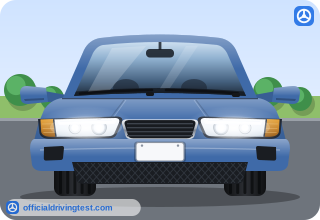
What is the benefit of daytime running lights?
- They make the vehicle easier for others to see
- They let you skip using your headlights at night
- They allow you to drive faster in daylight
- They let you drive without a turn signal
Show answer
Correct answer: They make the vehicle easier for others to see
Headlights that are on whenever the vehicle is running make it easier for others to see the vehicle in daylight, which reduces the likelihood of collisions.
Source: Tennessee Comprehensive Driver License Manual (March 2025 printing), page 45 · Open this page in the manual (Manual page 45)
-
By law, how many separate methods of applying brakes must all automobiles have?
- Two
- Three
- One
- Four
Show answer
Correct answer: Two
Cars must have two separate methods, commonly the regular foot brake and the parking or emergency brake.
Source: Tennessee Comprehensive Driver License Manual (March 2025 printing), page 48 · Open this page in the manual (Manual page 48)
-
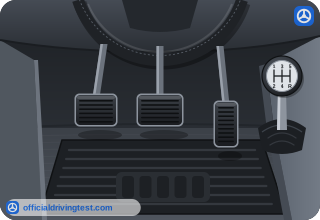
With a standard transmission, how can you use the gearshift when approaching a stop sign or signal?
- Shift into neutral, then coast to the sign
- Shift up to a higher gear before braking
- Shift into reverse to slow the vehicle down
- Flash the brake lights, then shift down a gear
Show answer
Correct answer: Flash the brake lights, then shift down a gear
After flashing your brake lights to signal drivers behind you, you can shift down to a lower gear to slow down.
Source: Tennessee Comprehensive Driver License Manual (March 2025 printing), page 48 · Open this page in the manual (Manual page 48)
-
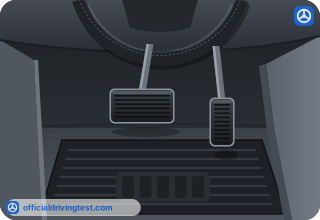
When slowing or stopping with anti-lock brakes (ABS), what should you apply to the brake pedal?
- Firm, steady pressure, never pumping the pedal
- Light taps, pumped repeatedly
- Pressure that you release just before stopping
- Gradual pressure released when the pedal vibrates
Show answer
Correct answer: Firm, steady pressure, never pumping the pedal
With ABS, apply firm, steady pressure and never pump the pedal; pumping or lifting your foot disengages the anti-lock system.
Source: Tennessee Comprehensive Driver License Manual (March 2025 printing), page 48 · Open this page in the manual (Manual page 48)
-
With anti-lock brakes, what does noise and vibration in the brake pedal tell you?
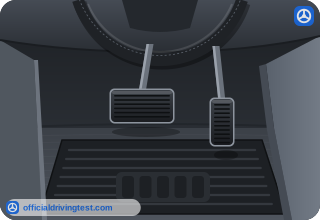
- That the brakes are failing
- That the tires are worn out
- That the ABS is working
- That you should lift your foot off the pedal
Show answer
Correct answer: That the ABS is working
Noise and vibration are signs the anti-lock system is working, so keep your foot firmly on the pedal.
Source: Tennessee Comprehensive Driver License Manual (March 2025 printing), page 48 · Open this page in the manual (Manual page 48)
-
Does using your turn signal give you the right-of-way?
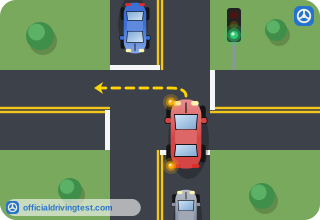
- Yes, over vehicles on your right
- Yes, over oncoming traffic
- No, signaling does not give you the right-of-way
- Yes, if you signal at least 50 feet before the turn
Show answer
Correct answer: No, signaling does not give you the right-of-way
A signal only tells others your intentions; it does not give you the right-of-way.
Source: Tennessee Comprehensive Driver License Manual (March 2025 printing), page 55 · Open this page in the manual (Manual page 55)
-
Which of these is a time when the manual says you should always use turn signals?
- Driving straight through an intersection on green
- Pulling away from a parked position along the curb
- Continuing straight in your lane with no traffic around
- Passing a driveway on your right
Show answer
Correct answer: Pulling away from a parked position along the curb
You should signal when pulling away from a parked position, among other times such as changing lanes and turning.
Source: Tennessee Comprehensive Driver License Manual (March 2025 printing), page 55 · Open this page in the manual (Manual page 55)
-
What may you use to signal a turn?
- Vehicle turn signal lights only, never hand signals
- Hand and arm signals only, never turn signal lights
- Your horn together with your high-beam headlights on
- Either vehicle turn signal lights or hand and arm signals
Show answer
Correct answer: Either vehicle turn signal lights or hand and arm signals
The manual says you may use either the vehicle’s turn signal lights or hand and arm signals.
Source: Tennessee Comprehensive Driver License Manual (March 2025 printing), page 55 · Open this page in the manual (Manual page 55)
-
When you give a hand signal, what should you do during the actual turn?
- Bring your arm in to keep control of the steering wheel
- Keep your arm out until the turn ends
- Hold the wheel with one hand at the bottom
- Signal with the arm that is farthest from the window
Show answer
Correct answer: Bring your arm in to keep control of the steering wheel
You bring your arm in during the actual turn to keep control of the steering wheel.
Source: Tennessee Comprehensive Driver License Manual (March 2025 printing), page 55 · Open this page in the manual (Manual page 55)
-
What does the manual say about hand and arm signals during non-daylight hours?
- They must be given with both arms out the window
- They are required at night
- They are usually not visible except in well lit areas
- They replace the need for working brake lights at night
Show answer
Correct answer: They are usually not visible except in well lit areas
At night, hand and arm signals are usually not visible except in well lit areas.
Source: Tennessee Comprehensive Driver License Manual (March 2025 printing), page 55 · Open this page in the manual (Manual page 55)
-
When does the manual say hand signals should be used?
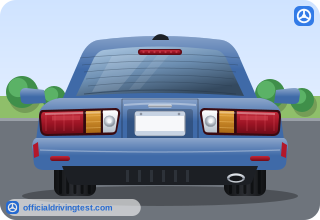
- When driving at night
- When your brake lights are working
- When the road is wet
- When the sun is shining brightly
Show answer
Correct answer: When the sun is shining brightly
Bright sun makes your turn signal light harder for other drivers to see, so a hand signal helps.
Source: Tennessee Comprehensive Driver License Manual (March 2025 printing), page 55 · Open this page in the manual (Manual page 55)
-
Why can a hand signal be useful in heavy traffic?
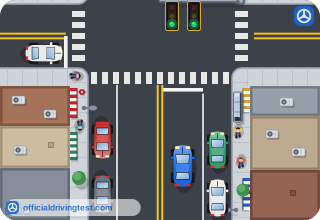
- Drivers several cars back may see it when they cannot see your signal light
- It lets you make a turn without checking for other traffic first
- It gives you the right-of-way over all the cars that are behind you
- It is easier to see than a turn signal light on a dark road at night
Show answer
Correct answer: Drivers several cars back may see it when they cannot see your signal light
A hand signal can be seen by drivers who are several cars back and cannot see your turn signal light.
Source: Tennessee Comprehensive Driver License Manual (March 2025 printing), page 55 · Open this page in the manual (Manual page 55)
-
How should you give a hand and arm signal?
- Hold your hand just inside the window and signal at the turn
- Extend your hand and arm well out of the window, in plenty of time
- Wave your hand briefly once the turn has started
- Signal with the horn while your arm is out
Show answer
Correct answer: Extend your hand and arm well out of the window, in plenty of time
The manual says to extend your hand and arm well out of the window and signal in plenty of time.
Source: Tennessee Comprehensive Driver License Manual (March 2025 printing), page 55 · Open this page in the manual (Manual page 55)
-
What should you keep clean and free from dust, dirt, ice or snow so that other drivers can see your signal?
- The inside rear-view mirror only
- The license plate only
- The front and rear turn signal lights
- The fog lights only
Show answer
Correct answer: The front and rear turn signal lights
Front and rear turn signal lights must be clean and free from dust, dirt, ice or snow so they can be seen.
Source: Tennessee Comprehensive Driver License Manual (March 2025 printing), page 55 · Open this page in the manual (Manual page 55)
-
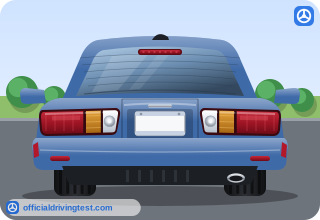
When signaling a stop, what does the manual say to do with your brakes?
- Press the brake pedal hard once and hold it down until you stop
- Tap the brakes only when you are driving on a freeway or interstate
- Lightly pump them a few times to flash your brake lights
- Leave the brakes alone and use only the horn to signal the stop
Show answer
Correct answer: Lightly pump them a few times to flash your brake lights
Lightly pumping the brakes a few times makes the brake lights flash and draws attention.
Source: Tennessee Comprehensive Driver License Manual (March 2025 printing), page 55 · Open this page in the manual (Manual page 55)
-
Why should you turn off your turn signal after using it?
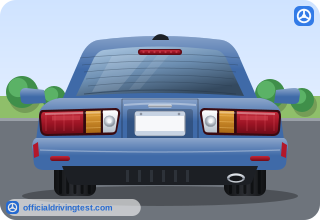
- An unintended signal still means “turn” to other drivers
- It wears out the turn signal bulbs much more quickly than usual
- It drains the battery faster than the headlights do
- It is always required to be off while moving in a straight line
Show answer
Correct answer: An unintended signal still means “turn” to other drivers
A signal left on still tells others you are turning, so they may pull out in front of you.
Source: Tennessee Comprehensive Driver License Manual (March 2025 printing), page 55 · Open this page in the manual (Manual page 55)
-
How far before a turn must you turn on your turn signal lights?
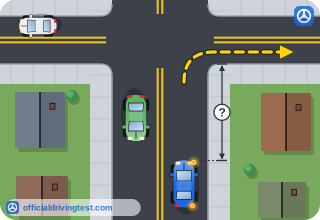
- At least 25 feet
- At least 100 feet
- At least 200 feet
- At least 50 feet
Show answer
Correct answer: At least 50 feet
The manual requires turn signal lights to be on at least 50 feet before the turn.
Source: Tennessee Comprehensive Driver License Manual (March 2025 printing), page 56 · Open this page in the manual (Manual page 56)
-
Which of these is a wrong use of your turn signals?
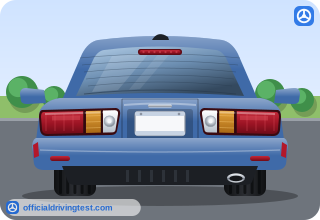
- Signaling before re-entering traffic from a parked position at the curb
- Signaling the driver behind you to come around and pass
- Signaling every time you change direction even if no one is around
- Signaling before changing lanes on a straight road
Show answer
Correct answer: Signaling the driver behind you to come around and pass
Signals should only show when YOU plan to turn or change lanes; using them to wave a driver past is misleading.
Source: Tennessee Comprehensive Driver License Manual (March 2025 printing), page 56 · Open this page in the manual (Manual page 56)
-
You see a driver ahead of you signaling a turn. What should you do with your own signals?
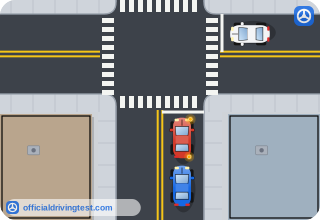
- Turn on your signals to warn the drivers behind you
- Not turn on your signals unless you also plan to turn
- Flash your brake lights twice and then signal
- Turn on your signals to match the driver ahead
Show answer
Correct answer: Not turn on your signals unless you also plan to turn
Relaying another driver’s turn intention is misleading; your brake lights are enough to warn those behind.
Source: Tennessee Comprehensive Driver License Manual (March 2025 printing), page 56 · Open this page in the manual (Manual page 56)
-
You are parked at a curb and about to re-enter traffic. How long should you signal?
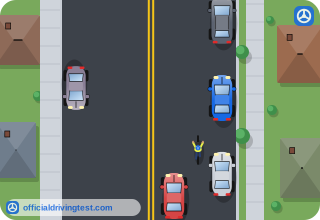
- Only until your vehicle has started to move away from the curb
- For exactly 50 feet, and not a second longer than that
- Long enough to alert oncoming traffic that you are pulling out
- Only if you can see a vehicle approaching from behind you
Show answer
Correct answer: Long enough to alert oncoming traffic that you are pulling out
The signal should last long enough to warn oncoming traffic that you are leaving the parked position.
Source: Tennessee Comprehensive Driver License Manual (March 2025 printing), page 56 · Open this page in the manual (Manual page 56)
-
You plan to turn beyond an intersection. When should you begin signaling?
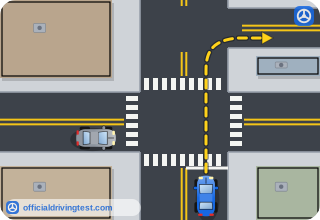
- Not until you are in the intersection
- As soon as you approach the intersection
- At least 200 feet before the intersection
- Only after you have passed the intersection
Show answer
Correct answer: Not until you are in the intersection
Signaling earlier may make another driver think you will turn at the intersection and pull into your path.
Source: Tennessee Comprehensive Driver License Manual (March 2025 printing), page 56 · Open this page in the manual (Manual page 56)
-
Why should you signal every time you change direction, even if you do not see anyone else around?
- Signals are required to be on at all times in traffic
- Signaling turns on the brake lights
- It makes other drivers move over
- The car you do not see is the most dangerous
Show answer
Correct answer: The car you do not see is the most dangerous
Signal even when no one seems to be around because the car you do not see is the most dangerous one.
Source: Tennessee Comprehensive Driver License Manual (March 2025 printing), page 56 · Open this page in the manual (Manual page 56)
-
What does the manual say about slowing down as a signal?
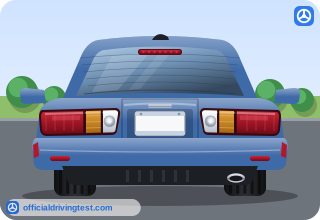
- Brake lights flash as a signal, and slowing itself acts as one
- Slowing down gives no signal unless you also use a turn signal
- Only hand signals can show other drivers that you are slowing
- Slowing down counts as a signal only when the road is wet or icy
Show answer
Correct answer: Brake lights flash as a signal, and slowing itself acts as one
When you slow down, your brake lights flash as a signal and the slowing itself also communicates.
Source: Tennessee Comprehensive Driver License Manual (March 2025 printing), page 56 · Open this page in the manual (Manual page 56)
-
What should you use to indicate your exit from a roundabout?
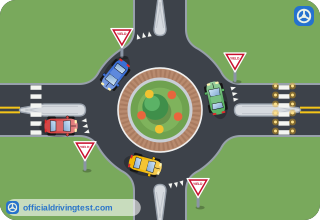
- Your right turn signal
- Your left turn signal
- Your horn
- Your hazard lights
Show answer
Correct answer: Your right turn signal
You always signal your exit from a roundabout with your right turn signal.
Source: Tennessee Comprehensive Driver License Manual (March 2025 printing), page 59 · Open this page in the manual (Manual page 59)
-
Before you change lanes to pass on the left, what should you do?
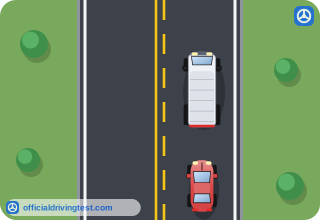
- Signal your move and check your rearview and side-view mirrors
- Sound your horn and then speed up to pass it
- Flash your high beams and then move over at once
- Move into the left lane first, then signal your move
Show answer
Correct answer: Signal your move and check your rearview and side-view mirrors
You signal your intended move to the left and check your rearview and side-view mirrors before changing lanes.
Source: Tennessee Comprehensive Driver License Manual (March 2025 printing), page 62 · Open this page in the manual (Manual page 62)
-
After you return to your lane from a pass, what should you be sure to do?
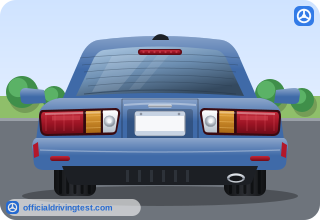
- Cancel your signal so it is not left flashing
- Leave your signal on until the next intersection
- Flash your brake lights to thank the driver
- Sound your horn twice as a courtesy
Show answer
Correct answer: Cancel your signal so it is not left flashing
You cancel the signal light so you are not driving with your right turn signal flashing.
Source: Tennessee Comprehensive Driver License Manual (March 2025 printing), page 62 · Open this page in the manual (Manual page 62)
-
Before passing, what does the manual say to do when necessary to avoid surprising the driver ahead?
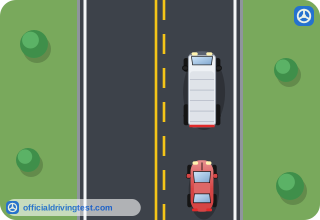
- Flash your hazard lights
- Tap the brake pedal repeatedly
- Tap your horn
- Flash your parking lights
Show answer
Correct answer: Tap your horn
A tap of the horn warns the driver ahead that you are about to pass so he or she is not surprised.
Source: Tennessee Comprehensive Driver License Manual (March 2025 printing), page 63 · Open this page in the manual (Manual page 63)
-
With what exception does the manual say you should never back a vehicle into a travel lane?
- Backing out of a driveway onto the road
- Backing into a parallel parking space
- Backing up after you miss your turn
- Backing to let another driver pass
Show answer
Correct answer: Backing into a parallel parking space
The only time you may back into a travel lane is when backing into a parallel parking space.
Source: Tennessee Comprehensive Driver License Manual (March 2025 printing), page 64 · Open this page in the manual (Manual page 64)
-
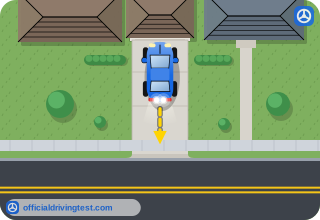
Why is backing more difficult for new drivers than traveling forward?
- The brakes work less effectively when the vehicle is in reverse gear
- Mirrors cannot be used while backing, and the steering wheel locks
- The vehicle blocks your view, and speed and direction are harder to control
- Other drivers always expect you to back toward them
Show answer
Correct answer: The vehicle blocks your view, and speed and direction are harder to control
The vehicle itself blocks the field of vision when backing, and speed and direction are harder to control.
Source: Tennessee Comprehensive Driver License Manual (March 2025 printing), page 64 · Open this page in the manual (Manual page 64)
-
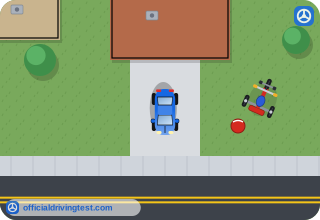
When should you check behind your vehicle for children or small objects that are hard to see from the driver's seat?
- After you start the engine
- Before you get behind the wheel
- Only after you shift into reverse
- While you are rolling backward
Show answer
Correct answer: Before you get behind the wheel
Check behind the vehicle before getting in, because children and small objects are hard to see from the driver’s seat.
Source: Tennessee Comprehensive Driver License Manual (March 2025 printing), page 64 · Open this page in the manual (Manual page 64)
-
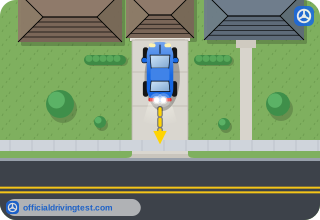
Before backing, which is the correct way to look to the rear?
- Depend only on your rearview and side mirrors
- Open the door and stick your head out
- Watch only your side mirrors while you ease back
- Turn around and look directly through the rear window
Show answer
Correct answer: Turn around and look directly through the rear window
Put your arm on the back of the seat and turn so you can look straight through the rear window; do not rely only on mirrors.
Source: Tennessee Comprehensive Driver License Manual (March 2025 printing), page 64 · Open this page in the manual (Manual page 64)
-
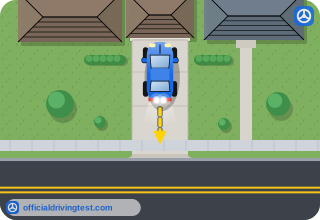
What does the manual say about opening the door and sticking your head out to see while backing?
- It is the best way to see in a tight space
- It is acceptable at very low speed
- It is required if your mirrors are dirty
- You should avoid it because it is dangerous
Show answer
Correct answer: You should avoid it because it is dangerous
Opening the door and sticking your head out is dangerous and should be avoided when backing.
Source: Tennessee Comprehensive Driver License Manual (March 2025 printing), page 64 · Open this page in the manual (Manual page 64)
-
How should you back a vehicle?
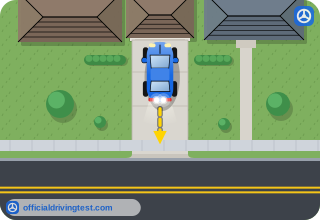
- Quickly, to clear the traffic lane
- Slowly and gradually
- At about the speed you drive forward
- With one quick glance in the mirror
Show answer
Correct answer: Slowly and gradually
The car is much harder to control and stop in reverse, so back slowly and gradually while looking to all sides.
Source: Tennessee Comprehensive Driver License Manual (March 2025 printing), page 64 · Open this page in the manual (Manual page 64)
-
If you miss your turn or exit, what does the manual say to do instead of backing up?
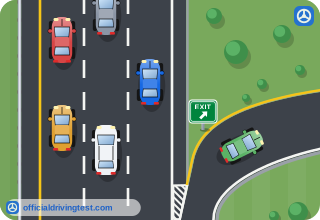
- Stop on the shoulder and back up slowly with your flashers on
- Continue to the next turn or exit or a safe, legal place to turn around
- Back up slowly if no vehicle is following you in your lane
- Make a quick U-turn at once from wherever you are on the road
Show answer
Correct answer: Continue to the next turn or exit or a safe, legal place to turn around
Do not back up after missing a turn or exit; go on to the next one or to a place where you can turn around safely and legally.
Source: Tennessee Comprehensive Driver License Manual (March 2025 printing), page 64 · Open this page in the manual (Manual page 64)
-
What does the manual say about stopping in a travel lane because you are lost or confused about directions?
- Do not stop; keep moving until you can safely pull off the roadway
- Stop in the lane and turn on your hazard flashers
- Stop in the lane just long enough to check your directions
- Brake quickly and wait in the lane for another driver to help
Show answer
Correct answer: Do not stop; keep moving until you can safely pull off the roadway
Do not stop in the travel lanes for any reason; keep moving until you can safely pull off the roadway.
Source: Tennessee Comprehensive Driver License Manual (March 2025 printing), page 64 · Open this page in the manual (Manual page 64)
-
Among the manual's tips for safe interstate driving, when should you signal your intentions?
- Only when cars are near
- As you begin to move
- Only when moving left
- Always, well in advance
Show answer
Correct answer: Always, well in advance
A safe interstate driver always signals well in advance so others know what is coming.
Source: Tennessee Comprehensive Driver License Manual (March 2025 printing), page 71 · Open this page in the manual (Manual page 71)
-
Tennessee law requires headlights that let you see a person on the highway clearly at least how far ahead of your car?
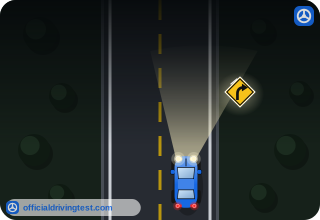
- 100 feet
- 200 feet
- 300 feet
- 500 feet
Show answer
Correct answer: 200 feet
The law requires headlights that show any person on the highway clearly at least two hundred feet ahead.
Source: Tennessee Comprehensive Driver License Manual (March 2025 printing), page 74 · Open this page in the manual (Manual page 74)
-
When driving in cities and towns at night, which lights should you always use?
- High beams
- Parking lights only
- Low beams
- Fog lights only
Show answer
Correct answer: Low beams
In cities and towns the manual says to always use your low beams.
Source: Tennessee Comprehensive Driver License Manual (March 2025 printing), page 74 · Open this page in the manual (Manual page 74)
-
On curves or turns to the right at night, what should you avoid doing?
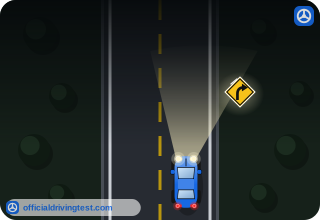
- Using your low beams when meeting traffic
- “Blasting” an oncoming car with high beams
- Watching the right edge of the road
- Dimming your lights for oncoming cars
Show answer
Correct answer: “Blasting” an oncoming car with high beams
On a right curve or turn your lights can sweep across oncoming traffic, so you should not hit them with high beams.
Source: Tennessee Comprehensive Driver License Manual (March 2025 printing), page 74 · Open this page in the manual (Manual page 74)
-
Why should you avoid flashing your high beams to warn another driver?
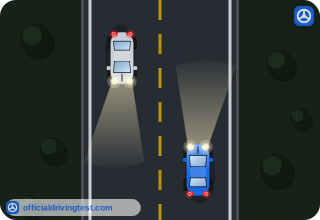
- It can damage the other vehicle's headlights
- It warns the other driver too early to react
- It is allowed only on interstate highways
- It might distract them and lead to a collision
Show answer
Correct answer: It might distract them and lead to a collision
Flashing high beams can distract the other driver and interfere with their driving, which could cause a collision.
Source: Tennessee Comprehensive Driver License Manual (March 2025 printing), page 74 · Open this page in the manual (Manual page 74)
-
For maximum glare prevention, how often should you clean your headlights and the windows, inside and out?
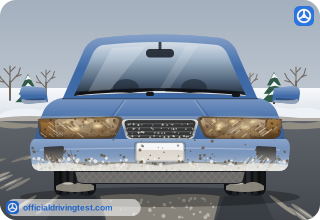
- Once every three months
- Once every six months
- At least once a month
- Once a year
Show answer
Correct answer: At least once a month
Keeping every surface between your eyes and the road clean helps fight glare, and the manual says to clean at least monthly.
Source: Tennessee Comprehensive Driver License Manual (March 2025 printing), page 74 · Open this page in the manual (Manual page 74)
-
Headlights that shine up or out excessively:
- Help you see objects farther along the roadway
- Reduce glare for the drivers you are meeting
- Make your lights safe to leave on while parked
- Do not help you see the roadway and add to glare
Show answer
Correct answer: Do not help you see the roadway and add to glare
Badly aimed lights do not light the road better; they only glare into the eyes of drivers you meet or follow.
Source: Tennessee Comprehensive Driver License Manual (March 2025 printing), page 74 · Open this page in the manual (Manual page 74)
-
Why should you wait a few seconds after rain starts before turning on your wipers?
- So the wiper blades do not wear out too quickly
- So there is enough water for the wipers to clear it
- So the defroster can clear the glass first
- So the rain has time to wash dust from the road
Show answer
Correct answer: So there is enough water for the wipers to clear it
With enough water on the glass the wipers clear it instead of smearing dust and grime across it.
Source: Tennessee Comprehensive Driver License Manual (March 2025 printing), page 75 · Open this page in the manual (Manual page 75)
-
What can you use to keep windows and mirrors clear in inclement weather?
- The high-beam headlights
- The windshield washer fluid only
- The hazard warning flashers
- The defroster or air conditioner
Show answer
Correct answer: The defroster or air conditioner
The manual says to use the defroster or air conditioner to keep windows and mirrors clear.
Source: Tennessee Comprehensive Driver License Manual (March 2025 printing), page 75 · Open this page in the manual (Manual page 75)
-
In fog or mist, why should you never put your headlights on high beam?
- The light cannot be seen by other drivers
- The light is reflected back into your eyes
- High beams burn out faster in damp air
- The light shines too far above the road
Show answer
Correct answer: The light is reflected back into your eyes
High beams bounce off the fog or mist and into your eyes, so low beams are used instead.
Source: Tennessee Comprehensive Driver License Manual (March 2025 printing), page 75 · Open this page in the manual (Manual page 75)
-
If you must drive in fog or smoke, which lights should you use?
- High beams
- Parking lights only
- Fog lights only
- Low beams
Show answer
Correct answer: Low beams
High beams impair your visibility in fog, and you should never drive with just parking or fog lights on.
Source: Tennessee Comprehensive Driver License Manual (March 2025 printing), page 75 · Open this page in the manual (Manual page 75)
-
When driving through dense fog, heavy rain or snow during the daytime, which headlights does Tennessee law require?
- High beam headlights
- Low beam headlights
- Parking lights
- Auxiliary fog lights only
Show answer
Correct answer: Low beam headlights
The manual says turning on low beams in those conditions is a requirement of Tennessee law.
Source: Tennessee Comprehensive Driver License Manual (March 2025 printing), page 75 · Open this page in the manual (Manual page 75)
-
What are antilock brakes designed to overcome?
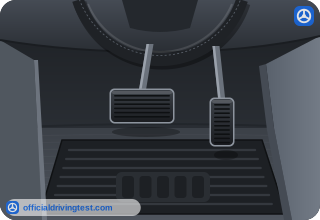
- Tire wear
- Engine overheating
- A loss of steering control
- Loss of headlight power
Show answer
Correct answer: A loss of steering control
Antilock brakes help you keep steering control when braking hard.
Source: Tennessee Comprehensive Driver License Manual (March 2025 printing), page 78 · Open this page in the manual (Manual page 78)
-
To make antilock brakes work correctly, how should you apply the brake pedal?
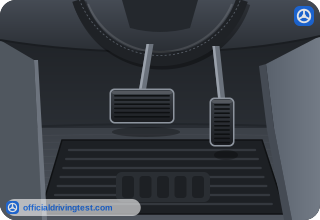
- With quick repeated pumps
- With constant, firm pressure
- With light taps
- With a brief hard push, then release
Show answer
Correct answer: With constant, firm pressure
The manual says to apply constant, firm pressure to the pedal for ABS to work correctly.
Source: Tennessee Comprehensive Driver License Manual (March 2025 printing), page 78 · Open this page in the manual (Manual page 78)
-
During an emergency stop with antilock brakes, even in wet or icy conditions, what may you need to do?
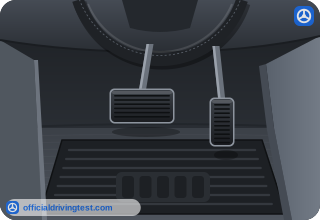
- Pump the pedal several times quickly
- Apply only light pressure to the pedal
- Lift off the pedal when it begins to pulse
- Push the brake pedal all the way to the floor
Show answer
Correct answer: Push the brake pedal all the way to the floor
In an emergency stop with ABS the pedal may need to go all the way down.
Source: Tennessee Comprehensive Driver License Manual (March 2025 printing), page 78 · Open this page in the manual (Manual page 78)
-
In the manual's five tips, how does "Make Sure They See You" say you should communicate in traffic?
- With hand gestures and loud shouting
- With your hazard flashers at all times
- With your windshield wipers and fan
- With your horn, lights and signals
Show answer
Correct answer: With your horn, lights and signals
To make sure others see you, the manual says to use your horn, lights and signals and to be reasonably sure of people's intentions.
Source: Tennessee Comprehensive Driver License Manual (March 2025 printing), page 92 · Open this page in the manual (Manual page 92)
-
What should you always do before changing lanes, according to the defensive driving rules?
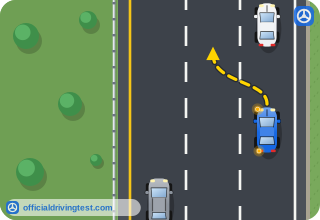
- Check your mirrors
- Sound your horn twice
- Turn on your high beams
- Slow to a stop in your lane
Show answer
Correct answer: Check your mirrors
The defensive driving rules say to use your rearview mirrors and always check them before you change lanes.
Source: Tennessee Comprehensive Driver License Manual (March 2025 printing), page 93 · Open this page in the manual (Manual page 93)
-
When does the manual say you should use your turn signals?
- Any time you plan to change directions, even on an empty road
- Only when another vehicle is close enough to see your signal
- Only when you turn at an intersection on a busy road
- Only when you change lanes on a road with several lanes
Show answer
Correct answer: Any time you plan to change directions, even on an empty road
Signal whenever you change directions, such as changing lanes, turning, entering an interstate or pulling away from a curb, even on an empty road.
Source: Tennessee Comprehensive Driver License Manual (March 2025 printing), page 94 · Open this page in the manual (Manual page 94)
-
According to the manual, whose duty is it to make certain the vehicle is safe to operate?
- The vehicle manufacturer’s
- The driver’s
- The insurance company’s
- The Driver Service Center’s
Show answer
Correct answer: The driver’s
It is the duty of drivers to make sure the vehicles they drive are safe to operate.
Source: Tennessee Comprehensive Driver License Manual (March 2025 printing), page 99 · Open this page in the manual (Manual page 99)
-
What should you do if your brakes make a lot of noise, smell funny or the brake pedal goes to the floor?
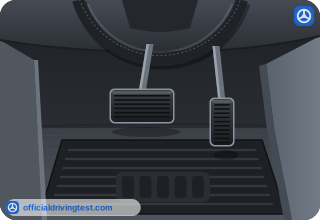
- Have a mechanic check them
- Pump the pedal before every stop
- Keep driving until they stop working
- Add brake fluid and drive on
Show answer
Correct answer: Have a mechanic check them
Only your brakes can stop the vehicle, so a mechanic should check any sign of a problem.
Source: Tennessee Comprehensive Driver License Manual (March 2025 printing), page 100 · Open this page in the manual (Manual page 100)
-
From where should you check that your turn signals, brake lights, taillights and headlights are operating properly?
- From the driver’s seat while driving
- From inside with the engine off
- From the outside of the vehicle
- Only at an inspection station
Show answer
Correct answer: From the outside of the vehicle
The manual says the lights should be checked from the outside of the vehicle.
Source: Tennessee Comprehensive Driver License Manual (March 2025 printing), page 100 · Open this page in the manual (Manual page 100)
-
In which weather do car batteries tend to run down more rapidly?
- Hot, dry weather
- Cold or damp weather
- Mild, sunny weather
- Windy weather
Show answer
Correct answer: Cold or damp weather
Batteries run down faster in cold or damp weather, so a neglected one can leave you stranded.
Source: Tennessee Comprehensive Driver License Manual (March 2025 printing), page 100 · Open this page in the manual (Manual page 100)
-
What does the manual say it is a prudent idea to keep in your vehicle in case the battery runs down?
- A spare battery
- A battery charger
- A set of spark plugs
- A set of jumper cables
Show answer
Correct answer: A set of jumper cables
Jumper cables may help start a vehicle whose battery has run down.
Source: Tennessee Comprehensive Driver License Manual (March 2025 printing), page 100 · Open this page in the manual (Manual page 100)
-
Why should a damaged windshield be repaired or replaced?
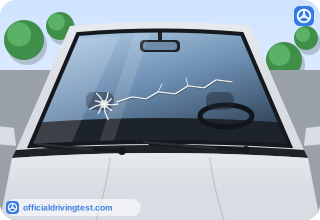
- It blocks the view of your mirrors
- It prevents the wiper blades from clearing rain, snow and road grime
- Damaged glass can easily break in a minor collision or when something hits it
- It causes the defroster to stop working
Show answer
Correct answer: Damaged glass can easily break in a minor collision or when something hits it
Damaged windshield glass can easily break in a minor collision or when struck.
Source: Tennessee Comprehensive Driver License Manual (March 2025 printing), page 100 · Open this page in the manual (Manual page 100)
-
What should you do if your wiper blades are not clearing your windshield?
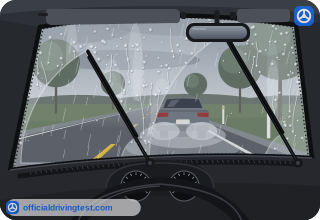
- Replace them
- Wait until the glass is damaged
- Use only the defroster
- Add more washer fluid
Show answer
Correct answer: Replace them
The manual says to replace blades that do not clear the windshield.
Source: Tennessee Comprehensive Driver License Manual (March 2025 printing), page 100 · Open this page in the manual (Manual page 100)
-
When does the manual suggest adding more windshield washer solution?
- At each tire rotation
- Once a year
- Only when the windshield is dirty
- With each oil change
Show answer
Correct answer: With each oil change
Add more solution with each oil change, and check the level with each gas fill-up.
Source: Tennessee Comprehensive Driver License Manual (March 2025 printing), page 100 · Open this page in the manual (Manual page 100)
-
When should you get in the habit of cleaning the windshield?
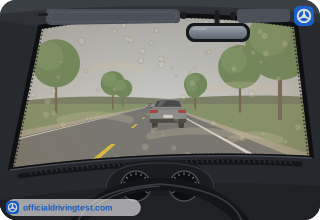
- Each time you check your tire pressure with a gauge
- Each time you stop to put gas into your vehicle
- Once a week
- Only when it rains
Show answer
Correct answer: Each time you stop to put gas into your vehicle
A dirty windshield makes it hard to see in bright sun or headlights, so clean it at every fuel stop.
Source: Tennessee Comprehensive Driver License Manual (March 2025 printing), page 100 · Open this page in the manual (Manual page 100)
-
Why should you keep the inside of your windows clean, especially if anyone using the vehicle smokes?
- Smoking causes a film to build up on the inside of the glass
- Smoke makes the glass crack and then fog up permanently
- Smoke damages the defroster
- Smoke makes the windshield wipers stick
Show answer
Correct answer: Smoking causes a film to build up on the inside of the glass
Smoke leaves a film on the inside of the glass that hurts visibility.
Source: Tennessee Comprehensive Driver License Manual (March 2025 printing), page 100 · Open this page in the manual (Manual page 100)
-
What does a working heater/defroster do?
- Prevents the battery from running down
- Keeps the tires at the right pressure
- Keeps the windows free of fog and ice
- Stops the windshield from cracking
Show answer
Correct answer: Keeps the windows free of fog and ice
A working heater/defroster keeps the windows clear of fog and ice.
Source: Tennessee Comprehensive Driver License Manual (March 2025 printing), page 100 · Open this page in the manual (Manual page 100)
-
How can worn or bald tires affect your driving, especially when the road is wet?
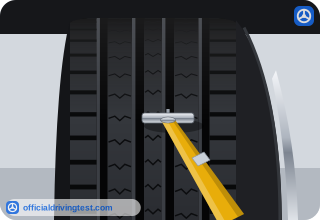
- They shorten your stopping distance
- They can increase your stopping distance and make turning more difficult
- They make the steering lighter
- They reduce the chance of a flat tire and of hydroplaning on wet roads
Show answer
Correct answer: They can increase your stopping distance and make turning more difficult
Worn or bald tires lengthen stopping distance and make turning harder, and can cause hydroplaning.
Source: Tennessee Comprehensive Driver License Manual (March 2025 printing), page 100 · Open this page in the manual (Manual page 100)
-
What do unbalanced tires and low tire pressure cause?
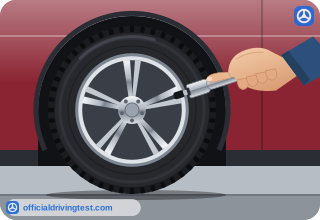
- Slower tire wear and better fuel economy
- Faster tire wear but better fuel economy
- No change in tire wear
- Faster tire wear and lower fuel economy
Show answer
Correct answer: Faster tire wear and lower fuel economy
They wear tires faster, reduce fuel economy and make the vehicle harder to steer and stop.
Source: Tennessee Comprehensive Driver License Manual (March 2025 printing), page 100 · Open this page in the manual (Manual page 100)
-
In the penny test for tire tread, what tread depth does Lincoln’s head represent?
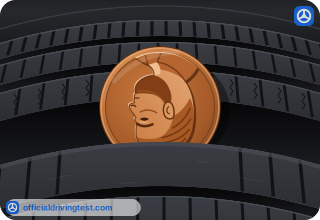
- 1/32 inch
- 4/32 inch
- 2/32 inch
- 6/32 inch
Show answer
Correct answer: 2/32 inch
If the tread does not reach Lincoln’s head (2/32 inch) the tire is illegal and unsafe.
Source: Tennessee Comprehensive Driver License Manual (March 2025 printing), page 100 · Open this page in the manual (Manual page 100)
-
In the penny test, what does it mean if the tread does not come at least to Lincoln’s head?
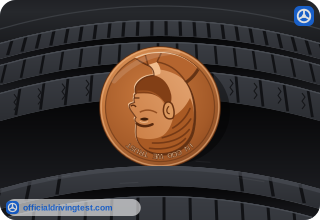
- The tire is illegal and unsafe and needs to be replaced
- The tire is legal but should be rotated before the next trip
- The tire only needs more air
- The tire is fine for dry roads only
Show answer
Correct answer: The tire is illegal and unsafe and needs to be replaced
A tire with tread below 2/32 inch is illegal and unsafe and must be replaced.
Source: Tennessee Comprehensive Driver License Manual (March 2025 printing), page 100 · Open this page in the manual (Manual page 100)
-
What does the manual say about the spare tire?
- It never needs to be checked
- It should be checked only after you have a flat tire
- It should be checked only before winter
- It should also be checked and maintained periodically
Show answer
Correct answer: It should also be checked and maintained periodically
The spare should be checked and kept up in case it is needed in an emergency.
Source: Tennessee Comprehensive Driver License Manual (March 2025 printing), page 100 · Open this page in the manual (Manual page 100)
-
On many newer cars, where is the vehicle’s recommended tire pressure usually found?
- On the sticker on the inside of the fuel filler door
- On the sticker in the door jamb, usually on the driver’s side front door
- On a metal plate on top of the dashboard near the windshield glass
- On the sidewall of each tire
Show answer
Correct answer: On the sticker in the door jamb, usually on the driver’s side front door
The recommended pressure is on the door-jamb sticker, usually on the driver’s side front door.
Source: Tennessee Comprehensive Driver License Manual (March 2025 printing), page 100 · Open this page in the manual (Manual page 100)
-
If the tire pressure sticker is not in the door jamb, where else does the manual say to check?
- The glove box, trunk or back of the sun visor
- The engine compartment or radiator cap
- The back of the license plate
- The spare tire well only
Show answer
Correct answer: The glove box, trunk or back of the sun visor
The manual lists the glove box, trunk or back of the sun visor as other places to look.
Source: Tennessee Comprehensive Driver License Manual (March 2025 printing), page 100 · Open this page in the manual (Manual page 100)
-
Why should you not use the tire pressure printed on the tires themselves?
- It is the minimum pressure and is too low for safe driving on any road
- It applies only to winter driving
- It is the tire’s maximum pressure and may not match your vehicle’s specifications
- It applies only to the spare tire
Show answer
Correct answer: It is the tire’s maximum pressure and may not match your vehicle’s specifications
The number on the tire is the maximum, which may differ from the manufacturer’s specifications for your vehicle.
Source: Tennessee Comprehensive Driver License Manual (March 2025 printing), page 100 · Open this page in the manual (Manual page 100)
-
If you cannot find the recommended tire pressure printed anywhere on the vehicle, where should you check?
- On the tire sidewall
- In the owner’s manual
- In the vehicle registration
- On the speedometer
Show answer
Correct answer: In the owner’s manual
The owner’s manual may include a tire pressure chart and other important information.
Source: Tennessee Comprehensive Driver License Manual (March 2025 printing), page 100 · Open this page in the manual (Manual page 100)
-
If you have replaced your original tires with an aftermarket brand of a different size, who should you contact for the proper tire pressure?
- The vehicle’s original manufacturer or its dealer
- A Driver Service Center
- Your insurance agent
- The tire manufacturer or the installer of the tires
Show answer
Correct answer: The tire manufacturer or the installer of the tires
The vehicle manufacturer’s pressure no longer applies, so ask the tire maker or installer.
Source: Tennessee Comprehensive Driver License Manual (March 2025 printing), page 100 · Open this page in the manual (Manual page 100)
-
What should you do if the vehicle is hard to turn or does not turn when the steering wheel is first turned?
- Add power steering fluid and keep driving
- Turn the ignition to the “lock” position
- Have the steering checked by a mechanic
- Drive slowly until it improves
Show answer
Correct answer: Have the steering checked by a mechanic
A steering problem makes it hard to control direction, so a mechanic should check it.
Source: Tennessee Comprehensive Driver License Manual (March 2025 printing), page 100 · Open this page in the manual (Manual page 100)
-
What happens if you turn your vehicle’s ignition to the “lock” position while the vehicle is in motion?
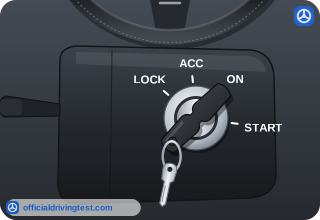
- The steering wheel locks in place and you lose control
- The engine stalls but the steering stays free
- The brakes lock
- The headlights go out
Show answer
Correct answer: The steering wheel locks in place and you lose control
Turning the ignition to lock while moving locks the steering wheel and you lose control.
Source: Tennessee Comprehensive Driver License Manual (March 2025 printing), page 101 · Open this page in the manual (Manual page 101)
-
What may a vehicle that keeps bouncing after a bump or a stop, or is hard to control, need?
- A new set of brake pads and rotors
- A new battery
- A new steering wheel
- New shocks or other suspension parts
Show answer
Correct answer: New shocks or other suspension parts
Continued bouncing or poor control points to worn shocks or other suspension parts.
Source: Tennessee Comprehensive Driver License Manual (March 2025 printing), page 101 · Open this page in the manual (Manual page 101)
-
If you and your passengers tend to get a sleepy feeling when driving or riding in your car, what may be wrong?
- Your windshield washer fluid level may be too low to clean it
- You may have an exhaust leak that needs to be repaired immediately
- Your tire tread may be worn
- Your battery may be run down
Show answer
Correct answer: You may have an exhaust leak that needs to be repaired immediately
Gases from a leaky exhaust can cause death in a vehicle in a very short time, and sleepiness is a warning.
Source: Tennessee Comprehensive Driver License Manual (March 2025 printing), page 101 · Open this page in the manual (Manual page 101)
-
When sitting for a prolonged period in a vehicle with the motor running, what should you do?
- Open a window to provide fresh air
- Close the vents and turn on the heater
- Keep all windows closed to hold the warmth
- Rest your head back and close your eyes
Show answer
Correct answer: Open a window to provide fresh air
Carbon monoxide can overcome people in an enclosed vehicle quicker than most people realize.
Source: Tennessee Comprehensive Driver License Manual (March 2025 printing), page 101 · Open this page in the manual (Manual page 101)
-
In which situation should you never run the motor?
- In an open driveway with the car doors and garage door open
- In a parking lot with the windows down
- In a closed garage or anywhere the tail pipe may be obstructed
- While the hood is open
Show answer
Correct answer: In a closed garage or anywhere the tail pipe may be obstructed
A blocked tail pipe, including in mud or snow, can fill the vehicle with exhaust fumes.
Source: Tennessee Comprehensive Driver License Manual (March 2025 printing), page 101 · Open this page in the manual (Manual page 101)
-
When you make an extended stop at a rest area while traveling, what should you not do?
- Walk around and get some fresh air
- Sleep or sit with the car running
- Check your tires
- Turn off the headlights
Show answer
Correct answer: Sleep or sit with the car running
The manual says not to sleep or sit with the car running during an extended stop.
Source: Tennessee Comprehensive Driver License Manual (March 2025 printing), page 101 · Open this page in the manual (Manual page 101)
-
What can a poor running engine do?
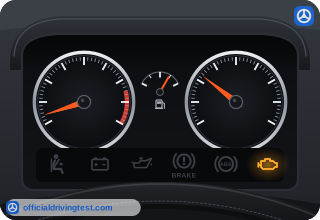
- Improve fuel economy and reduce pollution of the air
- Reduce the noise from the exhaust
- Keep the battery charged longer
- Lose power needed for normal driving and emergencies
Show answer
Correct answer: Lose power needed for normal driving and emergencies
A poor running engine may lose power, fail to start, waste fuel, pollute and stall on the road.
Source: Tennessee Comprehensive Driver License Manual (March 2025 printing), page 101 · Open this page in the manual (Manual page 101)
-
What can improperly maintained antifreeze/coolant levels result in?
- A dead battery in hot weather or a flat tire in winter
- A leaking exhaust in winter
- Overheating in warm weather or engine freezing in winter
- Worn tires in warm weather
Show answer
Correct answer: Overheating in warm weather or engine freezing in winter
Wrong coolant levels can cause overheating in warm weather or engine freezing in winter.
Source: Tennessee Comprehensive Driver License Manual (March 2025 printing), page 101 · Open this page in the manual (Manual page 101)
-
When should you check your radiator?
- Only when the vehicle is cool
- Right after the engine is turned off
- While the engine is running
- Only when the engine is hot
Show answer
Correct answer: Only when the vehicle is cool
The radiator should be checked only when the vehicle is cool, not immediately after operation.
Source: Tennessee Comprehensive Driver License Manual (March 2025 printing), page 101 · Open this page in the manual (Manual page 101)
-
Why should you make sure there are no objects on the floor of your vehicle?
- They could block the heater vents and fog up the windshield
- They could scratch the floor mats
- They could set off the air bag
- They could roll under the brake pedal and prevent you from stopping
Show answer
Correct answer: They could roll under the brake pedal and prevent you from stopping
A loose object under the brake pedal could stop you from braking.
Source: Tennessee Comprehensive Driver License Manual (March 2025 printing), page 101 · Open this page in the manual (Manual page 101)
-
For what should you use your horn, according to the manual?
- To greet other drivers
- Only as a warning to others
- To hurry slow traffic along
- To show frustration
Show answer
Correct answer: Only as a warning to others
The manual says to use the horn only as a warning to others.
Source: Tennessee Comprehensive Driver License Manual (March 2025 printing), page 101 · Open this page in the manual (Manual page 101)
-
How much gas should your vehicle always have before you start a trip of significant length?
- At least a half tank
- At least a quarter tank
- A completely full tank
- At least a third of a tank
Show answer
Correct answer: At least a half tank
The manual says to have at least a half tank before any trip of significant length.
Source: Tennessee Comprehensive Driver License Manual (March 2025 printing), page 101 · Open this page in the manual (Manual page 101)
-
Which arm signal does a bicyclist use to show a left turn?
- Left arm bent at 90 degrees at the elbow, hand pointing downward, palm facing back
- Left arm bent at 90 degrees at the elbow, hand pointing upward, palm facing forward
- Right arm extended out straight, with fingers extended or index finger pointing right
- Left arm extended out sideways, with fingers extended or index finger pointing left
Show answer
Correct answer: Left arm extended out sideways, with fingers extended or index finger pointing left
A bicyclist signals a left turn by extending the left arm out sideways, or by pointing left with the index finger.
Source: Tennessee Comprehensive Driver License Manual (March 2025 printing), page 105 · Open this page in the manual (Manual page 105)
-
A bicyclist holds the left arm out sideways, bent at 90 degrees at the elbow, with the hand pointing upward and the palm facing forward. What does this signal mean?
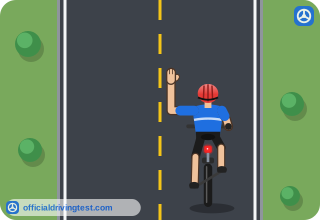
- A left turn
- A right turn
- Stopping or slowing
- A request for the driver to pass
Show answer
Correct answer: A right turn
Left arm out and bent upward with the palm forward is the bicyclist’s right-turn signal.
Source: Tennessee Comprehensive Driver License Manual (March 2025 printing), page 105 · Open this page in the manual (Manual page 105)
-
A bicyclist extends the right arm straight out to the side. What does this signal mean?
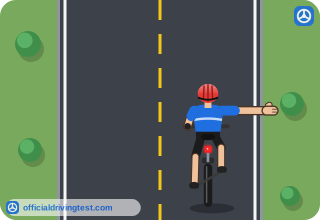
- A left turn
- Stopping or slowing
- A right turn
- A bicyclist who is turning around
Show answer
Correct answer: A right turn
Extending the right arm out straight, or pointing right, is the alternative right-turn signal.
Source: Tennessee Comprehensive Driver License Manual (March 2025 printing), page 105 · Open this page in the manual (Manual page 105)
-
A bicyclist extends an arm sideways and bends it at 90 degrees at the elbow, with the hand pointing downward and the palm facing backward. What does this signal mean?
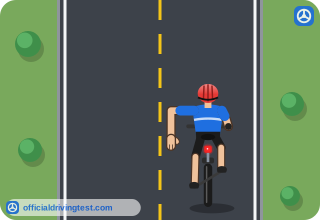
- A left turn
- A right turn
- Stopping or slowing
- Passing another vehicle
Show answer
Correct answer: Stopping or slowing
An arm bent downward with the palm facing back is the bicyclist’s signal for stopping or slowing.
Source: Tennessee Comprehensive Driver License Manual (March 2025 printing), page 105 · Open this page in the manual (Manual page 105)
-
How often should the tires and tire pressure of a 15-passenger van be checked?
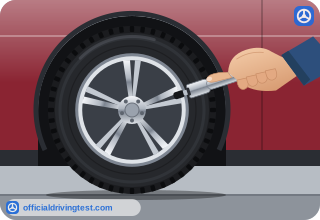
- Once a month
- Once a year
- Only before long trips
- Every time the van is used
Show answer
Correct answer: Every time the van is used
Worn or improperly inflated tires can lead to loss of control and rollover.
Source: Tennessee Comprehensive Driver License Manual (March 2025 printing), page 114 · Open this page in the manual (Manual page 114)
-
What is a major cause of tread separation in 15-passenger vans?
- Underinflated rear tires, especially the left rear
- Overinflation of the front tires on the van
- Using new tires on the front axle
- Driving the van at night on highways
Show answer
Correct answer: Underinflated rear tires, especially the left rear
Many of these vans have different front and rear tire pressure recommendations, and underinflated rear tires are a major cause of tread separation.
Source: Tennessee Comprehensive Driver License Manual (March 2025 printing), page 114 · Open this page in the manual (Manual page 114)