Tennessee: Vehicle controls and signals — Hand Signals, Brake Lights and the Horn Practice Test
Questions in this part include: “On which motor vehicles is a horn required?” · “What does the manual say about hand and arm signals during non-daylight hours?”
Independent educational site · not affiliated with any government agency or DMV
Ready? Test yourself
- Instant feedback with an explanation
- Every answer cites its source in the manual
- Your best score is saved on this device
- Keyboard: press 1 to 4 to answer and Enter for the next question
Questions are original and based on the official manual "Tennessee Comprehensive Driver License Manual" (March 2025 printing), Tennessee Department of Safety and Homeland Security.
All 16 questions in this practice test
Take the test above first, then use this list to study. Tap “Show answer” to see the correct answer and explanation.
Show the questions and answersHide the questions
-
On which motor vehicles is a horn required?
- Only vehicles driven on interstates
- Only passenger cars
- Only vehicles more than ten years old
- All motor vehicles
Show answer
Correct answer: All motor vehicles
A horn is required on all motor vehicles.
Source: Tennessee Comprehensive Driver License Manual (March 2025 printing), page 22 · Open this page in the manual (Manual page 22)
-
What may you use to signal a turn?
- Vehicle turn signal lights only, never hand signals
- Hand and arm signals only, never turn signal lights
- Your horn together with your high-beam headlights on
- Either vehicle turn signal lights or hand and arm signals
Show answer
Correct answer: Either vehicle turn signal lights or hand and arm signals
The manual says you may use either the vehicle’s turn signal lights or hand and arm signals.
Source: Tennessee Comprehensive Driver License Manual (March 2025 printing), page 55 · Open this page in the manual (Manual page 55)
-
When you give a hand signal, what should you do during the actual turn?
- Bring your arm in to keep control of the steering wheel
- Keep your arm out until the turn ends
- Hold the wheel with one hand at the bottom
- Signal with the arm that is farthest from the window
Show answer
Correct answer: Bring your arm in to keep control of the steering wheel
You bring your arm in during the actual turn to keep control of the steering wheel.
Source: Tennessee Comprehensive Driver License Manual (March 2025 printing), page 55 · Open this page in the manual (Manual page 55)
-
What does the manual say about hand and arm signals during non-daylight hours?
- They must be given with both arms out the window
- They are required at night
- They are usually not visible except in well lit areas
- They replace the need for working brake lights at night
Show answer
Correct answer: They are usually not visible except in well lit areas
At night, hand and arm signals are usually not visible except in well lit areas.
Source: Tennessee Comprehensive Driver License Manual (March 2025 printing), page 55 · Open this page in the manual (Manual page 55)
-
When does the manual say hand signals should be used?
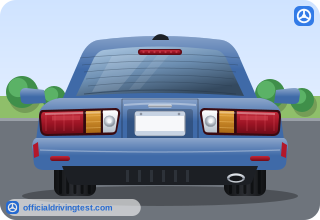
- When driving at night
- When your brake lights are working
- When the road is wet
- When the sun is shining brightly
Show answer
Correct answer: When the sun is shining brightly
Bright sun makes your turn signal light harder for other drivers to see, so a hand signal helps.
Source: Tennessee Comprehensive Driver License Manual (March 2025 printing), page 55 · Open this page in the manual (Manual page 55)
-
Why can a hand signal be useful in heavy traffic?
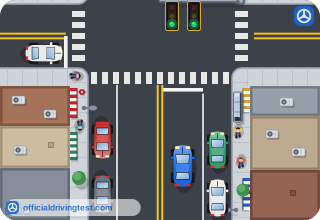
- Drivers several cars back may see it when they cannot see your signal light
- It lets you make a turn without checking for other traffic first
- It gives you the right-of-way over all the cars that are behind you
- It is easier to see than a turn signal light on a dark road at night
Show answer
Correct answer: Drivers several cars back may see it when they cannot see your signal light
A hand signal can be seen by drivers who are several cars back and cannot see your turn signal light.
Source: Tennessee Comprehensive Driver License Manual (March 2025 printing), page 55 · Open this page in the manual (Manual page 55)
-
How should you give a hand and arm signal?
- Hold your hand just inside the window and signal at the turn
- Extend your hand and arm well out of the window, in plenty of time
- Wave your hand briefly once the turn has started
- Signal with the horn while your arm is out
Show answer
Correct answer: Extend your hand and arm well out of the window, in plenty of time
The manual says to extend your hand and arm well out of the window and signal in plenty of time.
Source: Tennessee Comprehensive Driver License Manual (March 2025 printing), page 55 · Open this page in the manual (Manual page 55)
-
When signaling a stop, what does the manual say to do with your brakes?
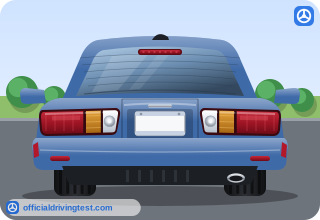
- Press the brake pedal hard once and hold it down until you stop
- Tap the brakes only when you are driving on a freeway or interstate
- Lightly pump them a few times to flash your brake lights
- Leave the brakes alone and use only the horn to signal the stop
Show answer
Correct answer: Lightly pump them a few times to flash your brake lights
Lightly pumping the brakes a few times makes the brake lights flash and draws attention.
Source: Tennessee Comprehensive Driver License Manual (March 2025 printing), page 55 · Open this page in the manual (Manual page 55)
-
What does the manual say about slowing down as a signal?
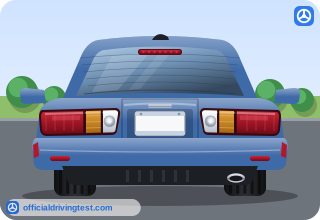
- Brake lights flash as a signal, and slowing itself acts as one
- Slowing down gives no signal unless you also use a turn signal
- Only hand signals can show other drivers that you are slowing
- Slowing down counts as a signal only when the road is wet or icy
Show answer
Correct answer: Brake lights flash as a signal, and slowing itself acts as one
When you slow down, your brake lights flash as a signal and the slowing itself also communicates.
Source: Tennessee Comprehensive Driver License Manual (March 2025 printing), page 56 · Open this page in the manual (Manual page 56)
-
Before passing, what does the manual say to do when necessary to avoid surprising the driver ahead?
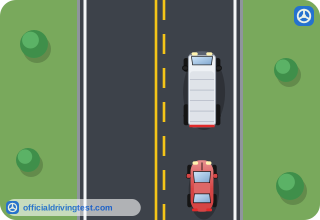
- Flash your hazard lights
- Tap the brake pedal repeatedly
- Tap your horn
- Flash your parking lights
Show answer
Correct answer: Tap your horn
A tap of the horn warns the driver ahead that you are about to pass so he or she is not surprised.
Source: Tennessee Comprehensive Driver License Manual (March 2025 printing), page 63 · Open this page in the manual (Manual page 63)
-
In the manual's five tips, how does "Make Sure They See You" say you should communicate in traffic?
- With hand gestures and loud shouting
- With your hazard flashers at all times
- With your windshield wipers and fan
- With your horn, lights and signals
Show answer
Correct answer: With your horn, lights and signals
To make sure others see you, the manual says to use your horn, lights and signals and to be reasonably sure of people's intentions.
Source: Tennessee Comprehensive Driver License Manual (March 2025 printing), page 92 · Open this page in the manual (Manual page 92)
-
For what should you use your horn, according to the manual?
- To greet other drivers
- Only as a warning to others
- To hurry slow traffic along
- To show frustration
Show answer
Correct answer: Only as a warning to others
The manual says to use the horn only as a warning to others.
Source: Tennessee Comprehensive Driver License Manual (March 2025 printing), page 101 · Open this page in the manual (Manual page 101)
-
Which arm signal does a bicyclist use to show a left turn?
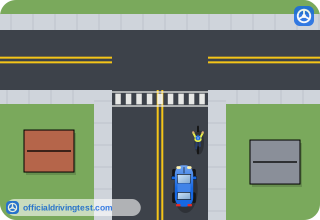
- Left arm bent at 90 degrees at the elbow, hand pointing downward, palm facing back
- Left arm bent at 90 degrees at the elbow, hand pointing upward, palm facing forward
- Right arm extended out straight, with fingers extended or index finger pointing right
- Left arm extended out sideways, with fingers extended or index finger pointing left
Show answer
Correct answer: Left arm extended out sideways, with fingers extended or index finger pointing left
A bicyclist signals a left turn by extending the left arm out sideways, or by pointing left with the index finger.
Source: Tennessee Comprehensive Driver License Manual (March 2025 printing), page 105 · Open this page in the manual (Manual page 105)
-
A bicyclist holds the left arm out sideways, bent at 90 degrees at the elbow, with the hand pointing upward and the palm facing forward. What does this signal mean?
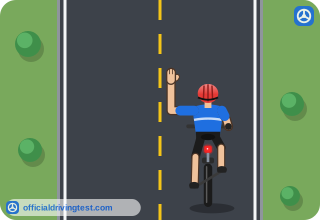
- A left turn
- A right turn
- Stopping or slowing
- A request for the driver to pass
Show answer
Correct answer: A right turn
Left arm out and bent upward with the palm forward is the bicyclist’s right-turn signal.
Source: Tennessee Comprehensive Driver License Manual (March 2025 printing), page 105 · Open this page in the manual (Manual page 105)
-
A bicyclist extends the right arm straight out to the side. What does this signal mean?
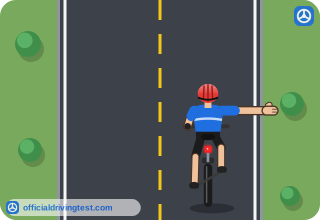
- A left turn
- Stopping or slowing
- A right turn
- A bicyclist who is turning around
Show answer
Correct answer: A right turn
Extending the right arm out straight, or pointing right, is the alternative right-turn signal.
Source: Tennessee Comprehensive Driver License Manual (March 2025 printing), page 105 · Open this page in the manual (Manual page 105)
-
A bicyclist extends an arm sideways and bends it at 90 degrees at the elbow, with the hand pointing downward and the palm facing backward. What does this signal mean?
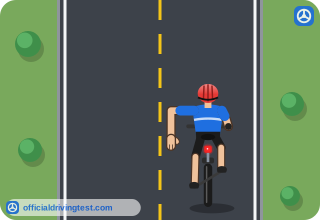
- A left turn
- A right turn
- Stopping or slowing
- Passing another vehicle
Show answer
Correct answer: Stopping or slowing
An arm bent downward with the palm facing back is the bicyclist’s signal for stopping or slowing.
Source: Tennessee Comprehensive Driver License Manual (March 2025 printing), page 105 · Open this page in the manual (Manual page 105)