Tennessee: Sharing the road — Large Trucks: Stopping, Following and Wind Practice Test
Questions in this part include: “What should you give trucks and buses that are entering the interstate?” · “When stopped in a traffic lane behind a truck, why should you leave extra space in front of your car?”
Independent educational site · not affiliated with any government agency or DMV
Ready? Test yourself
- Instant feedback with an explanation
- Every answer cites its source in the manual
- Your best score is saved on this device
- Keyboard: press 1 to 4 to answer and Enter for the next question
Questions are original and based on the official manual "Tennessee Comprehensive Driver License Manual" (March 2025 printing), Tennessee Department of Safety and Homeland Security.
All 23 questions in this practice test
Take the test above first, then use this list to study. Tap “Show answer” to see the correct answer and explanation.
Show the questions and answersHide the questions
-
What should you give trucks and buses that are entering the interstate?
- A blast of the horn to warn them you are there
- Extra time and space to adjust to the traffic flow
- The left lane, so they can enter at a slow speed
- A flash of your headlights to wave them in
Show answer
Correct answer: Extra time and space to adjust to the traffic flow
Trucks and buses may need extra time to adjust to traffic, so be cooperative and give them extra time and space.
Source: Tennessee Comprehensive Driver License Manual (March 2025 printing), page 69 · Open this page in the manual (Manual page 69)
-
When a truck or bus is passing you on the left in windy conditions, what should you do?
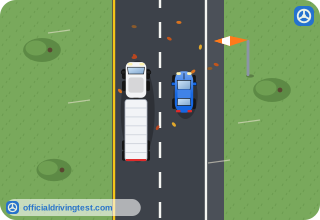
- Move toward the center line and hold your speed steady
- Speed up so you can pull ahead of it quickly
- Brake hard and stop in your lane
- Move as far right in your lane as possible and slow down
Show answer
Correct answer: Move as far right in your lane as possible and slow down
The gusts of wind these vehicles create can require steering corrections; staying far right and slowing helps.
Source: Tennessee Comprehensive Driver License Manual (March 2025 printing), page 77 · Open this page in the manual (Manual page 77)
-
What can wind currents from larger vehicles do to a trailer you are pulling?
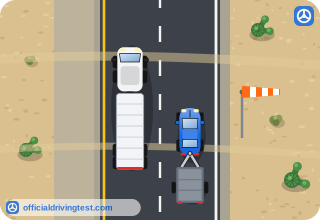
- Cause it to jackknife
- Lift it off the road
- Make its brake lights fail
- Unhitch it from your vehicle
Show answer
Correct answer: Cause it to jackknife
Wind currents from passing trucks and buses can cause a trailer to jackknife.
Source: Tennessee Comprehensive Driver License Manual (March 2025 printing), page 77 · Open this page in the manual (Manual page 77)
-
As a large vehicle passes you while you pull a trailer, what should you do?
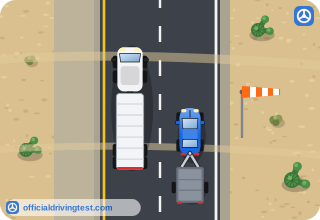
- Steer sharply toward the shoulder
- Steer toward the center line to keep clear
- Accelerate slowly to keep the trailer straight
- Stop on the shoulder and wait
Show answer
Correct answer: Accelerate slowly to keep the trailer straight
A gentle increase in speed keeps the trailer pulling in a straight path as the large vehicle goes by.
Source: Tennessee Comprehensive Driver License Manual (March 2025 printing), page 77 · Open this page in the manual (Manual page 77)
-
An oncoming semi-truck is approaching and there are parked cars on your side of the road. Where should you leave more room?
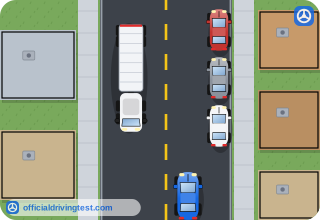
- On the side with the parked cars
- Equally on both sides, exactly
- On neither side; stay in the center of your lane
- On the side the truck will pass on
Show answer
Correct answer: On the side the truck will pass on
With an oncoming semi-truck, the manual says to leave more room on the side the truck passes instead of the side with the parked cars.
Source: Tennessee Comprehensive Driver License Manual (March 2025 printing), page 94 · Open this page in the manual (Manual page 94)
-
How does the stopping space of trucks compare with that of passenger vehicles, according to the manual?
- Trucks need the same space as passenger vehicles
- Trucks need slightly less space than passenger vehicles
- Trucks need less space because they weigh more
- Trucks can take much more space to stop than passenger vehicles
Show answer
Correct answer: Trucks can take much more space to stop than passenger vehicles
The manual says trucks can take much more space to stop than passenger vehicles, so pedestrians should never take a chance with one.
Source: Tennessee Comprehensive Driver License Manual (March 2025 printing), page 104 · Open this page in the manual (Manual page 104)
-
About how far does a truck traveling at 55 MPH need to stop, according to the manual?
- About 450+ feet
- About 240 feet
- About 150 feet
- About 300 feet
Show answer
Correct answer: About 450+ feet
A truck at 55 MPH needs far more room to stop than a car, which can stop in about 240 feet.
Source: Tennessee Comprehensive Driver License Manual (March 2025 printing), page 109 · Open this page in the manual (Manual page 109)
-
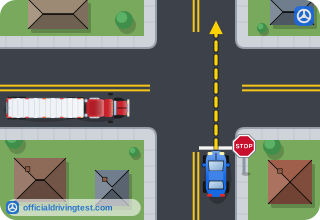
Why should you not pull out onto a roadway in front of a large truck or bus?
- It will always speed up to pass you in the lane
- It cannot slow down or stop as quickly as a car
- Its driver is not allowed to use the horn there
- It is not allowed to change lanes to avoid you
Show answer
Correct answer: It cannot slow down or stop as quickly as a car
Large vehicles need much more distance to slow down, so pulling out in front of one can cause a rear-end collision.
Source: Tennessee Comprehensive Driver License Manual (March 2025 printing), page 109 · Open this page in the manual (Manual page 109)
-
You are about to exit a highway and a truck is just ahead of you. What does the manual say to do?
- Speed up and cut in front of the truck
- Pull alongside the truck and stay there
- Follow the truck closely until the exit ends
- Slow down a few seconds and exit behind the truck
Show answer
Correct answer: Slow down a few seconds and exit behind the truck
It only takes a few extra seconds to exit behind the truck, which is safer than cutting it off.
Source: Tennessee Comprehensive Driver License Manual (March 2025 printing), page 109 · Open this page in the manual (Manual page 109)
-
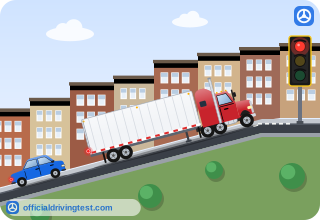
You are stopped behind a truck on an uphill grade. Where should you position your car in your lane?
- To the right side of your lane
- To the left side of your lane
- Directly behind the truck bumper
- Partly on the shoulder
Show answer
Correct answer: To the left side of your lane
Staying to the left in your lane lets the truck driver see you.
Source: Tennessee Comprehensive Driver License Manual (March 2025 printing), page 109 · Open this page in the manual (Manual page 109)
-
When stopped in a traffic lane behind a truck, why should you leave extra space in front of your car?
- The truck may need to turn around
- The truck driver may open the door
- Other trucks may need to pass between you
- The truck may roll back when it starts to move
Show answer
Correct answer: The truck may roll back when it starts to move
A truck can roll back when it starts, so extra space in front of your car protects you.
Source: Tennessee Comprehensive Driver License Manual (March 2025 printing), page 109 · Open this page in the manual (Manual page 109)
-
What should you do near a Commercial Vehicle Weigh Station?
- Avoid the right lane so slow trucks can merge back
- Stay in the right lane so you can use the exit
- Stop on the shoulder until trucks have merged
- Speed up to pass trucks entering the station
Show answer
Correct answer: Avoid the right lane so slow trucks can merge back
Staying out of the right lane lets slow trucks easily merge back into traffic.
Source: Tennessee Comprehensive Driver License Manual (March 2025 printing), page 109 · Open this page in the manual (Manual page 109)
-
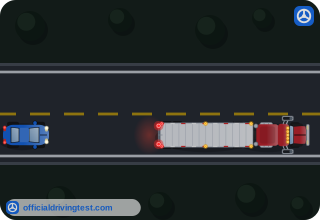
Why should you dim your lights at night when you are near a large truck?
- Truck lights are always turned off at night
- Dimmed lights make the truck look faster
- Bright lights in its mirrors can blind the driver
- Bright lights damage the truck's mirrors
Show answer
Correct answer: Bright lights in its mirrors can blind the driver
Bright lights shining in the mirrors of a truck can blind its driver.
Source: Tennessee Comprehensive Driver License Manual (March 2025 printing), page 109 · Open this page in the manual (Manual page 109)
-
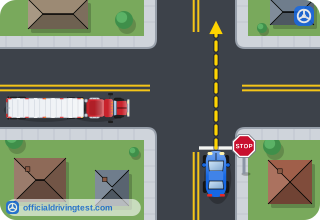
Why should you never underestimate the speed of an approaching truck or bus?
- It always travels above the speed limit
- It can change lanes without signaling
- Its brakes work faster than a car's
- It looks slower than it really is
Show answer
Correct answer: It looks slower than it really is
Large vehicles often appear to be traveling more slowly than their actual speed.
Source: Tennessee Comprehensive Driver License Manual (March 2025 printing), page 109 · Open this page in the manual (Manual page 109)
-
What does a large vehicle usually do on an upgrade or steep hill?
- It gains speed
- It keeps the same speed
- It loses speed
- It stops completely
Show answer
Correct answer: It loses speed
Large vehicles usually slow down as they climb a steep hill.
Source: Tennessee Comprehensive Driver License Manual (March 2025 printing), page 109 · Open this page in the manual (Manual page 109)
-
What should you do when a truck or bus is passing you?
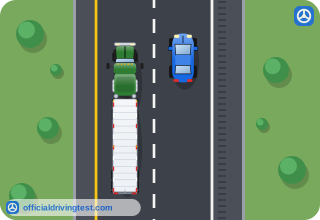
- Keep to the far side of your lane and never speed up
- Move toward the center of your lane to give room
- Speed up to stay beside it until it is clear
- Brake hard and stop in the lane right away
Show answer
Correct answer: Keep to the far side of your lane and never speed up
Staying to the side of your lane and reducing speed slightly helps the driver, and speeding up is dangerous.
Source: Tennessee Comprehensive Driver License Manual (March 2025 printing), page 110 · Open this page in the manual (Manual page 110)
-
When you meet a truck or bus coming from the opposite direction, what should you do?
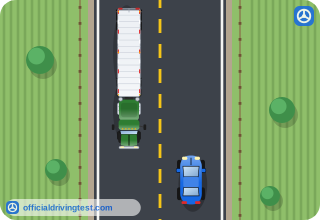
- Move toward the center line
- Flash your headlights and slow to a stop
- Keep as far as possible to the right of the road
- Drive on the left edge of your lane
Show answer
Correct answer: Keep as far as possible to the right of the road
Keeping to the right avoids being sideswiped and reduces wind turbulence between the vehicles.
Source: Tennessee Comprehensive Driver License Manual (March 2025 printing), page 110 · Open this page in the manual (Manual page 110)
-
According to the manual, what does the wind turbulence between two passing vehicles do?
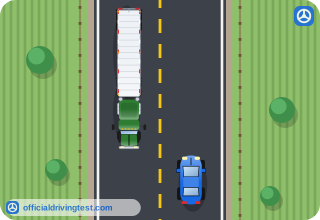
- It pulls the vehicles together
- It pushes the vehicles apart
- It makes both vehicles slow down
- It has no effect on either vehicle
Show answer
Correct answer: It pushes the vehicles apart
The manual states that the turbulence pushes vehicles apart and does not suck them together.
Source: Tennessee Comprehensive Driver License Manual (March 2025 printing), page 110 · Open this page in the manual (Manual page 110)
-
When you are following a truck or bus, what is a good idea?
- Follow as closely as you can
- Add more following distance
- Stay in its right blind spot
- Follow in the left lane edge only
Show answer
Correct answer: Add more following distance
Large vehicles need more room, so a longer following distance is recommended.
Source: Tennessee Comprehensive Driver License Manual (March 2025 printing), page 110 · Open this page in the manual (Manual page 110)
-
If spray from a truck is reducing your vision on a wet road, what should you do?
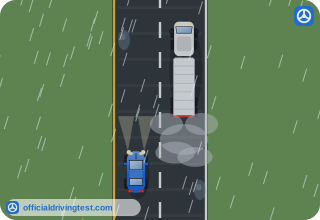
- Pass the truck as closely as you can
- Move as far from the truck as you can, in your lane
- Drive in the truck's blind spot to stay close
- Brake hard to drop back behind the truck
Show answer
Correct answer: Move as far from the truck as you can, in your lane
Spray from a truck can seriously reduce your vision, so stay in your lane but move away from it.
Source: Tennessee Comprehensive Driver License Manual (March 2025 printing), page 110 · Open this page in the manual (Manual page 110)
-
Why should you not drive too close to a truck that is transporting hazardous materials?
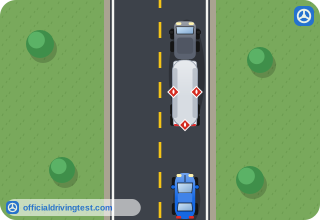
- It always drives well above the posted speed limit
- It cannot use the right lane on a divided road
- It is not allowed to use turn signals at night
- It makes frequent stops, such as at railroad crossings
Show answer
Correct answer: It makes frequent stops, such as at railroad crossings
Trucks carrying hazardous materials make frequent stops, so following closely is risky.
Source: Tennessee Comprehensive Driver License Manual (March 2025 printing), page 110 · Open this page in the manual (Manual page 110)
-
What can smoking wheels or a high speed on a large truck going downhill signal?
- Brake loss, so you should fall back and not pass
- A heavy load, so you should pass quickly
- A normal braking pattern
- The driver is about to stop on the shoulder
Show answer
Correct answer: Brake loss, so you should fall back and not pass
Those signs can mean the truck has lost its brakes, so stay back and do not pass.
Source: Tennessee Comprehensive Driver License Manual (March 2025 printing), page 110 · Open this page in the manual (Manual page 110)
-
What should vehicles never do in a runaway truck ramp area?
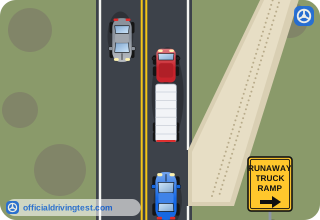
- Slow down
- Use the horn
- Stop or park
- Drive at the speed limit
Show answer
Correct answer: Stop or park
Runaway truck ramps are for out-of-control trucks or buses, so vehicles should not stop or park there.
Source: Tennessee Comprehensive Driver License Manual (March 2025 printing), page 110 · Open this page in the manual (Manual page 110)