Tennessee: Sharing the road — Changing Lanes and Passing Practice Test
Questions in this part include: “Which of these is a situation in which you may NOT cross the center line to pass?” · “What does the manual say about passing a truck that is pulling multiple trailers?”
Independent educational site · not affiliated with any government agency or DMV
Ready? Test yourself
- Instant feedback with an explanation
- Every answer cites its source in the manual
- Your best score is saved on this device
- Keyboard: press 1 to 4 to answer and Enter for the next question
Questions are original and based on the official manual "Tennessee Comprehensive Driver License Manual" (March 2025 printing), Tennessee Department of Safety and Homeland Security.
All 21 questions in this practice test
Take the test above first, then use this list to study. Tap “Show answer” to see the correct answer and explanation.
Show the questions and answersHide the questions
-
Why is checking your mirrors alone not enough before changing lanes?
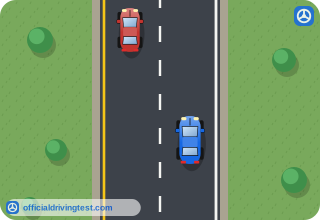
- Mirrors show only the lane you are in
- Mirrors are not allowed at night
- Mirrors make other cars look farther away
- Mirrors do not show vehicles in your blind spots
Show answer
Correct answer: Mirrors do not show vehicles in your blind spots
Mirrors alone do not show vehicles in your blind spots; you must turn your head and look over your shoulder to see vehicles next to you.
Source: Tennessee Comprehensive Driver License Manual (March 2025 printing), page 61 · Open this page in the manual (Manual page 61)
-
Which of these is part of making a safe lane change?
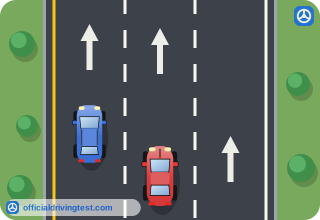
- Changing lanes gradually and carefully
- Changing lanes quickly before others react
- Signaling after you start moving over
- Staying in another driver's blind spot to keep pace
Show answer
Correct answer: Changing lanes gradually and carefully
The listed steps for safe lane changes include changing lanes gradually and carefully.
Source: Tennessee Comprehensive Driver License Manual (March 2025 printing), page 61 · Open this page in the manual (Manual page 61)
-
A driver in the lane next to you signals a lane change. What should you do?
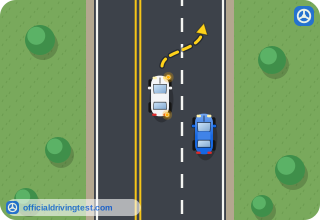
- Speed up to stay ahead
- Change lanes yourself at the same time
- Slow down and leave space for the change
- Flash your headlights and hold your position
Show answer
Correct answer: Slow down and leave space for the change
You slow down and leave space, and do not speed up or change lanes until the other driver has completed the move.
Source: Tennessee Comprehensive Driver License Manual (March 2025 printing), page 61 · Open this page in the manual (Manual page 61)
-
What does the manual say about passing when you are approaching a narrow bridge, a viaduct or a tunnel?
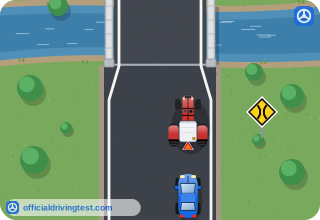
- Do not pass at all
- Pass only if you tap your horn first
- Pass only if no vehicle is oncoming
- Pass only if your turn signal is on
Show answer
Correct answer: Do not pass at all
Passing is not allowed when approaching an intersection, railroad crossing, narrow bridge, viaduct or tunnel.
Source: Tennessee Comprehensive Driver License Manual (March 2025 printing), page 63 · Open this page in the manual (Manual page 63)
-
Which of these is a situation in which you may NOT cross the center line to pass?
- When you have signaled left and checked your mirrors
- When the road ahead is straight and level
- When there is an oncoming car
- When the car ahead is traveling slowly
Show answer
Correct answer: When there is an oncoming car
You may not cross the center line to pass while a car is oncoming.
Source: Tennessee Comprehensive Driver License Manual (March 2025 printing), page 63 · Open this page in the manual (Manual page 63)
-
What does the manual say about passing when you are approaching a hill or a curve?
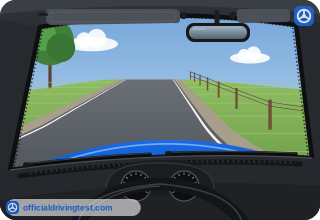
- Pass only if you give a signal first
- Do not pass when approaching either one
- Pass only if you are below the speed limit
- Pass only if the oncoming lane looks empty
Show answer
Correct answer: Do not pass when approaching either one
Passing is not allowed when approaching a hill or curve because you cannot see what is ahead.
Source: Tennessee Comprehensive Driver License Manual (March 2025 printing), page 63 · Open this page in the manual (Manual page 63)
-
Why should you not pass on the right shoulder of the highway?
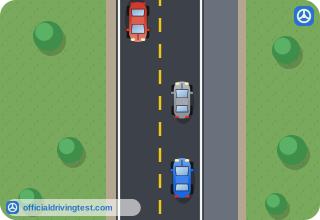
- Shoulders are reserved for emergency vehicles at all times
- Other drivers will not expect you to be there
- Your tires wear faster on gravel or dirt shoulders
- Slower drivers must always stay on the shoulder
Show answer
Correct answer: Other drivers will not expect you to be there
Other drivers do not expect a car on the shoulder and may pull off the road or turn right without looking.
Source: Tennessee Comprehensive Driver License Manual (March 2025 printing), page 63 · Open this page in the manual (Manual page 63)
-
If you must return to your original lane after passing, what does the manual say you should do?
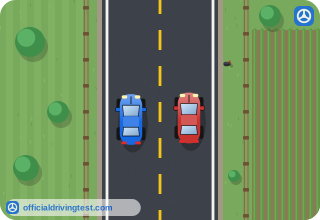
- Avoid cutting in too quickly in front of the other driver
- Move over right away, before the other driver can speed up
- Cut in sharply and then slow down in front of the car
- Return before you can see the passed car in your mirror
Show answer
Correct answer: Avoid cutting in too quickly in front of the other driver
Returning to your lane too sharply or too soon is dangerous, so the manual says to avoid cutting in too quickly.
Source: Tennessee Comprehensive Driver License Manual (March 2025 printing), page 63 · Open this page in the manual (Manual page 63)
-
Another driver is passing you on the left. What should you do?
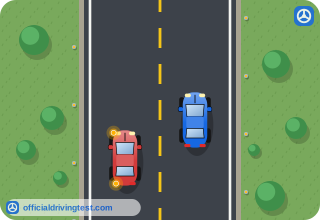
- Move left toward the center line to give more room
- Brake hard so the other driver can pass quickly
- Change lanes so you are no longer beside the car
- Stay in your lane and move to the right
Show answer
Correct answer: Stay in your lane and move to the right
Staying in your lane and moving to the right helps the other driver pass safely.
Source: Tennessee Comprehensive Driver License Manual (March 2025 printing), page 63 · Open this page in the manual (Manual page 63)
-
While another driver is passing you, you see a car approaching from the other direction. What should you do?
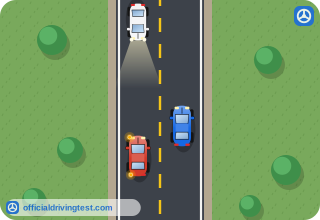
- Slow down to give the passing driver more space to pull back in front of you
- Speed up so the passing driver has less time in the oncoming lane
- Brake hard and stop in your lane so the driver can move back
- Move to the left toward the center line to block the oncoming car
Show answer
Correct answer: Slow down to give the passing driver more space to pull back in front of you
Slowing down lets the passing driver return to the right lane in front of you before meeting the oncoming vehicle.
Source: Tennessee Comprehensive Driver License Manual (March 2025 printing), page 63 · Open this page in the manual (Manual page 63)
-
Why should you finish passing a large truck or bus quickly instead of staying alongside it?
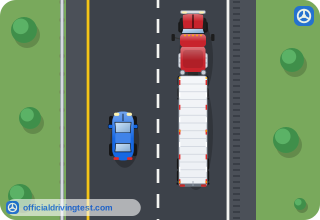
- A truck beside you cannot change lanes safely
- Staying beside it puts you in the driver’s blindspot
- Engine noise from the truck can distract you
- It makes the truck take longer to stop
Show answer
Correct answer: Staying beside it puts you in the driver’s blindspot
Staying beside a truck or bus does not tell the driver you are there; it puts you in the blindspot.
Source: Tennessee Comprehensive Driver License Manual (March 2025 printing), page 64 · Open this page in the manual (Manual page 64)
-
You are alongside a truck or bus and can see any part of the tractor from the driver or passenger door back to the fifth wheel. Where are you most likely to be?
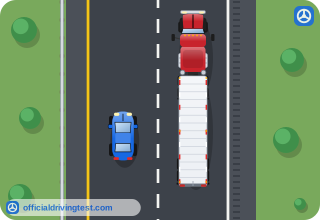
- In the truck’s braking zone
- Where the driver sees you in the mirrors
- In the driver’s blindspot
- In the safest place to pass
Show answer
Correct answer: In the driver’s blindspot
Seeing that part of the tractor from beside it means you are most likely in the driver’s blindspot.
Source: Tennessee Comprehensive Driver License Manual (March 2025 printing), page 64 · Open this page in the manual (Manual page 64)
-
After passing a truck or bus, what should you never do?
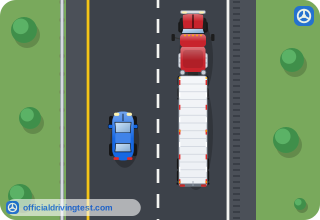
- Maintain your speed
- Complete the pass quickly
- Return only after it is clear of your mirror
- Pull in front of it and slow down
Show answer
Correct answer: Pull in front of it and slow down
Pulling in front of a truck or bus and slowing takes away the safety cushion of the driver you just passed.
Source: Tennessee Comprehensive Driver License Manual (March 2025 printing), page 64 · Open this page in the manual (Manual page 64)
-
On a level highway, how does the time needed to pass a truck or bus compare with passing a car?
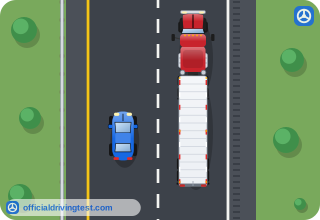
- It generally takes longer
- It generally takes less time
- It takes the same time
- It takes much less time
Show answer
Correct answer: It generally takes longer
On a level road it generally takes longer to pass a truck or bus than a car.
Source: Tennessee Comprehensive Driver License Manual (March 2025 printing), page 64 · Open this page in the manual (Manual page 64)
-
On an upgrade, what often happens to heavy vehicles such as trucks and buses?
- They often speed up as their engines work harder
- They keep exactly the same speed as on level road
- They often lose speed, making them easier to pass
- They must pull off the road to rest the engine
Show answer
Correct answer: They often lose speed, making them easier to pass
Heavy vehicles often slow on an upgrade, which makes passing them easier.
Source: Tennessee Comprehensive Driver License Manual (March 2025 printing), page 64 · Open this page in the manual (Manual page 64)
-
What does the manual say about passing a truck that is pulling multiple trailers?
- Avoid passing it unless the road ahead is level and straight
- Pass it only on an upgrade when it loses speed
- Never pass it on a two-lane road under any conditions
- No need to hesitate; follow the usual rules for sharing the road
Show answer
Correct answer: No need to hesitate; follow the usual rules for sharing the road
A truck pulling multiple trailers is treated like any other commercial vehicle, and you follow the same sharing-the-road rules.
Source: Tennessee Comprehensive Driver License Manual (March 2025 printing), page 64 · Open this page in the manual (Manual page 64)
-
What does the manual say about passing as a way to avoid road rage?
- Pass every vehicle that drives slower than you as soon as you can
- Pass on the right whenever that avoids a confrontation
- Drive relaxed, within the speed limit, passing only when necessary
- Speed up so that no other driver can follow your vehicle
Show answer
Correct answer: Drive relaxed, within the speed limit, passing only when necessary
Driving relaxed, within the speed limit and passing only when necessary helps you avoid road rage.
Source: Tennessee Comprehensive Driver License Manual (March 2025 printing), page 95 · Open this page in the manual (Manual page 95)
-
May a driver try to share a lane with a motorcycle?
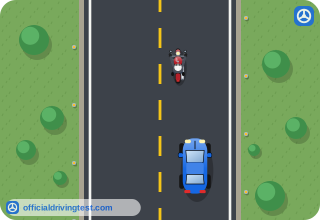
- Yes, if the driver stays in the left part of the lane and signals
- Yes, if the driver is moving slowly and has signaled
- No, never; respect the cycle’s space and position in traffic
- Yes, if the motorcycle is close to the edge of the lane
Show answer
Correct answer: No, never; respect the cycle’s space and position in traffic
A driver must never try to share a lane with a motorcycle and should always respect its space and position.
Source: Tennessee Comprehensive Driver License Manual (March 2025 printing), page 107 · Open this page in the manual (Manual page 107)
-
Why do motorcycle riders need the full width of the lane?
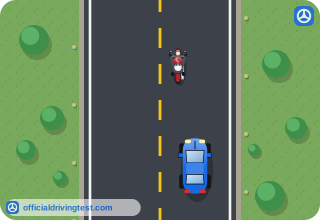
- To handle hazards such as potholes and strong winds
- To pass other vehicles in the same lane on the right
- To keep the headlight on the center line of the road
- To leave room for passengers to lean in the curves
Show answer
Correct answer: To handle hazards such as potholes and strong winds
Riders use the lane’s full width to handle hazards like potholes, blocked sight lines, strong winds and air blasts from passing vehicles.
Source: Tennessee Comprehensive Driver License Manual (March 2025 printing), page 107 · Open this page in the manual (Manual page 107)
-
How should you pass a motorcycle?
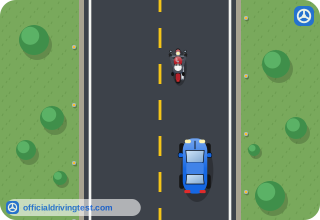
- At high speed, to clear the motorcycle quickly
- Very close, so the rider can clearly see your signal
- As you would pass a car, not too close or too fast
- Only on the right side of the motorcycle
Show answer
Correct answer: As you would pass a car, not too close or too fast
Passing too close or too fast can create an air blast that blows a motorcycle out of control.
Source: Tennessee Comprehensive Driver License Manual (March 2025 printing), page 107 · Open this page in the manual (Manual page 107)
-
Why should you check your blind spots for motorcycles before changing lanes?
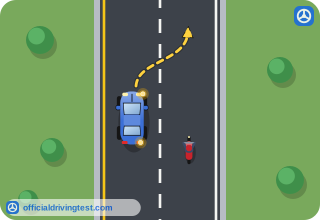
- A motorcycle in the next lane will always change lanes first
- Motorcycles alongside a lane of cars are often out of view
- A motorcycle rider cannot see cars in the next lane
- Motorcycle lights are brighter than the lights of cars
Show answer
Correct answer: Motorcycles alongside a lane of cars are often out of view
A driver who changes lanes without checking may clip or hit a motorcycle riding alongside.
Source: Tennessee Comprehensive Driver License Manual (March 2025 printing), page 107 · Open this page in the manual (Manual page 107)