Tennessee: Sharing the road — Bicyclist Rules and Sharing with Motorcycles Practice Test
Questions in this part include: “What does Tennessee law require on the front of a bicycle used at night?” · “What should you do with your headlights when you meet a motorcycle at night?”
Independent educational site · not affiliated with any government agency or DMV
Ready? Test yourself
- Instant feedback with an explanation
- Every answer cites its source in the manual
- Your best score is saved on this device
- Keyboard: press 1 to 4 to answer and Enter for the next question
Questions are original and based on the official manual "Tennessee Comprehensive Driver License Manual" (March 2025 printing), Tennessee Department of Safety and Homeland Security.
All 24 questions in this practice test
Take the test above first, then use this list to study. Tap “Show answer” to see the correct answer and explanation.
Show the questions and answersHide the questions
-
What does Tennessee law require on the front of a bicycle used at night?
- A lamp emitting a red light visible from at least 500 feet
- A lamp emitting a white light visible from at least 500 feet
- A lamp emitting a white light visible from at least 100 feet
- A reflector only, with no lamp required
Show answer
Correct answer: A lamp emitting a white light visible from at least 500 feet
A bicycle used at night needs a front lamp with a white light visible from a distance of at least 500 feet.
Source: Tennessee Comprehensive Driver License Manual (March 2025 printing), page 106 · Open this page in the manual (Manual page 106)
-
What does Tennessee law require on the rear of a bicycle used at night?
- A red reflector or a lamp emitting red light, visible from 500 feet
- A white reflector or a lamp emitting white light, visible from 500 feet
- A red reflector or a lamp emitting red light, visible from 100 feet
- A red lamp that flashes whenever the bicycle is moving
Show answer
Correct answer: A red reflector or a lamp emitting red light, visible from 500 feet
A bicycle ridden at night must have a red reflector or red lamp on the rear that can be seen from 500 feet.
Source: Tennessee Comprehensive Driver License Manual (March 2025 printing), page 106 · Open this page in the manual (Manual page 106)
-
A bicyclist has a red or orange pennant flag on an antenna attached to the bike. What should you do?
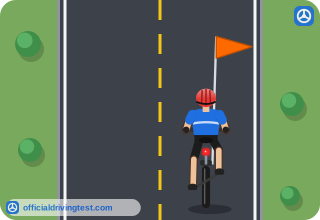
- Pass quickly, because the flag shows the rider has the right-of-way
- Sound your horn, because the rider will signal when to pass
- Slow down, because the rider may have impaired hearing
- Stop completely, because the rider cannot be passed
Show answer
Correct answer: Slow down, because the rider may have impaired hearing
A red or orange pennant flag is a common sign that the rider has impaired hearing, so the driver should slow down.
Source: Tennessee Comprehensive Driver License Manual (March 2025 printing), page 106 · Open this page in the manual (Manual page 106)
-
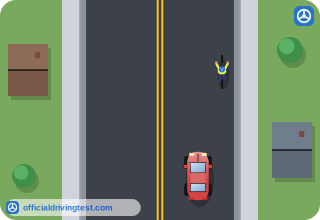
When are bicyclists required to ride as far right in the lane as possible?
- At all times, whether or not a car can share the lane
- Only when the lane is marked for bicycle use only
- Only when a vehicle is following closely behind the bicycle
- Only when a car and bicycle can safely share the lane
Show answer
Correct answer: Only when a car and bicycle can safely share the lane
The far-right rule applies only when a car and bicycle can safely share the lane side by side; at other times a bicycle can take the full lane.
Source: Tennessee Comprehensive Driver License Manual (March 2025 printing), page 106 · Open this page in the manual (Manual page 106)
-
Which situation allows a bicyclist full use of the lane?
- The bicyclist is riding at night or in the rain
- The bicyclist is riding in a lane next to a bike lane
- A vehicle is following the bicyclist too closely
- The lane is too narrow to be shared safely
Show answer
Correct answer: The lane is too narrow to be shared safely
When the lane is too narrow to be shared safely, it is safest to let the bicycle take the full lane.
Source: Tennessee Comprehensive Driver License Manual (March 2025 printing), page 106 · Open this page in the manual (Manual page 106)
-
A bicyclist is overtaking and passing another vehicle going in the same direction. How much of the lane should the bicyclist be allowed to use?
- Only the right half of the lane
- Only the part within 3 feet of the curb
- The full use of the lane
- None, because bicyclists may not pass vehicles
Show answer
Correct answer: The full use of the lane
A bicyclist who is overtaking and passing another vehicle should be allowed full use of the lane.
Source: Tennessee Comprehensive Driver License Manual (March 2025 printing), page 106 · Open this page in the manual (Manual page 106)
-
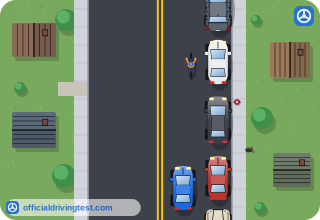
The roadway has parked cars, fixed obstacles, animals, potholes or debris. How much of the lane should a bicyclist be allowed to use?
- The full use of the lane
- Only the part of the lane closest to the curb
- Only the left half of the lane
- Only the part that is not blocked
Show answer
Correct answer: The full use of the lane
Unsafe roadway conditions such as parked cars, obstacles, pedestrians, animals, potholes or debris allow a bicyclist the full lane.
Source: Tennessee Comprehensive Driver License Manual (March 2025 printing), page 106 · Open this page in the manual (Manual page 106)
-
A lane is marked and signed for bicycle use only. How may drivers use it?
- They may use it as a turning lane when no bicyclists are present
- They must never use it as a turning lane, passing lane or for parking
- They may park in it for a short time if no bicyclists are near
- They may use it as a passing lane if they signal first
Show answer
Correct answer: They must never use it as a turning lane, passing lane or for parking
A lane marked and signed for bicycles only may never be used by drivers to turn, pass or park.
Source: Tennessee Comprehensive Driver License Manual (March 2025 printing), page 106 · Open this page in the manual (Manual page 106)
-
Why is riding a bicycle against traffic dangerous?
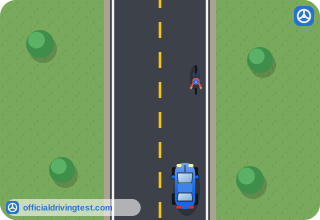
- The rider may miss traffic control devices such as signs and stop lights
- The rider is more visible to drivers who are coming toward them
- The rider can no longer use hand signals to turn
- The rider will be passed on the left by every vehicle
Show answer
Correct answer: The rider may miss traffic control devices such as signs and stop lights
A rider facing traffic may not see signs and signals meant for the flow of traffic, so the manual says to ride on the right with traffic.
Source: Tennessee Comprehensive Driver License Manual (March 2025 printing), page 106 · Open this page in the manual (Manual page 106)
-
What should a bicyclist never do when a truck or bus is making a wide right turn?
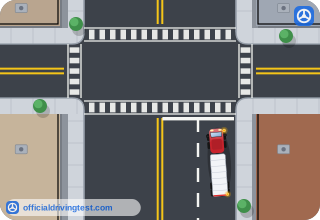
- Stay back and wait until the truck or bus has turned
- Ride well to the left of the truck or bus
- Sneak in between the truck or bus and the curb
- Watch the truck or bus signals as it turns
Show answer
Correct answer: Sneak in between the truck or bus and the curb
A bicyclist caught between a turning truck or bus and the curb could be crushed.
Source: Tennessee Comprehensive Driver License Manual (March 2025 printing), page 106 · Open this page in the manual (Manual page 106)
-
What should a bicyclist assume about other road users?
- That all drivers can see every hand signal
- That they are invisible to other road users
- That all drivers will yield to a bicyclist
- That drivers will always slow down for bicyclists
Show answer
Correct answer: That they are invisible to other road users
The manual advises bicyclists never to assume drivers see their hand signals or will yield, and to ride defensively.
Source: Tennessee Comprehensive Driver License Manual (March 2025 printing), page 106 · Open this page in the manual (Manual page 106)
-
What does the manual say a bicyclist should do before getting on the bike?
- Put on dark clothing
- Clip a flag to the rear
- Turn on the rear light
- Put on a helmet
Show answer
Correct answer: Put on a helmet
The manual calls a helmet the best thing a bicyclist can do to be safe.
Source: Tennessee Comprehensive Driver License Manual (March 2025 printing), page 106 · Open this page in the manual (Manual page 106)
-
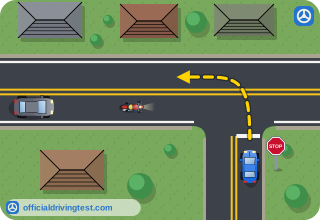
Why is it harder for drivers to see motorcycles and judge their distance and speed?
- A motorcycle is always much faster than other vehicles
- A motorcycle has bright lights that confuse other drivers
- A motorcycle always stays inside a driver’s blind spot
- Its narrow profile and short body make it hard to see and judge
Show answer
Correct answer: Its narrow profile and short body make it hard to see and judge
Drivers tend to look for cars and trucks, and a motorcycle is narrow and short, so it is harder to see and to judge.
Source: Tennessee Comprehensive Driver License Manual (March 2025 printing), page 107 · Open this page in the manual (Manual page 107)
-
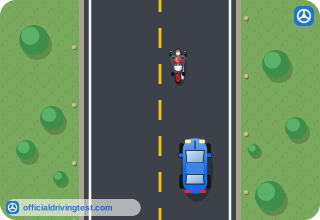
What does the manual say about a motorcycle’s use of the lane?
- A motorcycle may use only the right half of a lane
- Motorcycles have the right to the use of the full lane
- A motorcycle may use only the left half of a lane
- A motorcycle must share a lane with a car
Show answer
Correct answer: Motorcycles have the right to the use of the full lane
A motorcycle has the right to the full lane.
Source: Tennessee Comprehensive Driver License Manual (March 2025 printing), page 107 · Open this page in the manual (Manual page 107)
-
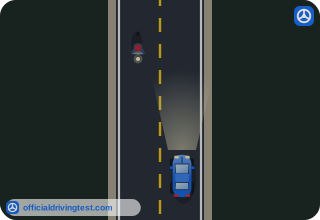
At night, why can you easily misjudge the distance of a motorcycle?
- Its lights point toward the sides of the road at night
- Its lights flash continuously when it is moving at night
- Its lights are always much dimmer than those of cars
- Its single headlight or taillight can blend into other lights
Show answer
Correct answer: Its single headlight or taillight can blend into other lights
A motorcycle has only one headlight or taillight, which can merge with other vehicles’ lights.
Source: Tennessee Comprehensive Driver License Manual (March 2025 printing), page 107 · Open this page in the manual (Manual page 107)
-
What should you do with your headlights when you meet a motorcycle at night?
- Dim them, as you would for other cars and trucks
- Keep the high beams on so the rider can see you
- Flash the high beams to warn the rider
- Turn them off for a moment to avoid glare
Show answer
Correct answer: Dim them, as you would for other cars and trucks
Drivers should dim their headlights for motorcycles just as they do for cars and trucks.
Source: Tennessee Comprehensive Driver License Manual (March 2025 printing), page 107 · Open this page in the manual (Manual page 107)
-
Where can strong cross winds move a motorcycle out of its lane of travel?
- On wide open, long stretches of highway and on bridges
- In narrow city streets that have tall buildings
- Only in the center lane of a multilane freeway
- Only on roads that are covered in snow and ice
Show answer
Correct answer: On wide open, long stretches of highway and on bridges
Open stretches of highway and bridges are places where cross winds can push a cycle out of its lane.
Source: Tennessee Comprehensive Driver License Manual (March 2025 printing), page 107 · Open this page in the manual (Manual page 107)
-
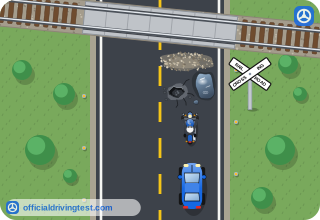
What will railroad grade crossings usually cause a motorcyclist to do?
- Speed up to cross the tracks as quickly as possible
- Stop and then walk the cycle across the tracks
- Stay close behind the vehicle that is ahead
- Slow down and possibly zigzag across the tracks
Show answer
Correct answer: Slow down and possibly zigzag across the tracks
Grade crossings are a particular hazard for cyclists, who usually slow down and may zigzag over the tracks.
Source: Tennessee Comprehensive Driver License Manual (March 2025 printing), page 107 · Open this page in the manual (Manual page 107)
-
What may an experienced cyclist do on a metal or grated bridge?
- Speed up and move to the edge of the lane
- Slow down and move to the center of the lane
- Stop in the lane and wait for traffic to clear
- Change lanes quickly to a smoother surface
Show answer
Correct answer: Slow down and move to the center of the lane
Metal or grated bridges make a cycle wobble, so experienced riders slow down and use the center of the lane; an inexperienced rider may be startled.
Source: Tennessee Comprehensive Driver License Manual (March 2025 printing), page 107 · Open this page in the manual (Manual page 107)
-
How do motorcycles compare with trucks in stopping, because of their light weight and braking system?
- Motorcycles stop more slowly than trucks
- Motorcycles and trucks stop in the same distance
- Motorcycles can stop much faster than trucks
- Motorcycles stop slower on dry roads only
Show answer
Correct answer: Motorcycles can stop much faster than trucks
Because they are light and have their braking system, motorcycles can stop much faster than trucks, so a truck may not stop as quickly as the rider.
Source: Tennessee Comprehensive Driver License Manual (March 2025 printing), page 107 · Open this page in the manual (Manual page 107)
-
Where does the manual tell a motorcyclist to check for the U.S. Department of Transportation (DOT) standard label on a helmet?
- On the outer shell
- On the chin strap
- Inside the helmet
- On the visor
Show answer
Correct answer: Inside the helmet
The DOT label is found inside the helmet.
Source: Tennessee Comprehensive Driver License Manual (March 2025 printing), page 107 · Open this page in the manual (Manual page 107)
-
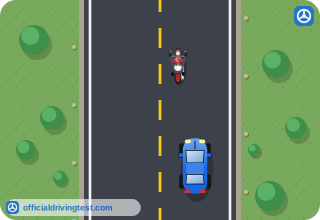
What should a motorcyclist never do in traffic?
- Use the full width of the lane when passing
- Ride in between lanes or share a lane with another vehicle
- Ride in the lane position that is farthest from the curb
- Signal before changing lanes
Show answer
Correct answer: Ride in between lanes or share a lane with another vehicle
A motorcycle must obey the laws of the road, so it never rides between lanes or shares a lane with another vehicle.
Source: Tennessee Comprehensive Driver License Manual (March 2025 printing), page 108 · Open this page in the manual (Manual page 108)
-
What protective clothing does the manual say a motorcyclist should wear?
- Shorts, sandals and a vest
- A jacket and sandals only
- Gloves and a bandana only
- Gloves, boots and a jacket
Show answer
Correct answer: Gloves, boots and a jacket
The manual advises gloves, boots and a jacket, along with a safety inspection before each ride.
Source: Tennessee Comprehensive Driver License Manual (March 2025 printing), page 108 · Open this page in the manual (Manual page 108)
-
Which vehicles accelerate the fastest and which are the slowest?
- Motorcycles accelerate the fastest, and trucks and buses are the slowest
- Cars accelerate the fastest, and motorcycles are the slowest
- Trucks and buses accelerate the fastest, and cars are the slowest
- All vehicles accelerate at about the same rate
Show answer
Correct answer: Motorcycles accelerate the fastest, and trucks and buses are the slowest
Of all vehicles, motorcycles accelerate the fastest, while trucks and buses are the slowest.
Source: Tennessee Comprehensive Driver License Manual (March 2025 printing), page 108 · Open this page in the manual (Manual page 108)