Tennessee: Sharing the road — Bicycles: Safety Tips for Drivers Practice Test
Questions in this part include: “Where are bicyclists prohibited?” · “What are the most common causes of collisions between cars and bicycles?”
Independent educational site · not affiliated with any government agency or DMV
Ready? Test yourself
- Instant feedback with an explanation
- Every answer cites its source in the manual
- Your best score is saved on this device
- Keyboard: press 1 to 4 to answer and Enter for the next question
Questions are original and based on the official manual "Tennessee Comprehensive Driver License Manual" (March 2025 printing), Tennessee Department of Safety and Homeland Security.
All 18 questions in this practice test
Take the test above first, then use this list to study. Tap “Show answer” to see the correct answer and explanation.
Show the questions and answersHide the questions
-
You are overtaking a bicyclist and a vehicle is coming toward you. What does the manual say to do?
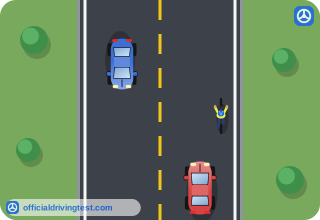
- Slow down and let the oncoming vehicle pass first, then move left
- Speed up and pass the bicycle before the vehicle arrives
- Pass the bicycle at once while the vehicle is still far away
- Stay beside the bicycle until the vehicle has passed
Show answer
Correct answer: Slow down and let the oncoming vehicle pass first, then move left
The "take hazards one at a time" rule means letting the oncoming vehicle pass first so you can safely move left around the bicycle.
Source: Tennessee Comprehensive Driver License Manual (March 2025 printing), page 94 · Open this page in the manual (Manual page 94)
-
Where are bicyclists prohibited?
- On any road that has a posted speed limit of over 35 mph
- On limited-access highways, expressways and some other marked roads
- On every two-lane road that has a painted center line
- On all streets in residential neighborhoods and school zones
Show answer
Correct answer: On limited-access highways, expressways and some other marked roads
Bicyclists are barred from limited-access highways, expressways and certain other marked roadways.
Source: Tennessee Comprehensive Driver License Manual (March 2025 printing), page 105 · Open this page in the manual (Manual page 105)
-
Which side of the road must bicyclists travel on, and in which direction?
- The right-hand side, in the same direction as vehicles
- The left-hand side, facing oncoming vehicles
- The right-hand side, facing oncoming vehicles
- Either side, as long as they ride in single file
Show answer
Correct answer: The right-hand side, in the same direction as vehicles
Bicyclists must ride on the right-hand side of the road in the same direction as other vehicles.
Source: Tennessee Comprehensive Driver License Manual (March 2025 printing), page 105 · Open this page in the manual (Manual page 105)
-
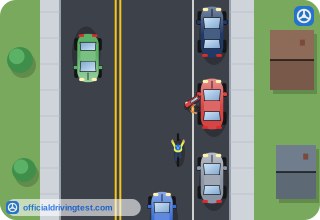
What should you always expect from a bicycle rider when you share the road?
- Steady straight riding
- Full stops at every corner
- Sudden moves
- Riding only at the curb
Show answer
Correct answer: Sudden moves
Hazards such as potholes, dogs or opening car doors can force a bicyclist to swerve suddenly in front of you.
Source: Tennessee Comprehensive Driver License Manual (March 2025 printing), page 105 · Open this page in the manual (Manual page 105)
-
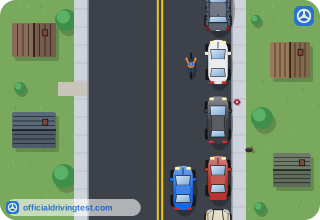
Why do cyclists passing parked cars tend to move toward the center of the lane?
- To avoid the oil and debris that gather at the edge of the road
- To avoid injuring or being injured by people getting out of those cars
- Because the law says to keep a set distance from the curb
- To get ready to turn right at the next corner
Show answer
Correct answer: To avoid injuring or being injured by people getting out of those cars
Moving away from parked cars is proper riding; it avoids a collision with someone opening a door or getting out.
Source: Tennessee Comprehensive Driver License Manual (March 2025 printing), page 105 · Open this page in the manual (Manual page 105)
-
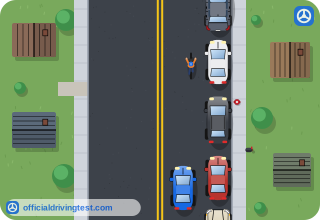
A cyclist is riding toward the center of the lane past parked cars. What should you do, if possible?
- Honk and pass on the cyclist’s left side
- Stay close behind until the cyclist moves right
- Pass at once while staying within the lane
- Give the cyclist the entire lane
Show answer
Correct answer: Give the cyclist the entire lane
If road conditions prevent giving the whole lane, the driver should pass with extreme caution.
Source: Tennessee Comprehensive Driver License Manual (March 2025 printing), page 105 · Open this page in the manual (Manual page 105)
-
At night, what should you do when you see an oncoming bicycle rider?
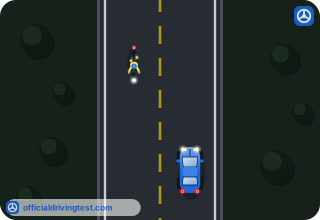
- Flash your high beams to warn the rider
- Switch on your high beams to see the rider
- Stop your vehicle at the side of the road
- Not use your high beams
Show answer
Correct answer: Not use your high beams
The manual says not to use high beams when you see an oncoming bicycle rider at night.
Source: Tennessee Comprehensive Driver License Manual (March 2025 printing), page 105 · Open this page in the manual (Manual page 105)
-
What should you do when you follow a bicyclist?
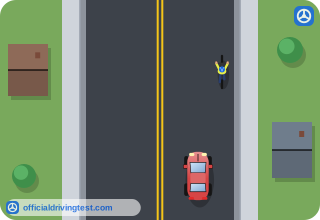
- Stay close so the rider can see your lights
- Give plenty of room and be prepared to stop quickly
- Follow at the same distance you use for cars
- Sound your horn to let the rider know you are there
Show answer
Correct answer: Give plenty of room and be prepared to stop quickly
Following bicyclists with plenty of room lets a driver stop quickly if needed, with extra caution in rain and ice.
Source: Tennessee Comprehensive Driver License Manual (March 2025 printing), page 105 · Open this page in the manual (Manual page 105)
-
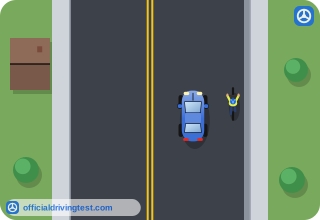
When passing a bicyclist who is going the same direction, how much space must you leave between your vehicle and the bicycle?
- Not less than 1 foot
- Not less than 2 feet
- Not less than 3 feet
- Not less than 5 feet
Show answer
Correct answer: Not less than 3 feet
Tennessee law requires at least 3 feet between the vehicle and the bicycle when passing.
Source: Tennessee Comprehensive Driver License Manual (March 2025 printing), page 105 · Open this page in the manual (Manual page 105)
-
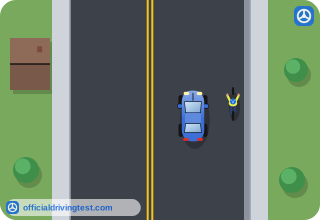
When must you keep the required clearance from the bicycle you are passing?
- Until you are safely past the overtaken bicycle
- Only while you are alongside the bicycle
- Only until you have signaled to pass
- Only while the bicyclist is looking at you
Show answer
Correct answer: Until you are safely past the overtaken bicycle
The clearance has to be maintained until the vehicle is safely past the overtaken bicycle.
Source: Tennessee Comprehensive Driver License Manual (March 2025 printing), page 105 · Open this page in the manual (Manual page 105)
-
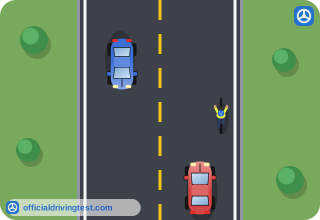
On a two-lane road, what should a driver never attempt to do when passing a bicyclist?
- Slow down and wait for oncoming vehicles to pass
- Pass the bicyclist when the road ahead is clear
- Pass between the bicyclist and oncoming vehicles
- Move over to the left of the center line
Show answer
Correct answer: Pass between the bicyclist and oncoming vehicles
The driver should slow down and let oncoming vehicles pass the rider safely instead of squeezing between them.
Source: Tennessee Comprehensive Driver License Manual (March 2025 printing), page 105 · Open this page in the manual (Manual page 105)
-
When should you NOT pass a bicycle?
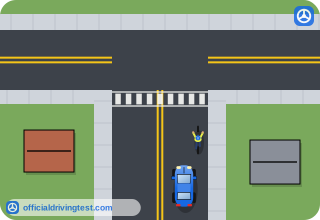
- When you would force the bicyclist too close to parked vehicles
- When the bicyclist is riding as close to the right edge as possible
- When the bicycle is moving in the same direction as your vehicle
- When you have already signaled and checked your mirrors well
Show answer
Correct answer: When you would force the bicyclist too close to parked vehicles
Wait until there is enough room to pass safely rather than crowding the bicyclist against parked vehicles.
Source: Tennessee Comprehensive Driver License Manual (March 2025 printing), page 105 · Open this page in the manual (Manual page 105)
-
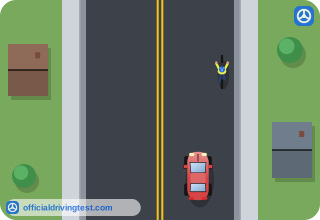
On a narrow road you think a rider does not know you are coming. How should you use your horn?
- Sound it with a long blast to get the rider off the road
- Do not use it at all, because it may startle the rider
- Tap it twice and then pass on the right
- Tap it gently and briefly as a signal that you are going to pass
Show answer
Correct answer: Tap it gently and briefly as a signal that you are going to pass
A gentle, brief tap warns the rider; a blast of the horn would startle or intimidate the bicyclist.
Source: Tennessee Comprehensive Driver License Manual (March 2025 printing), page 105 · Open this page in the manual (Manual page 105)
-
What are the most common causes of collisions between cars and bicycles?
- Drivers who follow a bicycle too closely on a long straight road
- Drivers turning left in front of, or right across the path of, a bicycle
- Bicyclists riding on the right-hand side of the roadway at night
- Drivers passing bicycles with more than three feet of space
Show answer
Correct answer: Drivers turning left in front of, or right across the path of, a bicycle
The manual names left turns in front of oncoming bicycles and right turns across a bicycle’s path as the most common causes.
Source: Tennessee Comprehensive Driver License Manual (March 2025 printing), page 105 · Open this page in the manual (Manual page 105)
-
What should a driver attempt to do with a bicyclist before turning?
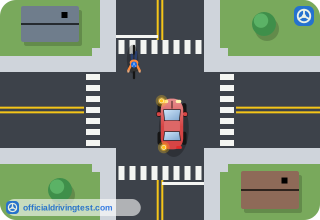
- Gain and maintain eye contact with the bicyclist
- Sound the horn so the bicyclist stops
- Flash the headlights so the bicyclist yields
- Wave the bicyclist forward through the intersection
Show answer
Correct answer: Gain and maintain eye contact with the bicyclist
Most bicyclists keep eye contact with drivers when turning, so a driver should try to do the same to make the turn safer.
Source: Tennessee Comprehensive Driver License Manual (March 2025 printing), page 105 · Open this page in the manual (Manual page 105)
-
In residential areas, what does the manual warn that bicyclists might do?
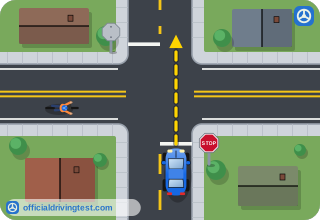
- Ride only on the sidewalk and stop at every stop sign and signal
- Ride mid-street and disregard stop signs and traffic signals
- Ride only on the left side and stop at every stop sign and signal
- Ride only in pairs and always obey every traffic signal
Show answer
Correct answer: Ride mid-street and disregard stop signs and traffic signals
The manual warns that bicyclists in neighborhoods may ride in the middle of the street and ignore stop signs and signals, so drivers must be careful.
Source: Tennessee Comprehensive Driver License Manual (March 2025 printing), page 106 · Open this page in the manual (Manual page 106)
-
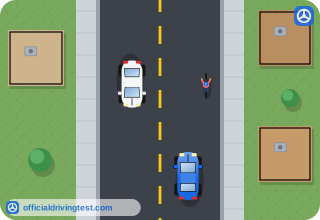
Why should drivers be alert for erratic movement and sudden changes in direction from children on bicycles?
- Children are permitted to ride on the wrong side of the road
- Children are always required to ride on the sidewalk
- Children ride faster than adult bicyclists do
- Children are not capable of proper judgment of traffic conditions
Show answer
Correct answer: Children are not capable of proper judgment of traffic conditions
Children cannot judge traffic conditions well, so they may move erratically or change direction suddenly.
Source: Tennessee Comprehensive Driver License Manual (March 2025 printing), page 106 · Open this page in the manual (Manual page 106)
-
Where should you watch for bikes that may suddenly come into your path?
- From driveways or from behind parked cars or obstructions
- Only on roads that have bike lane signs posted along them
- Only on roads that have a painted center line and no curb
- Only on streets that have no parked vehicles or driveways
Show answer
Correct answer: From driveways or from behind parked cars or obstructions
Bikes can appear from driveways and from behind parked cars or other obstructions.
Source: Tennessee Comprehensive Driver License Manual (March 2025 printing), page 106 · Open this page in the manual (Manual page 106)