Tennessee: Sharing the road — Large Trucks: No-Zones, Turns and Backing Practice Test
Questions in this part include: “How do trucks with wide loads compare with other trucks, according to the manual?” · “Which of these does the manual list among the things aggressive drivers do?”
Independent educational site · not affiliated with any government agency or DMV
Ready? Test yourself
- Instant feedback with an explanation
- Every answer cites its source in the manual
- Your best score is saved on this device
- Keyboard: press 1 to 4 to answer and Enter for the next question
Questions are original and based on the official manual "Tennessee Comprehensive Driver License Manual" (March 2025 printing), Tennessee Department of Safety and Homeland Security.
All 23 questions in this practice test
Take the test above first, then use this list to study. Tap “Show answer” to see the correct answer and explanation.
Show the questions and answersHide the questions
-
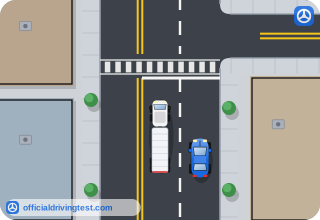
Why should you not pass a large truck on the right in city traffic?
- Trucks cannot be passed on any road
- It might be about to make a right turn
- Trucks must stay in the left lane
- Trucks speed up when someone passes
Show answer
Correct answer: It might be about to make a right turn
Large trucks and buses must make wide turns, so you should not pass one on the right if it might make a right turn.
Source: Tennessee Comprehensive Driver License Manual (March 2025 printing), page 58 · Open this page in the manual (Manual page 58)
-
How do trucks with wide loads compare with other trucks, according to the manual?
- They turn more narrowly and stop sooner than other trucks
- They turn wider but stop sooner than other trucks
- They turn wider and stop more slowly than other trucks
- They see the sides better than other trucks do
Show answer
Correct answer: They turn wider and stop more slowly than other trucks
Wide loads need more room, swing wider on right turns and take even longer to stop than other trucks.
Source: Tennessee Comprehensive Driver License Manual (March 2025 printing), page 104 · Open this page in the manual (Manual page 104)
-
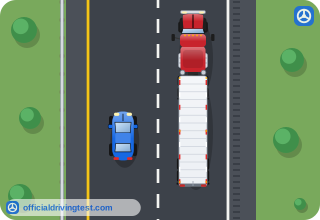
What should you do before you pull in front of a truck after passing it?
- Sound your horn to let the truck driver know you are there
- Look for the truck’s front in your rear-view mirror
- Slow down quickly so the truck can pass again
- Move over slowly and brake as you do so
Show answer
Correct answer: Look for the truck’s front in your rear-view mirror
Trucks take much longer to stop than cars, so a driver must see the truck’s front in the mirror before pulling back in front.
Source: Tennessee Comprehensive Driver License Manual (March 2025 printing), page 108 · Open this page in the manual (Manual page 108)
-
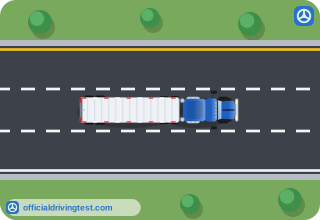
What is the rule of thumb about a truck’s mirror and the truck driver?
- If you can see the truck’s mirror, then the truck driver can also see you
- Truck drivers can see every vehicle that is near the truck
- If you cannot see the truck driver in its mirror, the driver cannot see you
- A truck driver can always see you if your lights are on
Show answer
Correct answer: If you cannot see the truck driver in its mirror, the driver cannot see you
Staying out of the truck’s blind spots matters because a driver you cannot see in the mirror cannot see you.
Source: Tennessee Comprehensive Driver License Manual (March 2025 printing), page 108 · Open this page in the manual (Manual page 108)
-
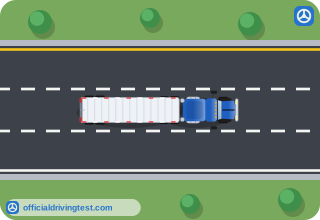
Where do large trucks have blind spots, or No-Zones?
- Only directly behind the truck
- Only along the right side of the truck
- Only in front of the truck
- Around the front, back and sides of the truck
Show answer
Correct answer: Around the front, back and sides of the truck
Large trucks have blind spots on all sides, so drivers should not stay in them.
Source: Tennessee Comprehensive Driver License Manual (March 2025 printing), page 108 · Open this page in the manual (Manual page 108)
-
Which of these does the manual list among the things aggressive drivers do?
- Staying in the right lane at the speed limit
- Giving trucks lots of room to maneuver
- Pulling in front of trucks too quickly when passing
- Looking for the front of the truck in the mirror
Show answer
Correct answer: Pulling in front of trucks too quickly when passing
Aggressive drivers speed, run red lights and stop signs, cut in front of trucks and change lanes often in truck blind spots.
Source: Tennessee Comprehensive Driver License Manual (March 2025 printing), page 108 · Open this page in the manual (Manual page 108)
-
What can happen if you try to get in between a truck making a wide right turn and the curb?
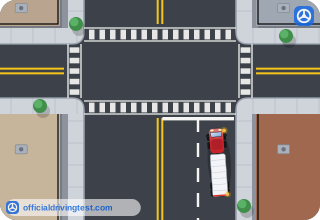
- You may be caught in a squeeze and suffer a serious accident
- The truck driver will see you in the mirror and stop
- You will be able to pass the truck on the right safely
- The truck will slow down to let you through
Show answer
Correct answer: You may be caught in a squeeze and suffer a serious accident
Cutting in between a turning truck and the curb increases the possibility of a crash.
Source: Tennessee Comprehensive Driver License Manual (March 2025 printing), page 108 · Open this page in the manual (Manual page 108)
-
Before making a right turn, what do truck drivers sometimes need to do, especially in urban areas?
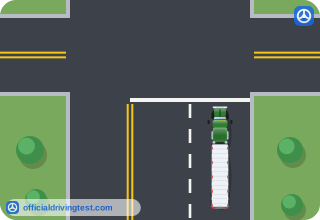
- Swing wide to the right
- Swing wide to the left
- Stop in the left lane
- Back up in the lane
Show answer
Correct answer: Swing wide to the left
To make a right turn safely, a truck driver sometimes has to swing wide to the left, so other drivers should give room.
Source: Tennessee Comprehensive Driver License Manual (March 2025 printing), page 108 · Open this page in the manual (Manual page 108)
-
To make a right turn safely, which way must a large truck first swing?
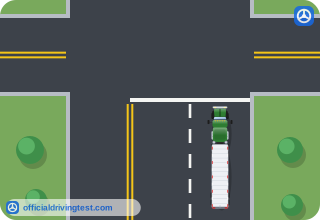
- Wide to the right
- Close to the right curb
- Wide to the left
- Back and then forward in the same lane
Show answer
Correct answer: Wide to the left
Trucks swing wide to the left to get around a right turn, so they need extra room.
Source: Tennessee Comprehensive Driver License Manual (March 2025 printing), page 109 · Open this page in the manual (Manual page 109)
-
When passing a large vehicle, when may you pull back into the lane in front of it?
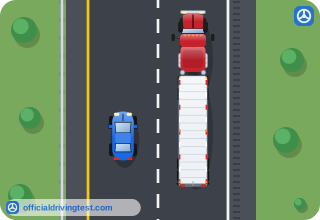
- As soon as your rear bumper clears the truck's front bumper
- When the truck driver sounds the horn to signal you
- Only when the whole front of the truck shows in your rearview mirror
- After you have slowed down to match the truck's speed
Show answer
Correct answer: Only when the whole front of the truck shows in your rearview mirror
You should see the whole front of the truck in your rearview mirror before moving back in front of it.
Source: Tennessee Comprehensive Driver License Manual (March 2025 printing), page 109 · Open this page in the manual (Manual page 109)
-
After you pass a large truck and move in front of it, what should you do?
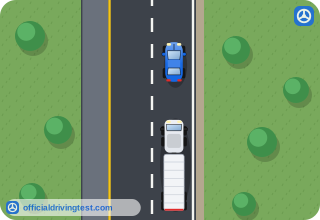
- Keep your speed and do not slow down
- Slow down to let the truck catch up
- Stop in the lane and signal for the truck to pass
- Brake to open a gap behind you
Show answer
Correct answer: Keep your speed and do not slow down
Slowing down after you pull in front forces the truck driver to brake, so keep your speed.
Source: Tennessee Comprehensive Driver License Manual (March 2025 printing), page 109 · Open this page in the manual (Manual page 109)
-
How far behind a large truck can its blind spot extend?
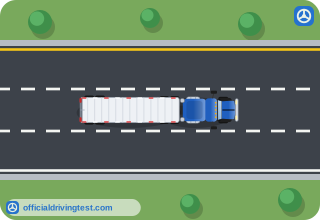
- Up to 50 feet
- Up to 100 feet
- Up to 400 feet
- Up to 200 feet
Show answer
Correct answer: Up to 200 feet
A truck has blind spots in front, on both sides and up to 200 feet behind it.
Source: Tennessee Comprehensive Driver License Manual (March 2025 printing), page 109 · Open this page in the manual (Manual page 109)
-
What does it mean if you cannot see a truck's side mirror?
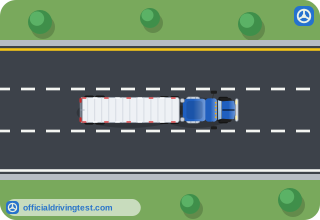
- The truck driver is about to stop
- The truck driver cannot see you
- The truck driver will let you pass
- The truck driver sees you in the rearview mirror
Show answer
Correct answer: The truck driver cannot see you
If you cannot see the truck's mirror, the driver cannot see you in it, so you are in a blind spot.
Source: Tennessee Comprehensive Driver License Manual (March 2025 printing), page 109 · Open this page in the manual (Manual page 109)
-
If a truck or bus driver blinks the vehicle's headlights after you pass, what does it signal?
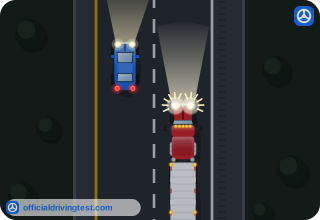
- You must stop on the shoulder
- You are cleared to pull back in front
- The truck is about to pass you again
- There is a hazard in the road behind you
Show answer
Correct answer: You are cleared to pull back in front
The blinking headlights tell you that you may move back in front, but only when you can see the vehicle's front in your rearview mirror.
Source: Tennessee Comprehensive Driver License Manual (March 2025 printing), page 109 · Open this page in the manual (Manual page 109)
-
What should you do if a truck might be making a right turn?
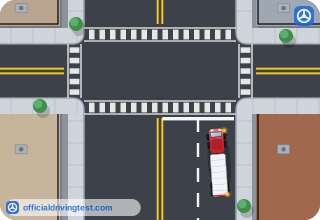
- Pass it quickly on the right side to get ahead
- Stay between the truck and the curb to be safe
- Honk and move up beside the trailer to pass
- Stay out of the space on its right and do not pass
Show answer
Correct answer: Stay out of the space on its right and do not pass
A driver between the truck and the curb may not be seen and can be crunched or sideswiped by the trailer.
Source: Tennessee Comprehensive Driver License Manual (March 2025 printing), page 110 · Open this page in the manual (Manual page 110)
-
What should you never do when a truck is preparing to back up?
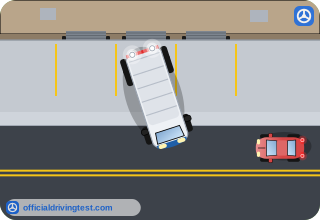
- Wait patiently
- Give the driver plenty of room
- Cross behind it
- Stay clear of its blind spots
Show answer
Correct answer: Cross behind it
Crossing behind a backing truck puts you in the driver's blind spots in a high-collision situation.
Source: Tennessee Comprehensive Driver License Manual (March 2025 printing), page 110 · Open this page in the manual (Manual page 110)
-
When you are driving in front of a truck, what should you do about your speed?
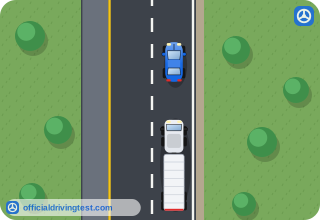
- Keep your speed up to stay a safe distance ahead
- Slow down so the truck can pass you quickly
- Stop suddenly if the truck gets too close
- Change lanes often to stay out of its way
Show answer
Correct answer: Keep your speed up to stay a safe distance ahead
Keeping up your speed maintains a safe gap in front of the truck and avoids sudden slow downs.
Source: Tennessee Comprehensive Driver License Manual (March 2025 printing), page 110 · Open this page in the manual (Manual page 110)
-
When you are driving in front of a truck or bus, how should you signal a turn or lane change?
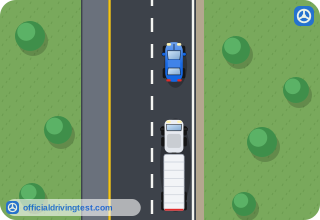
- At the last moment
- Only with a hand signal
- Not at all, because trucks can see everything
- Early enough for the truck driver to prepare
Show answer
Correct answer: Early enough for the truck driver to prepare
The truck driver needs time to prepare for your maneuver, so signal early.
Source: Tennessee Comprehensive Driver License Manual (March 2025 printing), page 110 · Open this page in the manual (Manual page 110)
-
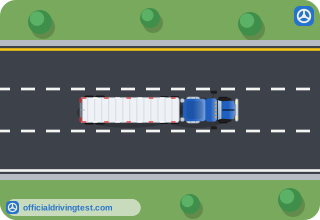
About how far in front of a large vehicle is the NO-ZONE?
- Up to about 5 feet
- Up to about 40 feet
- Up to about 60 feet
- Up to about 20 feet
Show answer
Correct answer: Up to about 20 feet
The area up to about 20 feet directly in front of a large vehicle is a NO-ZONE where crashes are more likely.
Source: Tennessee Comprehensive Driver License Manual (March 2025 printing), page 110 · Open this page in the manual (Manual page 110)
-
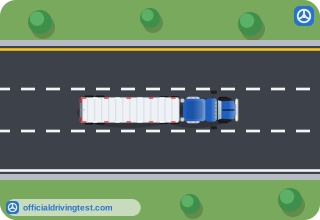
What does the NO-ZONE around a truck or bus represent?
- Areas where parking is not allowed at all
- Danger areas where crashes are more likely
- Lanes reserved for trucks and buses only
- Places where trucks cannot make any turns
Show answer
Correct answer: Danger areas where crashes are more likely
The NO-ZONE marks the danger areas around large vehicles where crashes are more likely.
Source: Tennessee Comprehensive Driver License Manual (March 2025 printing), page 110 · Open this page in the manual (Manual page 110)
-
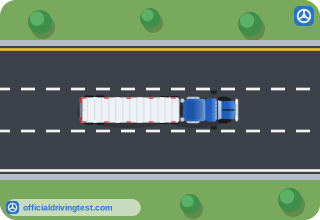
What happens if you stay in the rear blind spot of a large vehicle?
- The driver sees you easily in the large side mirrors
- You are fully protected from wind turbulence
- The driver cannot see you and your view ahead is reduced
- You can see the traffic ahead much better than usual
Show answer
Correct answer: The driver cannot see you and your view ahead is reduced
Following too closely behind a large vehicle hides you from its driver and blocks your view ahead.
Source: Tennessee Comprehensive Driver License Manual (March 2025 printing), page 110 · Open this page in the manual (Manual page 110)
-
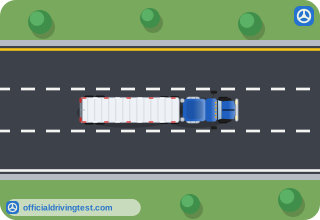
What does remaining alongside a large vehicle too long make impossible?
- For the driver to take evasive action if an obstacle appears
- For you to see the road behind the large vehicle ahead
- For you to use your turn signals while you pass it
- For the truck to use its brakes in time
Show answer
Correct answer: For the driver to take evasive action if an obstacle appears
Staying in a side blind spot leaves the driver unable to swerve if something blocks the road ahead.
Source: Tennessee Comprehensive Driver License Manual (March 2025 printing), page 110 · Open this page in the manual (Manual page 110)
-
Why is it dangerous to cut in between a truck or bus and the curb as it turns right?
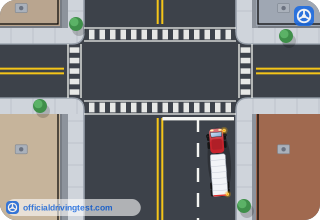
- Its driver often cannot see vehicles beside it in the turn
- The turn signal blocks the driver's view of the road
- The truck must always stop before it makes a turn
- The curb lane is reserved for buses in every city
Show answer
Correct answer: Its driver often cannot see vehicles beside it in the turn
Truck drivers often cannot see vehicles beside them when turning right, so cutting in raises the crash risk.
Source: Tennessee Comprehensive Driver License Manual (March 2025 printing), page 110 · Open this page in the manual (Manual page 110)