Tennessee: Sharing the road
Bicyclists and the passing-distance law, motorcyclists, large trucks and their No Zones, school buses, slow-moving vehicles and RVs. Split into 8 shorter tests so you're not stuck in one long quiz.
Independent educational site · not affiliated with any government agency or DMV
Choose a part
Sharing the road — School Buses, Transit Buses and Funerals
Questions in this part include: “How much can a driver be fined for not stopping for a stopped school bus?”
StartSharing the road — Changing Lanes and Passing
Questions in this part include: “Which of these is a situation in which you may NOT cross the center line to pass?”
StartSharing the road — Defensive Driving, Space and Road Rage
Questions in this part include: “In the manual's five tips, what does "Aim High In Steering" tell you to do?”
StartSharing the road — Bicycles: Safety Tips for Drivers
Questions in this part include: “Where are bicyclists prohibited?”
StartSharing the road — Bicyclist Rules and Sharing with Motorcycles
Questions in this part include: “What does Tennessee law require on the front of a bicycle used at night?”
StartSharing the road — Large Trucks: No-Zones, Turns and Backing
Questions in this part include: “How do trucks with wide loads compare with other trucks, according to the manual?”
StartSharing the road — Large Trucks: Stopping, Following and Wind
Questions in this part include: “What should you give trucks and buses that are entering the interstate?”
StartSharing the road — Slow-Moving Vehicles, Passenger Vans and RVs
Questions in this part include: “What must be displayed on the rear of vehicles drawn by animals and most farm vehicles and construction equipment?”
StartAll 171 Sharing the road questions with answers
Choose a part above to take a practice test, or study every question and answer here.
Show the questions and answersHide the questions
-
On which kind of vehicle may you see the slow-moving vehicle (SMV) emblem?
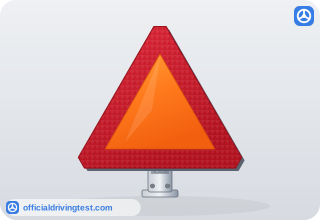
- A police patrol car
- A horse-drawn vehicle
- A school bus
- A fast-moving tour bus
Show answer
Correct answer: A horse-drawn vehicle
The SMV emblem is used on slow-moving vehicles such as farm tractors, machinery, construction equipment and horse-drawn vehicles.
Source: Tennessee Comprehensive Driver License Manual (March 2025 printing), page 40 · Open this page in the manual (Manual page 40)
-
Under Tennessee law, what may vehicles following a funeral procession on a two-lane roadway NOT do?
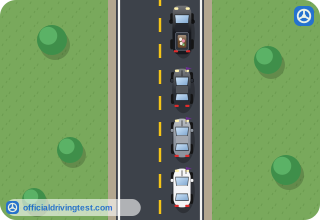
- Attempt to pass the procession
- Follow at a safe distance
- Use their headlights
- Slow down
Show answer
Correct answer: Attempt to pass the procession
Tennessee law says vehicles following a funeral procession on a two-lane roadway may not attempt to pass it.
Source: Tennessee Comprehensive Driver License Manual (March 2025 printing), page 46 · Open this page in the manual (Manual page 46)
-
When may the operator of a vehicle drive between vehicles in a properly identified funeral procession?
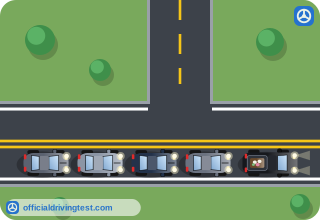
- When the procession is moving slowly
- When the other vehicles are far apart
- Only when a traffic officer directs it
- When the road has four lanes
Show answer
Correct answer: Only when a traffic officer directs it
No driver may drive between vehicles in a properly identified funeral procession unless a traffic officer directs it.
Source: Tennessee Comprehensive Driver License Manual (March 2025 printing), page 46 · Open this page in the manual (Manual page 46)
-
Why must you never pass a stopped school bus on its right side?
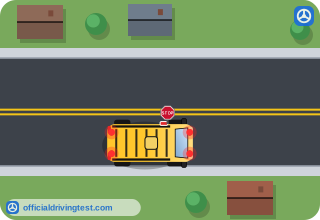
- The shoulder is usually too narrow for a car
- The bus driver cannot see vehicles on that side
- That is where the children enter or exit the bus
- Right-side passing is allowed only on divided roads
Show answer
Correct answer: That is where the children enter or exit the bus
The right side of the bus is where the children get on and off, so passing there is illegal and can have tragic results.
Source: Tennessee Comprehensive Driver License Manual (March 2025 printing), page 51 · Open this page in the manual (Manual page 51)
-
What does it mean when the yellow lights on the front and back of a school bus are flashing?
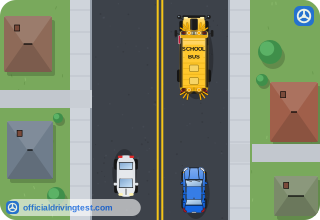
- The bus has stopped and children are getting on or off
- The bus is broken down and needs help
- The bus driver is waving traffic past
- The bus is preparing to stop to load or unload children
Show answer
Correct answer: The bus is preparing to stop to load or unload children
Flashing yellow lights warn motorists to slow down and prepare to stop because the bus is about to load or unload children.
Source: Tennessee Comprehensive Driver License Manual (March 2025 printing), page 51 · Open this page in the manual (Manual page 51)
-
What do flashing red lights and an extended stop arm on a school bus tell you?
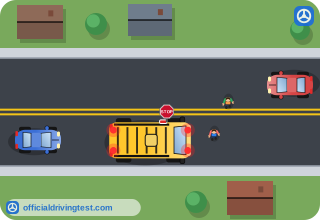
- The bus is about to stop in a short distance to load children
- The bus has stopped and children are getting on or off
- The bus is out of service and may be passed on the left
- The bus is letting other traffic go by before it moves
Show answer
Correct answer: The bus has stopped and children are getting on or off
Red flashing lights with the stop arm out mean the bus HAS stopped and children are now boarding or leaving, so motorists must stop.
Source: Tennessee Comprehensive Driver License Manual (March 2025 printing), page 51 · Open this page in the manual (Manual page 51)
-
A school bus is stopped at an intersection to load and unload children. Which drivers must stop?
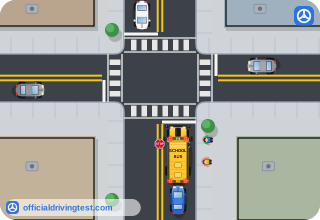
- Drivers from all directions
- Only drivers behind the bus
- Only drivers meeting the bus head-on
- Only drivers in the same lane as the bus
Show answer
Correct answer: Drivers from all directions
At an intersection, drivers from all directions are required to stop until the bus resumes motion.
Source: Tennessee Comprehensive Driver License Manual (March 2025 printing), page 51 · Open this page in the manual (Manual page 51)
-
How much can a driver be fined for not stopping for a stopped school bus?
- Between $50 and $200
- Between $100 and $300
- Between $250 and $1,000
- Between $500 and $2,500
Show answer
Correct answer: Between $250 and $1,000
Not stopping for a stopped school bus brings a fine of between $250 and $1,000.
Source: Tennessee Comprehensive Driver License Manual (March 2025 printing), page 51 · Open this page in the manual (Manual page 51)
-
Not stopping for a stopped school bus is what kind of offense in Tennessee?
- A Class C misdemeanor
- A Class B felony
- A warning-only violation
- A Class A misdemeanor
Show answer
Correct answer: A Class A misdemeanor
The manual says failing to stop for a stopped school bus is a Class A misdemeanor.
Source: Tennessee Comprehensive Driver License Manual (March 2025 printing), page 51 · Open this page in the manual (Manual page 51)
-
On a highway with separate roadways for opposite directions, divided by a median space or a barrier not suitable for vehicular traffic, what must a driver on the opposite roadway do when a school bus stops?
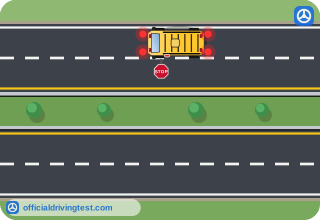
- Stop and wait until the bus moves
- Not stop, but proceed with caution
- Stop only if children are crossing
- Slow to 10 miles per hour and pass
Show answer
Correct answer: Not stop, but proceed with caution
Where a median or barrier separates the roadways, the driver need not stop but should proceed with caution.
Source: Tennessee Comprehensive Driver License Manual (March 2025 printing), page 51 · Open this page in the manual (Manual page 51)
-
A school bus stops on a four-lane highway that has a turn lane in the middle. What must drivers meeting the bus do?
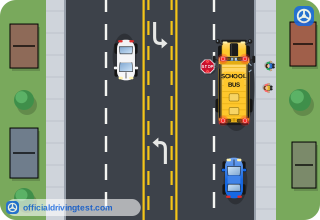
- Stop only in the bus’s own direction
- Keep going, because the turn lane acts as a barrier
- Stop in both directions, because the turn lane is not a barrier
- Keep going at a reduced speed in the opposite direction
Show answer
Correct answer: Stop in both directions, because the turn lane is not a barrier
A middle turn lane is a fifth lane suitable for vehicles, not a barrier, so traffic in both directions must stop.
Source: Tennessee Comprehensive Driver License Manual (March 2025 printing), page 51 · Open this page in the manual (Manual page 51)
-
A transit vehicle (metro bus) has signaled and is pulling back onto the roadway from a bus stop. What must you do?
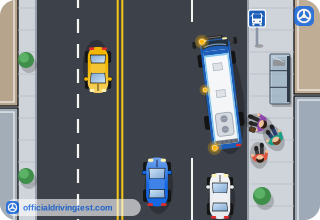
- Speed up and pass it on the left
- Sound your horn so it waits
- Yield the right-of-way to the bus
- Keep your speed because it must wait for traffic
Show answer
Correct answer: Yield the right-of-way to the bus
You must yield the right-of-way to a transit bus that has signaled and is pulling back onto the roadway.
Source: Tennessee Comprehensive Driver License Manual (March 2025 printing), page 54 · Open this page in the manual (Manual page 54)
-
A transit bus is stopped for passenger pick-up or drop-off. What does the manual say about stopping for it?
- You are not required to stop for it, nor forbidden to pass it
- You must stop for it, as you would for a school bus
- You may not pass it at any time while it is stopped
- You must stop for it only if children are getting on or off
Show answer
Correct answer: You are not required to stop for it, nor forbidden to pass it
Unlike a school bus, a transit bus stopped for passengers does not require you to stop, and passing is not forbidden.
Source: Tennessee Comprehensive Driver License Manual (March 2025 printing), page 54 · Open this page in the manual (Manual page 54)
-
What does the manual advise near stopped buses?
- Stay at least 100 feet behind the bus whenever it is stopped
- Be extremely cautious and watch for passengers trying to cross the road
- Sound your horn to warn the passengers before you drive past
- Pass quickly before any of the passengers can reach the road
Show answer
Correct answer: Be extremely cautious and watch for passengers trying to cross the road
Passengers, including elderly people and children, may cross the road near stopped buses.
Source: Tennessee Comprehensive Driver License Manual (March 2025 printing), page 55 · Open this page in the manual (Manual page 55)
-
Why should you not pass a large truck on the right in city traffic?
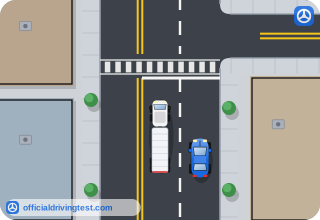
- Trucks cannot be passed on any road
- It might be about to make a right turn
- Trucks must stay in the left lane
- Trucks speed up when someone passes
Show answer
Correct answer: It might be about to make a right turn
Large trucks and buses must make wide turns, so you should not pass one on the right if it might make a right turn.
Source: Tennessee Comprehensive Driver License Manual (March 2025 printing), page 58 · Open this page in the manual (Manual page 58)
-
Why is checking your mirrors alone not enough before changing lanes?
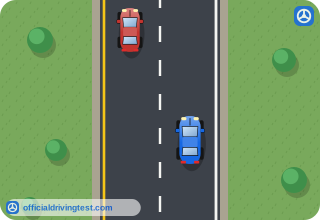
- Mirrors show only the lane you are in
- Mirrors are not allowed at night
- Mirrors make other cars look farther away
- Mirrors do not show vehicles in your blind spots
Show answer
Correct answer: Mirrors do not show vehicles in your blind spots
Mirrors alone do not show vehicles in your blind spots; you must turn your head and look over your shoulder to see vehicles next to you.
Source: Tennessee Comprehensive Driver License Manual (March 2025 printing), page 61 · Open this page in the manual (Manual page 61)
-
Which of these is part of making a safe lane change?
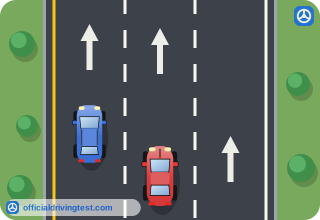
- Changing lanes gradually and carefully
- Changing lanes quickly before others react
- Signaling after you start moving over
- Staying in another driver's blind spot to keep pace
Show answer
Correct answer: Changing lanes gradually and carefully
The listed steps for safe lane changes include changing lanes gradually and carefully.
Source: Tennessee Comprehensive Driver License Manual (March 2025 printing), page 61 · Open this page in the manual (Manual page 61)
-
A driver in the lane next to you signals a lane change. What should you do?
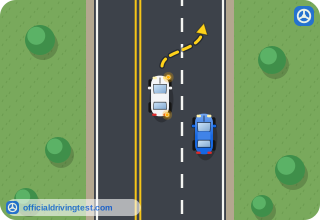
- Speed up to stay ahead
- Change lanes yourself at the same time
- Slow down and leave space for the change
- Flash your headlights and hold your position
Show answer
Correct answer: Slow down and leave space for the change
You slow down and leave space, and do not speed up or change lanes until the other driver has completed the move.
Source: Tennessee Comprehensive Driver License Manual (March 2025 printing), page 61 · Open this page in the manual (Manual page 61)
-
What does the manual say about passing when you are approaching a narrow bridge, a viaduct or a tunnel?
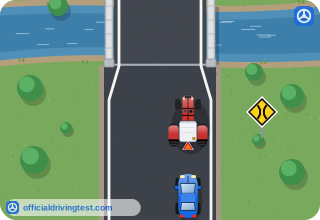
- Do not pass at all
- Pass only if you tap your horn first
- Pass only if no vehicle is oncoming
- Pass only if your turn signal is on
Show answer
Correct answer: Do not pass at all
Passing is not allowed when approaching an intersection, railroad crossing, narrow bridge, viaduct or tunnel.
Source: Tennessee Comprehensive Driver License Manual (March 2025 printing), page 63 · Open this page in the manual (Manual page 63)
-
Which of these is a situation in which you may NOT cross the center line to pass?
- When you have signaled left and checked your mirrors
- When the road ahead is straight and level
- When there is an oncoming car
- When the car ahead is traveling slowly
Show answer
Correct answer: When there is an oncoming car
You may not cross the center line to pass while a car is oncoming.
Source: Tennessee Comprehensive Driver License Manual (March 2025 printing), page 63 · Open this page in the manual (Manual page 63)
-
A school bus or church bus ahead has its flashing lights operating and its stop arm extended. What does the manual say about passing it?
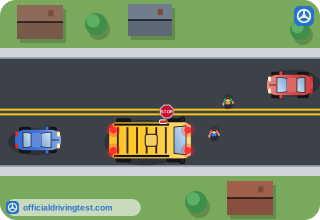
- You may pass it if you slow down first
- You may pass it on the right shoulder
- You may pass it if no children are in sight
- You must not pass it
Show answer
Correct answer: You must not pass it
You may not pass a school bus or church bus while its flashing lights are operating and its stop arm is extended.
Source: Tennessee Comprehensive Driver License Manual (March 2025 printing), page 63 · Open this page in the manual (Manual page 63)
-
What does the manual say about passing when you are approaching a hill or a curve?
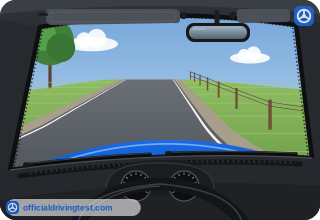
- Pass only if you give a signal first
- Do not pass when approaching either one
- Pass only if you are below the speed limit
- Pass only if the oncoming lane looks empty
Show answer
Correct answer: Do not pass when approaching either one
Passing is not allowed when approaching a hill or curve because you cannot see what is ahead.
Source: Tennessee Comprehensive Driver License Manual (March 2025 printing), page 63 · Open this page in the manual (Manual page 63)
-
Why should you not pass on the right shoulder of the highway?
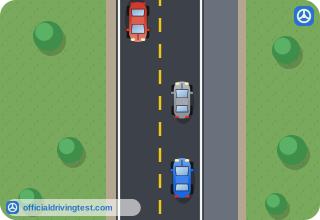
- Shoulders are reserved for emergency vehicles at all times
- Other drivers will not expect you to be there
- Your tires wear faster on gravel or dirt shoulders
- Slower drivers must always stay on the shoulder
Show answer
Correct answer: Other drivers will not expect you to be there
Other drivers do not expect a car on the shoulder and may pull off the road or turn right without looking.
Source: Tennessee Comprehensive Driver License Manual (March 2025 printing), page 63 · Open this page in the manual (Manual page 63)
-
If you must return to your original lane after passing, what does the manual say you should do?
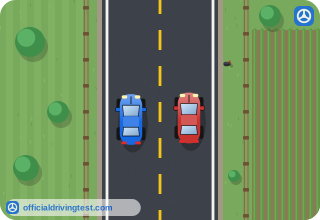
- Avoid cutting in too quickly in front of the other driver
- Move over right away, before the other driver can speed up
- Cut in sharply and then slow down in front of the car
- Return before you can see the passed car in your mirror
Show answer
Correct answer: Avoid cutting in too quickly in front of the other driver
Returning to your lane too sharply or too soon is dangerous, so the manual says to avoid cutting in too quickly.
Source: Tennessee Comprehensive Driver License Manual (March 2025 printing), page 63 · Open this page in the manual (Manual page 63)
-
Another driver is passing you on the left. What should you do?
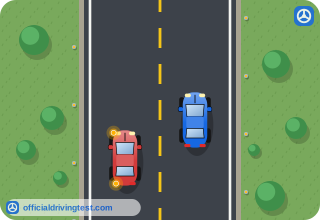
- Move left toward the center line to give more room
- Brake hard so the other driver can pass quickly
- Change lanes so you are no longer beside the car
- Stay in your lane and move to the right
Show answer
Correct answer: Stay in your lane and move to the right
Staying in your lane and moving to the right helps the other driver pass safely.
Source: Tennessee Comprehensive Driver License Manual (March 2025 printing), page 63 · Open this page in the manual (Manual page 63)
-
While another driver is passing you, you see a car approaching from the other direction. What should you do?
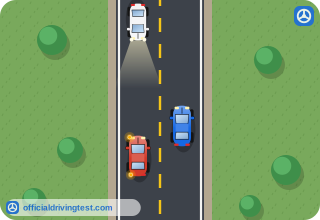
- Slow down to give the passing driver more space to pull back in front of you
- Speed up so the passing driver has less time in the oncoming lane
- Brake hard and stop in your lane so the driver can move back
- Move to the left toward the center line to block the oncoming car
Show answer
Correct answer: Slow down to give the passing driver more space to pull back in front of you
Slowing down lets the passing driver return to the right lane in front of you before meeting the oncoming vehicle.
Source: Tennessee Comprehensive Driver License Manual (March 2025 printing), page 63 · Open this page in the manual (Manual page 63)
-
Why should you finish passing a large truck or bus quickly instead of staying alongside it?
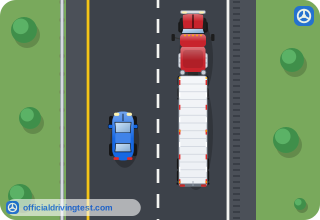
- A truck beside you cannot change lanes safely
- Staying beside it puts you in the driver’s blindspot
- Engine noise from the truck can distract you
- It makes the truck take longer to stop
Show answer
Correct answer: Staying beside it puts you in the driver’s blindspot
Staying beside a truck or bus does not tell the driver you are there; it puts you in the blindspot.
Source: Tennessee Comprehensive Driver License Manual (March 2025 printing), page 64 · Open this page in the manual (Manual page 64)
-
You are alongside a truck or bus and can see any part of the tractor from the driver or passenger door back to the fifth wheel. Where are you most likely to be?
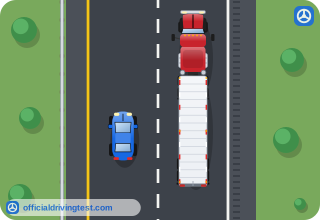
- In the truck’s braking zone
- Where the driver sees you in the mirrors
- In the driver’s blindspot
- In the safest place to pass
Show answer
Correct answer: In the driver’s blindspot
Seeing that part of the tractor from beside it means you are most likely in the driver’s blindspot.
Source: Tennessee Comprehensive Driver License Manual (March 2025 printing), page 64 · Open this page in the manual (Manual page 64)
-
After passing a truck or bus, what should you never do?
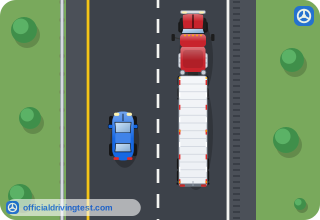
- Maintain your speed
- Complete the pass quickly
- Return only after it is clear of your mirror
- Pull in front of it and slow down
Show answer
Correct answer: Pull in front of it and slow down
Pulling in front of a truck or bus and slowing takes away the safety cushion of the driver you just passed.
Source: Tennessee Comprehensive Driver License Manual (March 2025 printing), page 64 · Open this page in the manual (Manual page 64)
-
On a level highway, how does the time needed to pass a truck or bus compare with passing a car?
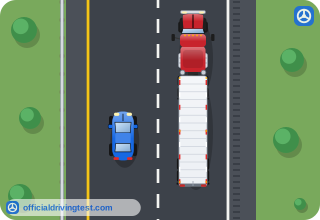
- It generally takes longer
- It generally takes less time
- It takes the same time
- It takes much less time
Show answer
Correct answer: It generally takes longer
On a level road it generally takes longer to pass a truck or bus than a car.
Source: Tennessee Comprehensive Driver License Manual (March 2025 printing), page 64 · Open this page in the manual (Manual page 64)
-
On an upgrade, what often happens to heavy vehicles such as trucks and buses?
- They often speed up as their engines work harder
- They keep exactly the same speed as on level road
- They often lose speed, making them easier to pass
- They must pull off the road to rest the engine
Show answer
Correct answer: They often lose speed, making them easier to pass
Heavy vehicles often slow on an upgrade, which makes passing them easier.
Source: Tennessee Comprehensive Driver License Manual (March 2025 printing), page 64 · Open this page in the manual (Manual page 64)
-
What does the manual say about passing a truck that is pulling multiple trailers?
- Avoid passing it unless the road ahead is level and straight
- Pass it only on an upgrade when it loses speed
- Never pass it on a two-lane road under any conditions
- No need to hesitate; follow the usual rules for sharing the road
Show answer
Correct answer: No need to hesitate; follow the usual rules for sharing the road
A truck pulling multiple trailers is treated like any other commercial vehicle, and you follow the same sharing-the-road rules.
Source: Tennessee Comprehensive Driver License Manual (March 2025 printing), page 64 · Open this page in the manual (Manual page 64)
-
What should you give trucks and buses that are entering the interstate?
- A blast of the horn to warn them you are there
- Extra time and space to adjust to the traffic flow
- The left lane, so they can enter at a slow speed
- A flash of your headlights to wave them in
Show answer
Correct answer: Extra time and space to adjust to the traffic flow
Trucks and buses may need extra time to adjust to traffic, so be cooperative and give them extra time and space.
Source: Tennessee Comprehensive Driver License Manual (March 2025 printing), page 69 · Open this page in the manual (Manual page 69)
-
When a truck or bus is passing you on the left in windy conditions, what should you do?
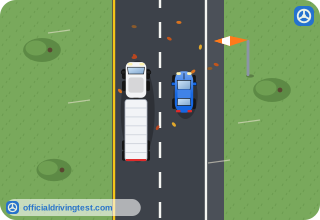
- Move toward the center line and hold your speed steady
- Speed up so you can pull ahead of it quickly
- Brake hard and stop in your lane
- Move as far right in your lane as possible and slow down
Show answer
Correct answer: Move as far right in your lane as possible and slow down
The gusts of wind these vehicles create can require steering corrections; staying far right and slowing helps.
Source: Tennessee Comprehensive Driver License Manual (March 2025 printing), page 77 · Open this page in the manual (Manual page 77)
-
What can wind currents from larger vehicles do to a trailer you are pulling?
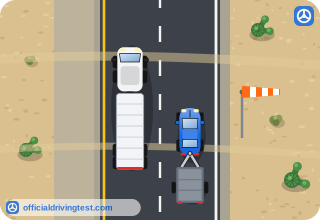
- Cause it to jackknife
- Lift it off the road
- Make its brake lights fail
- Unhitch it from your vehicle
Show answer
Correct answer: Cause it to jackknife
Wind currents from passing trucks and buses can cause a trailer to jackknife.
Source: Tennessee Comprehensive Driver License Manual (March 2025 printing), page 77 · Open this page in the manual (Manual page 77)
-
As a large vehicle passes you while you pull a trailer, what should you do?
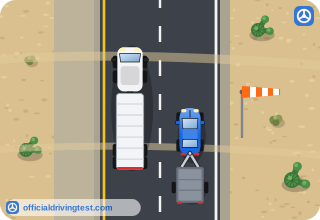
- Steer sharply toward the shoulder
- Steer toward the center line to keep clear
- Accelerate slowly to keep the trailer straight
- Stop on the shoulder and wait
Show answer
Correct answer: Accelerate slowly to keep the trailer straight
A gentle increase in speed keeps the trailer pulling in a straight path as the large vehicle goes by.
Source: Tennessee Comprehensive Driver License Manual (March 2025 printing), page 77 · Open this page in the manual (Manual page 77)
-
In the manual's five tips, what does "Aim High In Steering" tell you to do?
- Keep your eyes on the hood of your vehicle at all times
- Steer with your hands at the very top of the wheel
- Look as far down the road as possible to find traffic information
- Focus only on the vehicle directly ahead of you
Show answer
Correct answer: Look as far down the road as possible to find traffic information
Aiming high means looking far down the road so you can spot traffic information early and make good decisions.
Source: Tennessee Comprehensive Driver License Manual (March 2025 printing), page 92 · Open this page in the manual (Manual page 92)
-
According to the manual, what is the most important driving attitude you can develop?
- Confidence in your own driving skill
- A willingness to compete for road space
- Courtesy and consideration toward others
- A habit of driving faster than traffic
Show answer
Correct answer: Courtesy and consideration toward others
The manual calls courtesy and consideration toward others the key to safe driving.
Source: Tennessee Comprehensive Driver License Manual (March 2025 printing), page 93 · Open this page in the manual (Manual page 93)
-
Why does the manual say to stay out of another driver's blind spots?
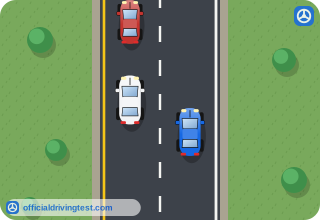
- To keep the other driver from passing you
- To stay clear of that driver's exhaust smoke
- To prevent another vehicle from turning into you
- To follow the other vehicle more closely
Show answer
Correct answer: To prevent another vehicle from turning into you
Staying out of blind spots keeps another driver from turning into you without seeing you.
Source: Tennessee Comprehensive Driver License Manual (March 2025 printing), page 93 · Open this page in the manual (Manual page 93)
-
Which defensive driving rule does the manual give about other drivers?
- Assume every other driver will yield to you in every situation
- Expect the other driver to do the wrong thing and have a plan
- Rely on other drivers to make room for you when you need it
- Expect other drivers to obey every traffic rule at all times
Show answer
Correct answer: Expect the other driver to do the wrong thing and have a plan
A defensive driver expects mistakes and keeps a plan ready to counter the other driver's error.
Source: Tennessee Comprehensive Driver License Manual (March 2025 printing), page 93 · Open this page in the manual (Manual page 93)
-
As you scan the road and traffic, what does the manual say to avoid?
- Looking to the sides
- Looking behind you
- A fixed stare
- Reading directional signs
Show answer
Correct answer: A fixed stare
The manual says to keep your eyes moving and avoid a fixed stare while scanning.
Source: Tennessee Comprehensive Driver License Manual (March 2025 printing), page 93 · Open this page in the manual (Manual page 93)
-
Which of these clues on another vehicle tells you it may pull into your path?
- A clean windshield
- Closed windows
- A full tank of fuel
- Turned wheels
Show answer
Correct answer: Turned wheels
Exhaust smoke, brake or back-up lights and turned wheels show that a vehicle may be about to move into your path.
Source: Tennessee Comprehensive Driver License Manual (March 2025 printing), page 93 · Open this page in the manual (Manual page 93)
-
What does the manual say to watch for in rural areas?
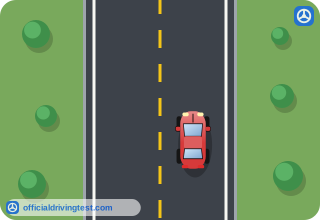
- Hidden intersections and driveways, curves and hills
- Only the traffic signals at major intersections
- Only parked vehicles along the roadside
- Only vehicles that are following you closely
Show answer
Correct answer: Hidden intersections and driveways, curves and hills
In rural areas, hidden intersections and driveways, curves, hills and a changing road surface can surprise you.
Source: Tennessee Comprehensive Driver License Manual (March 2025 printing), page 93 · Open this page in the manual (Manual page 93)
-
About how often should you check the traffic behind you with your rearview mirror?
- About every 60 seconds
- About every 10 seconds
- Only when you change lanes
- About every 3 minutes
Show answer
Correct answer: About every 10 seconds
The manual says to check traffic behind you frequently, about every 10 seconds.
Source: Tennessee Comprehensive Driver License Manual (March 2025 printing), page 93 · Open this page in the manual (Manual page 93)
-
When you look behind you, how long should you keep your eyes off the road ahead?
- Up to five seconds
- As long as it takes to see everything
- Until the vehicle behind you passes
- No more than a brief look
Show answer
Correct answer: No more than a brief look
The manual warns not to keep your eyes off the road ahead for more than a brief look behind.
Source: Tennessee Comprehensive Driver License Manual (March 2025 printing), page 93 · Open this page in the manual (Manual page 93)
-
What is the "safety cushion" the manual describes?
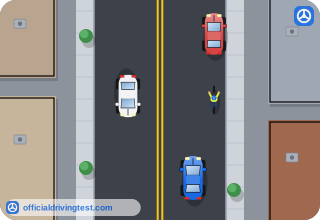
- The padding built into the seats of your vehicle
- The space you keep between your vehicle and others
- The extra fuel you carry to avoid stopping on long trips
- The paved shoulder beside the lane you are driving in
Show answer
Correct answer: The space you keep between your vehicle and others
A safety cushion is the driving space around your vehicle that gives you time to react.
Source: Tennessee Comprehensive Driver License Manual (March 2025 printing), page 94 · Open this page in the manual (Manual page 94)
-
Where should you try to maintain a safety cushion around your vehicle?
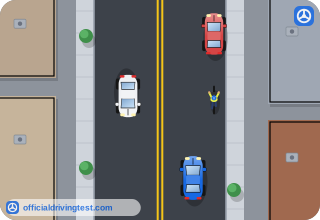
- Only to the front of your vehicle
- Only to the front and rear of your vehicle
- Only on the side next to oncoming traffic
- To the front, rear and each side at all times
Show answer
Correct answer: To the front, rear and each side at all times
The manual says to keep a cushion on all four sides at all times to leave room for escape or prevention.
Source: Tennessee Comprehensive Driver License Manual (March 2025 printing), page 94 · Open this page in the manual (Manual page 94)
-
On a two-lane road, how should you position your vehicle when meeting oncoming vehicles?
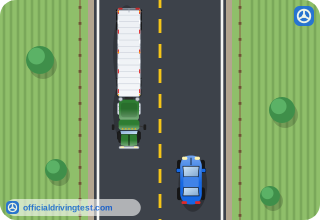
- Along the centerline to give the other driver room
- Straddling the center of the roadway
- As far to the left of your lane as you can go
- Slightly to the right of your lane, away from the centerline
Show answer
Correct answer: Slightly to the right of your lane, away from the centerline
Staying slightly right in your lane keeps you from crowding the centerline when vehicles meet.
Source: Tennessee Comprehensive Driver License Manual (March 2025 printing), page 94 · Open this page in the manual (Manual page 94)
-
When other vehicles are trying to merge into traffic on a multi-lane road, what does the manual say to do?
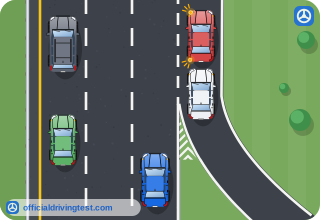
- Be courteous and move to the left lane
- Speed up to close the gap
- Move to the right lane in front of them
- Stay in your lane and sound your horn
Show answer
Correct answer: Be courteous and move to the left lane
The manual says to be courteous and move to the left lane to make room for merging vehicles.
Source: Tennessee Comprehensive Driver License Manual (March 2025 printing), page 94 · Open this page in the manual (Manual page 94)
-
Which of these should you keep extra space from along the roadside, especially if they are children?
- Only vehicles that are stopped at a signal
- Only vehicles that are moving faster than you
- Parked cars, pedestrians and bicyclists
- Only vehicles that have their hazard lights on
Show answer
Correct answer: Parked cars, pedestrians and bicyclists
The manual says to keep extra space between your vehicle and parked cars, pedestrians and bicyclists on the roadside.
Source: Tennessee Comprehensive Driver License Manual (March 2025 printing), page 94 · Open this page in the manual (Manual page 94)
-
What does the "split the difference" rule tell you to do about two hazards?
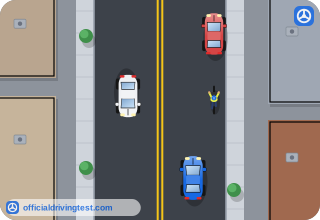
- Stay close to the hazard that is moving the fastest
- Steer between them, with more space on the more dangerous side
- Steer toward the hazard that is farther away from you
- Stop until both hazards have gone past your vehicle
Show answer
Correct answer: Steer between them, with more space on the more dangerous side
Splitting the difference means steering between two hazards, with extra space on the side that is more dangerous.
Source: Tennessee Comprehensive Driver License Manual (March 2025 printing), page 94 · Open this page in the manual (Manual page 94)
-
An oncoming semi-truck is approaching and there are parked cars on your side of the road. Where should you leave more room?
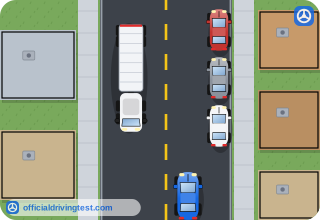
- On the side with the parked cars
- Equally on both sides, exactly
- On neither side; stay in the center of your lane
- On the side the truck will pass on
Show answer
Correct answer: On the side the truck will pass on
With an oncoming semi-truck, the manual says to leave more room on the side the truck passes instead of the side with the parked cars.
Source: Tennessee Comprehensive Driver License Manual (March 2025 printing), page 94 · Open this page in the manual (Manual page 94)
-
You are overtaking a bicyclist and a vehicle is coming toward you. What does the manual say to do?
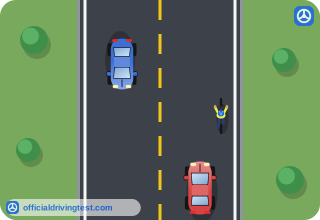
- Slow down and let the oncoming vehicle pass first, then move left
- Speed up and pass the bicycle before the vehicle arrives
- Pass the bicycle at once while the vehicle is still far away
- Stay beside the bicycle until the vehicle has passed
Show answer
Correct answer: Slow down and let the oncoming vehicle pass first, then move left
The "take hazards one at a time" rule means letting the oncoming vehicle pass first so you can safely move left around the bicycle.
Source: Tennessee Comprehensive Driver License Manual (March 2025 printing), page 94 · Open this page in the manual (Manual page 94)
-
Which of these does the manual give as an example of obstructed vision of yourself or another driver?
- A painted crosswalk
- A green traffic light
- A speed limit sign
- Bushes at an intersection
Show answer
Correct answer: Bushes at an intersection
Bushes at an intersection, glaring sunlight and pedestrians with umbrellas are examples of obstructed vision.
Source: Tennessee Comprehensive Driver License Manual (March 2025 printing), page 94 · Open this page in the manual (Manual page 94)
-
Which of these is given as an example of a confused driver or pedestrian?
- Weaving in and out of lanes
- Staying in the middle of the lane
- Driving at the posted speed limit
- Signaling well before a turn
Show answer
Correct answer: Weaving in and out of lanes
The manual lists weaving in and out of lanes, looking for road names and reading maps as signs of confused drivers or pedestrians.
Source: Tennessee Comprehensive Driver License Manual (March 2025 printing), page 95 · Open this page in the manual (Manual page 95)
-
Which behavior does the manual list as aggressive driving?
- Yielding to merging vehicles
- Cutting off other drivers
- Checking your mirrors often
- Leaving a safety cushion
Show answer
Correct answer: Cutting off other drivers
The manual lists tailgating, honking, gestures, yelling, speeding and cutting off other drivers as aggressive driving.
Source: Tennessee Comprehensive Driver License Manual (March 2025 printing), page 95 · Open this page in the manual (Manual page 95)
-
Which is a tip the manual gives for avoiding road rage?
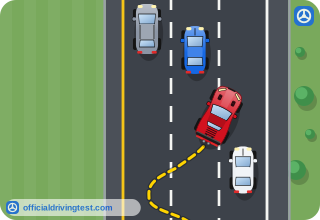
- Honk at an angry driver to warn the driver to back off
- Glare back so the other driver knows you saw what happened
- Match the speed of an aggressive driver so you can keep up
- Don't join the confrontation, even with honking or glaring
Show answer
Correct answer: Don't join the confrontation, even with honking or glaring
Joining in, even with a honk or a glare, makes a confrontation worse, so the manual says not to do it.
Source: Tennessee Comprehensive Driver License Manual (March 2025 printing), page 95 · Open this page in the manual (Manual page 95)
-
How does the manual say to treat an angry driver?
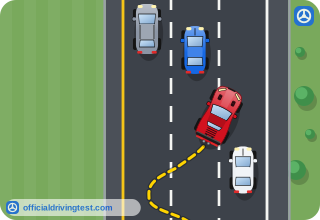
- Give an angry driver plenty of space
- Drive right behind the angry driver
- Block the angry driver from passing you
- Pass the angry driver as quickly as you can
Show answer
Correct answer: Give an angry driver plenty of space
One tip to avoid road rage is to give an angry driver plenty of space.
Source: Tennessee Comprehensive Driver License Manual (March 2025 printing), page 95 · Open this page in the manual (Manual page 95)
-
What does the manual say about passing as a way to avoid road rage?
- Pass every vehicle that drives slower than you as soon as you can
- Pass on the right whenever that avoids a confrontation
- Drive relaxed, within the speed limit, passing only when necessary
- Speed up so that no other driver can follow your vehicle
Show answer
Correct answer: Drive relaxed, within the speed limit, passing only when necessary
Driving relaxed, within the speed limit and passing only when necessary helps you avoid road rage.
Source: Tennessee Comprehensive Driver License Manual (March 2025 printing), page 95 · Open this page in the manual (Manual page 95)
-
If a driver follows you, what does the manual say to do?
- Drive home and wait in the driveway until the driver leaves
- Go to a police station or a public place where you can get help
- Stop and talk to the driver to find out what the problem is
- Pull onto an empty side road and park until the driver passes
Show answer
Correct answer: Go to a police station or a public place where you can get help
If you are followed, head to a police station or a public place where you can get help.
Source: Tennessee Comprehensive Driver License Manual (March 2025 printing), page 95 · Open this page in the manual (Manual page 95)
-
If another driver harasses you on the road, what does the manual say to do if possible?
- Follow the offender until a police officer arrives
- Return the gestures to show you are not afraid
- Take no action and report nothing afterward
- Get the offender's license tag number and report it
Show answer
Correct answer: Get the offender's license tag number and report it
The manual says to get the harasser's tag number if possible and report the incident.
Source: Tennessee Comprehensive Driver License Manual (March 2025 printing), page 95 · Open this page in the manual (Manual page 95)
-
How does the stopping space of trucks compare with that of passenger vehicles, according to the manual?
- Trucks need the same space as passenger vehicles
- Trucks need slightly less space than passenger vehicles
- Trucks need less space because they weigh more
- Trucks can take much more space to stop than passenger vehicles
Show answer
Correct answer: Trucks can take much more space to stop than passenger vehicles
The manual says trucks can take much more space to stop than passenger vehicles, so pedestrians should never take a chance with one.
Source: Tennessee Comprehensive Driver License Manual (March 2025 printing), page 104 · Open this page in the manual (Manual page 104)
-
How do trucks with wide loads compare with other trucks, according to the manual?
- They turn more narrowly and stop sooner than other trucks
- They turn wider but stop sooner than other trucks
- They turn wider and stop more slowly than other trucks
- They see the sides better than other trucks do
Show answer
Correct answer: They turn wider and stop more slowly than other trucks
Wide loads need more room, swing wider on right turns and take even longer to stop than other trucks.
Source: Tennessee Comprehensive Driver License Manual (March 2025 printing), page 104 · Open this page in the manual (Manual page 104)
-
Where are bicyclists prohibited?
- On any road that has a posted speed limit of over 35 mph
- On limited-access highways, expressways and some other marked roads
- On every two-lane road that has a painted center line
- On all streets in residential neighborhoods and school zones
Show answer
Correct answer: On limited-access highways, expressways and some other marked roads
Bicyclists are barred from limited-access highways, expressways and certain other marked roadways.
Source: Tennessee Comprehensive Driver License Manual (March 2025 printing), page 105 · Open this page in the manual (Manual page 105)
-
Which side of the road must bicyclists travel on, and in which direction?
- The right-hand side, in the same direction as vehicles
- The left-hand side, facing oncoming vehicles
- The right-hand side, facing oncoming vehicles
- Either side, as long as they ride in single file
Show answer
Correct answer: The right-hand side, in the same direction as vehicles
Bicyclists must ride on the right-hand side of the road in the same direction as other vehicles.
Source: Tennessee Comprehensive Driver License Manual (March 2025 printing), page 105 · Open this page in the manual (Manual page 105)
-
What should you always expect from a bicycle rider when you share the road?
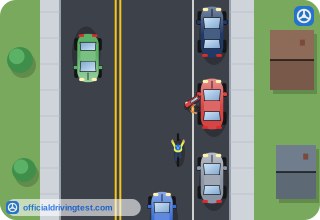
- Steady straight riding
- Full stops at every corner
- Sudden moves
- Riding only at the curb
Show answer
Correct answer: Sudden moves
Hazards such as potholes, dogs or opening car doors can force a bicyclist to swerve suddenly in front of you.
Source: Tennessee Comprehensive Driver License Manual (March 2025 printing), page 105 · Open this page in the manual (Manual page 105)
-
Why do cyclists passing parked cars tend to move toward the center of the lane?
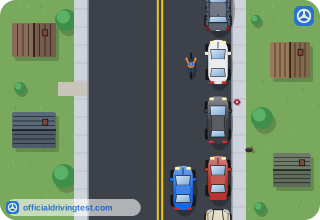
- To avoid the oil and debris that gather at the edge of the road
- To avoid injuring or being injured by people getting out of those cars
- Because the law says to keep a set distance from the curb
- To get ready to turn right at the next corner
Show answer
Correct answer: To avoid injuring or being injured by people getting out of those cars
Moving away from parked cars is proper riding; it avoids a collision with someone opening a door or getting out.
Source: Tennessee Comprehensive Driver License Manual (March 2025 printing), page 105 · Open this page in the manual (Manual page 105)
-
A cyclist is riding toward the center of the lane past parked cars. What should you do, if possible?
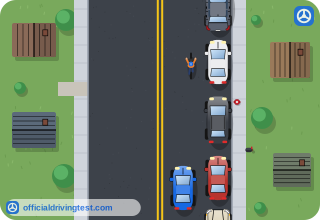
- Honk and pass on the cyclist’s left side
- Stay close behind until the cyclist moves right
- Pass at once while staying within the lane
- Give the cyclist the entire lane
Show answer
Correct answer: Give the cyclist the entire lane
If road conditions prevent giving the whole lane, the driver should pass with extreme caution.
Source: Tennessee Comprehensive Driver License Manual (March 2025 printing), page 105 · Open this page in the manual (Manual page 105)
-
At night, what should you do when you see an oncoming bicycle rider?
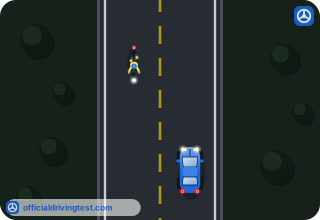
- Flash your high beams to warn the rider
- Switch on your high beams to see the rider
- Stop your vehicle at the side of the road
- Not use your high beams
Show answer
Correct answer: Not use your high beams
The manual says not to use high beams when you see an oncoming bicycle rider at night.
Source: Tennessee Comprehensive Driver License Manual (March 2025 printing), page 105 · Open this page in the manual (Manual page 105)
-
What should you do when you follow a bicyclist?
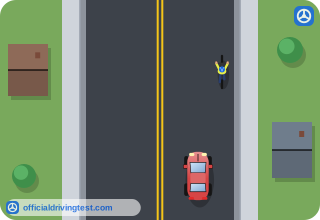
- Stay close so the rider can see your lights
- Give plenty of room and be prepared to stop quickly
- Follow at the same distance you use for cars
- Sound your horn to let the rider know you are there
Show answer
Correct answer: Give plenty of room and be prepared to stop quickly
Following bicyclists with plenty of room lets a driver stop quickly if needed, with extra caution in rain and ice.
Source: Tennessee Comprehensive Driver License Manual (March 2025 printing), page 105 · Open this page in the manual (Manual page 105)
-
When passing a bicyclist who is going the same direction, how much space must you leave between your vehicle and the bicycle?
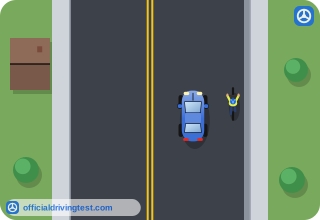
- Not less than 1 foot
- Not less than 2 feet
- Not less than 3 feet
- Not less than 5 feet
Show answer
Correct answer: Not less than 3 feet
Tennessee law requires at least 3 feet between the vehicle and the bicycle when passing.
Source: Tennessee Comprehensive Driver License Manual (March 2025 printing), page 105 · Open this page in the manual (Manual page 105)
-
When must you keep the required clearance from the bicycle you are passing?
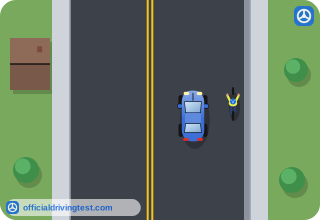
- Until you are safely past the overtaken bicycle
- Only while you are alongside the bicycle
- Only until you have signaled to pass
- Only while the bicyclist is looking at you
Show answer
Correct answer: Until you are safely past the overtaken bicycle
The clearance has to be maintained until the vehicle is safely past the overtaken bicycle.
Source: Tennessee Comprehensive Driver License Manual (March 2025 printing), page 105 · Open this page in the manual (Manual page 105)
-
On a two-lane road, what should a driver never attempt to do when passing a bicyclist?
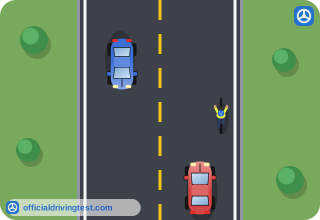
- Slow down and wait for oncoming vehicles to pass
- Pass the bicyclist when the road ahead is clear
- Pass between the bicyclist and oncoming vehicles
- Move over to the left of the center line
Show answer
Correct answer: Pass between the bicyclist and oncoming vehicles
The driver should slow down and let oncoming vehicles pass the rider safely instead of squeezing between them.
Source: Tennessee Comprehensive Driver License Manual (March 2025 printing), page 105 · Open this page in the manual (Manual page 105)
-
When should you NOT pass a bicycle?
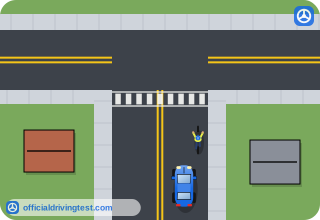
- When you would force the bicyclist too close to parked vehicles
- When the bicyclist is riding as close to the right edge as possible
- When the bicycle is moving in the same direction as your vehicle
- When you have already signaled and checked your mirrors well
Show answer
Correct answer: When you would force the bicyclist too close to parked vehicles
Wait until there is enough room to pass safely rather than crowding the bicyclist against parked vehicles.
Source: Tennessee Comprehensive Driver License Manual (March 2025 printing), page 105 · Open this page in the manual (Manual page 105)
-
On a narrow road you think a rider does not know you are coming. How should you use your horn?
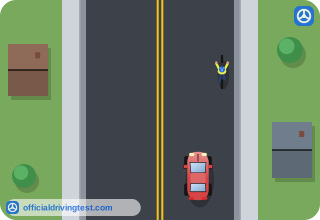
- Sound it with a long blast to get the rider off the road
- Do not use it at all, because it may startle the rider
- Tap it twice and then pass on the right
- Tap it gently and briefly as a signal that you are going to pass
Show answer
Correct answer: Tap it gently and briefly as a signal that you are going to pass
A gentle, brief tap warns the rider; a blast of the horn would startle or intimidate the bicyclist.
Source: Tennessee Comprehensive Driver License Manual (March 2025 printing), page 105 · Open this page in the manual (Manual page 105)
-
What are the most common causes of collisions between cars and bicycles?
- Drivers who follow a bicycle too closely on a long straight road
- Drivers turning left in front of, or right across the path of, a bicycle
- Bicyclists riding on the right-hand side of the roadway at night
- Drivers passing bicycles with more than three feet of space
Show answer
Correct answer: Drivers turning left in front of, or right across the path of, a bicycle
The manual names left turns in front of oncoming bicycles and right turns across a bicycle’s path as the most common causes.
Source: Tennessee Comprehensive Driver License Manual (March 2025 printing), page 105 · Open this page in the manual (Manual page 105)
-
What should a driver attempt to do with a bicyclist before turning?
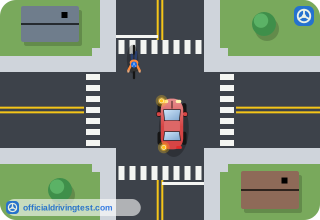
- Gain and maintain eye contact with the bicyclist
- Sound the horn so the bicyclist stops
- Flash the headlights so the bicyclist yields
- Wave the bicyclist forward through the intersection
Show answer
Correct answer: Gain and maintain eye contact with the bicyclist
Most bicyclists keep eye contact with drivers when turning, so a driver should try to do the same to make the turn safer.
Source: Tennessee Comprehensive Driver License Manual (March 2025 printing), page 105 · Open this page in the manual (Manual page 105)
-
In residential areas, what does the manual warn that bicyclists might do?
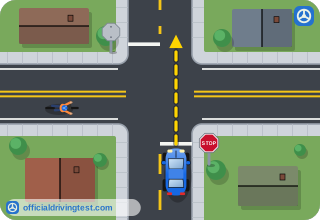
- Ride only on the sidewalk and stop at every stop sign and signal
- Ride mid-street and disregard stop signs and traffic signals
- Ride only on the left side and stop at every stop sign and signal
- Ride only in pairs and always obey every traffic signal
Show answer
Correct answer: Ride mid-street and disregard stop signs and traffic signals
The manual warns that bicyclists in neighborhoods may ride in the middle of the street and ignore stop signs and signals, so drivers must be careful.
Source: Tennessee Comprehensive Driver License Manual (March 2025 printing), page 106 · Open this page in the manual (Manual page 106)
-
Why should drivers be alert for erratic movement and sudden changes in direction from children on bicycles?
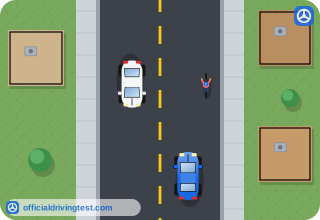
- Children are permitted to ride on the wrong side of the road
- Children are always required to ride on the sidewalk
- Children ride faster than adult bicyclists do
- Children are not capable of proper judgment of traffic conditions
Show answer
Correct answer: Children are not capable of proper judgment of traffic conditions
Children cannot judge traffic conditions well, so they may move erratically or change direction suddenly.
Source: Tennessee Comprehensive Driver License Manual (March 2025 printing), page 106 · Open this page in the manual (Manual page 106)
-
Where should you watch for bikes that may suddenly come into your path?
- From driveways or from behind parked cars or obstructions
- Only on roads that have bike lane signs posted along them
- Only on roads that have a painted center line and no curb
- Only on streets that have no parked vehicles or driveways
Show answer
Correct answer: From driveways or from behind parked cars or obstructions
Bikes can appear from driveways and from behind parked cars or other obstructions.
Source: Tennessee Comprehensive Driver License Manual (March 2025 printing), page 106 · Open this page in the manual (Manual page 106)
-
What does Tennessee law require on the front of a bicycle used at night?
- A lamp emitting a red light visible from at least 500 feet
- A lamp emitting a white light visible from at least 500 feet
- A lamp emitting a white light visible from at least 100 feet
- A reflector only, with no lamp required
Show answer
Correct answer: A lamp emitting a white light visible from at least 500 feet
A bicycle used at night needs a front lamp with a white light visible from a distance of at least 500 feet.
Source: Tennessee Comprehensive Driver License Manual (March 2025 printing), page 106 · Open this page in the manual (Manual page 106)
-
What does Tennessee law require on the rear of a bicycle used at night?
- A red reflector or a lamp emitting red light, visible from 500 feet
- A white reflector or a lamp emitting white light, visible from 500 feet
- A red reflector or a lamp emitting red light, visible from 100 feet
- A red lamp that flashes whenever the bicycle is moving
Show answer
Correct answer: A red reflector or a lamp emitting red light, visible from 500 feet
A bicycle ridden at night must have a red reflector or red lamp on the rear that can be seen from 500 feet.
Source: Tennessee Comprehensive Driver License Manual (March 2025 printing), page 106 · Open this page in the manual (Manual page 106)
-
A bicyclist has a red or orange pennant flag on an antenna attached to the bike. What should you do?
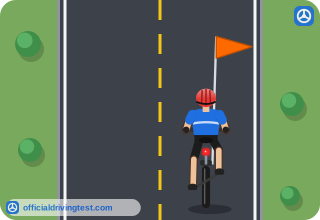
- Pass quickly, because the flag shows the rider has the right-of-way
- Sound your horn, because the rider will signal when to pass
- Slow down, because the rider may have impaired hearing
- Stop completely, because the rider cannot be passed
Show answer
Correct answer: Slow down, because the rider may have impaired hearing
A red or orange pennant flag is a common sign that the rider has impaired hearing, so the driver should slow down.
Source: Tennessee Comprehensive Driver License Manual (March 2025 printing), page 106 · Open this page in the manual (Manual page 106)
-
When are bicyclists required to ride as far right in the lane as possible?
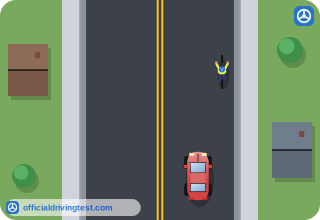
- At all times, whether or not a car can share the lane
- Only when the lane is marked for bicycle use only
- Only when a vehicle is following closely behind the bicycle
- Only when a car and bicycle can safely share the lane
Show answer
Correct answer: Only when a car and bicycle can safely share the lane
The far-right rule applies only when a car and bicycle can safely share the lane side by side; at other times a bicycle can take the full lane.
Source: Tennessee Comprehensive Driver License Manual (March 2025 printing), page 106 · Open this page in the manual (Manual page 106)
-
Which situation allows a bicyclist full use of the lane?
- The bicyclist is riding at night or in the rain
- The bicyclist is riding in a lane next to a bike lane
- A vehicle is following the bicyclist too closely
- The lane is too narrow to be shared safely
Show answer
Correct answer: The lane is too narrow to be shared safely
When the lane is too narrow to be shared safely, it is safest to let the bicycle take the full lane.
Source: Tennessee Comprehensive Driver License Manual (March 2025 printing), page 106 · Open this page in the manual (Manual page 106)
-
A bicyclist is overtaking and passing another vehicle going in the same direction. How much of the lane should the bicyclist be allowed to use?
- Only the right half of the lane
- Only the part within 3 feet of the curb
- The full use of the lane
- None, because bicyclists may not pass vehicles
Show answer
Correct answer: The full use of the lane
A bicyclist who is overtaking and passing another vehicle should be allowed full use of the lane.
Source: Tennessee Comprehensive Driver License Manual (March 2025 printing), page 106 · Open this page in the manual (Manual page 106)
-
The roadway has parked cars, fixed obstacles, animals, potholes or debris. How much of the lane should a bicyclist be allowed to use?
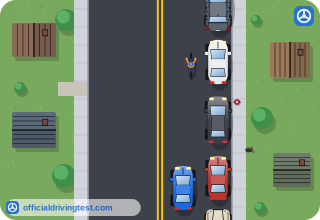
- The full use of the lane
- Only the part of the lane closest to the curb
- Only the left half of the lane
- Only the part that is not blocked
Show answer
Correct answer: The full use of the lane
Unsafe roadway conditions such as parked cars, obstacles, pedestrians, animals, potholes or debris allow a bicyclist the full lane.
Source: Tennessee Comprehensive Driver License Manual (March 2025 printing), page 106 · Open this page in the manual (Manual page 106)
-
A lane is marked and signed for bicycle use only. How may drivers use it?
- They may use it as a turning lane when no bicyclists are present
- They must never use it as a turning lane, passing lane or for parking
- They may park in it for a short time if no bicyclists are near
- They may use it as a passing lane if they signal first
Show answer
Correct answer: They must never use it as a turning lane, passing lane or for parking
A lane marked and signed for bicycles only may never be used by drivers to turn, pass or park.
Source: Tennessee Comprehensive Driver License Manual (March 2025 printing), page 106 · Open this page in the manual (Manual page 106)
-
Why is riding a bicycle against traffic dangerous?
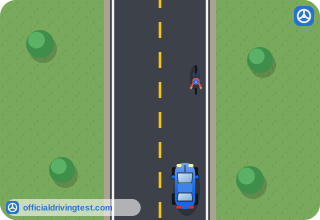
- The rider may miss traffic control devices such as signs and stop lights
- The rider is more visible to drivers who are coming toward them
- The rider can no longer use hand signals to turn
- The rider will be passed on the left by every vehicle
Show answer
Correct answer: The rider may miss traffic control devices such as signs and stop lights
A rider facing traffic may not see signs and signals meant for the flow of traffic, so the manual says to ride on the right with traffic.
Source: Tennessee Comprehensive Driver License Manual (March 2025 printing), page 106 · Open this page in the manual (Manual page 106)
-
What should a bicyclist never do when a truck or bus is making a wide right turn?
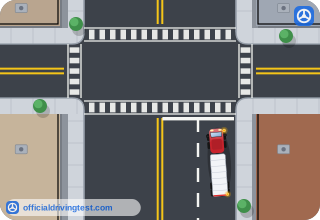
- Stay back and wait until the truck or bus has turned
- Ride well to the left of the truck or bus
- Sneak in between the truck or bus and the curb
- Watch the truck or bus signals as it turns
Show answer
Correct answer: Sneak in between the truck or bus and the curb
A bicyclist caught between a turning truck or bus and the curb could be crushed.
Source: Tennessee Comprehensive Driver License Manual (March 2025 printing), page 106 · Open this page in the manual (Manual page 106)
-
What should a bicyclist assume about other road users?
- That all drivers can see every hand signal
- That they are invisible to other road users
- That all drivers will yield to a bicyclist
- That drivers will always slow down for bicyclists
Show answer
Correct answer: That they are invisible to other road users
The manual advises bicyclists never to assume drivers see their hand signals or will yield, and to ride defensively.
Source: Tennessee Comprehensive Driver License Manual (March 2025 printing), page 106 · Open this page in the manual (Manual page 106)
-
What does the manual say a bicyclist should do before getting on the bike?
- Put on dark clothing
- Clip a flag to the rear
- Turn on the rear light
- Put on a helmet
Show answer
Correct answer: Put on a helmet
The manual calls a helmet the best thing a bicyclist can do to be safe.
Source: Tennessee Comprehensive Driver License Manual (March 2025 printing), page 106 · Open this page in the manual (Manual page 106)
-
Why is it harder for drivers to see motorcycles and judge their distance and speed?
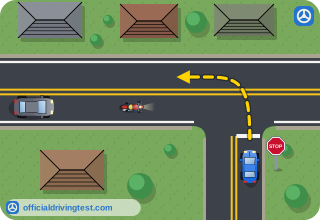
- A motorcycle is always much faster than other vehicles
- A motorcycle has bright lights that confuse other drivers
- A motorcycle always stays inside a driver’s blind spot
- Its narrow profile and short body make it hard to see and judge
Show answer
Correct answer: Its narrow profile and short body make it hard to see and judge
Drivers tend to look for cars and trucks, and a motorcycle is narrow and short, so it is harder to see and to judge.
Source: Tennessee Comprehensive Driver License Manual (March 2025 printing), page 107 · Open this page in the manual (Manual page 107)
-
What does the manual say about a motorcycle’s use of the lane?
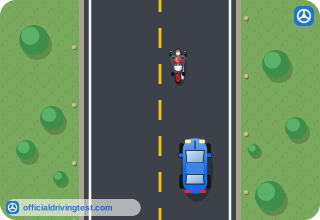
- A motorcycle may use only the right half of a lane
- Motorcycles have the right to the use of the full lane
- A motorcycle may use only the left half of a lane
- A motorcycle must share a lane with a car
Show answer
Correct answer: Motorcycles have the right to the use of the full lane
A motorcycle has the right to the full lane.
Source: Tennessee Comprehensive Driver License Manual (March 2025 printing), page 107 · Open this page in the manual (Manual page 107)
-
May a driver try to share a lane with a motorcycle?
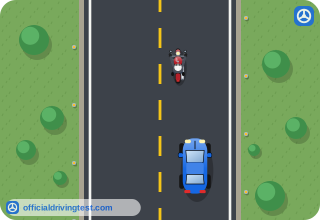
- Yes, if the driver stays in the left part of the lane and signals
- Yes, if the driver is moving slowly and has signaled
- No, never; respect the cycle’s space and position in traffic
- Yes, if the motorcycle is close to the edge of the lane
Show answer
Correct answer: No, never; respect the cycle’s space and position in traffic
A driver must never try to share a lane with a motorcycle and should always respect its space and position.
Source: Tennessee Comprehensive Driver License Manual (March 2025 printing), page 107 · Open this page in the manual (Manual page 107)
-
Why do motorcycle riders need the full width of the lane?
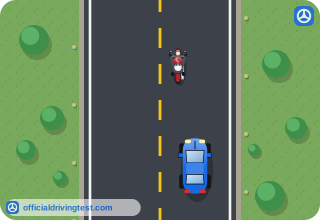
- To handle hazards such as potholes and strong winds
- To pass other vehicles in the same lane on the right
- To keep the headlight on the center line of the road
- To leave room for passengers to lean in the curves
Show answer
Correct answer: To handle hazards such as potholes and strong winds
Riders use the lane’s full width to handle hazards like potholes, blocked sight lines, strong winds and air blasts from passing vehicles.
Source: Tennessee Comprehensive Driver License Manual (March 2025 printing), page 107 · Open this page in the manual (Manual page 107)
-
How should you pass a motorcycle?
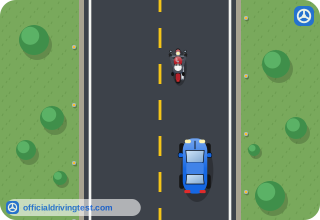
- At high speed, to clear the motorcycle quickly
- Very close, so the rider can clearly see your signal
- As you would pass a car, not too close or too fast
- Only on the right side of the motorcycle
Show answer
Correct answer: As you would pass a car, not too close or too fast
Passing too close or too fast can create an air blast that blows a motorcycle out of control.
Source: Tennessee Comprehensive Driver License Manual (March 2025 printing), page 107 · Open this page in the manual (Manual page 107)
-
Why should you check your blind spots for motorcycles before changing lanes?
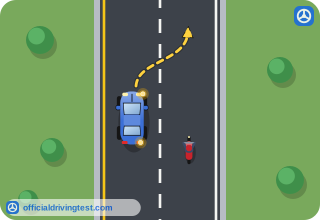
- A motorcycle in the next lane will always change lanes first
- Motorcycles alongside a lane of cars are often out of view
- A motorcycle rider cannot see cars in the next lane
- Motorcycle lights are brighter than the lights of cars
Show answer
Correct answer: Motorcycles alongside a lane of cars are often out of view
A driver who changes lanes without checking may clip or hit a motorcycle riding alongside.
Source: Tennessee Comprehensive Driver License Manual (March 2025 printing), page 107 · Open this page in the manual (Manual page 107)
-
At night, why can you easily misjudge the distance of a motorcycle?
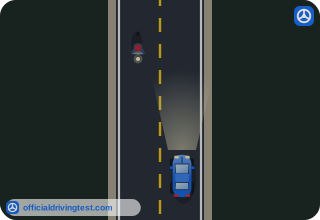
- Its lights point toward the sides of the road at night
- Its lights flash continuously when it is moving at night
- Its lights are always much dimmer than those of cars
- Its single headlight or taillight can blend into other lights
Show answer
Correct answer: Its single headlight or taillight can blend into other lights
A motorcycle has only one headlight or taillight, which can merge with other vehicles’ lights.
Source: Tennessee Comprehensive Driver License Manual (March 2025 printing), page 107 · Open this page in the manual (Manual page 107)
-
What should you do with your headlights when you meet a motorcycle at night?
- Dim them, as you would for other cars and trucks
- Keep the high beams on so the rider can see you
- Flash the high beams to warn the rider
- Turn them off for a moment to avoid glare
Show answer
Correct answer: Dim them, as you would for other cars and trucks
Drivers should dim their headlights for motorcycles just as they do for cars and trucks.
Source: Tennessee Comprehensive Driver License Manual (March 2025 printing), page 107 · Open this page in the manual (Manual page 107)
-
Where can strong cross winds move a motorcycle out of its lane of travel?
- On wide open, long stretches of highway and on bridges
- In narrow city streets that have tall buildings
- Only in the center lane of a multilane freeway
- Only on roads that are covered in snow and ice
Show answer
Correct answer: On wide open, long stretches of highway and on bridges
Open stretches of highway and bridges are places where cross winds can push a cycle out of its lane.
Source: Tennessee Comprehensive Driver License Manual (March 2025 printing), page 107 · Open this page in the manual (Manual page 107)
-
What will railroad grade crossings usually cause a motorcyclist to do?
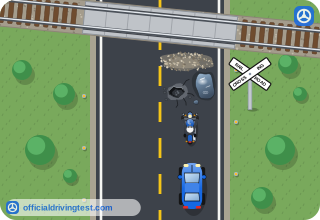
- Speed up to cross the tracks as quickly as possible
- Stop and then walk the cycle across the tracks
- Stay close behind the vehicle that is ahead
- Slow down and possibly zigzag across the tracks
Show answer
Correct answer: Slow down and possibly zigzag across the tracks
Grade crossings are a particular hazard for cyclists, who usually slow down and may zigzag over the tracks.
Source: Tennessee Comprehensive Driver License Manual (March 2025 printing), page 107 · Open this page in the manual (Manual page 107)
-
What may an experienced cyclist do on a metal or grated bridge?
- Speed up and move to the edge of the lane
- Slow down and move to the center of the lane
- Stop in the lane and wait for traffic to clear
- Change lanes quickly to a smoother surface
Show answer
Correct answer: Slow down and move to the center of the lane
Metal or grated bridges make a cycle wobble, so experienced riders slow down and use the center of the lane; an inexperienced rider may be startled.
Source: Tennessee Comprehensive Driver License Manual (March 2025 printing), page 107 · Open this page in the manual (Manual page 107)
-
How do motorcycles compare with trucks in stopping, because of their light weight and braking system?
- Motorcycles stop more slowly than trucks
- Motorcycles and trucks stop in the same distance
- Motorcycles can stop much faster than trucks
- Motorcycles stop slower on dry roads only
Show answer
Correct answer: Motorcycles can stop much faster than trucks
Because they are light and have their braking system, motorcycles can stop much faster than trucks, so a truck may not stop as quickly as the rider.
Source: Tennessee Comprehensive Driver License Manual (March 2025 printing), page 107 · Open this page in the manual (Manual page 107)
-
Where does the manual tell a motorcyclist to check for the U.S. Department of Transportation (DOT) standard label on a helmet?
- On the outer shell
- On the chin strap
- Inside the helmet
- On the visor
Show answer
Correct answer: Inside the helmet
The DOT label is found inside the helmet.
Source: Tennessee Comprehensive Driver License Manual (March 2025 printing), page 107 · Open this page in the manual (Manual page 107)
-
What should a motorcyclist never do in traffic?
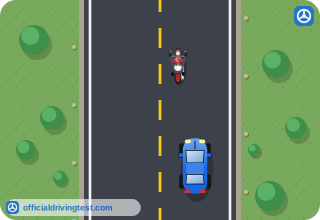
- Use the full width of the lane when passing
- Ride in between lanes or share a lane with another vehicle
- Ride in the lane position that is farthest from the curb
- Signal before changing lanes
Show answer
Correct answer: Ride in between lanes or share a lane with another vehicle
A motorcycle must obey the laws of the road, so it never rides between lanes or shares a lane with another vehicle.
Source: Tennessee Comprehensive Driver License Manual (March 2025 printing), page 108 · Open this page in the manual (Manual page 108)
-
What protective clothing does the manual say a motorcyclist should wear?
- Shorts, sandals and a vest
- A jacket and sandals only
- Gloves and a bandana only
- Gloves, boots and a jacket
Show answer
Correct answer: Gloves, boots and a jacket
The manual advises gloves, boots and a jacket, along with a safety inspection before each ride.
Source: Tennessee Comprehensive Driver License Manual (March 2025 printing), page 108 · Open this page in the manual (Manual page 108)
-
Which vehicles accelerate the fastest and which are the slowest?
- Motorcycles accelerate the fastest, and trucks and buses are the slowest
- Cars accelerate the fastest, and motorcycles are the slowest
- Trucks and buses accelerate the fastest, and cars are the slowest
- All vehicles accelerate at about the same rate
Show answer
Correct answer: Motorcycles accelerate the fastest, and trucks and buses are the slowest
Of all vehicles, motorcycles accelerate the fastest, while trucks and buses are the slowest.
Source: Tennessee Comprehensive Driver License Manual (March 2025 printing), page 108 · Open this page in the manual (Manual page 108)
-
What should you do before you pull in front of a truck after passing it?
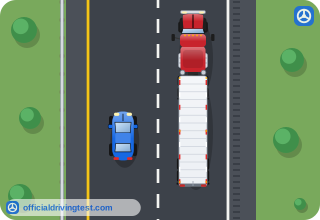
- Sound your horn to let the truck driver know you are there
- Look for the truck’s front in your rear-view mirror
- Slow down quickly so the truck can pass again
- Move over slowly and brake as you do so
Show answer
Correct answer: Look for the truck’s front in your rear-view mirror
Trucks take much longer to stop than cars, so a driver must see the truck’s front in the mirror before pulling back in front.
Source: Tennessee Comprehensive Driver License Manual (March 2025 printing), page 108 · Open this page in the manual (Manual page 108)
-
What is the rule of thumb about a truck’s mirror and the truck driver?
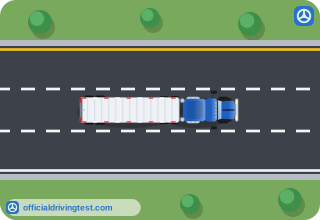
- If you can see the truck’s mirror, then the truck driver can also see you
- Truck drivers can see every vehicle that is near the truck
- If you cannot see the truck driver in its mirror, the driver cannot see you
- A truck driver can always see you if your lights are on
Show answer
Correct answer: If you cannot see the truck driver in its mirror, the driver cannot see you
Staying out of the truck’s blind spots matters because a driver you cannot see in the mirror cannot see you.
Source: Tennessee Comprehensive Driver License Manual (March 2025 printing), page 108 · Open this page in the manual (Manual page 108)
-
Where do large trucks have blind spots, or No-Zones?
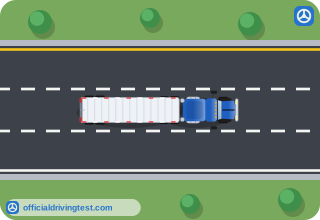
- Only directly behind the truck
- Only along the right side of the truck
- Only in front of the truck
- Around the front, back and sides of the truck
Show answer
Correct answer: Around the front, back and sides of the truck
Large trucks have blind spots on all sides, so drivers should not stay in them.
Source: Tennessee Comprehensive Driver License Manual (March 2025 printing), page 108 · Open this page in the manual (Manual page 108)
-
Which of these does the manual list among the things aggressive drivers do?
- Staying in the right lane at the speed limit
- Giving trucks lots of room to maneuver
- Pulling in front of trucks too quickly when passing
- Looking for the front of the truck in the mirror
Show answer
Correct answer: Pulling in front of trucks too quickly when passing
Aggressive drivers speed, run red lights and stop signs, cut in front of trucks and change lanes often in truck blind spots.
Source: Tennessee Comprehensive Driver License Manual (March 2025 printing), page 108 · Open this page in the manual (Manual page 108)
-
What can happen if you try to get in between a truck making a wide right turn and the curb?
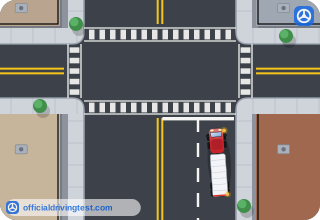
- You may be caught in a squeeze and suffer a serious accident
- The truck driver will see you in the mirror and stop
- You will be able to pass the truck on the right safely
- The truck will slow down to let you through
Show answer
Correct answer: You may be caught in a squeeze and suffer a serious accident
Cutting in between a turning truck and the curb increases the possibility of a crash.
Source: Tennessee Comprehensive Driver License Manual (March 2025 printing), page 108 · Open this page in the manual (Manual page 108)
-
Before making a right turn, what do truck drivers sometimes need to do, especially in urban areas?
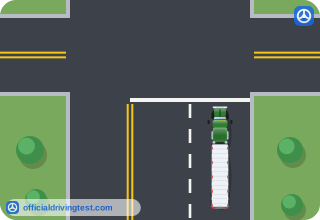
- Swing wide to the right
- Swing wide to the left
- Stop in the left lane
- Back up in the lane
Show answer
Correct answer: Swing wide to the left
To make a right turn safely, a truck driver sometimes has to swing wide to the left, so other drivers should give room.
Source: Tennessee Comprehensive Driver License Manual (March 2025 printing), page 108 · Open this page in the manual (Manual page 108)
-
About how far does a truck traveling at 55 MPH need to stop, according to the manual?
- About 450+ feet
- About 240 feet
- About 150 feet
- About 300 feet
Show answer
Correct answer: About 450+ feet
A truck at 55 MPH needs far more room to stop than a car, which can stop in about 240 feet.
Source: Tennessee Comprehensive Driver License Manual (March 2025 printing), page 109 · Open this page in the manual (Manual page 109)
-
To make a right turn safely, which way must a large truck first swing?
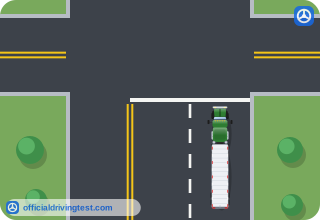
- Wide to the right
- Close to the right curb
- Wide to the left
- Back and then forward in the same lane
Show answer
Correct answer: Wide to the left
Trucks swing wide to the left to get around a right turn, so they need extra room.
Source: Tennessee Comprehensive Driver License Manual (March 2025 printing), page 109 · Open this page in the manual (Manual page 109)
-
Why should you not pull out onto a roadway in front of a large truck or bus?
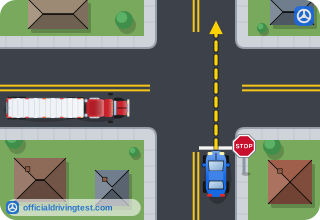
- It will always speed up to pass you in the lane
- It cannot slow down or stop as quickly as a car
- Its driver is not allowed to use the horn there
- It is not allowed to change lanes to avoid you
Show answer
Correct answer: It cannot slow down or stop as quickly as a car
Large vehicles need much more distance to slow down, so pulling out in front of one can cause a rear-end collision.
Source: Tennessee Comprehensive Driver License Manual (March 2025 printing), page 109 · Open this page in the manual (Manual page 109)
-
You are about to exit a highway and a truck is just ahead of you. What does the manual say to do?
- Speed up and cut in front of the truck
- Pull alongside the truck and stay there
- Follow the truck closely until the exit ends
- Slow down a few seconds and exit behind the truck
Show answer
Correct answer: Slow down a few seconds and exit behind the truck
It only takes a few extra seconds to exit behind the truck, which is safer than cutting it off.
Source: Tennessee Comprehensive Driver License Manual (March 2025 printing), page 109 · Open this page in the manual (Manual page 109)
-
When passing a large vehicle, when may you pull back into the lane in front of it?
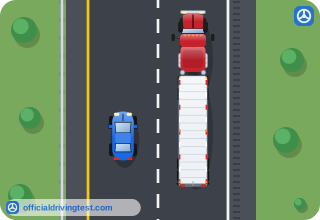
- As soon as your rear bumper clears the truck's front bumper
- When the truck driver sounds the horn to signal you
- Only when the whole front of the truck shows in your rearview mirror
- After you have slowed down to match the truck's speed
Show answer
Correct answer: Only when the whole front of the truck shows in your rearview mirror
You should see the whole front of the truck in your rearview mirror before moving back in front of it.
Source: Tennessee Comprehensive Driver License Manual (March 2025 printing), page 109 · Open this page in the manual (Manual page 109)
-
After you pass a large truck and move in front of it, what should you do?
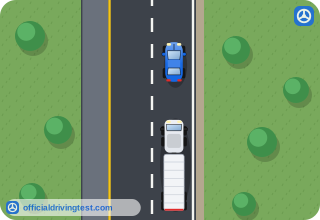
- Keep your speed and do not slow down
- Slow down to let the truck catch up
- Stop in the lane and signal for the truck to pass
- Brake to open a gap behind you
Show answer
Correct answer: Keep your speed and do not slow down
Slowing down after you pull in front forces the truck driver to brake, so keep your speed.
Source: Tennessee Comprehensive Driver License Manual (March 2025 printing), page 109 · Open this page in the manual (Manual page 109)
-
How far behind a large truck can its blind spot extend?
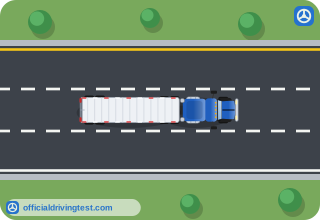
- Up to 50 feet
- Up to 100 feet
- Up to 400 feet
- Up to 200 feet
Show answer
Correct answer: Up to 200 feet
A truck has blind spots in front, on both sides and up to 200 feet behind it.
Source: Tennessee Comprehensive Driver License Manual (March 2025 printing), page 109 · Open this page in the manual (Manual page 109)
-
What does it mean if you cannot see a truck's side mirror?
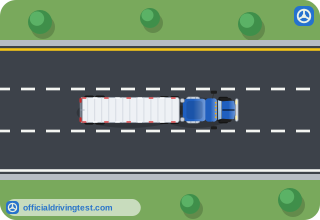
- The truck driver is about to stop
- The truck driver cannot see you
- The truck driver will let you pass
- The truck driver sees you in the rearview mirror
Show answer
Correct answer: The truck driver cannot see you
If you cannot see the truck's mirror, the driver cannot see you in it, so you are in a blind spot.
Source: Tennessee Comprehensive Driver License Manual (March 2025 printing), page 109 · Open this page in the manual (Manual page 109)
-
You are stopped behind a truck on an uphill grade. Where should you position your car in your lane?
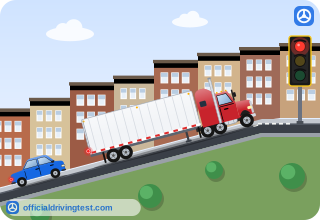
- To the right side of your lane
- To the left side of your lane
- Directly behind the truck bumper
- Partly on the shoulder
Show answer
Correct answer: To the left side of your lane
Staying to the left in your lane lets the truck driver see you.
Source: Tennessee Comprehensive Driver License Manual (March 2025 printing), page 109 · Open this page in the manual (Manual page 109)
-
When stopped in a traffic lane behind a truck, why should you leave extra space in front of your car?
- The truck may need to turn around
- The truck driver may open the door
- Other trucks may need to pass between you
- The truck may roll back when it starts to move
Show answer
Correct answer: The truck may roll back when it starts to move
A truck can roll back when it starts, so extra space in front of your car protects you.
Source: Tennessee Comprehensive Driver License Manual (March 2025 printing), page 109 · Open this page in the manual (Manual page 109)
-
What should you do near a Commercial Vehicle Weigh Station?
- Avoid the right lane so slow trucks can merge back
- Stay in the right lane so you can use the exit
- Stop on the shoulder until trucks have merged
- Speed up to pass trucks entering the station
Show answer
Correct answer: Avoid the right lane so slow trucks can merge back
Staying out of the right lane lets slow trucks easily merge back into traffic.
Source: Tennessee Comprehensive Driver License Manual (March 2025 printing), page 109 · Open this page in the manual (Manual page 109)
-
Why should you dim your lights at night when you are near a large truck?
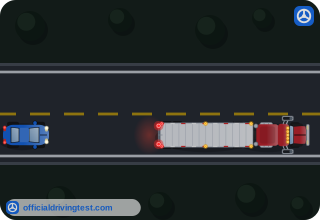
- Truck lights are always turned off at night
- Dimmed lights make the truck look faster
- Bright lights in its mirrors can blind the driver
- Bright lights damage the truck's mirrors
Show answer
Correct answer: Bright lights in its mirrors can blind the driver
Bright lights shining in the mirrors of a truck can blind its driver.
Source: Tennessee Comprehensive Driver License Manual (March 2025 printing), page 109 · Open this page in the manual (Manual page 109)
-
Why should you never underestimate the speed of an approaching truck or bus?
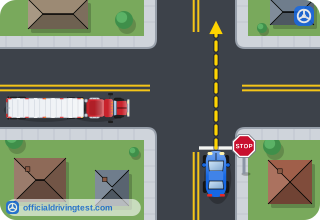
- It always travels above the speed limit
- It can change lanes without signaling
- Its brakes work faster than a car's
- It looks slower than it really is
Show answer
Correct answer: It looks slower than it really is
Large vehicles often appear to be traveling more slowly than their actual speed.
Source: Tennessee Comprehensive Driver License Manual (March 2025 printing), page 109 · Open this page in the manual (Manual page 109)
-
If a truck or bus driver blinks the vehicle's headlights after you pass, what does it signal?
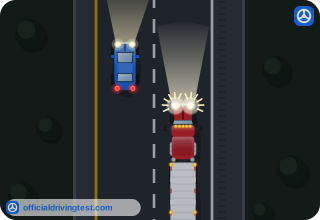
- You must stop on the shoulder
- You are cleared to pull back in front
- The truck is about to pass you again
- There is a hazard in the road behind you
Show answer
Correct answer: You are cleared to pull back in front
The blinking headlights tell you that you may move back in front, but only when you can see the vehicle's front in your rearview mirror.
Source: Tennessee Comprehensive Driver License Manual (March 2025 printing), page 109 · Open this page in the manual (Manual page 109)
-
What does a large vehicle usually do on an upgrade or steep hill?
- It gains speed
- It keeps the same speed
- It loses speed
- It stops completely
Show answer
Correct answer: It loses speed
Large vehicles usually slow down as they climb a steep hill.
Source: Tennessee Comprehensive Driver License Manual (March 2025 printing), page 109 · Open this page in the manual (Manual page 109)
-
What should you do when a truck or bus is passing you?
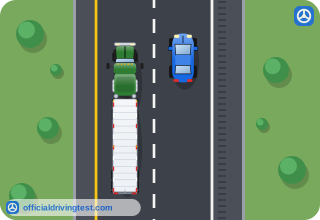
- Keep to the far side of your lane and never speed up
- Move toward the center of your lane to give room
- Speed up to stay beside it until it is clear
- Brake hard and stop in the lane right away
Show answer
Correct answer: Keep to the far side of your lane and never speed up
Staying to the side of your lane and reducing speed slightly helps the driver, and speeding up is dangerous.
Source: Tennessee Comprehensive Driver License Manual (March 2025 printing), page 110 · Open this page in the manual (Manual page 110)
-
When you meet a truck or bus coming from the opposite direction, what should you do?
- Move toward the center line
- Flash your headlights and slow to a stop
- Keep as far as possible to the right of the road
- Drive on the left edge of your lane
Show answer
Correct answer: Keep as far as possible to the right of the road
Keeping to the right avoids being sideswiped and reduces wind turbulence between the vehicles.
Source: Tennessee Comprehensive Driver License Manual (March 2025 printing), page 110 · Open this page in the manual (Manual page 110)
-
According to the manual, what does the wind turbulence between two passing vehicles do?
- It pulls the vehicles together
- It pushes the vehicles apart
- It makes both vehicles slow down
- It has no effect on either vehicle
Show answer
Correct answer: It pushes the vehicles apart
The manual states that the turbulence pushes vehicles apart and does not suck them together.
Source: Tennessee Comprehensive Driver License Manual (March 2025 printing), page 110 · Open this page in the manual (Manual page 110)
-
What should you do if a truck might be making a right turn?
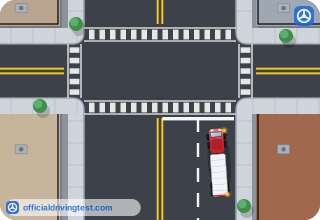
- Pass it quickly on the right side to get ahead
- Stay between the truck and the curb to be safe
- Honk and move up beside the trailer to pass
- Stay out of the space on its right and do not pass
Show answer
Correct answer: Stay out of the space on its right and do not pass
A driver between the truck and the curb may not be seen and can be crunched or sideswiped by the trailer.
Source: Tennessee Comprehensive Driver License Manual (March 2025 printing), page 110 · Open this page in the manual (Manual page 110)
-
What should you never do when a truck is preparing to back up?
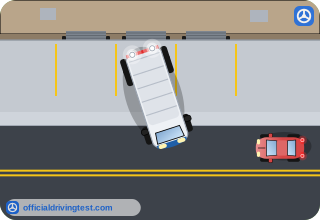
- Wait patiently
- Give the driver plenty of room
- Cross behind it
- Stay clear of its blind spots
Show answer
Correct answer: Cross behind it
Crossing behind a backing truck puts you in the driver's blind spots in a high-collision situation.
Source: Tennessee Comprehensive Driver License Manual (March 2025 printing), page 110 · Open this page in the manual (Manual page 110)
-
When you are driving in front of a truck, what should you do about your speed?
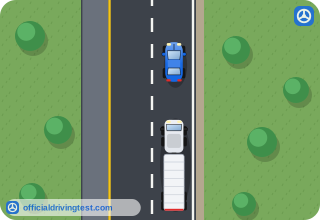
- Keep your speed up to stay a safe distance ahead
- Slow down so the truck can pass you quickly
- Stop suddenly if the truck gets too close
- Change lanes often to stay out of its way
Show answer
Correct answer: Keep your speed up to stay a safe distance ahead
Keeping up your speed maintains a safe gap in front of the truck and avoids sudden slow downs.
Source: Tennessee Comprehensive Driver License Manual (March 2025 printing), page 110 · Open this page in the manual (Manual page 110)
-
When you are driving in front of a truck or bus, how should you signal a turn or lane change?
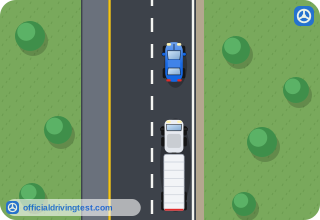
- At the last moment
- Only with a hand signal
- Not at all, because trucks can see everything
- Early enough for the truck driver to prepare
Show answer
Correct answer: Early enough for the truck driver to prepare
The truck driver needs time to prepare for your maneuver, so signal early.
Source: Tennessee Comprehensive Driver License Manual (March 2025 printing), page 110 · Open this page in the manual (Manual page 110)
-
When you are following a truck or bus, what is a good idea?
- Follow as closely as you can
- Add more following distance
- Stay in its right blind spot
- Follow in the left lane edge only
Show answer
Correct answer: Add more following distance
Large vehicles need more room, so a longer following distance is recommended.
Source: Tennessee Comprehensive Driver License Manual (March 2025 printing), page 110 · Open this page in the manual (Manual page 110)
-
If spray from a truck is reducing your vision on a wet road, what should you do?
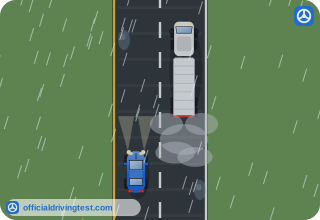
- Pass the truck as closely as you can
- Move as far from the truck as you can, in your lane
- Drive in the truck's blind spot to stay close
- Brake hard to drop back behind the truck
Show answer
Correct answer: Move as far from the truck as you can, in your lane
Spray from a truck can seriously reduce your vision, so stay in your lane but move away from it.
Source: Tennessee Comprehensive Driver License Manual (March 2025 printing), page 110 · Open this page in the manual (Manual page 110)
-
Why should you not drive too close to a truck that is transporting hazardous materials?
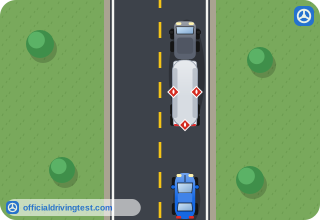
- It always drives well above the posted speed limit
- It cannot use the right lane on a divided road
- It is not allowed to use turn signals at night
- It makes frequent stops, such as at railroad crossings
Show answer
Correct answer: It makes frequent stops, such as at railroad crossings
Trucks carrying hazardous materials make frequent stops, so following closely is risky.
Source: Tennessee Comprehensive Driver License Manual (March 2025 printing), page 110 · Open this page in the manual (Manual page 110)
-
What can smoking wheels or a high speed on a large truck going downhill signal?
- Brake loss, so you should fall back and not pass
- A heavy load, so you should pass quickly
- A normal braking pattern
- The driver is about to stop on the shoulder
Show answer
Correct answer: Brake loss, so you should fall back and not pass
Those signs can mean the truck has lost its brakes, so stay back and do not pass.
Source: Tennessee Comprehensive Driver License Manual (March 2025 printing), page 110 · Open this page in the manual (Manual page 110)
-
What should vehicles never do in a runaway truck ramp area?
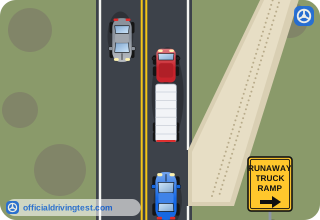
- Slow down
- Use the horn
- Stop or park
- Drive at the speed limit
Show answer
Correct answer: Stop or park
Runaway truck ramps are for out-of-control trucks or buses, so vehicles should not stop or park there.
Source: Tennessee Comprehensive Driver License Manual (March 2025 printing), page 110 · Open this page in the manual (Manual page 110)
-
About how far in front of a large vehicle is the NO-ZONE?
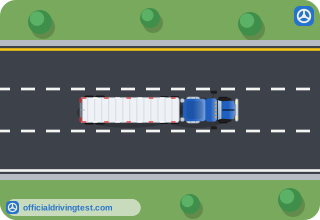
- Up to about 5 feet
- Up to about 40 feet
- Up to about 60 feet
- Up to about 20 feet
Show answer
Correct answer: Up to about 20 feet
The area up to about 20 feet directly in front of a large vehicle is a NO-ZONE where crashes are more likely.
Source: Tennessee Comprehensive Driver License Manual (March 2025 printing), page 110 · Open this page in the manual (Manual page 110)
-
What does the NO-ZONE around a truck or bus represent?
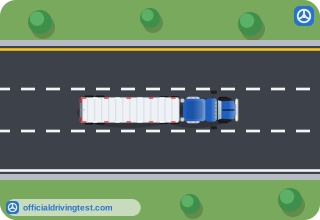
- Areas where parking is not allowed at all
- Danger areas where crashes are more likely
- Lanes reserved for trucks and buses only
- Places where trucks cannot make any turns
Show answer
Correct answer: Danger areas where crashes are more likely
The NO-ZONE marks the danger areas around large vehicles where crashes are more likely.
Source: Tennessee Comprehensive Driver License Manual (March 2025 printing), page 110 · Open this page in the manual (Manual page 110)
-
What happens if you stay in the rear blind spot of a large vehicle?
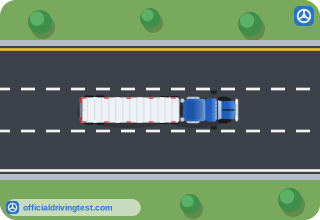
- The driver sees you easily in the large side mirrors
- You are fully protected from wind turbulence
- The driver cannot see you and your view ahead is reduced
- You can see the traffic ahead much better than usual
Show answer
Correct answer: The driver cannot see you and your view ahead is reduced
Following too closely behind a large vehicle hides you from its driver and blocks your view ahead.
Source: Tennessee Comprehensive Driver License Manual (March 2025 printing), page 110 · Open this page in the manual (Manual page 110)
-
What does remaining alongside a large vehicle too long make impossible?
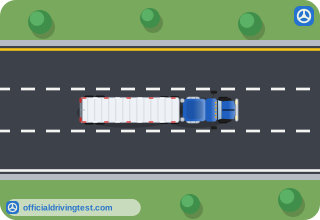
- For the driver to take evasive action if an obstacle appears
- For you to see the road behind the large vehicle ahead
- For you to use your turn signals while you pass it
- For the truck to use its brakes in time
Show answer
Correct answer: For the driver to take evasive action if an obstacle appears
Staying in a side blind spot leaves the driver unable to swerve if something blocks the road ahead.
Source: Tennessee Comprehensive Driver License Manual (March 2025 printing), page 110 · Open this page in the manual (Manual page 110)
-
Why is it dangerous to cut in between a truck or bus and the curb as it turns right?
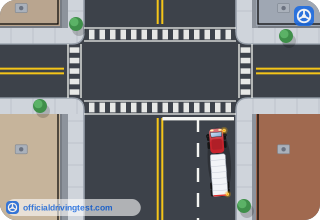
- Its driver often cannot see vehicles beside it in the turn
- The turn signal blocks the driver's view of the road
- The truck must always stop before it makes a turn
- The curb lane is reserved for buses in every city
Show answer
Correct answer: Its driver often cannot see vehicles beside it in the turn
Truck drivers often cannot see vehicles beside them when turning right, so cutting in raises the crash risk.
Source: Tennessee Comprehensive Driver License Manual (March 2025 printing), page 110 · Open this page in the manual (Manual page 110)
-
How far away from a school bus should children stay, according to the manual?
- Two feet
- Twenty feet
- Ten feet
- Thirty feet
Show answer
Correct answer: Ten feet
The danger zone is on all sides of the bus, and children should stay ten feet away and never go behind it.
Source: Tennessee Comprehensive Driver License Manual (March 2025 printing), page 111 · Open this page in the manual (Manual page 111)
-
How many "giant steps" are children taught to take as soon as they exit a school bus?
- Two
- Five
- Three
- Ten
Show answer
Correct answer: Five
Children are taught to escape the danger zone by taking five giant steps away from the bus.
Source: Tennessee Comprehensive Driver License Manual (March 2025 printing), page 111 · Open this page in the manual (Manual page 111)
-
Why must drivers stop far enough from a school bus?
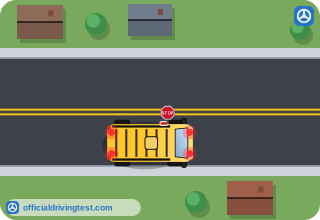
- To let the bus driver back up without delay
- To keep their vehicle out of the bus driver's mirrors
- To be able to pass the bus on the right side
- To leave the space children need to move away from it
Show answer
Correct answer: To leave the space children need to move away from it
Children take five giant steps away from the bus, so drivers must leave room for that safety space.
Source: Tennessee Comprehensive Driver License Manual (March 2025 printing), page 111 · Open this page in the manual (Manual page 111)
-
According to the manual, where are more children hurt around school buses?
- Outside the bus
- Inside the bus
- Inside the bus on rough roads
- On the bus steps only
Show answer
Correct answer: Outside the bus
More children are hurt outside a school bus than inside one.
Source: Tennessee Comprehensive Driver License Manual (March 2025 printing), page 111 · Open this page in the manual (Manual page 111)
-
What should you do when approaching slow-moving vehicles from the rear?
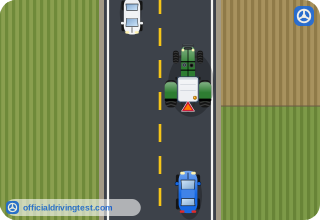
- Speed up to pass them as quickly as possible
- Sound your horn continuously until they move
- Follow as closely behind them as possible
- Use caution and prepare to slow down
Show answer
Correct answer: Use caution and prepare to slow down
The manual advises caution and being ready to slow down when you come up behind slow-moving vehicles.
Source: Tennessee Comprehensive Driver License Manual (March 2025 printing), page 111 · Open this page in the manual (Manual page 111)
-
What must be displayed on the rear of vehicles drawn by animals and most farm vehicles and construction equipment?
- A red flag on a short pole mounted on the rear
- A fluorescent or reflective orange triangle
- A yellow circle with a black border
- A white square with a green stripe
Show answer
Correct answer: A fluorescent or reflective orange triangle
The slow moving vehicle emblem is a fluorescent or reflective orange triangle.
Source: Tennessee Comprehensive Driver License Manual (March 2025 printing), page 111 · Open this page in the manual (Manual page 111)
-
How may operators of farm machinery make a right turn?
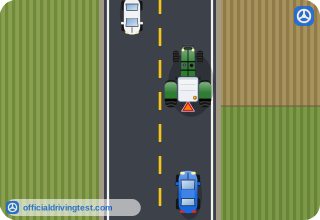
- They always signal with turn signals
- They may first pull wide to the left, then turn right
- They always stop and wait for traffic to clear
- They always turn from the shoulder
Show answer
Correct answer: They may first pull wide to the left, then turn right
Farm machinery usually has no turn signals, and operators may swing wide to the left before turning right.
Source: Tennessee Comprehensive Driver License Manual (March 2025 printing), page 111 · Open this page in the manual (Manual page 111)
-
What rights do animal-drawn vehicles have on the road?
- No right to use the roadway at all
- The right to use only the road shoulder
- Right of way over all other traffic
- The same rights and rules as a motor vehicle
Show answer
Correct answer: The same rights and rules as a motor vehicle
Animal-drawn vehicles may use the road and must follow the rules of the road like motor vehicles.
Source: Tennessee Comprehensive Driver License Manual (March 2025 printing), page 111 · Open this page in the manual (Manual page 111)
-
How must horseback riders ride on a road?
- Single file near the right curb or road edge
- Two abreast near the center line of the road
- On the left side of the road facing traffic
- In the middle of the lane to be more visible
Show answer
Correct answer: Single file near the right curb or road edge
Riders are subject to the rules of the road and must ride single file on the right.
Source: Tennessee Comprehensive Driver License Manual (March 2025 printing), page 111 · Open this page in the manual (Manual page 111)
-
What should you not do when approaching or passing a horse?
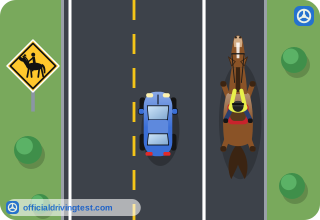
- Drive at a reasonable speed past the horse
- Keep a reasonable distance from the horse
- Sound your horn or rev your engine loudly
- Use due care when you come up to the horse
Show answer
Correct answer: Sound your horn or rev your engine loudly
A loud horn or engine can frighten the horse, so avoid both.
Source: Tennessee Comprehensive Driver License Manual (March 2025 printing), page 111 · Open this page in the manual (Manual page 111)
-
How must you drive when approaching a horse being ridden or led along a road?
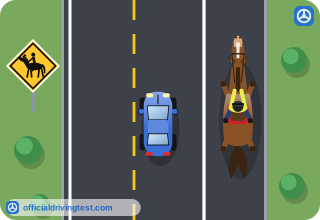
- At the speed limit and as close as possible
- Slowly, staying directly behind the horse at all times
- Quickly, to get past it as soon as you can
- At a reasonable speed and a reasonable distance
Show answer
Correct answer: At a reasonable speed and a reasonable distance
The law requires due care, a reasonable speed and a reasonable distance from the horse.
Source: Tennessee Comprehensive Driver License Manual (March 2025 printing), page 111 · Open this page in the manual (Manual page 111)
-
What may slow-moving vehicles do at any time?
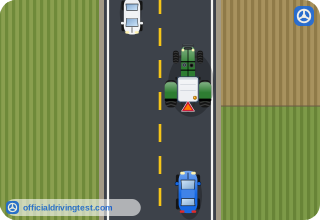
- Stop in the middle of the road without warning
- Turn right or left into unmarked entrances
- Drive on the left side of the road
- Ignore traffic signals
Show answer
Correct answer: Turn right or left into unmarked entrances
They may make wide turns and turn right or left at any time into unmarked entrances, so stay back.
Source: Tennessee Comprehensive Driver License Manual (March 2025 printing), page 112 · Open this page in the manual (Manual page 112)
-
Before you pass a slow-moving vehicle from the rear, what should you be certain of?
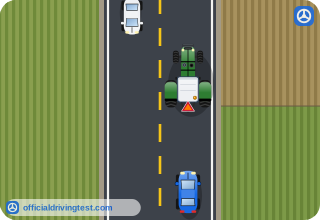
- The driver has sounded the horn to signal you
- The driver has moved fully onto the shoulder
- The driver has seen you and knows you will pass
- The driver has come to a complete stop
Show answer
Correct answer: The driver has seen you and knows you will pass
Stay a safe distance back until it is safe to pass, and make sure the driver knows you are passing.
Source: Tennessee Comprehensive Driver License Manual (March 2025 printing), page 112 · Open this page in the manual (Manual page 112)
-
A self-luminous red lamp on the rear of a slow-moving vehicle is normally visible for how far to the rear?
- 500 feet
- 100 feet
- 200 feet
- 1,000 feet
Show answer
Correct answer: 500 feet
Such a lamp is normally visible for 500 feet behind the vehicle.
Source: Tennessee Comprehensive Driver License Manual (March 2025 printing), page 112 · Open this page in the manual (Manual page 112)
-
Which lane must slower traffic drive in?
- The right-hand lane
- The left-hand lane
- Either lane
- The center of the roadway
Show answer
Correct answer: The right-hand lane
Slower traffic stays in the right-hand lane, and the left lane is for passing and turning.
Source: Tennessee Comprehensive Driver License Manual (March 2025 printing), page 112 · Open this page in the manual (Manual page 112)
-
How do 15-passenger vans compare with passenger cars?
- Shorter stopping distances and easier turning
- The same stopping distance and the same turning
- Shorter stopping distances but harder turning
- Longer stopping distances and harder turning
Show answer
Correct answer: Longer stopping distances and harder turning
These vans react differently from cars, with longer stopping distances and harder turning.
Source: Tennessee Comprehensive Driver License Manual (March 2025 printing), page 115 · Open this page in the manual (Manual page 115)
-
Where should passengers sit in a 15-passenger van?
- As far toward the rear as possible
- As far toward the front as possible
- Only in the rear seat behind the axle
- Only on one side of the van
Show answer
Correct answer: As far toward the front as possible
The rear seat is behind the rear axle, which pushes the center of gravity back.
Source: Tennessee Comprehensive Driver License Manual (March 2025 printing), page 115 · Open this page in the manual (Manual page 115)
-
What should you not do with a 15-passenger van, because it raises the chance of rollover?
- Carry passengers in the front seat
- Park it on level ground
- Tow a trailer or put cargo on the roof
- Use it on highways
Show answer
Correct answer: Tow a trailer or put cargo on the roof
Towing and roof cargo change the center of gravity and increase the chance of rollover.
Source: Tennessee Comprehensive Driver License Manual (March 2025 printing), page 115 · Open this page in the manual (Manual page 115)
-
When do most 15-passenger van rollovers occur?
- At high speeds after sudden steering
- At low speeds in parking lots and driveways
- When the van is completely empty
- Only on snow-covered roads
Show answer
Correct answer: At high speeds after sudden steering
Most rollovers happen at high speed after sudden steering.
Source: Tennessee Comprehensive Driver License Manual (March 2025 printing), page 115 · Open this page in the manual (Manual page 115)
-
If a 15-passenger van's tires drop off the roadway, what should the driver do?
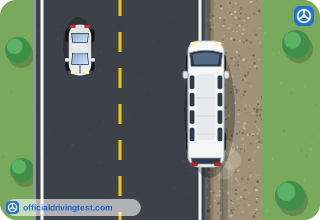
- Slow down gradually and steer back on when safe
- Brake hard and steer back onto the road at once
- Speed up and steer sharply back on the road
- Stop in the lane and turn off the engine
Show answer
Correct answer: Slow down gradually and steer back on when safe
Sudden moves can cause loss of control, so slow gradually and return to the road when safe.
Source: Tennessee Comprehensive Driver License Manual (March 2025 printing), page 115 · Open this page in the manual (Manual page 115)
-
Before each trip in a recreational vehicle (RV), what should you check?
- That the tires are overinflated
- That the horn is loud
- That the tires are properly inflated
- That the seats face the rear
Show answer
Correct answer: That the tires are properly inflated
The manual advises checking tire inflation before each trip.
Source: Tennessee Comprehensive Driver License Manual (March 2025 printing), page 115 · Open this page in the manual (Manual page 115)
-
Why should heavy items in a recreational vehicle (RV) be secured?
- They can lower the fuel use of the vehicle
- They can shift and affect handling and braking
- They can change the license class needed
- They can block the turn signals and lights
Show answer
Correct answer: They can shift and affect handling and braking
Loose heavy items can shift and affect how the RV handles.
Source: Tennessee Comprehensive Driver License Manual (March 2025 printing), page 115 · Open this page in the manual (Manual page 115)
-
How should weight be distributed in a recreational vehicle (RV)?
- High up and weighted toward one side
- Toward the rear of the vehicle only
- On the roof where it is easy to reach
- Low to the ground and equal on both sides
Show answer
Correct answer: Low to the ground and equal on both sides
That keeps the center of gravity low and gives better handling.
Source: Tennessee Comprehensive Driver License Manual (March 2025 printing), page 115 · Open this page in the manual (Manual page 115)
-
The manual says RVs, because of their size, handle more like what kind of vehicle?
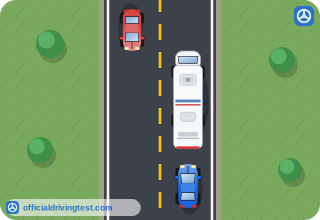
- A large truck
- A motorcycle
- A small car
- A bicycle
Show answer
Correct answer: A large truck
RVs are very different from cars and handle more like a large truck.
Source: Tennessee Comprehensive Driver License Manual (March 2025 printing), page 115 · Open this page in the manual (Manual page 115)
-
What can help prevent serious accidents when driving an RV with many blind spots?
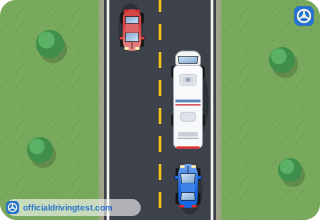
- Driving with all of the windows open
- Staying close to the vehicle ahead of you
- Driving faster than the traffic around you
- Using your mirrors and signals properly
Show answer
Correct answer: Using your mirrors and signals properly
RVs have many blind spots, and proper use of mirrors and signals helps prevent accidents.
Source: Tennessee Comprehensive Driver License Manual (March 2025 printing), page 115 · Open this page in the manual (Manual page 115)