Tennessee: Emergencies and crashes — Part 6 Practice Test
Questions in this part include: “When does the manual say to report a crash with an animal to the police?” · “Where should you practice emergency braking and steering with ABS?”
Independent educational site · not affiliated with any government agency or DMV
Ready? Test yourself
- Instant feedback with an explanation
- Every answer cites its source in the manual
- Your best score is saved on this device
- Keyboard: press 1 to 4 to answer and Enter for the next question
Questions are original and based on the official manual "Tennessee Comprehensive Driver License Manual" (March 2025 printing), Tennessee Department of Safety and Homeland Security.
All 19 questions in this practice test
Take the test above first, then use this list to study. Tap “Show answer” to see the correct answer and explanation.
Show the questions and answersHide the questions
-
In which areas should you be especially watchful for deer?
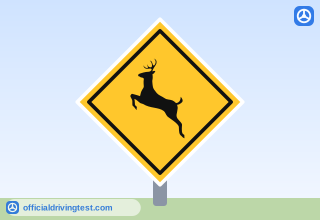
- Open, treeless fields
- Downtown business districts
- Areas near woods and water
- Busy shopping center parking lots
Show answer
Correct answer: Areas near woods and water
Deer are especially likely near woods and water.
Source: Tennessee Comprehensive Driver License Manual (March 2025 printing), page 97 · Open this page in the manual (Manual page 97)
-
If you see one deer near the road, what should you keep in mind?
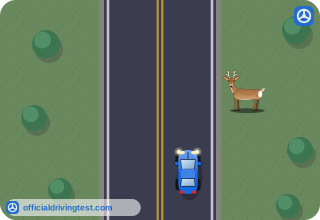
- There may be several others nearby
- It is probably alone, since deer travel singly
- The danger has passed once it crosses
- More will appear only in winter
Show answer
Correct answer: There may be several others nearby
Where there is one deer there may be several others close by.
Source: Tennessee Comprehensive Driver License Manual (March 2025 printing), page 97 · Open this page in the manual (Manual page 97)
-
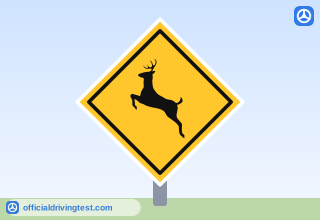
At what times should you be particularly alert for deer that venture out to feed?
- At noon
- In mid-afternoon
- Only after midnight
- At dusk and dawn
Show answer
Correct answer: At dusk and dawn
Deer venture out to feed at dusk and dawn, so be especially alert then.
Source: Tennessee Comprehensive Driver License Manual (March 2025 printing), page 97 · Open this page in the manual (Manual page 97)
-
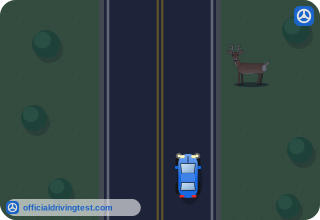
What can you watch for along the sides of the road to spot deer at night?
- Their tracks on the pavement
- The reflection of your headlights in their eyes
- Tall roadside grass moving in the wind
- Shadows of trees falling across your lane
Show answer
Correct answer: The reflection of your headlights in their eyes
Scanning the road sides for headlight reflection in deer eyes helps you see them.
Source: Tennessee Comprehensive Driver License Manual (March 2025 printing), page 97 · Open this page in the manual (Manual page 97)
-
If you see an animal on or near the roadway and think you have time to avoid hitting it, what does the manual say to do?
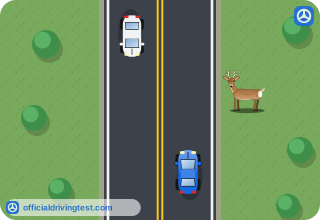
- Reduce speed, tap your brakes to warn other drivers, and sound your horn
- Hold your speed and steer around the animal on the road shoulder
- Stop in your lane and turn off your headlights
- Speed up to pass before it moves onto the road
Show answer
Correct answer: Reduce speed, tap your brakes to warn other drivers, and sound your horn
Slow down, tap your brakes to warn other drivers, and sound your horn.
Source: Tennessee Comprehensive Driver License Manual (March 2025 printing), page 97 · Open this page in the manual (Manual page 97)
-
According to the manual, what may happen if you flash your headlights at a deer?
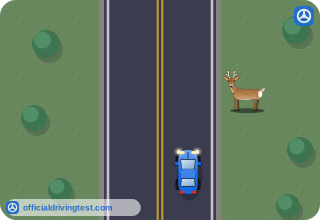
- The animal will quickly leave the road
- The animal will run toward your vehicle
- The animal may freeze in the road
- The animal will be able to see the road edges
Show answer
Correct answer: The animal may freeze in the road
Deer tend to fixate on headlights, so flashing them may make the animal freeze.
Source: Tennessee Comprehensive Driver License Manual (March 2025 printing), page 97 · Open this page in the manual (Manual page 97)
-
If no vehicle is close behind you and an animal is in the road, how should you brake?
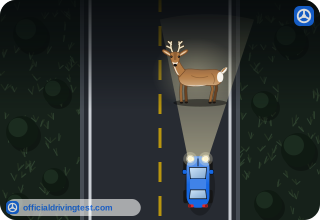
- Brake lightly so you do not startle the animal or other drivers
- Brake hard, but do not lock the wheels and cause a skid
- Tap the brakes only and never brake hard
- Do not brake; steer around the animal
Show answer
Correct answer: Brake hard, but do not lock the wheels and cause a skid
With no vehicle close behind, brake hard but avoid locking the wheels.
Source: Tennessee Comprehensive Driver License Manual (March 2025 printing), page 97 · Open this page in the manual (Manual page 97)
-
If a collision with an animal seems inevitable, what should you do?
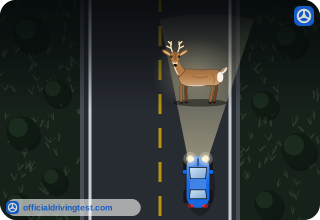
- Swerve sharply to avoid the animal
- Swerve into the opposite lane to avoid hitting the animal
- Leave the roadway to avoid hitting it
- Do not swerve; keep the vehicle under control and on the roadway
Show answer
Correct answer: Do not swerve; keep the vehicle under control and on the roadway
Swerving can raise your risk of injury, so stay in control and on the roadway.
Source: Tennessee Comprehensive Driver License Manual (March 2025 printing), page 97 · Open this page in the manual (Manual page 97)
-
When does the manual say to report a crash with an animal to the police?
- Only when it involves a small animal such as a rabbit
- Only if your vehicle cannot be driven afterward
- When it involves a large animal such as a deer or farm animal
- Never; animal crashes are not reported
Show answer
Correct answer: When it involves a large animal such as a deer or farm animal
A crash with a large animal such as a deer or farm animal should be reported to the police.
Source: Tennessee Comprehensive Driver License Manual (March 2025 printing), page 97 · Open this page in the manual (Manual page 97)
-
If you hit a domestic pet and homes are nearby, what should you try to do?
- Notify the pet’s owner if possible
- Move the animal into the nearest yard
- Drive on and tell only the police
- Leave a note at every nearby home
Show answer
Correct answer: Notify the pet’s owner if possible
The manual says to try to notify the pet’s owner if possible.
Source: Tennessee Comprehensive Driver License Manual (March 2025 printing), page 97 · Open this page in the manual (Manual page 97)
-
Which two habits does the manual recommend in its tips on avoiding collisions with animals?
- Always keep your high beams on and your windows open
- Always drive ten miles per hour under the limit
- Always stop and wait whenever you see an animal
- Always obey the speed limit and wear your safety belt
Show answer
Correct answer: Always obey the speed limit and wear your safety belt
The manual's animal-collision tips include always obeying the speed limit and wearing your safety belt.
Source: Tennessee Comprehensive Driver License Manual (March 2025 printing), page 97 · Open this page in the manual (Manual page 97)
-
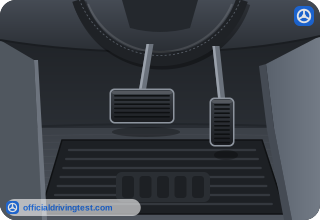
Why should you never pump the brake pedal of a vehicle equipped with ABS, even if the pedal is pulsating?
- The pulsating means the ABS has failed and needs to be reset
- The pulsating is the ABS pumping the brakes much faster than you could
- Pumping would make the pedal go to the floor
- Pumping is needed only on wet roads
Show answer
Correct answer: The pulsating is the ABS pumping the brakes much faster than you could
The pedal pulsation is the ABS pumping the brakes far faster than any driver could by hand.
Source: Tennessee Comprehensive Driver License Manual (March 2025 printing), page 97 · Open this page in the manual (Manual page 97)
-
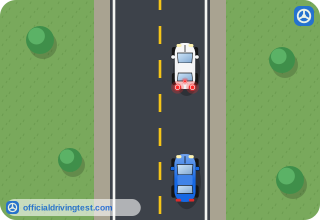
After slamming on ABS brakes because of an obstacle, what should you do?
- Steer around the obstacle, then continue to a safe place
- Hold the wheel straight until the vehicle stops
- Release the pedal to regain steering
- Pump the pedal while you steer
Show answer
Correct answer: Steer around the obstacle, then continue to a safe place
ABS keeps the wheels from skidding so you can steer around the obstacle and on to a safe place.
Source: Tennessee Comprehensive Driver License Manual (March 2025 printing), page 98 · Open this page in the manual (Manual page 98)
-
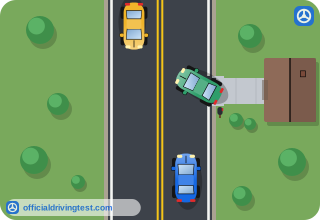
Why should you not jerk the steering wheel suddenly in an emergency?
- It can cause the ABS to switch off and the brakes to fail
- It can lock the steering column
- It can make you hit another object or leave the road and roll over
- It can flatten a front tire
Show answer
Correct answer: It can make you hit another object or leave the road and roll over
Jerking the wheel can cause a collision with another object or a rollover off the road.
Source: Tennessee Comprehensive Driver License Manual (March 2025 printing), page 98 · Open this page in the manual (Manual page 98)
-
When practicing ABS braking in an empty lot, at about what speed should you start?
- About 10 M.P.H.
- About 20 M.P.H.
- About 35 M.P.H.
- About 50 M.P.H.
Show answer
Correct answer: About 20 M.P.H.
The manual says to start at about 20 M.P.H., slam on the brakes and steer.
Source: Tennessee Comprehensive Driver License Manual (March 2025 printing), page 98 · Open this page in the manual (Manual page 98)
-
Where should you practice emergency braking and steering with ABS?
- On a quiet residential street
- On a country road with no traffic
- In a crowded lot with parked cars and light poles to steer around
- In a wide open vacant lot without curbs or many light poles
Show answer
Correct answer: In a wide open vacant lot without curbs or many light poles
A big, empty, wide open lot with no curbs or lots of light poles is the place to practice.
Source: Tennessee Comprehensive Driver License Manual (March 2025 printing), page 98 · Open this page in the manual (Manual page 98)
-
Under which weather conditions should you practice ABS braking and steering?
- Only on dry pavement
- Only in light rain
- In various conditions, such as dry, rain and snow
- Only in daylight on dry pavement with clear skies
Show answer
Correct answer: In various conditions, such as dry, rain and snow
The manual advises practicing in various weather conditions, such as dry, rain and snow.
Source: Tennessee Comprehensive Driver License Manual (March 2025 printing), page 98 · Open this page in the manual (Manual page 98)
-
Where does the manual say to look for additional driving instructions about your vehicle’s anti-lock brake system?
- In the owner’s manual
- On the tire sidewall
- On the driver’s door jamb sticker
- At a Driver Service Center
Show answer
Correct answer: In the owner’s manual
The owner’s manual has the instructions for the specific ABS in your vehicle.
Source: Tennessee Comprehensive Driver License Manual (March 2025 printing), page 98 · Open this page in the manual (Manual page 98)
-
How should you drive a vehicle with ABS compared with a vehicle without ABS?
- Faster around curves
- With more abrupt lane changes
- Closer to the vehicle ahead
- No more aggressively
Show answer
Correct answer: No more aggressively
The manual says never to drive an ABS vehicle more aggressively than one without ABS.
Source: Tennessee Comprehensive Driver License Manual (March 2025 printing), page 98 · Open this page in the manual (Manual page 98)