Tennessee: Emergencies and crashes — Part 2 Practice Test
Questions in this part include: “A driver who knowingly ignores clearly visible flood warning signs or barricades and drives into a flooded area can be charged with what?”
Independent educational site · not affiliated with any government agency or DMV
Ready? Test yourself
- Instant feedback with an explanation
- Every answer cites its source in the manual
- Your best score is saved on this device
- Keyboard: press 1 to 4 to answer and Enter for the next question
Questions are original and based on the official manual "Tennessee Comprehensive Driver License Manual" (March 2025 printing), Tennessee Department of Safety and Homeland Security.
All 19 questions in this practice test
Take the test above first, then use this list to study. Tap “Show answer” to see the correct answer and explanation.
Show the questions and answersHide the questions
-
What should you do if your vehicle starts to hydroplane?
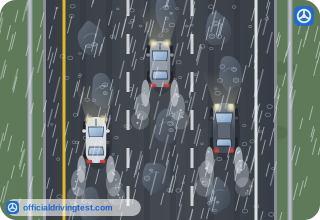
- Slam on the brakes to regain traction
- Slow down gradually by letting up on the gas
- Steer sharply toward the road edge
- Speed up to push through the water
Show answer
Correct answer: Slow down gradually by letting up on the gas
Letting up on the gas slows the car gradually; don't slam on the brakes, because hydroplaning takes away the traction needed to steer and brake safely.
Source: Tennessee Comprehensive Driver License Manual (March 2025 printing), page 76 · Open this page in the manual (Manual page 76)
-
When hydroplaning occurs, how far may stopping distances increase?
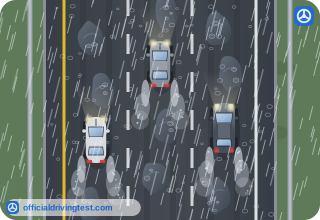
- Doubled
- Cut in half
- Unchanged
- Tripled
Show answer
Correct answer: Tripled
The manual says stopping distances may be tripled and steering control may be reduced or lost.
Source: Tennessee Comprehensive Driver License Manual (March 2025 printing), page 76 · Open this page in the manual (Manual page 76)
-
At what speeds can tires hydroplane under certain conditions?
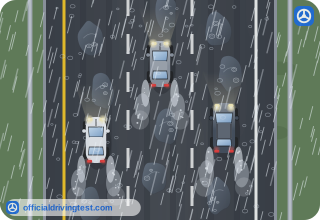
- At any speed
- Only above 55 mph
- Only above 35 mph
- Only below 25 mph
Show answer
Correct answer: At any speed
Hydroplaning is more common at higher speeds, but the manual says it can happen at any speed.
Source: Tennessee Comprehensive Driver License Manual (March 2025 printing), page 76 · Open this page in the manual (Manual page 76)
-
According to the manual, skids are caused by drivers who are:
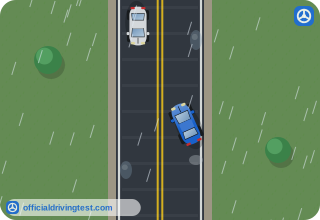
- Driving with worn wiper blades
- Using low beam headlights
- Traveling too fast for conditions
- Driving on dry pavement
Show answer
Correct answer: Traveling too fast for conditions
Skids happen when tires can no longer grip, and the manual blames traveling too fast for conditions.
Source: Tennessee Comprehensive Driver License Manual (March 2025 printing), page 76 · Open this page in the manual (Manual page 76)
-
If your vehicle begins to skid, what should you do about the brake?
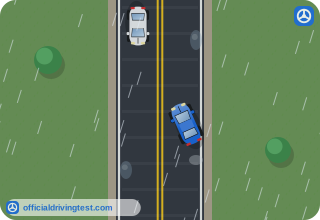
- Brake hard until the car stops
- Apply the parking brake firmly
- Shift into reverse
- Stay off the brake
Show answer
Correct answer: Stay off the brake
Until the vehicle slows, braking will not work and could make the skid worse.
Source: Tennessee Comprehensive Driver License Manual (March 2025 printing), page 76 · Open this page in the manual (Manual page 76)
-
If your vehicle begins to skid, which way should you steer?
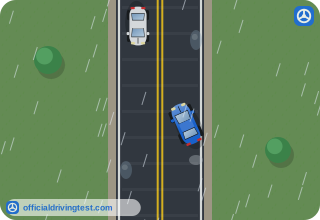
- In the direction you want your car to go
- Away from where you want the car to go
- Straight ahead, keeping the wheel still
- Toward the nearest edge of the road
Show answer
Correct answer: In the direction you want your car to go
Turning the wheel toward where you want the car to go brings the front back in line with the direction of motion.
Source: Tennessee Comprehensive Driver License Manual (March 2025 printing), page 76 · Open this page in the manual (Manual page 76)
-
As soon as a skidding vehicle begins to straighten out, what should you do with the steering wheel?
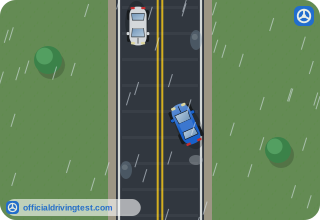
- Hold it still
- Turn it farther in the same direction
- Turn it back the other way
- Let go of it
Show answer
Correct answer: Turn it back the other way
If you do not turn back the other way, the vehicle may swing around and start a new skid.
Source: Tennessee Comprehensive Driver License Manual (March 2025 printing), page 76 · Open this page in the manual (Manual page 76)
-
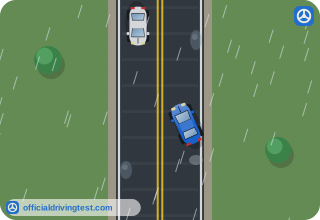
What is the manual's best advice about skids?
- Learn to recover quickly by braking hard each time
- Avoid skidding in the first place by slowing early
- Drive only on roads that are completely dry
- Steer with one hand for faster corrections
Show answer
Correct answer: Avoid skidding in the first place by slowing early
The best protection is to be aware of weather conditions and slow down well before your stopping point.
Source: Tennessee Comprehensive Driver License Manual (March 2025 printing), page 76 · Open this page in the manual (Manual page 76)
-
When your wheels have gotten off the paved roadway, what should you do first?
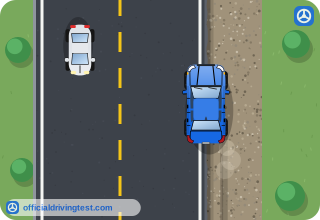
- Lift your foot off the gas pedal
- Brake hard immediately
- Jerk the steering wheel back toward the pavement
- Accelerate to pull back onto the road
Show answer
Correct answer: Lift your foot off the gas pedal
You stop feeding the gas but do not suddenly apply the brake.
Source: Tennessee Comprehensive Driver License Manual (March 2025 printing), page 76 · Open this page in the manual (Manual page 76)
-
When your wheels are off the pavement, how should you hold the steering wheel?
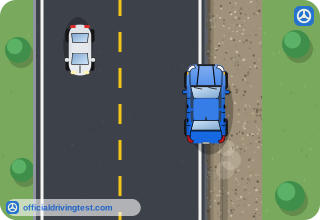
- Loosen your grip so the vehicle can straighten itself out
- Turn it sharply toward the pavement right away
- Keep a firm grip and do not jerk it back toward the pavement
- Let the car drift while you check your mirrors
Show answer
Correct answer: Keep a firm grip and do not jerk it back toward the pavement
A firm grip keeps control, while jerking the wheel back toward the pavement could cause a loss of control.
Source: Tennessee Comprehensive Driver License Manual (March 2025 printing), page 76 · Open this page in the manual (Manual page 76)
-
When your wheels are off the pavement, how should you brake?
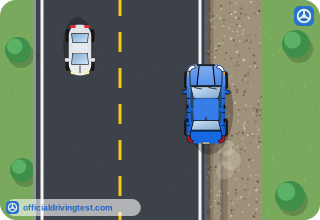
- Hard and continuously
- Lightly and briefly
- By holding the pedal down
- Not at all
Show answer
Correct answer: Lightly and briefly
Slamming the brakes or holding the pedal down risks losing control; brake lightly and briefly to slow gradually.
Source: Tennessee Comprehensive Driver License Manual (March 2025 printing), page 76 · Open this page in the manual (Manual page 76)
-
When may you turn back onto the pavement after your wheels leave it?
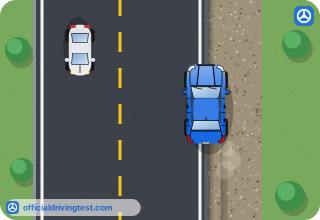
- Right away, before you lose any speed
- Only after the vehicle has stopped completely
- As soon as you can see the road behind you
- Once oncoming traffic is clear and you have slowed
Show answer
Correct answer: Once oncoming traffic is clear and you have slowed
You wait until no cars are close by, traffic is clear and your speed is down before steering back.
Source: Tennessee Comprehensive Driver License Manual (March 2025 printing), page 76 · Open this page in the manual (Manual page 76)
-
Most cars can be swept away by moving water of about what depth?
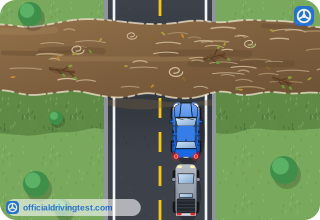
- 18 to 24 inches
- 3 to 6 inches
- 36 to 48 inches
- 60 to 72 inches
Show answer
Correct answer: 18 to 24 inches
The manual says most cars can be swept away in 18 to 24 inches of moving water.
Source: Tennessee Comprehensive Driver License Manual (March 2025 printing), page 76 · Open this page in the manual (Manual page 76)
-
Compared with cars, how much additional clearance do trucks and SUVs have against moving flood water?
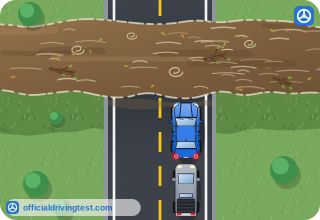
- Two to three feet more
- Only six to twelve inches more
- Three to four feet more
- Eighteen to twenty-four inches more
Show answer
Correct answer: Only six to twelve inches more
The manual says trucks and SUVs are not much better, with only six to twelve inches of additional clearance.
Source: Tennessee Comprehensive Driver License Manual (March 2025 printing), page 76 · Open this page in the manual (Manual page 76)
-
Why can a heavy 3,000 to 5,000 pound vehicle float in flood water?
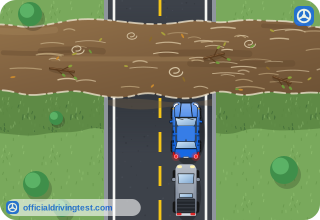
- Because of its tire pressure
- Because of its brake fluid
- Because of its fuel tank
- Because of buoyancy
Show answer
Correct answer: Because of buoyancy
Vehicles, like ships, float because of buoyancy, so weight does not make a car safe in a flood.
Source: Tennessee Comprehensive Driver License Manual (March 2025 printing), page 76 · Open this page in the manual (Manual page 76)
-
Once a vehicle is swept downstream, how much time does the driver have to escape?
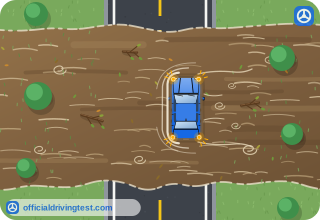
- Only a few seconds
- About one minute
- About five minutes
- About ten minutes
Show answer
Correct answer: Only a few seconds
A swept-away vehicle often rolls or flips, leaving the driver only a few seconds.
Source: Tennessee Comprehensive Driver License Manual (March 2025 printing), page 76 · Open this page in the manual (Manual page 76)
-
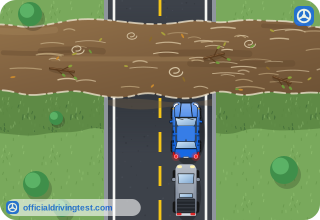
What does the manual say is the simple solution when you come to a flooded road?
- Drive through slowly in low gear
- Drive through quickly to avoid stalling
- Turn around and stay out of the flooded roadway
- Follow the vehicle ahead through the water
Show answer
Correct answer: Turn around and stay out of the flooded roadway
The slogan is to turn around, and not to enter a flooded roadway at all.
Source: Tennessee Comprehensive Driver License Manual (March 2025 printing), page 76 · Open this page in the manual (Manual page 76)
-
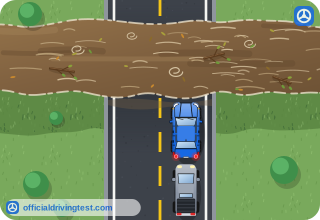
Why should you stay out of a flooded roadway?
- Splashed water will stall your engine within seconds
- Road signs are usually removed during floods
- Police will not allow vehicles near flooded areas
- The water may be deeper than it looks and the road washed out
Show answer
Correct answer: The water may be deeper than it looks and the road washed out
Flood water can hide road beds that have washed out, so it may be much deeper than it appears.
Source: Tennessee Comprehensive Driver License Manual (March 2025 printing), page 76 · Open this page in the manual (Manual page 76)
-
A driver who knowingly ignores clearly visible flood warning signs or barricades and drives into a flooded area can be charged with what?
- Reckless driving
- Careless parking
- Failure to yield
- Illegal turning
Show answer
Correct answer: Reckless driving
Tennessee can charge such a driver with reckless driving.
Source: Tennessee Comprehensive Driver License Manual (March 2025 printing), page 77 · Open this page in the manual (Manual page 77)