Tennessee: Emergencies and crashes — Part 5 Practice Test
Questions in this part include: “Without ABS, why does braking first help you turn more quickly?” · “Why is fall the peak season for deer-car crashes?”
Independent educational site · not affiliated with any government agency or DMV
Ready? Test yourself
- Instant feedback with an explanation
- Every answer cites its source in the manual
- Your best score is saved on this device
- Keyboard: press 1 to 4 to answer and Enter for the next question
Questions are original and based on the official manual "Tennessee Comprehensive Driver License Manual" (March 2025 printing), Tennessee Department of Safety and Homeland Security.
All 19 questions in this practice test
Take the test above first, then use this list to study. Tap “Show answer” to see the correct answer and explanation.
Show the questions and answersHide the questions
-
In an emergency on a slippery road, what happens with ABS?
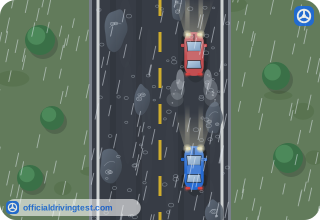
- The wheels lock, but the driver keeps full steering control
- The car skids but can still be steered
- The brakes release so the car rolls freely
- The wheels do not lock and the car can be steered around obstacles
Show answer
Correct answer: The wheels do not lock and the car can be steered around obstacles
With ABS the wheels do not lock, so the car stays stable and can be steered around obstacles.
Source: Tennessee Comprehensive Driver License Manual (March 2025 printing), page 96 · Open this page in the manual (Manual page 96)
-
In most cases, how does turning a vehicle compare with stopping it?
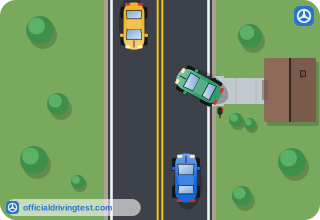
- You can stop it quicker than you can turn it
- You can turn it quicker than you can stop it
- Both take about the same time
- Turning is quicker only if the vehicle has ABS
Show answer
Correct answer: You can turn it quicker than you can stop it
The manual says that in most cases you can turn quicker than you can stop.
Source: Tennessee Comprehensive Driver License Manual (March 2025 printing), page 96 · Open this page in the manual (Manual page 96)
-
If you are unable to stop in time to avoid a collision, what should you try to do?
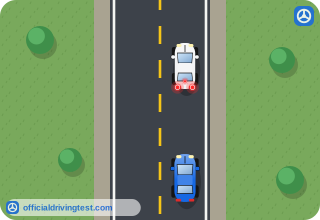
- Steer around the vehicle or object
- Hold the wheel straight and brake as hard as you can
- Sound the horn and wait for the other driver to move
- Close the gap so the impact is slower
Show answer
Correct answer: Steer around the vehicle or object
Evasive steering means steering around the vehicle or object when you cannot stop in time.
Source: Tennessee Comprehensive Driver License Manual (March 2025 printing), page 96 · Open this page in the manual (Manual page 96)
-
Where is it best to place your hands on the steering wheel to keep your wrists and forearms out of the main impact area of the air bag?
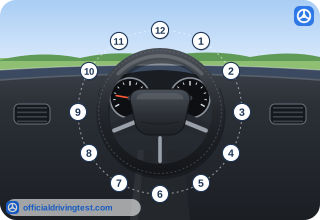
- About the 12 o’clock and 6 o’clock positions
- About the 1 o’clock and 7 o’clock positions
- About the 3 o’clock and 9 o’clock positions
- About the 11 o’clock and 5 o’clock positions
Show answer
Correct answer: About the 3 o’clock and 9 o’clock positions
Hands at about 3 and 9 o’clock give a good grip for quick turns and stay clear of the air bag.
Source: Tennessee Comprehensive Driver License Manual (March 2025 printing), page 96 · Open this page in the manual (Manual page 96)
-
What is the first step in making a quick evasive turn to the left?
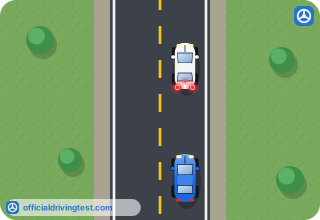
- Turn the wheel left only slightly to prevent a skid
- Turn the wheel left as far as necessary to avoid the obstacle
- Turn the wheel right first, then swing it left
- Let go of the wheel so the vehicle straightens itself
Show answer
Correct answer: Turn the wheel left as far as necessary to avoid the obstacle
You first turn the wheel left as far as needed to get around the obstacle or vehicle.
Source: Tennessee Comprehensive Driver License Manual (March 2025 printing), page 96 · Open this page in the manual (Manual page 96)
-
After you clear the hazard in a quick evasive turn to the left, what do you do next?
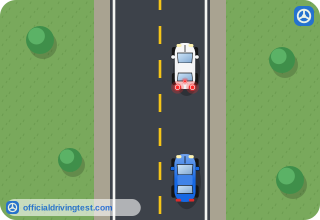
- Keep the wheel to the left until the vehicle stops on its own
- Brake hard to straighten the vehicle at once, then turn right
- Release the wheel and let the car drift back to the lane
- Turn the wheel back right as far as necessary to return to your lane
Show answer
Correct answer: Turn the wheel back right as far as necessary to return to your lane
Once past the hazard you steer back to the right as far as necessary to get into your lane again.
Source: Tennessee Comprehensive Driver License Manual (March 2025 printing), page 96 · Open this page in the manual (Manual page 96)
-
How do you make a quick evasive turn to the right?
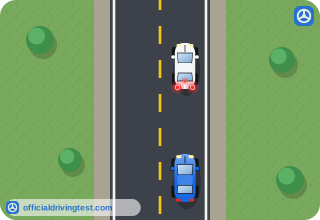
- Brake first, then turn the wheel only to the left
- Use a different method with one hand on the wheel
- Use the same steps as for the left, turning the wheel the opposite way
- Turn the wheel right once and hold it until the hazard passes
Show answer
Correct answer: Use the same steps as for the left, turning the wheel the opposite way
The right-hand turn uses the same procedure as the left, with the wheel turned the opposite way at each step.
Source: Tennessee Comprehensive Driver License Manual (March 2025 printing), page 96 · Open this page in the manual (Manual page 96)
-
After turning away from a road hazard, in which direction should you steer?
- In the direction you want the vehicle to go
- Toward the hazard you have just avoided
- Toward the nearest shoulder
- Toward the vehicle behind you
Show answer
Correct answer: In the direction you want the vehicle to go
Some drivers steer away from one collision and into another, so you steer where you want the vehicle to go.
Source: Tennessee Comprehensive Driver License Manual (March 2025 printing), page 97 · Open this page in the manual (Manual page 97)
-
What is one thing ABS lets you do that helps when you must swerve, stop or slow down quickly?
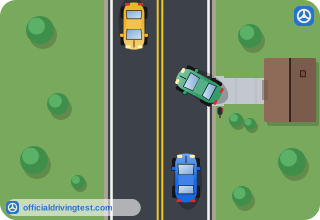
- Brake without pressing the pedal
- Turn only after releasing the brake pedal
- Steer without holding the wheel firmly
- Turn your vehicle while braking without skidding
Show answer
Correct answer: Turn your vehicle while braking without skidding
With ABS you can turn while braking without skidding.
Source: Tennessee Comprehensive Driver License Manual (March 2025 printing), page 97 · Open this page in the manual (Manual page 97)
-
Without ABS, why does braking first help you turn more quickly?
- It puts more weight on the front tires
- It puts more weight on the rear tires
- It locks the rear wheels so the car pivots
- It switches on the vehicle’s stability system
Show answer
Correct answer: It puts more weight on the front tires
Braking slows the vehicle and puts more weight on the front tires, which allows a quicker turn.
Source: Tennessee Comprehensive Driver License Manual (March 2025 printing), page 97 · Open this page in the manual (Manual page 97)
-
What does the manual say is generally better when you cannot avoid a crash?
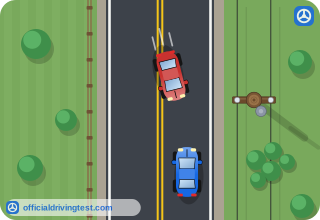
- To crash head-on than to leave the pavement
- To turn off the road than to crash head-on into another vehicle
- To keep braking in your lane than to turn off the road
- To speed up than to turn off the road
Show answer
Correct answer: To turn off the road than to crash head-on into another vehicle
Generally it is better to turn off the road than to hit another vehicle head-on.
Source: Tennessee Comprehensive Driver License Manual (March 2025 printing), page 97 · Open this page in the manual (Manual page 97)
-
When may it be best or necessary to speed up to avoid a collision?
- When the vehicle ahead stops suddenly and you have no room in front of your vehicle
- When a deer is standing beside the roadway
- When a traffic signal turns yellow as you approach
- When another vehicle is about to hit you from the side or behind and there is room ahead
Show answer
Correct answer: When another vehicle is about to hit you from the side or behind and there is room ahead
Speeding up can help when a vehicle is about to hit you from the side or from behind and there is room in front to get out of danger.
Source: Tennessee Comprehensive Driver License Manual (March 2025 printing), page 97 · Open this page in the manual (Manual page 97)
-
After you speed up to get out of danger, what should you do once the danger has passed?
- Keep the higher speed
- Stop in your lane
- Slow down
- Turn on your hazard flashers
Show answer
Correct answer: Slow down
The manual says to slow down once the danger has passed.
Source: Tennessee Comprehensive Driver License Manual (March 2025 printing), page 97 · Open this page in the manual (Manual page 97)
-
Which season is the peak season for deer-car crashes?
- Spring
- Summer
- Winter
- Fall
Show answer
Correct answer: Fall
Fall is the peak season because autumn is both mating and hunting season.
Source: Tennessee Comprehensive Driver License Manual (March 2025 printing), page 97 · Open this page in the manual (Manual page 97)
-
Why is fall the peak season for deer-car crashes?
- Deer move toward highways to find water in autumn
- It is mating and hunting season, so deer are more active and roam farther
- Shorter days make deer travel in larger herds across the roads
- Leaves on the road make deer harder to see
Show answer
Correct answer: It is mating and hunting season, so deer are more active and roam farther
In autumn deer are more active and more likely to roam beyond their normal territory.
Source: Tennessee Comprehensive Driver License Manual (March 2025 printing), page 97 · Open this page in the manual (Manual page 97)
-
Which animal collisions are generally the most dangerous and costly?
- Collisions with deer
- Collisions with dogs
- Collisions with rabbits
- Collisions with squirrels
Show answer
Correct answer: Collisions with deer
Collisions with deer are generally the most dangerous and costly crashes involving animals.
Source: Tennessee Comprehensive Driver License Manual (March 2025 printing), page 97 · Open this page in the manual (Manual page 97)
-
What does the manual say about keeping deer and other wild animals off highways?
- Roadside fences keep them off all highways
- Sounding the horn keeps them away for good
- No foolproof way has been found to do it
- Deer-crossing signs keep them away from the road
Show answer
Correct answer: No foolproof way has been found to do it
No foolproof way has been found to keep wild animals away from highways and vehicles.
Source: Tennessee Comprehensive Driver License Manual (March 2025 printing), page 97 · Open this page in the manual (Manual page 97)
-
To help avoid a collision with a deer, where should you look?
- Only at the road directly ahead of your hood
- Well down the road and far off to each side
- Mostly at the center line
- Mainly in your mirrors
Show answer
Correct answer: Well down the road and far off to each side
You should look well down the road and far off to each side to spot animals early.
Source: Tennessee Comprehensive Driver License Manual (March 2025 printing), page 97 · Open this page in the manual (Manual page 97)
-
At night, what can help you see deer near the edges of the road?
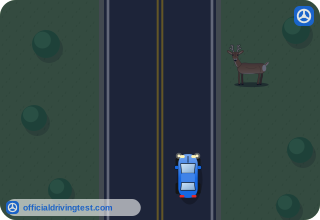
- Driving with only your parking lights on
- Using your fog lights by themselves
- Turning off your headlights briefly
- Using your high-beam lights if possible
Show answer
Correct answer: Using your high-beam lights if possible
High beams, when possible, light up the edges of the road at night.
Source: Tennessee Comprehensive Driver License Manual (March 2025 printing), page 97 · Open this page in the manual (Manual page 97)