Tennessee: Emergencies and crashes — Part 1 Practice Test
Questions in this part include: “Which of these does the manual say to do when you leave a disabled vehicle parked on a highway or street?” · “How should you treat the instructions of a HELP operator at an incident scene?”
Independent educational site · not affiliated with any government agency or DMV
Ready? Test yourself
- Instant feedback with an explanation
- Every answer cites its source in the manual
- Your best score is saved on this device
- Keyboard: press 1 to 4 to answer and Enter for the next question
Questions are original and based on the official manual "Tennessee Comprehensive Driver License Manual" (March 2025 printing), Tennessee Department of Safety and Homeland Security.
All 20 questions in this practice test
Take the test above first, then use this list to study. Tap “Show answer” to see the correct answer and explanation.
Show the questions and answersHide the questions
-
How do interstate reference markers help motorists who call emergency operators from mobile phones?
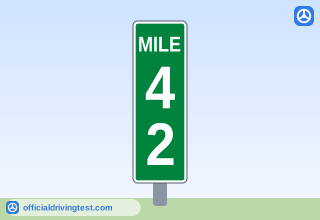
- They let callers give the exact location where help is needed
- They tell callers which emergency service will arrive first at the scene
- They allow callers to report the speed of traffic on that stretch of road
- They warn callers about earlier crashes that happened in the same area
Show answer
Correct answer: They let callers give the exact location where help is needed
Callers can describe the exact spot of an incident, so emergency personnel can respond faster and clear the highway sooner.
Source: Tennessee Comprehensive Driver License Manual (March 2025 printing), page 41 · Open this page in the manual (Manual page 41)
-
You must leave your disabled vehicle on a highway or street and cannot get all four wheels off the traveled portion. What should you do?
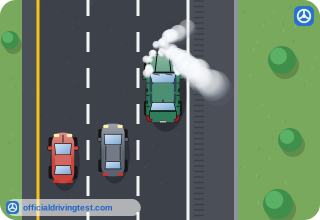
- Stop in the lane nearest the center line so you are visible
- Pull onto the shoulder as far away from traffic as possible
- Stop at the left edge of the road facing traffic
- Stop in the lane and turn on your headlights only
Show answer
Correct answer: Pull onto the shoulder as far away from traffic as possible
If all four wheels cannot be off the traveled portion, use the shoulder as far from traffic as possible.
Source: Tennessee Comprehensive Driver License Manual (March 2025 printing), page 66 · Open this page in the manual (Manual page 66)
-
Which of these does the manual say to do when you leave a disabled vehicle parked on a highway or street?
- Turn on the emergency flasher lights and lock the vehicle
- Turn off all lights and leave the engine running
- Leave the doors unlocked and the hood down
- Release the parking brake and leave the flashers off
Show answer
Correct answer: Turn on the emergency flasher lights and lock the vehicle
The manual says to turn on the emergency flashers, set the parking brake, shift into park or leave it in gear, turn off the engine and lock the vehicle.
Source: Tennessee Comprehensive Driver License Manual (March 2025 printing), page 66 · Open this page in the manual (Manual page 66)
-
If you have vehicle trouble on the interstate, where should you move as soon as you can?
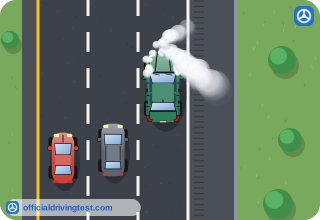
- The left shoulder beside the median
- The HOV lane, where traffic is lighter
- The right shoulder or an emergency stopping area
- The center of your lane, with flashers on
Show answer
Correct answer: The right shoulder or an emergency stopping area
With vehicle trouble, get to the right shoulder or an emergency stopping area as soon as you can.
Source: Tennessee Comprehensive Driver License Manual (March 2025 printing), page 72 · Open this page in the manual (Manual page 72)
-
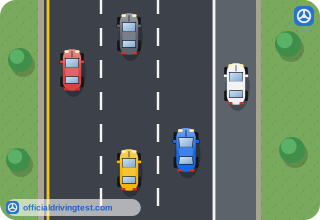
After pulling off the interstate with vehicle trouble, what should you turn on to warn other traffic?
- Your high beams
- Your emergency flashers
- Your left turn signal
- Your interior dome light
Show answer
Correct answer: Your emergency flashers
Turn on your emergency flashers so other traffic is warned about your stopped vehicle.
Source: Tennessee Comprehensive Driver License Manual (March 2025 printing), page 72 · Open this page in the manual (Manual page 72)
-
What does the manual say about walking along the interstate?
- It is dangerous
- It is safe on the paved shoulder
- It is the fastest way to get help
- It is safe in daylight
Show answer
Correct answer: It is dangerous
The manual warns that walking along the interstate is dangerous and says to keep children away from traffic.
Source: Tennessee Comprehensive Driver License Manual (March 2025 printing), page 72 · Open this page in the manual (Manual page 72)
-
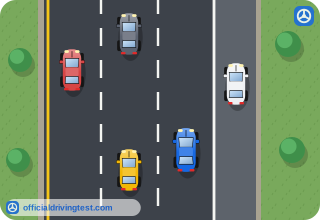
If you stay with your disabled vehicle on the interstate, who will stop to help you when they drive by, if they are not on another call?
- A Driver Service Center clerk
- A passing school bus driver
- A law enforcement officer
- A local postal carrier
Show answer
Correct answer: A law enforcement officer
A law enforcement officer who drives by will stop to help a driver who stays with the vehicle, unless the officer is on another call.
Source: Tennessee Comprehensive Driver License Manual (March 2025 printing), page 72 · Open this page in the manual (Manual page 72)
-
In which Tennessee metropolitan areas may you get help from a yellow TDOT Incident Response Unit (HELP Truck)?
- Memphis, Nashville, Jackson or Clarksville
- Knoxville, Bristol, Jackson or Franklin
- Chattanooga, Kingsport, Cookeville or Memphis
- Memphis, Nashville, Chattanooga or Knoxville
Show answer
Correct answer: Memphis, Nashville, Chattanooga or Knoxville
HELP Trucks of the Tennessee Department of Transportation assist drivers in the major metropolitan areas of Memphis, Nashville, Chattanooga and Knoxville.
Source: Tennessee Comprehensive Driver License Manual (March 2025 printing), page 72 · Open this page in the manual (Manual page 72)
-
What authority do TDOT HELP operators have at an incident scene?
- To write traffic tickets to any driver at the scene
- To suspend a driver's license at the crash scene
- To collect payment for a tow from the scene
- To remove any vehicle that obstructs or endangers traffic
Show answer
Correct answer: To remove any vehicle that obstructs or endangers traffic
HELP operators may remove, or have removed, any vehicle that is an obstruction or hazard to traffic.
Source: Tennessee Comprehensive Driver License Manual (March 2025 printing), page 73 · Open this page in the manual (Manual page 73)
-
How should you treat the instructions of a HELP operator at an incident scene?
- Follow them as you would those of police
- Treat them as advice you may ignore
- Follow them only if an officer is there
- Follow them only inside city limits
Show answer
Correct answer: Follow them as you would those of police
HELP operators are trained for incident scenes, so follow their instructions just as you would those of police or other traffic control personnel.
Source: Tennessee Comprehensive Driver License Manual (March 2025 printing), page 73 · Open this page in the manual (Manual page 73)
-
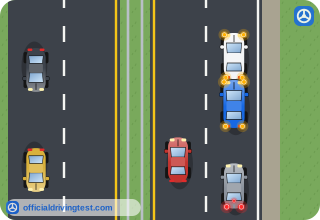
After a crash on the interstate, when does Tennessee law let you pull your vehicle to the emergency lane to wait for a trooper or police officer?
- Only after a police officer has arrived at the scene
- Only when the other driver agrees to move as well
- When it is drivable and no one is seriously hurt or killed
- Only when neither vehicle has any damage
Show answer
Correct answer: When it is drivable and no one is seriously hurt or killed
If the vehicle can still be driven and there are no serious injuries or deaths, you may move it to the emergency lane so it does not block traffic, then wait for the officer.
Source: Tennessee Comprehensive Driver License Manual (March 2025 printing), page 73 · Open this page in the manual (Manual page 73)
-
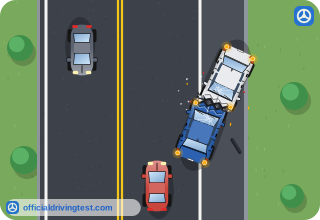
When a crash involves a fatality, what should you never do?
- Stay at the scene of the crash
- Disturb the crash scene in any way
- Call for police and medical help
- Wait for a trooper to arrive
Show answer
Correct answer: Disturb the crash scene in any way
Never disturb a crash scene in any manner when someone has been killed.
Source: Tennessee Comprehensive Driver License Manual (March 2025 printing), page 73 · Open this page in the manual (Manual page 73)
-
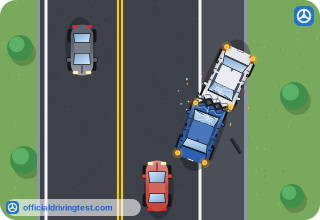
Under Tennessee law, what must you not do after any type of crash?
- Exchange information with the other driver
- Call a law enforcement officer
- Turn on your emergency flashers
- Leave the scene of the crash
Show answer
Correct answer: Leave the scene of the crash
Tennessee law says you must not leave the scene of any type of crash.
Source: Tennessee Comprehensive Driver License Manual (March 2025 printing), page 73 · Open this page in the manual (Manual page 73)
-
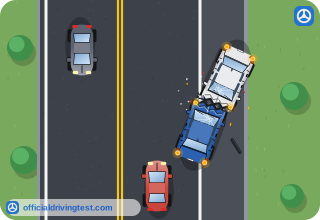
While you remain at the scene of a crash, what does Tennessee law say you should not do?
- Unnecessarily obstruct traffic
- Talk with a law enforcement officer
- Use your emergency flashers
- Write down the other driver's name
Show answer
Correct answer: Unnecessarily obstruct traffic
You must stay at the scene of a crash, but while there you should not unnecessarily obstruct traffic.
Source: Tennessee Comprehensive Driver License Manual (March 2025 printing), page 73 · Open this page in the manual (Manual page 73)
-
Which item does the manual suggest keeping in your car for night-time emergencies?
- A spare set of headlight bulbs
- A set of glow sticks
- Three fuses or reflectors
- A roll of reflective tape
Show answer
Correct answer: Three fuses or reflectors
The suggested safety and emergency equipment list includes three fuses or reflectors for night-time emergencies.
Source: Tennessee Comprehensive Driver License Manual (March 2025 printing), page 73 · Open this page in the manual (Manual page 73)
-
According to the manual's suggested equipment list, when is it especially important to carry water?
- During winter travel
- During night driving
- On trips through cities
- During the summer
Show answer
Correct answer: During the summer
The list suggests bottled water and simple snack foods, and notes that water is important to carry during the summer.
Source: Tennessee Comprehensive Driver License Manual (March 2025 printing), page 73 · Open this page in the manual (Manual page 73)
-
Which of these does the manual's suggested equipment list say to carry during winter travel?
- A snow shovel and a bag of sand
- A blanket and a window scraper
- A can of de-icer and a tow rope
- Extra antifreeze and a heat lamp
Show answer
Correct answer: A blanket and a window scraper
For winter travel the manual suggests a blanket, a small portable heater, a window scraper for iced windows, and snow tires or tire chains.
Source: Tennessee Comprehensive Driver License Manual (March 2025 printing), page 73 · Open this page in the manual (Manual page 73)
-
In fog, if you cannot see the road's edge, what should you do?

- Pull far to the right, out of the traffic lane, and use flashers
- Stop in the lane and flash your high beams to warn others
- Slow to a crawl in the left lane and follow the center line
- Keep driving in the middle of the road and sound your horn
Show answer
Correct answer: Pull far to the right, out of the traffic lane, and use flashers
You should get well out of the traffic lane to the right and turn on your emergency flashers.
Source: Tennessee Comprehensive Driver License Manual (March 2025 printing), page 75 · Open this page in the manual (Manual page 75)
-
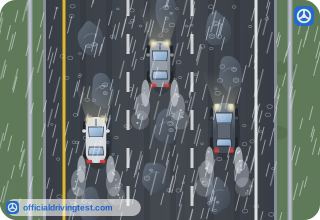
What happens when a vehicle hydroplanes?
- The engine stalls because water enters the intake
- The tires grip better because the road is wet
- The windshield fogs so you cannot see ahead
- Tires lose all contact with the roadway due to water
Show answer
Correct answer: Tires lose all contact with the roadway due to water
Hydroplaning is when heavy rain lifts your tires off the road surface.
Source: Tennessee Comprehensive Driver License Manual (March 2025 printing), page 76 · Open this page in the manual (Manual page 76)
-
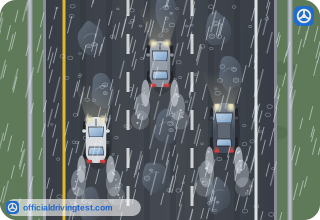
In heavy rain, what can cause your car to skid or spin?
- A slight change of direction or a gust of wind
- Turning on your windshield wipers and defroster
- Using your low beam headlights in the rain
- Letting up on the gas pedal gradually
Show answer
Correct answer: A slight change of direction or a gust of wind
With a lot of water on the road, even a small steering change or a gust of wind can start a skid or spin.
Source: Tennessee Comprehensive Driver License Manual (March 2025 printing), page 76 · Open this page in the manual (Manual page 76)