Tennessee: Emergencies and crashes
Avoiding collisions, ABS and skids, animals on the road, breakdowns, flooding and winter driving, and what to do after a crash. Split into 6 shorter tests so you're not stuck in one long quiz.
Independent educational site · not affiliated with any government agency or DMV
Choose a part
Emergencies and crashes — Part 1
Questions in this part include: “Which of these does the manual say to do when you leave a disabled vehicle parked on a highway or street?”
StartEmergencies and crashes — Part 2
Questions in this part include: “A driver who knowingly ignores clearly visible flood warning signs or barricades and drives into a flooded area can be charged with what?”
StartEmergencies and crashes — Part 3
Questions in this part include: “In threatening weather, where should you not camp or park your vehicle?”
StartEmergencies and crashes — Part 4
Questions in this part include: “Who must file an Owner/Driver Report for a reportable crash?”
StartEmergencies and crashes — Part 5
Questions in this part include: “Without ABS, why does braking first help you turn more quickly?”
StartEmergencies and crashes — Part 6
Questions in this part include: “When does the manual say to report a crash with an animal to the police?”
StartAll 115 Emergencies and crashes questions with answers
Choose a part above to take a practice test, or study every question and answer here.
Show the questions and answersHide the questions
-
How do interstate reference markers help motorists who call emergency operators from mobile phones?
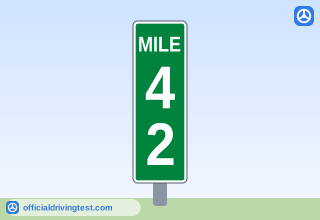
- They let callers give the exact location where help is needed
- They tell callers which emergency service will arrive first at the scene
- They allow callers to report the speed of traffic on that stretch of road
- They warn callers about earlier crashes that happened in the same area
Show answer
Correct answer: They let callers give the exact location where help is needed
Callers can describe the exact spot of an incident, so emergency personnel can respond faster and clear the highway sooner.
Source: Tennessee Comprehensive Driver License Manual (March 2025 printing), page 41 · Open this page in the manual (Manual page 41)
-
You must leave your disabled vehicle on a highway or street and cannot get all four wheels off the traveled portion. What should you do?
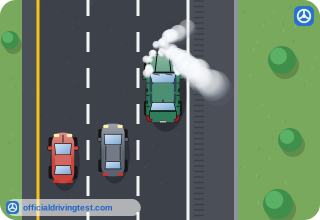
- Stop in the lane nearest the center line so you are visible
- Pull onto the shoulder as far away from traffic as possible
- Stop at the left edge of the road facing traffic
- Stop in the lane and turn on your headlights only
Show answer
Correct answer: Pull onto the shoulder as far away from traffic as possible
If all four wheels cannot be off the traveled portion, use the shoulder as far from traffic as possible.
Source: Tennessee Comprehensive Driver License Manual (March 2025 printing), page 66 · Open this page in the manual (Manual page 66)
-
Which of these does the manual say to do when you leave a disabled vehicle parked on a highway or street?
- Turn on the emergency flasher lights and lock the vehicle
- Turn off all lights and leave the engine running
- Leave the doors unlocked and the hood down
- Release the parking brake and leave the flashers off
Show answer
Correct answer: Turn on the emergency flasher lights and lock the vehicle
The manual says to turn on the emergency flashers, set the parking brake, shift into park or leave it in gear, turn off the engine and lock the vehicle.
Source: Tennessee Comprehensive Driver License Manual (March 2025 printing), page 66 · Open this page in the manual (Manual page 66)
-
If you have vehicle trouble on the interstate, where should you move as soon as you can?
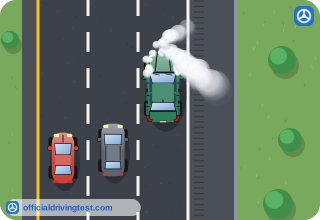
- The left shoulder beside the median
- The HOV lane, where traffic is lighter
- The right shoulder or an emergency stopping area
- The center of your lane, with flashers on
Show answer
Correct answer: The right shoulder or an emergency stopping area
With vehicle trouble, get to the right shoulder or an emergency stopping area as soon as you can.
Source: Tennessee Comprehensive Driver License Manual (March 2025 printing), page 72 · Open this page in the manual (Manual page 72)
-
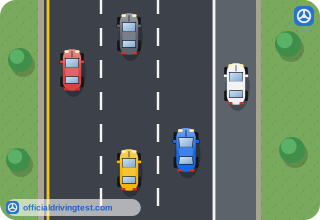
After pulling off the interstate with vehicle trouble, what should you turn on to warn other traffic?
- Your high beams
- Your emergency flashers
- Your left turn signal
- Your interior dome light
Show answer
Correct answer: Your emergency flashers
Turn on your emergency flashers so other traffic is warned about your stopped vehicle.
Source: Tennessee Comprehensive Driver License Manual (March 2025 printing), page 72 · Open this page in the manual (Manual page 72)
-
What does the manual say about walking along the interstate?
- It is dangerous
- It is safe on the paved shoulder
- It is the fastest way to get help
- It is safe in daylight
Show answer
Correct answer: It is dangerous
The manual warns that walking along the interstate is dangerous and says to keep children away from traffic.
Source: Tennessee Comprehensive Driver License Manual (March 2025 printing), page 72 · Open this page in the manual (Manual page 72)
-
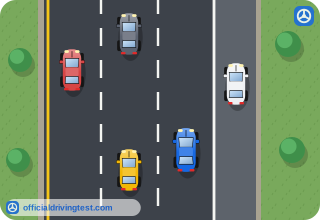
If you stay with your disabled vehicle on the interstate, who will stop to help you when they drive by, if they are not on another call?
- A Driver Service Center clerk
- A passing school bus driver
- A law enforcement officer
- A local postal carrier
Show answer
Correct answer: A law enforcement officer
A law enforcement officer who drives by will stop to help a driver who stays with the vehicle, unless the officer is on another call.
Source: Tennessee Comprehensive Driver License Manual (March 2025 printing), page 72 · Open this page in the manual (Manual page 72)
-
In which Tennessee metropolitan areas may you get help from a yellow TDOT Incident Response Unit (HELP Truck)?
- Memphis, Nashville, Jackson or Clarksville
- Knoxville, Bristol, Jackson or Franklin
- Chattanooga, Kingsport, Cookeville or Memphis
- Memphis, Nashville, Chattanooga or Knoxville
Show answer
Correct answer: Memphis, Nashville, Chattanooga or Knoxville
HELP Trucks of the Tennessee Department of Transportation assist drivers in the major metropolitan areas of Memphis, Nashville, Chattanooga and Knoxville.
Source: Tennessee Comprehensive Driver License Manual (March 2025 printing), page 72 · Open this page in the manual (Manual page 72)
-
What authority do TDOT HELP operators have at an incident scene?
- To write traffic tickets to any driver at the scene
- To suspend a driver's license at the crash scene
- To collect payment for a tow from the scene
- To remove any vehicle that obstructs or endangers traffic
Show answer
Correct answer: To remove any vehicle that obstructs or endangers traffic
HELP operators may remove, or have removed, any vehicle that is an obstruction or hazard to traffic.
Source: Tennessee Comprehensive Driver License Manual (March 2025 printing), page 73 · Open this page in the manual (Manual page 73)
-
How should you treat the instructions of a HELP operator at an incident scene?
- Follow them as you would those of police
- Treat them as advice you may ignore
- Follow them only if an officer is there
- Follow them only inside city limits
Show answer
Correct answer: Follow them as you would those of police
HELP operators are trained for incident scenes, so follow their instructions just as you would those of police or other traffic control personnel.
Source: Tennessee Comprehensive Driver License Manual (March 2025 printing), page 73 · Open this page in the manual (Manual page 73)
-
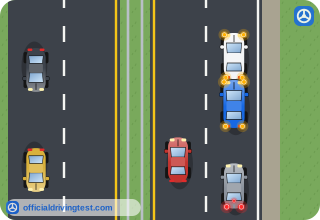
After a crash on the interstate, when does Tennessee law let you pull your vehicle to the emergency lane to wait for a trooper or police officer?
- Only after a police officer has arrived at the scene
- Only when the other driver agrees to move as well
- When it is drivable and no one is seriously hurt or killed
- Only when neither vehicle has any damage
Show answer
Correct answer: When it is drivable and no one is seriously hurt or killed
If the vehicle can still be driven and there are no serious injuries or deaths, you may move it to the emergency lane so it does not block traffic, then wait for the officer.
Source: Tennessee Comprehensive Driver License Manual (March 2025 printing), page 73 · Open this page in the manual (Manual page 73)
-
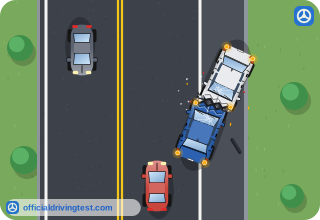
When a crash involves a fatality, what should you never do?
- Stay at the scene of the crash
- Disturb the crash scene in any way
- Call for police and medical help
- Wait for a trooper to arrive
Show answer
Correct answer: Disturb the crash scene in any way
Never disturb a crash scene in any manner when someone has been killed.
Source: Tennessee Comprehensive Driver License Manual (March 2025 printing), page 73 · Open this page in the manual (Manual page 73)
-
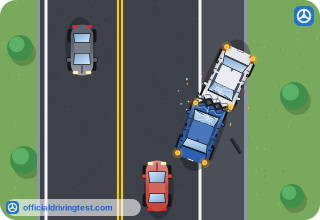
Under Tennessee law, what must you not do after any type of crash?
- Exchange information with the other driver
- Call a law enforcement officer
- Turn on your emergency flashers
- Leave the scene of the crash
Show answer
Correct answer: Leave the scene of the crash
Tennessee law says you must not leave the scene of any type of crash.
Source: Tennessee Comprehensive Driver License Manual (March 2025 printing), page 73 · Open this page in the manual (Manual page 73)
-
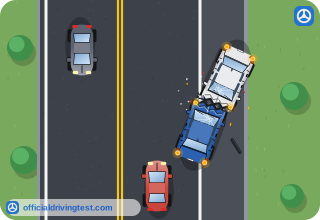
While you remain at the scene of a crash, what does Tennessee law say you should not do?
- Unnecessarily obstruct traffic
- Talk with a law enforcement officer
- Use your emergency flashers
- Write down the other driver's name
Show answer
Correct answer: Unnecessarily obstruct traffic
You must stay at the scene of a crash, but while there you should not unnecessarily obstruct traffic.
Source: Tennessee Comprehensive Driver License Manual (March 2025 printing), page 73 · Open this page in the manual (Manual page 73)
-
Which item does the manual suggest keeping in your car for night-time emergencies?
- A spare set of headlight bulbs
- A set of glow sticks
- Three fuses or reflectors
- A roll of reflective tape
Show answer
Correct answer: Three fuses or reflectors
The suggested safety and emergency equipment list includes three fuses or reflectors for night-time emergencies.
Source: Tennessee Comprehensive Driver License Manual (March 2025 printing), page 73 · Open this page in the manual (Manual page 73)
-
According to the manual's suggested equipment list, when is it especially important to carry water?
- During winter travel
- During night driving
- On trips through cities
- During the summer
Show answer
Correct answer: During the summer
The list suggests bottled water and simple snack foods, and notes that water is important to carry during the summer.
Source: Tennessee Comprehensive Driver License Manual (March 2025 printing), page 73 · Open this page in the manual (Manual page 73)
-
Which of these does the manual's suggested equipment list say to carry during winter travel?
- A snow shovel and a bag of sand
- A blanket and a window scraper
- A can of de-icer and a tow rope
- Extra antifreeze and a heat lamp
Show answer
Correct answer: A blanket and a window scraper
For winter travel the manual suggests a blanket, a small portable heater, a window scraper for iced windows, and snow tires or tire chains.
Source: Tennessee Comprehensive Driver License Manual (March 2025 printing), page 73 · Open this page in the manual (Manual page 73)
-
In fog, if you cannot see the road's edge, what should you do?

- Pull far to the right, out of the traffic lane, and use flashers
- Stop in the lane and flash your high beams to warn others
- Slow to a crawl in the left lane and follow the center line
- Keep driving in the middle of the road and sound your horn
Show answer
Correct answer: Pull far to the right, out of the traffic lane, and use flashers
You should get well out of the traffic lane to the right and turn on your emergency flashers.
Source: Tennessee Comprehensive Driver License Manual (March 2025 printing), page 75 · Open this page in the manual (Manual page 75)
-
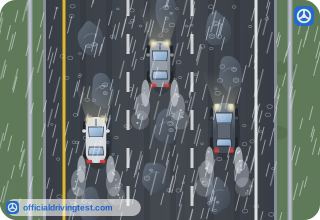
What happens when a vehicle hydroplanes?
- The engine stalls because water enters the intake
- The tires grip better because the road is wet
- The windshield fogs so you cannot see ahead
- Tires lose all contact with the roadway due to water
Show answer
Correct answer: Tires lose all contact with the roadway due to water
Hydroplaning is when heavy rain lifts your tires off the road surface.
Source: Tennessee Comprehensive Driver License Manual (March 2025 printing), page 76 · Open this page in the manual (Manual page 76)
-
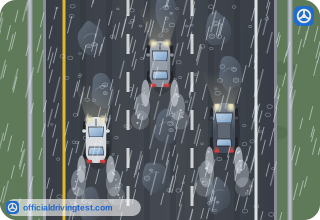
In heavy rain, what can cause your car to skid or spin?
- A slight change of direction or a gust of wind
- Turning on your windshield wipers and defroster
- Using your low beam headlights in the rain
- Letting up on the gas pedal gradually
Show answer
Correct answer: A slight change of direction or a gust of wind
With a lot of water on the road, even a small steering change or a gust of wind can start a skid or spin.
Source: Tennessee Comprehensive Driver License Manual (March 2025 printing), page 76 · Open this page in the manual (Manual page 76)
-
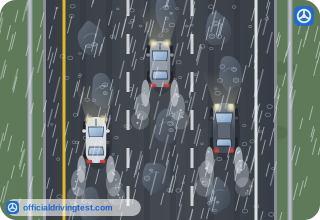
What should you do if your vehicle starts to hydroplane?
- Slam on the brakes to regain traction
- Slow down gradually by letting up on the gas
- Steer sharply toward the road edge
- Speed up to push through the water
Show answer
Correct answer: Slow down gradually by letting up on the gas
Letting up on the gas slows the car gradually; don't slam on the brakes, because hydroplaning takes away the traction needed to steer and brake safely.
Source: Tennessee Comprehensive Driver License Manual (March 2025 printing), page 76 · Open this page in the manual (Manual page 76)
-
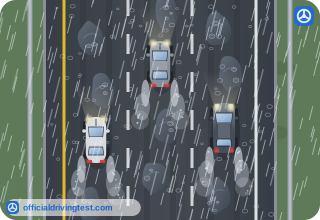
When hydroplaning occurs, how far may stopping distances increase?
- Doubled
- Cut in half
- Unchanged
- Tripled
Show answer
Correct answer: Tripled
The manual says stopping distances may be tripled and steering control may be reduced or lost.
Source: Tennessee Comprehensive Driver License Manual (March 2025 printing), page 76 · Open this page in the manual (Manual page 76)
-
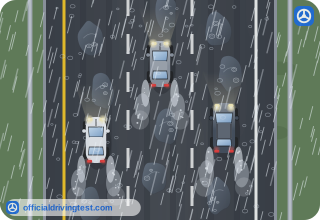
At what speeds can tires hydroplane under certain conditions?
- At any speed
- Only above 55 mph
- Only above 35 mph
- Only below 25 mph
Show answer
Correct answer: At any speed
Hydroplaning is more common at higher speeds, but the manual says it can happen at any speed.
Source: Tennessee Comprehensive Driver License Manual (March 2025 printing), page 76 · Open this page in the manual (Manual page 76)
-
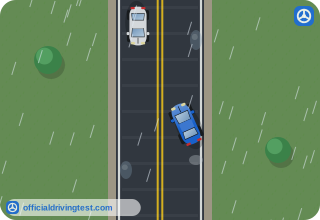
According to the manual, skids are caused by drivers who are:
- Driving with worn wiper blades
- Using low beam headlights
- Traveling too fast for conditions
- Driving on dry pavement
Show answer
Correct answer: Traveling too fast for conditions
Skids happen when tires can no longer grip, and the manual blames traveling too fast for conditions.
Source: Tennessee Comprehensive Driver License Manual (March 2025 printing), page 76 · Open this page in the manual (Manual page 76)
-
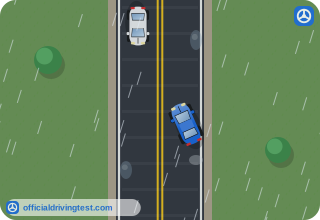
If your vehicle begins to skid, what should you do about the brake?
- Brake hard until the car stops
- Apply the parking brake firmly
- Shift into reverse
- Stay off the brake
Show answer
Correct answer: Stay off the brake
Until the vehicle slows, braking will not work and could make the skid worse.
Source: Tennessee Comprehensive Driver License Manual (March 2025 printing), page 76 · Open this page in the manual (Manual page 76)
-
If your vehicle begins to skid, which way should you steer?
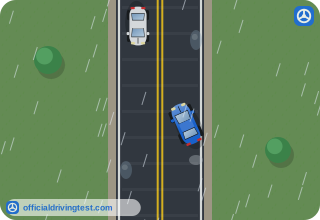
- In the direction you want your car to go
- Away from where you want the car to go
- Straight ahead, keeping the wheel still
- Toward the nearest edge of the road
Show answer
Correct answer: In the direction you want your car to go
Turning the wheel toward where you want the car to go brings the front back in line with the direction of motion.
Source: Tennessee Comprehensive Driver License Manual (March 2025 printing), page 76 · Open this page in the manual (Manual page 76)
-
As soon as a skidding vehicle begins to straighten out, what should you do with the steering wheel?
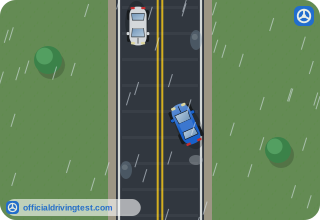
- Hold it still
- Turn it farther in the same direction
- Turn it back the other way
- Let go of it
Show answer
Correct answer: Turn it back the other way
If you do not turn back the other way, the vehicle may swing around and start a new skid.
Source: Tennessee Comprehensive Driver License Manual (March 2025 printing), page 76 · Open this page in the manual (Manual page 76)
-
What is the manual's best advice about skids?
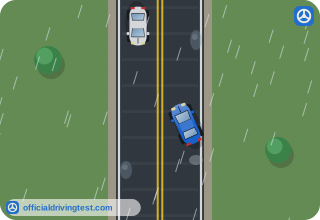
- Learn to recover quickly by braking hard each time
- Avoid skidding in the first place by slowing early
- Drive only on roads that are completely dry
- Steer with one hand for faster corrections
Show answer
Correct answer: Avoid skidding in the first place by slowing early
The best protection is to be aware of weather conditions and slow down well before your stopping point.
Source: Tennessee Comprehensive Driver License Manual (March 2025 printing), page 76 · Open this page in the manual (Manual page 76)
-
When your wheels have gotten off the paved roadway, what should you do first?
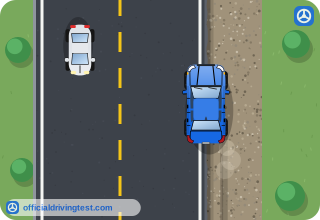
- Lift your foot off the gas pedal
- Brake hard immediately
- Jerk the steering wheel back toward the pavement
- Accelerate to pull back onto the road
Show answer
Correct answer: Lift your foot off the gas pedal
You stop feeding the gas but do not suddenly apply the brake.
Source: Tennessee Comprehensive Driver License Manual (March 2025 printing), page 76 · Open this page in the manual (Manual page 76)
-
When your wheels are off the pavement, how should you hold the steering wheel?
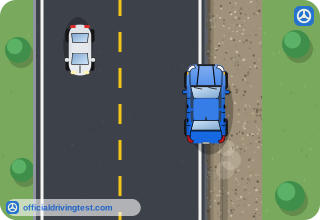
- Loosen your grip so the vehicle can straighten itself out
- Turn it sharply toward the pavement right away
- Keep a firm grip and do not jerk it back toward the pavement
- Let the car drift while you check your mirrors
Show answer
Correct answer: Keep a firm grip and do not jerk it back toward the pavement
A firm grip keeps control, while jerking the wheel back toward the pavement could cause a loss of control.
Source: Tennessee Comprehensive Driver License Manual (March 2025 printing), page 76 · Open this page in the manual (Manual page 76)
-
When your wheels are off the pavement, how should you brake?
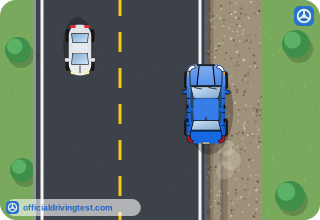
- Hard and continuously
- Lightly and briefly
- By holding the pedal down
- Not at all
Show answer
Correct answer: Lightly and briefly
Slamming the brakes or holding the pedal down risks losing control; brake lightly and briefly to slow gradually.
Source: Tennessee Comprehensive Driver License Manual (March 2025 printing), page 76 · Open this page in the manual (Manual page 76)
-
When may you turn back onto the pavement after your wheels leave it?
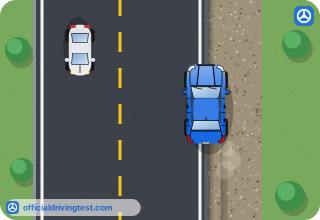
- Right away, before you lose any speed
- Only after the vehicle has stopped completely
- As soon as you can see the road behind you
- Once oncoming traffic is clear and you have slowed
Show answer
Correct answer: Once oncoming traffic is clear and you have slowed
You wait until no cars are close by, traffic is clear and your speed is down before steering back.
Source: Tennessee Comprehensive Driver License Manual (March 2025 printing), page 76 · Open this page in the manual (Manual page 76)
-
Most cars can be swept away by moving water of about what depth?
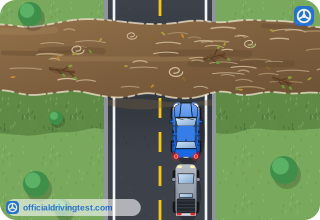
- 18 to 24 inches
- 3 to 6 inches
- 36 to 48 inches
- 60 to 72 inches
Show answer
Correct answer: 18 to 24 inches
The manual says most cars can be swept away in 18 to 24 inches of moving water.
Source: Tennessee Comprehensive Driver License Manual (March 2025 printing), page 76 · Open this page in the manual (Manual page 76)
-
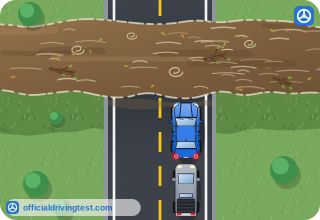
Compared with cars, how much additional clearance do trucks and SUVs have against moving flood water?
- Two to three feet more
- Only six to twelve inches more
- Three to four feet more
- Eighteen to twenty-four inches more
Show answer
Correct answer: Only six to twelve inches more
The manual says trucks and SUVs are not much better, with only six to twelve inches of additional clearance.
Source: Tennessee Comprehensive Driver License Manual (March 2025 printing), page 76 · Open this page in the manual (Manual page 76)
-
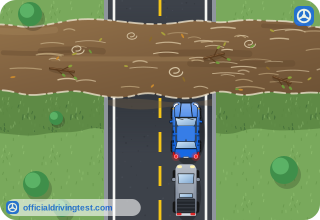
Why can a heavy 3,000 to 5,000 pound vehicle float in flood water?
- Because of its tire pressure
- Because of its brake fluid
- Because of its fuel tank
- Because of buoyancy
Show answer
Correct answer: Because of buoyancy
Vehicles, like ships, float because of buoyancy, so weight does not make a car safe in a flood.
Source: Tennessee Comprehensive Driver License Manual (March 2025 printing), page 76 · Open this page in the manual (Manual page 76)
-
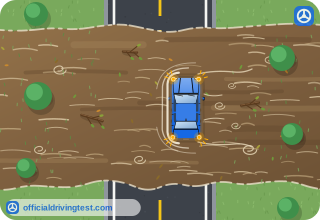
Once a vehicle is swept downstream, how much time does the driver have to escape?
- Only a few seconds
- About one minute
- About five minutes
- About ten minutes
Show answer
Correct answer: Only a few seconds
A swept-away vehicle often rolls or flips, leaving the driver only a few seconds.
Source: Tennessee Comprehensive Driver License Manual (March 2025 printing), page 76 · Open this page in the manual (Manual page 76)
-
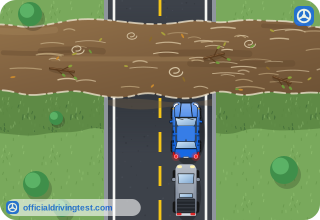
What does the manual say is the simple solution when you come to a flooded road?
- Drive through slowly in low gear
- Drive through quickly to avoid stalling
- Turn around and stay out of the flooded roadway
- Follow the vehicle ahead through the water
Show answer
Correct answer: Turn around and stay out of the flooded roadway
The slogan is to turn around, and not to enter a flooded roadway at all.
Source: Tennessee Comprehensive Driver License Manual (March 2025 printing), page 76 · Open this page in the manual (Manual page 76)
-
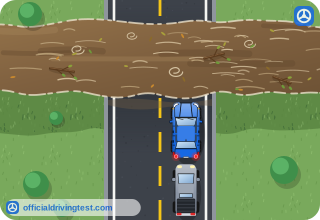
Why should you stay out of a flooded roadway?
- Splashed water will stall your engine within seconds
- Road signs are usually removed during floods
- Police will not allow vehicles near flooded areas
- The water may be deeper than it looks and the road washed out
Show answer
Correct answer: The water may be deeper than it looks and the road washed out
Flood water can hide road beds that have washed out, so it may be much deeper than it appears.
Source: Tennessee Comprehensive Driver License Manual (March 2025 printing), page 76 · Open this page in the manual (Manual page 76)
-
A driver who knowingly ignores clearly visible flood warning signs or barricades and drives into a flooded area can be charged with what?
- Reckless driving
- Careless parking
- Failure to yield
- Illegal turning
Show answer
Correct answer: Reckless driving
Tennessee can charge such a driver with reckless driving.
Source: Tennessee Comprehensive Driver License Manual (March 2025 printing), page 77 · Open this page in the manual (Manual page 77)
-
A driver who knowingly ignores clearly visible flood warning signs or barricades and drives into a flooded road can also be held responsible for what?
- Replacing the road signs
- Repairing the barricades
- Restitution for the cost of the rescue
- Paying the owner of the flooded property
Show answer
Correct answer: Restitution for the cost of the rescue
The driver may have to repay the cost of the rescue as well.
Source: Tennessee Comprehensive Driver License Manual (March 2025 printing), page 77 · Open this page in the manual (Manual page 77)
-
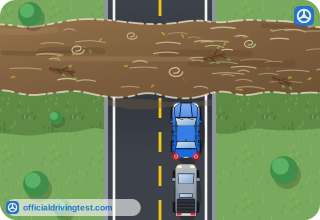
As little as how much water may cause you to lose control of your vehicle?
- Two to three feet
- Six to twelve inches
- Three to four feet
- Five to six feet
Show answer
Correct answer: Six to twelve inches
As little as six to twelve inches of water can make you lose control, and two feet will carry most cars downstream.
Source: Tennessee Comprehensive Driver License Manual (March 2025 printing), page 77 · Open this page in the manual (Manual page 77)
-
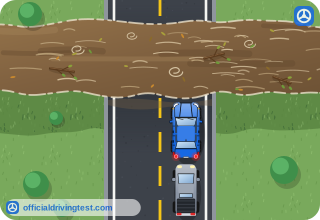
In your vehicle, where should you look out for flooding?
- Highway dips, low spots and around bridges
- Hilltops, ridges and long straight stretches
- Wide shoulders, rest areas and ramps
- Tunnels and divided highways only
Show answer
Correct answer: Highway dips, low spots and around bridges
Flooding collects in dips and low spots and near bridges.
Source: Tennessee Comprehensive Driver License Manual (March 2025 printing), page 77 · Open this page in the manual (Manual page 77)
-
In threatening weather, where should you not camp or park your vehicle?
- On hilltops
- Along streams
- In open fields
- Near tall buildings
Show answer
Correct answer: Along streams
Streams can rise quickly in threatening weather, so you should not camp or park beside them.
Source: Tennessee Comprehensive Driver License Manual (March 2025 printing), page 77 · Open this page in the manual (Manual page 77)
-
When is it harder to recognize flood dangers?
- At noon
- On dry days
- When driving slowly
- At night
Show answer
Correct answer: At night
At night flood dangers are harder to recognize, so extra caution is needed.
Source: Tennessee Comprehensive Driver License Manual (March 2025 printing), page 77 · Open this page in the manual (Manual page 77)
-
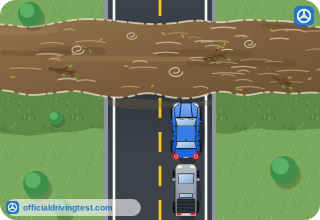
What does the manual say about attempting to cross a flowing stream in your vehicle?
- Cross it only in a truck or SUV
- Cross it only in low gear
- Do not attempt it
- Cross it only at night
Show answer
Correct answer: Do not attempt it
You should avoid flooded areas and areas with rapid water flow and never try to cross a flowing stream.
Source: Tennessee Comprehensive Driver License Manual (March 2025 printing), page 77 · Open this page in the manual (Manual page 77)
-
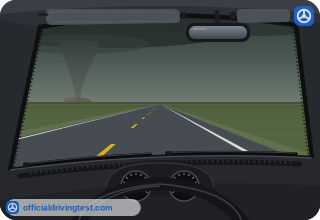
If you spot a tornado while driving, what should you do?
- Drive faster than the tornado to get out of its path
- Leave the car and lie face down in a ditch or low area
- Stay in the car and keep the safety belt fastened
- Park beside a large building and stay in the car
Show answer
Correct answer: Leave the car and lie face down in a ditch or low area
You should not try to outrun a tornado; get out, find a ditch or low-lying area and lie face down to protect yourself from debris.
Source: Tennessee Comprehensive Driver License Manual (March 2025 printing), page 77 · Open this page in the manual (Manual page 77)
-
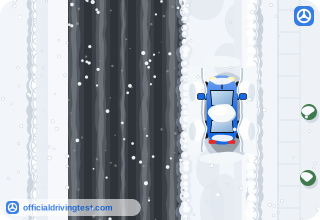
When your vehicle is stuck in mud or snow, what should you do first?
- Shift to high gear and turn the front wheels sharply
- Rev the engine hard to spin the wheels free
- Shift to low gear and keep the front wheels straight
- Put boards under the tires while they are spinning
Show answer
Correct answer: Shift to low gear and keep the front wheels straight
The first tip is low gear with the front wheels straight, then gently step on the gas.
Source: Tennessee Comprehensive Driver License Manual (March 2025 printing), page 77 · Open this page in the manual (Manual page 77)
-
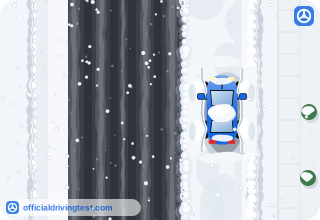
What should you repeat until a stuck car rolls free?
- Spinning the wheels
- Forward and backward rocking
- Turning the wheel left and right
- Setting and releasing the parking brake
Show answer
Correct answer: Forward and backward rocking
You rock the car by driving forward as far as possible, then backing up slowly, again and again.
Source: Tennessee Comprehensive Driver License Manual (March 2025 printing), page 77 · Open this page in the manual (Manual page 77)
-
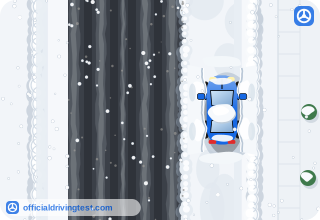
When should you never put boards or tree branches under the tires of a stuck vehicle?
- When the mud or snow is more than a few inches deep
- When the ground is frozen or covered with ice
- When another vehicle is waiting to help you
- When the tires are spinning or the vehicle is in gear
Show answer
Correct answer: When the tires are spinning or the vehicle is in gear
Boards go under the tires in deep mud or snow, but never while the tires are spinning or the vehicle is in gear.
Source: Tennessee Comprehensive Driver License Manual (March 2025 printing), page 77 · Open this page in the manual (Manual page 77)
-
Before installing tire chains, what should you do?
- Stop in the center lane to have more room
- Turn on your high beams so others can see you
- Drive as far to the right side of the roadway as possible
- Install them while the wheels are still spinning
Show answer
Correct answer: Drive as far to the right side of the roadway as possible
Chains should be put on from the right side of the roadway, away from traffic.
Source: Tennessee Comprehensive Driver License Manual (March 2025 printing), page 77 · Open this page in the manual (Manual page 77)
-
Tire chains should be put on the tires before driving in what?
- Snow only
- Snow or mud
- Ice only
- Wet leaves
Show answer
Correct answer: Snow or mud
The manual says to put them on before driving in snow OR mud, and carrying chains may keep you from getting stuck.
Source: Tennessee Comprehensive Driver License Manual (March 2025 printing), page 77 · Open this page in the manual (Manual page 77)
-
During a hailstorm or sleet, how does the manual say to find shelter?
- By parking beside a tall tree
- By stopping in an open field
- By driving faster to get out of it
- By driving under an overpass or bridge
Show answer
Correct answer: By driving under an overpass or bridge
The manual's tip for hailstorms and sleet is to find shelter under an overpass or bridge.
Source: Tennessee Comprehensive Driver License Manual (March 2025 printing), page 78 · Open this page in the manual (Manual page 78)
-
How does the manual define a crash?
- Only a collision between two moving vehicles on a road
- Any vehicle collision with a vehicle, person or object
- Only a collision that causes an injury to a person
- Only a collision causing more than $400 in damage
Show answer
Correct answer: Any vehicle collision with a vehicle, person or object
A crash is any vehicle collision involving another vehicle, person or object.
Source: Tennessee Comprehensive Driver License Manual (March 2025 printing), page 89 · Open this page in the manual (Manual page 89)
-
If a crash occurs within a municipality, whom must drivers immediately notify?
- The County Sheriff's office
- The Driver Improvement Section
- The county clerk
- The local police department
Show answer
Correct answer: The local police department
Within a municipality, drivers must immediately notify the local police department of a crash involving death, injury or property damage over $50.
Source: Tennessee Comprehensive Driver License Manual (March 2025 printing), page 89 · Open this page in the manual (Manual page 89)
-
If a crash occurs outside a municipality, whom must drivers immediately notify?
- The County Sheriff's office or the nearest Highway Patrol
- The local police department of the nearest city only
- The Department of Safety by mail
- The county clerk
Show answer
Correct answer: The County Sheriff's office or the nearest Highway Patrol
Outside a municipality, drivers notify the County Sheriff's office or the nearest Tennessee Highway Patrol.
Source: Tennessee Comprehensive Driver License Manual (March 2025 printing), page 89 · Open this page in the manual (Manual page 89)
-
If the driver is physically unable to give immediate notice of a crash, who shall give it?
- No one, until the driver recovers
- A passenger capable of doing so
- Only the owner of the other vehicle
- Only a passing driver
Show answer
Correct answer: A passenger capable of doing so
If a capable passenger is present, the passenger shall make or cause notice to be given.
Source: Tennessee Comprehensive Driver License Manual (March 2025 printing), page 89 · Open this page in the manual (Manual page 89)
-
A crash must be reported to the Department of Safety as a reportable crash if property damage to any one person, including oneself, exceeds how much?
- $50
- $100
- $1,000
- $400
Show answer
Correct answer: $400
Reportable crashes include any crash in which someone is killed or injured, or in which property damage to any one person exceeds $400.
Source: Tennessee Comprehensive Driver License Manual (March 2025 printing), page 89 · Open this page in the manual (Manual page 89)
-
Within how many days must the operator or owner file an Owner/Driver Report for a reportable crash?
- 20 days
- 5 days
- 10 days
- 30 days
Show answer
Correct answer: 20 days
The Owner/Driver Report must be filed with the Department within 20 days, regardless of who is to blame.
Source: Tennessee Comprehensive Driver License Manual (March 2025 printing), page 89 · Open this page in the manual (Manual page 89)
-
Who must file an Owner/Driver Report for a reportable crash?
- Only the driver who was at fault
- Only the owner of the vehicle damaged most
- The operator and/or owner, regardless of fault
- Only the police officer at the scene
Show answer
Correct answer: The operator and/or owner, regardless of fault
The operator and/or owner of a vehicle in a reportable crash must file the report regardless of fault.
Source: Tennessee Comprehensive Driver License Manual (March 2025 printing), page 89 · Open this page in the manual (Manual page 89)
-
If the crash involved an unattended vehicle or a domestic animal and you cannot locate the owner, what should you do?
- Leave a note and drive away
- Report the crash to the police
- Wait one week for the owner to call
- Report it only to your insurance company
Show answer
Correct answer: Report the crash to the police
You should report the crash to the police when you cannot find the owner of an unattended vehicle or a domestic animal.
Source: Tennessee Comprehensive Driver License Manual (March 2025 printing), page 89 · Open this page in the manual (Manual page 89)
-
If you are involved in a crash, what does the law require you to do first?
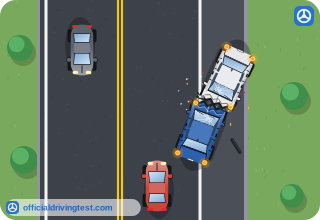
- Stop immediately at the scene or as close as possible
- Drive home first and call the police later on
- Drive away from the scene to look for a phone
- Wait for the other driver to leave the scene first
Show answer
Correct answer: Stop immediately at the scene or as close as possible
Drivers must stop immediately at the scene, or as close as possible without obstructing traffic.
Source: Tennessee Comprehensive Driver License Manual (March 2025 printing), page 89 · Open this page in the manual (Manual page 89)
-
After a crash, why should you turn off the ignition in the damaged vehicle?
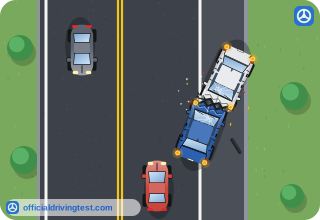
- To save the battery
- To reset the dashboard
- To prevent a fire
- To keep the doors locked
Show answer
Correct answer: To prevent a fire
Turning off the ignition in the damaged vehicle helps prevent a fire.
Source: Tennessee Comprehensive Driver License Manual (March 2025 printing), page 89 · Open this page in the manual (Manual page 89)
-
If a vehicle involved in a crash is on fire, what should you do?
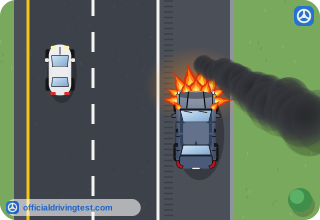
- Stay inside the vehicle until help arrives
- Help the people out and take them away from it
- Move the vehicle to the shoulder first and wait
- Wait nearby for the fire to go out by itself
Show answer
Correct answer: Help the people out and take them away from it
Helping people out and taking them away from the vehicle prevents further injury if there is an explosion.
Source: Tennessee Comprehensive Driver License Manual (March 2025 printing), page 89 · Open this page in the manual (Manual page 89)
-
Which crashes must be reported to the police?
- Those involving property damage, injury or death
- Only those that involve a death or a serious injury
- Only those involving two or more vehicles on the road
- Only those that happen on a state highway or interstate
Show answer
Correct answer: Those involving property damage, injury or death
Motor vehicle crashes involving property damage, personal injury or death must be reported to the police.
Source: Tennessee Comprehensive Driver License Manual (March 2025 printing), page 89 · Open this page in the manual (Manual page 89)
-
After a crash on the interstate, when does Tennessee law allow you to pull the vehicle to the emergency lane?
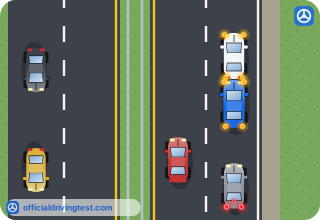
- Only when a police officer is already present
- Only when the other driver agrees
- When it is drivable and no one is seriously hurt
- Never; you must stay in the travel lane
Show answer
Correct answer: When it is drivable and no one is seriously hurt
If the vehicle is drivable and there are no serious personal injuries or deaths, you may move it to the emergency lane to await police.
Source: Tennessee Comprehensive Driver License Manual (March 2025 printing), page 89 · Open this page in the manual (Manual page 89)
-
After a crash, which information should you get from the people involved?
- The other driver's Social Security number
- The other driver's employer
- The other driver's insurance premium
- The name and address of each witness
Show answer
Correct answer: The name and address of each witness
The manual lists the name and address of each witness among the information to collect after a crash.
Source: Tennessee Comprehensive Driver License Manual (March 2025 printing), page 89 · Open this page in the manual (Manual page 89)
-
After a crash, which information should you get about the other vehicles?
- Their license plate numbers
- Their original purchase prices
- Their odometer readings
- Their tire brands and sizes
Show answer
Correct answer: Their license plate numbers
The manual lists the license plate numbers of other vehicles among the information to collect.
Source: Tennessee Comprehensive Driver License Manual (March 2025 printing), page 89 · Open this page in the manual (Manual page 89)
-
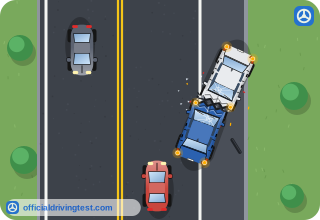
You arrive first at a crash scene. What does the manual say to do right away?
- Take photographs of the vehicles first
- Notify the police immediately
- Wait for the drivers to call their insurers
- Leave so you do not become a witness
Show answer
Correct answer: Notify the police immediately
If you are the first to arrive at a crash scene, notify the police immediately.
Source: Tennessee Comprehensive Driver License Manual (March 2025 printing), page 90 · Open this page in the manual (Manual page 90)
-
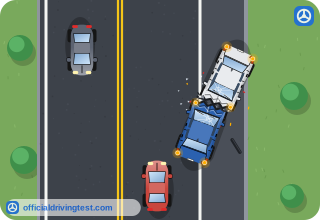
You come upon a crash scene and you are not professionally trained to render aid. What should you do?
- Stop nearby and watch until the police arrive
- Park on the shoulder and direct traffic yourself
- Slowly drive on so you do not get in the way
- Speed past the scene to clear the road quickly
Show answer
Correct answer: Slowly drive on so you do not get in the way
Without professional training, slowly continue on so you do not interfere with police, medical and rescue services; this also keeps you from a secondary collision.
Source: Tennessee Comprehensive Driver License Manual (March 2025 printing), page 90 · Open this page in the manual (Manual page 90)
-
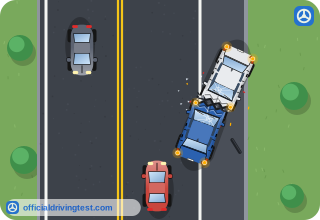
You witnessed a crash happen. What does the manual say to do?
- Keep driving and mail a written statement to the police later
- Stop in your lane and wait there until an officer arrives
- Call the drivers' insurance companies before calling police
- Pull safely off the road, turn on your flashers and tell the police
Show answer
Correct answer: Pull safely off the road, turn on your flashers and tell the police
A witness pulls safely off to the side of the road, turns on the emergency flashers and tells the police officer or State Trooper about witnessing the crash.
Source: Tennessee Comprehensive Driver License Manual (March 2025 printing), page 90 · Open this page in the manual (Manual page 90)
-
After you are involved in a crash, whom does the manual say you should also notify immediately?
- Your insurance company
- Your employer
- Your vehicle's maker
- Your county clerk
Show answer
Correct answer: Your insurance company
Besides exchanging information at the scene, you should notify your insurance company immediately.
Source: Tennessee Comprehensive Driver License Manual (March 2025 printing), page 90 · Open this page in the manual (Manual page 90)
-
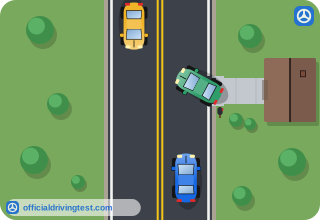
Which set lists the three options a driver has when trying to avoid a collision?
- Stop, turn, or speed up
- Stop, sound the horn, or flash the lights
- Turn, reverse, or change lanes
- Brake, signal, or move to the shoulder
Show answer
Correct answer: Stop, turn, or speed up
The manual says that when a collision threatens, a driver can stop, turn, or speed up.
Source: Tennessee Comprehensive Driver License Manual (March 2025 printing), page 96 · Open this page in the manual (Manual page 96)
-
According to the manual, what will an antilock braking system (ABS) allow you to do?
- Stop in a shorter distance on every surface
- Take curves at a higher speed
- Stop without skidding
- Brake hard without pressing the pedal firmly
Show answer
Correct answer: Stop without skidding
An ABS lets a driver stop hard without the wheels skidding.
Source: Tennessee Comprehensive Driver License Manual (March 2025 printing), page 96 · Open this page in the manual (Manual page 96)
-
If your vehicle has ABS and you need to stop quickly, what should you do?
- Pump the brake pedal several times quickly
- Press as hard as you can and keep pressing firmly
- Press lightly, then release when it pulses
- Press once, then let up to reset the system
Show answer
Correct answer: Press as hard as you can and keep pressing firmly
With ABS you press the brake pedal as hard as you can and keep pressing it firmly.
Source: Tennessee Comprehensive Driver License Manual (March 2025 printing), page 96 · Open this page in the manual (Manual page 96)
-
With ABS, you feel the brake pedal pushing back while you stop. What should you do?
- Let up on the pedal slightly
- Release the pedal and press it again
- Pump the pedal in time with the pushing
- Keep the pedal pressed down firmly
Show answer
Correct answer: Keep the pedal pressed down firmly
The pushback means the ABS is working, and it only works while the pedal is held down firmly.
Source: Tennessee Comprehensive Driver License Manual (March 2025 printing), page 96 · Open this page in the manual (Manual page 96)
-
If you must stop quickly and your vehicle does NOT have ABS, how should you apply the brakes?
- Lightly, and wait until the vehicle starts to skid
- Hard enough to keep the wheels fully locked
- As hard as you can without locking them
- Gently, so the pedal never pushes back
Show answer
Correct answer: As hard as you can without locking them
Without ABS you brake as hard as you can but must not lock the wheels, or the vehicle can skid.
Source: Tennessee Comprehensive Driver License Manual (March 2025 printing), page 96 · Open this page in the manual (Manual page 96)
-
In an emergency stop on a slippery road, what happens when all wheels lock on a vehicle without ABS?
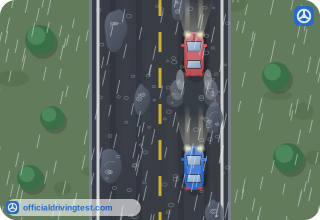
- It begins to skid and cannot be steered properly
- It stays stable and can be steered around obstacles
- It stops in a shorter distance than with ABS
- It slows down but keeps full steering control
Show answer
Correct answer: It begins to skid and cannot be steered properly
Locked wheels make the car skid, and a skidding car cannot be steered properly.
Source: Tennessee Comprehensive Driver License Manual (March 2025 printing), page 96 · Open this page in the manual (Manual page 96)
-
In an emergency on a slippery road, what happens with ABS?
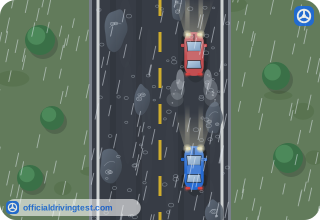
- The wheels lock, but the driver keeps full steering control
- The car skids but can still be steered
- The brakes release so the car rolls freely
- The wheels do not lock and the car can be steered around obstacles
Show answer
Correct answer: The wheels do not lock and the car can be steered around obstacles
With ABS the wheels do not lock, so the car stays stable and can be steered around obstacles.
Source: Tennessee Comprehensive Driver License Manual (March 2025 printing), page 96 · Open this page in the manual (Manual page 96)
-
In most cases, how does turning a vehicle compare with stopping it?
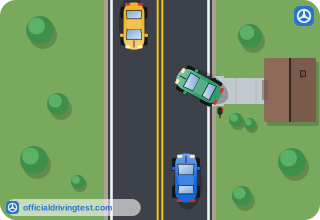
- You can stop it quicker than you can turn it
- You can turn it quicker than you can stop it
- Both take about the same time
- Turning is quicker only if the vehicle has ABS
Show answer
Correct answer: You can turn it quicker than you can stop it
The manual says that in most cases you can turn quicker than you can stop.
Source: Tennessee Comprehensive Driver License Manual (March 2025 printing), page 96 · Open this page in the manual (Manual page 96)
-
If you are unable to stop in time to avoid a collision, what should you try to do?
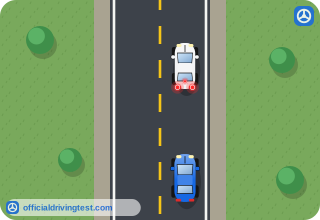
- Steer around the vehicle or object
- Hold the wheel straight and brake as hard as you can
- Sound the horn and wait for the other driver to move
- Close the gap so the impact is slower
Show answer
Correct answer: Steer around the vehicle or object
Evasive steering means steering around the vehicle or object when you cannot stop in time.
Source: Tennessee Comprehensive Driver License Manual (March 2025 printing), page 96 · Open this page in the manual (Manual page 96)
-
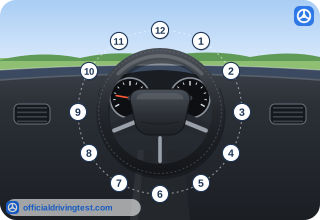
Where is it best to place your hands on the steering wheel to keep your wrists and forearms out of the main impact area of the air bag?
- About the 12 o’clock and 6 o’clock positions
- About the 1 o’clock and 7 o’clock positions
- About the 3 o’clock and 9 o’clock positions
- About the 11 o’clock and 5 o’clock positions
Show answer
Correct answer: About the 3 o’clock and 9 o’clock positions
Hands at about 3 and 9 o’clock give a good grip for quick turns and stay clear of the air bag.
Source: Tennessee Comprehensive Driver License Manual (March 2025 printing), page 96 · Open this page in the manual (Manual page 96)
-
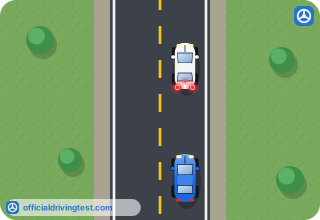
What is the first step in making a quick evasive turn to the left?
- Turn the wheel left only slightly to prevent a skid
- Turn the wheel left as far as necessary to avoid the obstacle
- Turn the wheel right first, then swing it left
- Let go of the wheel so the vehicle straightens itself
Show answer
Correct answer: Turn the wheel left as far as necessary to avoid the obstacle
You first turn the wheel left as far as needed to get around the obstacle or vehicle.
Source: Tennessee Comprehensive Driver License Manual (March 2025 printing), page 96 · Open this page in the manual (Manual page 96)
-
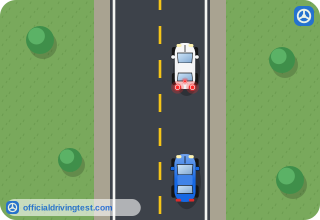
After you clear the hazard in a quick evasive turn to the left, what do you do next?
- Keep the wheel to the left until the vehicle stops on its own
- Brake hard to straighten the vehicle at once, then turn right
- Release the wheel and let the car drift back to the lane
- Turn the wheel back right as far as necessary to return to your lane
Show answer
Correct answer: Turn the wheel back right as far as necessary to return to your lane
Once past the hazard you steer back to the right as far as necessary to get into your lane again.
Source: Tennessee Comprehensive Driver License Manual (March 2025 printing), page 96 · Open this page in the manual (Manual page 96)
-
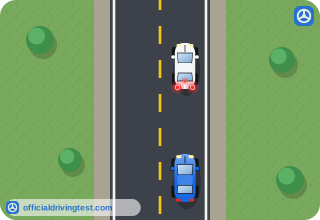
How do you make a quick evasive turn to the right?
- Brake first, then turn the wheel only to the left
- Use a different method with one hand on the wheel
- Use the same steps as for the left, turning the wheel the opposite way
- Turn the wheel right once and hold it until the hazard passes
Show answer
Correct answer: Use the same steps as for the left, turning the wheel the opposite way
The right-hand turn uses the same procedure as the left, with the wheel turned the opposite way at each step.
Source: Tennessee Comprehensive Driver License Manual (March 2025 printing), page 96 · Open this page in the manual (Manual page 96)
-
After turning away from a road hazard, in which direction should you steer?
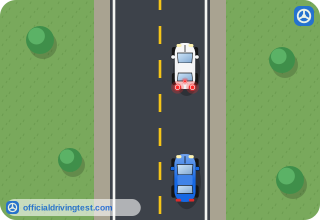
- In the direction you want the vehicle to go
- Toward the hazard you have just avoided
- Toward the nearest shoulder
- Toward the vehicle behind you
Show answer
Correct answer: In the direction you want the vehicle to go
Some drivers steer away from one collision and into another, so you steer where you want the vehicle to go.
Source: Tennessee Comprehensive Driver License Manual (March 2025 printing), page 97 · Open this page in the manual (Manual page 97)
-
What is one thing ABS lets you do that helps when you must swerve, stop or slow down quickly?
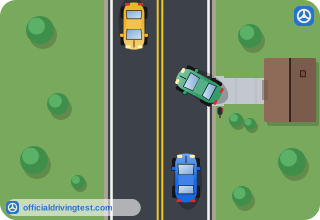
- Brake without pressing the pedal
- Turn only after releasing the brake pedal
- Steer without holding the wheel firmly
- Turn your vehicle while braking without skidding
Show answer
Correct answer: Turn your vehicle while braking without skidding
With ABS you can turn while braking without skidding.
Source: Tennessee Comprehensive Driver License Manual (March 2025 printing), page 97 · Open this page in the manual (Manual page 97)
-
Without ABS, why does braking first help you turn more quickly?
- It puts more weight on the front tires
- It puts more weight on the rear tires
- It locks the rear wheels so the car pivots
- It switches on the vehicle’s stability system
Show answer
Correct answer: It puts more weight on the front tires
Braking slows the vehicle and puts more weight on the front tires, which allows a quicker turn.
Source: Tennessee Comprehensive Driver License Manual (March 2025 printing), page 97 · Open this page in the manual (Manual page 97)
-
What does the manual say is generally better when you cannot avoid a crash?
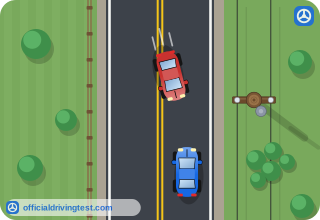
- To crash head-on than to leave the pavement
- To turn off the road than to crash head-on into another vehicle
- To keep braking in your lane than to turn off the road
- To speed up than to turn off the road
Show answer
Correct answer: To turn off the road than to crash head-on into another vehicle
Generally it is better to turn off the road than to hit another vehicle head-on.
Source: Tennessee Comprehensive Driver License Manual (March 2025 printing), page 97 · Open this page in the manual (Manual page 97)
-
When may it be best or necessary to speed up to avoid a collision?
- When the vehicle ahead stops suddenly and you have no room in front of your vehicle
- When a deer is standing beside the roadway
- When a traffic signal turns yellow as you approach
- When another vehicle is about to hit you from the side or behind and there is room ahead
Show answer
Correct answer: When another vehicle is about to hit you from the side or behind and there is room ahead
Speeding up can help when a vehicle is about to hit you from the side or from behind and there is room in front to get out of danger.
Source: Tennessee Comprehensive Driver License Manual (March 2025 printing), page 97 · Open this page in the manual (Manual page 97)
-
After you speed up to get out of danger, what should you do once the danger has passed?
- Keep the higher speed
- Stop in your lane
- Slow down
- Turn on your hazard flashers
Show answer
Correct answer: Slow down
The manual says to slow down once the danger has passed.
Source: Tennessee Comprehensive Driver License Manual (March 2025 printing), page 97 · Open this page in the manual (Manual page 97)
-
Which season is the peak season for deer-car crashes?
- Spring
- Summer
- Winter
- Fall
Show answer
Correct answer: Fall
Fall is the peak season because autumn is both mating and hunting season.
Source: Tennessee Comprehensive Driver License Manual (March 2025 printing), page 97 · Open this page in the manual (Manual page 97)
-
Why is fall the peak season for deer-car crashes?
- Deer move toward highways to find water in autumn
- It is mating and hunting season, so deer are more active and roam farther
- Shorter days make deer travel in larger herds across the roads
- Leaves on the road make deer harder to see
Show answer
Correct answer: It is mating and hunting season, so deer are more active and roam farther
In autumn deer are more active and more likely to roam beyond their normal territory.
Source: Tennessee Comprehensive Driver License Manual (March 2025 printing), page 97 · Open this page in the manual (Manual page 97)
-
Which animal collisions are generally the most dangerous and costly?
- Collisions with deer
- Collisions with dogs
- Collisions with rabbits
- Collisions with squirrels
Show answer
Correct answer: Collisions with deer
Collisions with deer are generally the most dangerous and costly crashes involving animals.
Source: Tennessee Comprehensive Driver License Manual (March 2025 printing), page 97 · Open this page in the manual (Manual page 97)
-
What does the manual say about keeping deer and other wild animals off highways?
- Roadside fences keep them off all highways
- Sounding the horn keeps them away for good
- No foolproof way has been found to do it
- Deer-crossing signs keep them away from the road
Show answer
Correct answer: No foolproof way has been found to do it
No foolproof way has been found to keep wild animals away from highways and vehicles.
Source: Tennessee Comprehensive Driver License Manual (March 2025 printing), page 97 · Open this page in the manual (Manual page 97)
-
To help avoid a collision with a deer, where should you look?
- Only at the road directly ahead of your hood
- Well down the road and far off to each side
- Mostly at the center line
- Mainly in your mirrors
Show answer
Correct answer: Well down the road and far off to each side
You should look well down the road and far off to each side to spot animals early.
Source: Tennessee Comprehensive Driver License Manual (March 2025 printing), page 97 · Open this page in the manual (Manual page 97)
-
At night, what can help you see deer near the edges of the road?
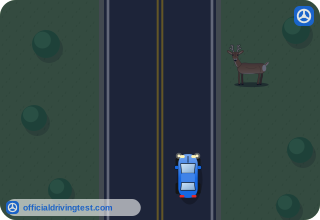
- Driving with only your parking lights on
- Using your fog lights by themselves
- Turning off your headlights briefly
- Using your high-beam lights if possible
Show answer
Correct answer: Using your high-beam lights if possible
High beams, when possible, light up the edges of the road at night.
Source: Tennessee Comprehensive Driver License Manual (March 2025 printing), page 97 · Open this page in the manual (Manual page 97)
-
In which areas should you be especially watchful for deer?
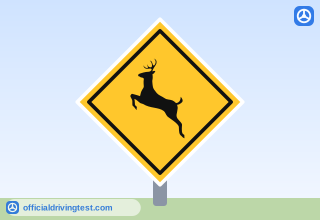
- Open, treeless fields
- Downtown business districts
- Areas near woods and water
- Busy shopping center parking lots
Show answer
Correct answer: Areas near woods and water
Deer are especially likely near woods and water.
Source: Tennessee Comprehensive Driver License Manual (March 2025 printing), page 97 · Open this page in the manual (Manual page 97)
-
If you see one deer near the road, what should you keep in mind?
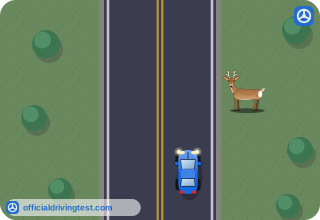
- There may be several others nearby
- It is probably alone, since deer travel singly
- The danger has passed once it crosses
- More will appear only in winter
Show answer
Correct answer: There may be several others nearby
Where there is one deer there may be several others close by.
Source: Tennessee Comprehensive Driver License Manual (March 2025 printing), page 97 · Open this page in the manual (Manual page 97)
-
At what times should you be particularly alert for deer that venture out to feed?
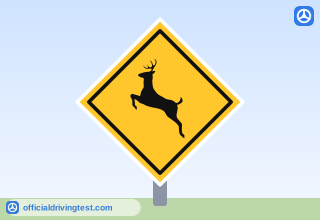
- At noon
- In mid-afternoon
- Only after midnight
- At dusk and dawn
Show answer
Correct answer: At dusk and dawn
Deer venture out to feed at dusk and dawn, so be especially alert then.
Source: Tennessee Comprehensive Driver License Manual (March 2025 printing), page 97 · Open this page in the manual (Manual page 97)
-
What can you watch for along the sides of the road to spot deer at night?
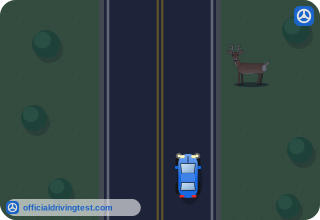
- Their tracks on the pavement
- The reflection of your headlights in their eyes
- Tall roadside grass moving in the wind
- Shadows of trees falling across your lane
Show answer
Correct answer: The reflection of your headlights in their eyes
Scanning the road sides for headlight reflection in deer eyes helps you see them.
Source: Tennessee Comprehensive Driver License Manual (March 2025 printing), page 97 · Open this page in the manual (Manual page 97)
-
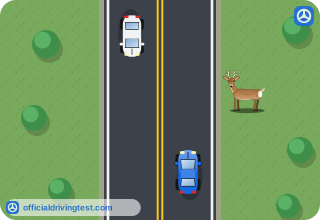
If you see an animal on or near the roadway and think you have time to avoid hitting it, what does the manual say to do?
- Reduce speed, tap your brakes to warn other drivers, and sound your horn
- Hold your speed and steer around the animal on the road shoulder
- Stop in your lane and turn off your headlights
- Speed up to pass before it moves onto the road
Show answer
Correct answer: Reduce speed, tap your brakes to warn other drivers, and sound your horn
Slow down, tap your brakes to warn other drivers, and sound your horn.
Source: Tennessee Comprehensive Driver License Manual (March 2025 printing), page 97 · Open this page in the manual (Manual page 97)
-
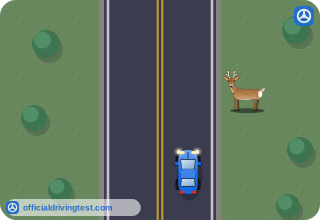
According to the manual, what may happen if you flash your headlights at a deer?
- The animal will quickly leave the road
- The animal will run toward your vehicle
- The animal may freeze in the road
- The animal will be able to see the road edges
Show answer
Correct answer: The animal may freeze in the road
Deer tend to fixate on headlights, so flashing them may make the animal freeze.
Source: Tennessee Comprehensive Driver License Manual (March 2025 printing), page 97 · Open this page in the manual (Manual page 97)
-
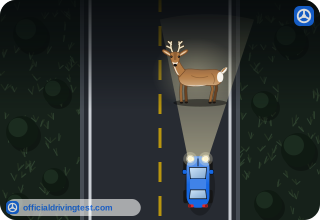
If no vehicle is close behind you and an animal is in the road, how should you brake?
- Brake lightly so you do not startle the animal or other drivers
- Brake hard, but do not lock the wheels and cause a skid
- Tap the brakes only and never brake hard
- Do not brake; steer around the animal
Show answer
Correct answer: Brake hard, but do not lock the wheels and cause a skid
With no vehicle close behind, brake hard but avoid locking the wheels.
Source: Tennessee Comprehensive Driver License Manual (March 2025 printing), page 97 · Open this page in the manual (Manual page 97)
-
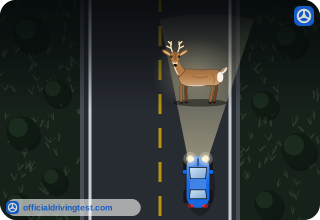
If a collision with an animal seems inevitable, what should you do?
- Swerve sharply to avoid the animal
- Swerve into the opposite lane to avoid hitting the animal
- Leave the roadway to avoid hitting it
- Do not swerve; keep the vehicle under control and on the roadway
Show answer
Correct answer: Do not swerve; keep the vehicle under control and on the roadway
Swerving can raise your risk of injury, so stay in control and on the roadway.
Source: Tennessee Comprehensive Driver License Manual (March 2025 printing), page 97 · Open this page in the manual (Manual page 97)
-
When does the manual say to report a crash with an animal to the police?
- Only when it involves a small animal such as a rabbit
- Only if your vehicle cannot be driven afterward
- When it involves a large animal such as a deer or farm animal
- Never; animal crashes are not reported
Show answer
Correct answer: When it involves a large animal such as a deer or farm animal
A crash with a large animal such as a deer or farm animal should be reported to the police.
Source: Tennessee Comprehensive Driver License Manual (March 2025 printing), page 97 · Open this page in the manual (Manual page 97)
-
If you hit a domestic pet and homes are nearby, what should you try to do?
- Notify the pet’s owner if possible
- Move the animal into the nearest yard
- Drive on and tell only the police
- Leave a note at every nearby home
Show answer
Correct answer: Notify the pet’s owner if possible
The manual says to try to notify the pet’s owner if possible.
Source: Tennessee Comprehensive Driver License Manual (March 2025 printing), page 97 · Open this page in the manual (Manual page 97)
-
Which two habits does the manual recommend in its tips on avoiding collisions with animals?
- Always keep your high beams on and your windows open
- Always drive ten miles per hour under the limit
- Always stop and wait whenever you see an animal
- Always obey the speed limit and wear your safety belt
Show answer
Correct answer: Always obey the speed limit and wear your safety belt
The manual's animal-collision tips include always obeying the speed limit and wearing your safety belt.
Source: Tennessee Comprehensive Driver License Manual (March 2025 printing), page 97 · Open this page in the manual (Manual page 97)
-
Why should you never pump the brake pedal of a vehicle equipped with ABS, even if the pedal is pulsating?
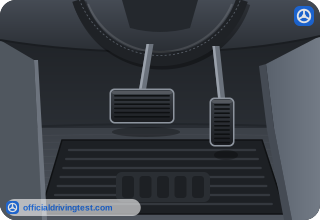
- The pulsating means the ABS has failed and needs to be reset
- The pulsating is the ABS pumping the brakes much faster than you could
- Pumping would make the pedal go to the floor
- Pumping is needed only on wet roads
Show answer
Correct answer: The pulsating is the ABS pumping the brakes much faster than you could
The pedal pulsation is the ABS pumping the brakes far faster than any driver could by hand.
Source: Tennessee Comprehensive Driver License Manual (March 2025 printing), page 97 · Open this page in the manual (Manual page 97)
-
After slamming on ABS brakes because of an obstacle, what should you do?
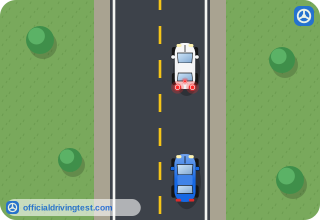
- Steer around the obstacle, then continue to a safe place
- Hold the wheel straight until the vehicle stops
- Release the pedal to regain steering
- Pump the pedal while you steer
Show answer
Correct answer: Steer around the obstacle, then continue to a safe place
ABS keeps the wheels from skidding so you can steer around the obstacle and on to a safe place.
Source: Tennessee Comprehensive Driver License Manual (March 2025 printing), page 98 · Open this page in the manual (Manual page 98)
-
Why should you not jerk the steering wheel suddenly in an emergency?
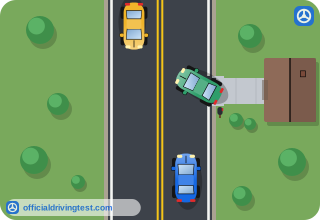
- It can cause the ABS to switch off and the brakes to fail
- It can lock the steering column
- It can make you hit another object or leave the road and roll over
- It can flatten a front tire
Show answer
Correct answer: It can make you hit another object or leave the road and roll over
Jerking the wheel can cause a collision with another object or a rollover off the road.
Source: Tennessee Comprehensive Driver License Manual (March 2025 printing), page 98 · Open this page in the manual (Manual page 98)
-
When practicing ABS braking in an empty lot, at about what speed should you start?
- About 10 M.P.H.
- About 20 M.P.H.
- About 35 M.P.H.
- About 50 M.P.H.
Show answer
Correct answer: About 20 M.P.H.
The manual says to start at about 20 M.P.H., slam on the brakes and steer.
Source: Tennessee Comprehensive Driver License Manual (March 2025 printing), page 98 · Open this page in the manual (Manual page 98)
-
Where should you practice emergency braking and steering with ABS?
- On a quiet residential street
- On a country road with no traffic
- In a crowded lot with parked cars and light poles to steer around
- In a wide open vacant lot without curbs or many light poles
Show answer
Correct answer: In a wide open vacant lot without curbs or many light poles
A big, empty, wide open lot with no curbs or lots of light poles is the place to practice.
Source: Tennessee Comprehensive Driver License Manual (March 2025 printing), page 98 · Open this page in the manual (Manual page 98)
-
Under which weather conditions should you practice ABS braking and steering?
- Only on dry pavement
- Only in light rain
- In various conditions, such as dry, rain and snow
- Only in daylight on dry pavement with clear skies
Show answer
Correct answer: In various conditions, such as dry, rain and snow
The manual advises practicing in various weather conditions, such as dry, rain and snow.
Source: Tennessee Comprehensive Driver License Manual (March 2025 printing), page 98 · Open this page in the manual (Manual page 98)
-
Where does the manual say to look for additional driving instructions about your vehicle’s anti-lock brake system?
- In the owner’s manual
- On the tire sidewall
- On the driver’s door jamb sticker
- At a Driver Service Center
Show answer
Correct answer: In the owner’s manual
The owner’s manual has the instructions for the specific ABS in your vehicle.
Source: Tennessee Comprehensive Driver License Manual (March 2025 printing), page 98 · Open this page in the manual (Manual page 98)
-
How should you drive a vehicle with ABS compared with a vehicle without ABS?
- Faster around curves
- With more abrupt lane changes
- Closer to the vehicle ahead
- No more aggressively
Show answer
Correct answer: No more aggressively
The manual says never to drive an ABS vehicle more aggressively than one without ABS.
Source: Tennessee Comprehensive Driver License Manual (March 2025 printing), page 98 · Open this page in the manual (Manual page 98)