South Carolina: Sharing the road — Part 5 Practice Test
Questions in this part include: “Which of these should you never do around a large vehicle?”
Independent educational site · not affiliated with any government agency or DMV
Ready? Test yourself
- Instant feedback with an explanation
- Every answer cites its source in the manual
- Your best score is saved on this device
- Keyboard: press 1 to 4 to answer and Enter for the next question
Questions are original and based on the official manual "South Carolina Driver's Manual" (2026 (posted April 2026)), South Carolina Department of Motor Vehicles.
All 16 questions in this practice test
Take the test above first, then use this list to study. Tap “Show answer” to see the correct answer and explanation.
Show the questions and answersHide the questions
-
Near truck weigh stations, which lane should you avoid driving in, if possible?
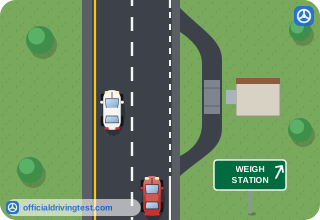
- The right lane
- The left lane
- The middle lane
- None, every lane is equally safe
Show answer
Correct answer: The right lane
Large vehicles re-enter faster traffic near weigh stations, so avoid the right lane there if possible.
Source: South Carolina Driver's Manual (2026 (posted April 2026)), page 10-10 · Open this page in the manual (Manual page 10-10)
-
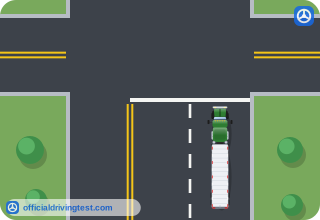
What should you give large vehicles that are turning?
- A short horn blast as a warning
- A tight gap to squeeze past on the right
- Plenty of room to maneuver
- Your headlights flashed as a signal
Show answer
Correct answer: Plenty of room to maneuver
Pay attention to the turn signals of large vehicles and give them plenty of room to maneuver.
Source: South Carolina Driver's Manual (2026 (posted April 2026)), page 10-10 · Open this page in the manual (Manual page 10-10)
-
Why might a truck or bus driver swing the vehicle wide to the left before turning right?
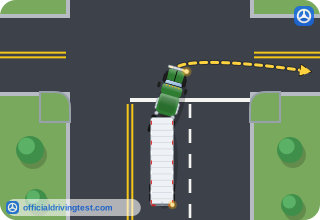
- To clear the corner of a curb or other obstruction
- To let faster traffic pass it safely on the right side
- To warn nearby drivers that its brakes are failing
- To show other drivers that it will turn left next
Show answer
Correct answer: To clear the corner of a curb or other obstruction
The driver may swing wide to the left so that the vehicle can safely clear the corner of a curb or other obstruction.
Source: South Carolina Driver's Manual (2026 (posted April 2026)), page 10-10 · Open this page in the manual (Manual page 10-10)
-
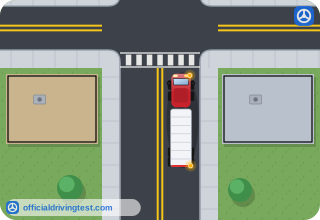
To avoid a collision with a truck or bus that is making a turn, what should you do?
- Move in between it and the curb
- Turn at the same time, beside it
- Honk and edge ahead of it
- Wait until it completes its turn
Show answer
Correct answer: Wait until it completes its turn
If you get between a turning truck or bus and the curb you can be squeezed, so wait until its turn is finished.
Source: South Carolina Driver's Manual (2026 (posted April 2026)), page 10-10 · Open this page in the manual (Manual page 10-10)
-
When you meet a truck coming from the opposite direction, what should you do?
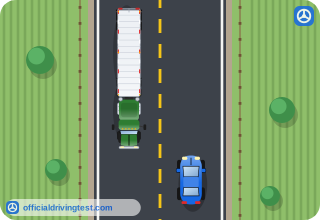
- Move toward the center line to give it room
- Keep as far to the right as possible
- Brake hard and stop in the roadway
- Speed up to get past it quickly
Show answer
Correct answer: Keep as far to the right as possible
Staying far to the right avoids a side-swept collision and reduces the wind turbulence that pushes the vehicles apart.
Source: South Carolina Driver's Manual (2026 (posted April 2026)), page 10-11 · Open this page in the manual (Manual page 10-11)
-
Many collisions with large vehicles at intersections occur because motorists cannot accurately judge what before turning left?
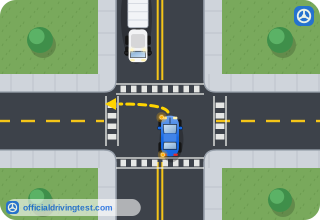
- The length of the truck's trailer
- The speed of an approaching truck
- The height of the truck
- The distance to the stop line
Show answer
Correct answer: The speed of an approaching truck
Drivers have trouble judging how fast an approaching truck is moving before they turn left in front of it.
Source: South Carolina Driver's Manual (2026 (posted April 2026)), page 10-11 · Open this page in the manual (Manual page 10-11)
-
What should you do if you are in doubt about the speed of an oncoming truck or bus when you want to turn left?
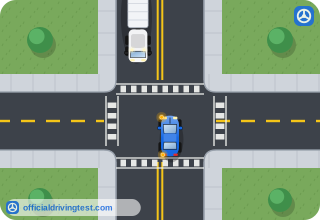
- Turn left quickly before it arrives
- Flash your lights so it slows down
- Turn only if its driver signals
- Do not turn left in its path
Show answer
Correct answer: Do not turn left in its path
A truck or bus may be going faster than you think and takes longer to stop, so do not turn left in its path.
Source: South Carolina Driver's Manual (2026 (posted April 2026)), page 10-11 · Open this page in the manual (Manual page 10-11)
-
How do stop lines at intersections help larger vehicles?
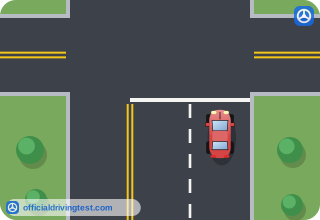
- They set you farther back, giving more turning space
- They show trucks the correct lane to use for a turn
- They require trucks to stop sooner than other vehicles
- They mark the place where trucks must park at night
Show answer
Correct answer: They set you farther back, giving more turning space
Stopping behind the line keeps you farther back, which leaves larger vehicles more space to turn.
Source: South Carolina Driver's Manual (2026 (posted April 2026)), page 10-11 · Open this page in the manual (Manual page 10-11)
-
At an intersection marked with a stop line, where should you always stop?
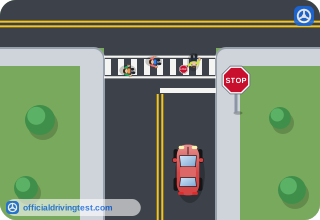
- On the stop line
- Just past the stop line
- Behind the stop line
- In the crosswalk beyond it
Show answer
Correct answer: Behind the stop line
The manual says to always stop behind stop lines.
Source: South Carolina Driver's Manual (2026 (posted April 2026)), page 10-11 · Open this page in the manual (Manual page 10-11)
-
Which of these should you never do around a large vehicle?
- Cut it off to beat it into a single-lane construction zone
- Look for its whole front in your mirror when passing
- Keep as far right as possible when meeting it
- Stay behind the stop line at an intersection
Show answer
Correct answer: Cut it off to beat it into a single-lane construction zone
The manual says not to cut off a large vehicle to reach an exit or turn or to beat it into a single-lane construction zone; the few seconds saved are not worth a life.
Source: South Carolina Driver's Manual (2026 (posted April 2026)), page 10-11 · Open this page in the manual (Manual page 10-11)
-
A fluorescent or reflective orange and red triangle is displayed on the rear of a farm vehicle. What does it mean?
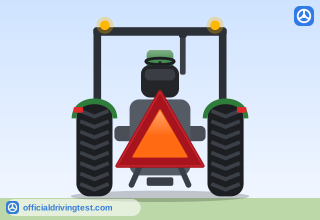
- The vehicle is traveling less than 15 mph
- The vehicle is carrying an oversize load
- The vehicle is stopped for repairs
- The vehicle is traveling less than 25 mph
Show answer
Correct answer: The vehicle is traveling less than 25 mph
The orange and red triangle on a farm, construction or animal-drawn vehicle means it is traveling less than 25 mph.
Source: South Carolina Driver's Manual (2026 (posted April 2026)), page 10-16 · Open this page in the manual (Manual page 10-16)
-
Before passing a slow-moving vehicle, what must you be sure of?
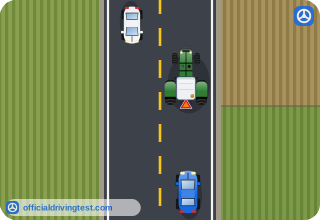
- That the driver has waved you around
- That it is safe to pass
- That your horn works
- That the vehicle is traveling under 45 mph
Show answer
Correct answer: That it is safe to pass
Use caution approaching a slow-moving vehicle and make sure passing is safe.
Source: South Carolina Driver's Manual (2026 (posted April 2026)), page 10-16 · Open this page in the manual (Manual page 10-16)
-
Why should you pass farm machinery with caution?
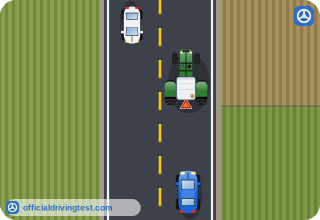
- It is not allowed to travel on state highways at all
- Its operator always signals well before every turn
- Its operator most likely cannot hear approaching vehicles
- Its operator must pull over for every vehicle behind it
Show answer
Correct answer: Its operator most likely cannot hear approaching vehicles
The noise of farm machinery means its operator most likely cannot hear you coming.
Source: South Carolina Driver's Manual (2026 (posted April 2026)), page 10-16 · Open this page in the manual (Manual page 10-16)
-
What rights do animal-drawn vehicles and horseback riders have on the road?
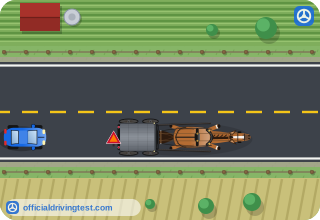
- The same rights as a motor vehicle, and they must follow the same rules
- They may use the road only when no motor vehicles are present
- They must use the shoulder and yield to every motor vehicle
- They may use the road only in rural areas on weekends
Show answer
Correct answer: The same rights as a motor vehicle, and they must follow the same rules
Animal-drawn vehicles and horseback riders share the road with the same rights and rules as motor vehicles.
Source: South Carolina Driver's Manual (2026 (posted April 2026)), page 10-16 · Open this page in the manual (Manual page 10-16)
-
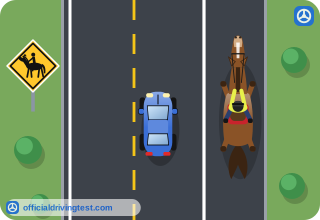
When passing an animal-drawn vehicle or horseback rider, what should you not do?
- Pass with caution
- Watch for posted warning signs
- Use your horn or rev your engine
- Anticipate left turns into fields
Show answer
Correct answer: Use your horn or rev your engine
A horn or revving engine may scare the animal and cause a collision.
Source: South Carolina Driver's Manual (2026 (posted April 2026)), page 10-16 · Open this page in the manual (Manual page 10-16)
-
What turns should you anticipate from animal-drawn vehicles?
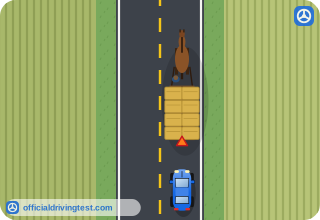
- Left turns into fields and driveways
- Right turns into side streets
- U-turns on the highway
- Left turns across railroad tracks
Show answer
Correct answer: Left turns into fields and driveways
The manual says to anticipate left turns that animal-drawn vehicles make into fields and driveways.
Source: South Carolina Driver's Manual (2026 (posted April 2026)), page 10-16 · Open this page in the manual (Manual page 10-16)