South Carolina: Sharing the road — Part 3 Practice Test
Questions in this part include: “A bicyclist ahead holds the left arm straight out to the left. What is the bicyclist about to do?” · “How do the rights and responsibilities of motorcyclists compare with those of other drivers?”
Independent educational site · not affiliated with any government agency or DMV
Ready? Test yourself
- Instant feedback with an explanation
- Every answer cites its source in the manual
- Your best score is saved on this device
- Keyboard: press 1 to 4 to answer and Enter for the next question
Questions are original and based on the official manual "South Carolina Driver's Manual" (2026 (posted April 2026)), South Carolina Department of Motor Vehicles.
All 16 questions in this practice test
Take the test above first, then use this list to study. Tap “Show answer” to see the correct answer and explanation.
Show the questions and answersHide the questions
-
What are bicyclists required to do when turning and stopping?
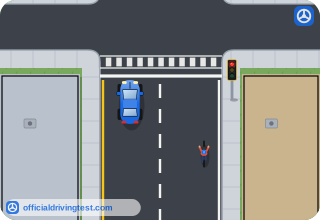
- Sound a horn
- Walk the bicycle
- Pull off the road and wait
- Use hand signals
Show answer
Correct answer: Use hand signals
Bicyclists are required to use hand signals when turning and stopping.
Source: South Carolina Driver's Manual (2026 (posted April 2026)), page 10-4 · Open this page in the manual (Manual page 10-4)
-
What other clues of a bicyclist’s intent should you look for, since the bicyclist may not signal?
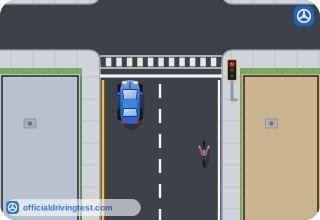
- Turning the head or looking over the shoulder
- Ringing a bell or waving to you before turning
- Riding closer to the center line
- Pedaling faster
Show answer
Correct answer: Turning the head or looking over the shoulder
The manual lists turning the head or looking over the shoulder before changing lane positions as clues to a bicyclist’s intent.
Source: South Carolina Driver's Manual (2026 (posted April 2026)), page 10-4 · Open this page in the manual (Manual page 10-4)
-
A bicyclist ahead holds the left arm straight out to the left. What is the bicyclist about to do?
- Make a right turn
- Stop
- Make a left turn
- Let you pass
Show answer
Correct answer: Make a left turn
A left arm held straight out to the left is the bicyclist’s hand signal for a left turn.
Source: South Carolina Driver's Manual (2026 (posted April 2026)), page 10-4 · Open this page in the manual (Manual page 10-4)
-
A bicyclist ahead holds the left arm out to the side, angled downward with the hand pointing down. What is the bicyclist signaling?
- A left turn
- A stop
- A right turn
- That you may pass
Show answer
Correct answer: A stop
An arm angled down with the hand pointing down is the bicyclist’s hand signal for stopping.
Source: South Carolina Driver's Manual (2026 (posted April 2026)), page 10-4 · Open this page in the manual (Manual page 10-4)
-
A bicyclist ahead holds the left arm bent upward at the elbow, or holds the right arm straight out to the right. What is the bicyclist signaling?
- A left turn
- A stop
- That the bicyclist is slowing to let you pass
- A right turn
Show answer
Correct answer: A right turn
Either a left arm bent upward or a right arm held straight out is a bicyclist’s hand signal for a right turn.
Source: South Carolina Driver's Manual (2026 (posted April 2026)), page 10-5 · Open this page in the manual (Manual page 10-5)
-
When you are parked on the street, what should you check before you open your vehicle door?
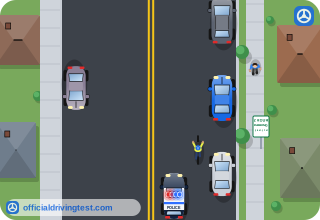
- The sides and rear of the vehicle for bicyclists
- The front of the vehicle for pedestrians
- Your mirrors for passing police vehicles
- The curb for a parking sign
Show answer
Correct answer: The sides and rear of the vehicle for bicyclists
Before opening a door on the street, check the sides and rear of the vehicle for bicyclists.
Source: South Carolina Driver's Manual (2026 (posted April 2026)), page 10-5 · Open this page in the manual (Manual page 10-5)
-
Where should you be especially cautious about bicyclists in your path when backing up?
- Only on multi-lane divided highways
- Only in construction zones
- Near schools or residential areas
- Only at railroad crossings
Show answer
Correct answer: Near schools or residential areas
Bicyclists are more likely to be present near schools and residential areas, so check your path before backing.
Source: South Carolina Driver's Manual (2026 (posted April 2026)), page 10-5 · Open this page in the manual (Manual page 10-5)
-
How do the rights and responsibilities of motorcyclists compare with those of other drivers?
- Motorcyclists have fewer responsibilities
- Motorcyclists have the same rights and responsibilities
- Motorcyclists have the right-of-way in every lane
- Motorcyclists must yield to all other vehicles
Show answer
Correct answer: Motorcyclists have the same rights and responsibilities
The manual says motorcyclists have the same rights and responsibilities as other drivers, though they may be harder to see.
Source: South Carolina Driver's Manual (2026 (posted April 2026)), page 10-5 · Open this page in the manual (Manual page 10-5)
-
How much of a lane should you allow a motorcyclist?
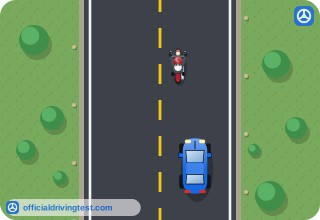
- Half of the lane
- Only the space left by your vehicle
- The width of two motorcycles
- A full lane width
Show answer
Correct answer: A full lane width
A motorcyclist should be allowed a full lane width; you must not share the lane.
Source: South Carolina Driver's Manual (2026 (posted April 2026)), page 10-5 · Open this page in the manual (Manual page 10-5)
-
Why does the manual say you should always check your mirrors and blind spots for motorcycles?
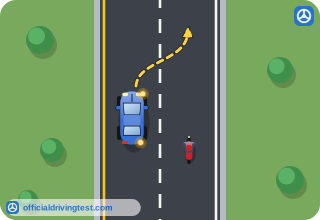
- Motorcycles are small and therefore more difficult to see
- Motorcycles always travel faster than other traffic
- Motorcycles are not allowed in the left lane
- Motorcycle riders cannot see vehicles beside them
Show answer
Correct answer: Motorcycles are small and therefore more difficult to see
Motorcycles are small and therefore more difficult to see, so always check your mirrors and blind spots for them.
Source: South Carolina Driver's Manual (2026 (posted April 2026)), page 10-6 · Open this page in the manual (Manual page 10-6)
-
Before turning left, where should you look carefully for motorcycles?
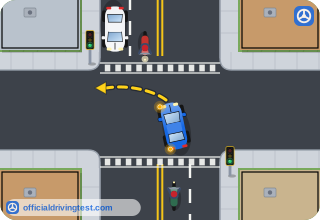
- Behind your vehicle, in your mirrors
- Far down the road ahead of the intersection
- To the front and sides of your vehicle
- Over your right shoulder only
Show answer
Correct answer: To the front and sides of your vehicle
Before a left turn you should check carefully in front of and beside your vehicle for motorcycles.
Source: South Carolina Driver's Manual (2026 (posted April 2026)), page 10-6 · Open this page in the manual (Manual page 10-6)
-
You see a motorcycle with its turn signal flashing. What should you do?
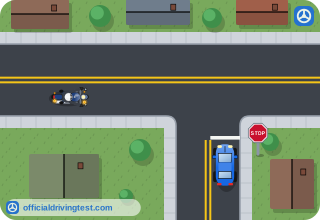
- Assume it is turning and proceed at once
- Wait until you are sure the rider will turn
- Sound your horn to warn the rider
- Move up close behind it to watch its next move
Show answer
Correct answer: Wait until you are sure the rider will turn
Motorcycle turn signals may not cancel by themselves, so the rider may have forgotten to turn them off. Wait until you are sure the rider will turn.
Source: South Carolina Driver's Manual (2026 (posted April 2026)), page 10-7 · Open this page in the manual (Manual page 10-7)
-
What minimum following distance should you allow when following a motorcyclist?
- 2 seconds
- 3 seconds
- 6 seconds
- 4 seconds
Show answer
Correct answer: 4 seconds
The manual says to allow a minimum of 4 seconds behind a motorcyclist, and more in wet conditions.
Source: South Carolina Driver's Manual (2026 (posted April 2026)), page 10-7 · Open this page in the manual (Manual page 10-7)
-
Which of these may force a motorcyclist to suddenly change speed or lane position?
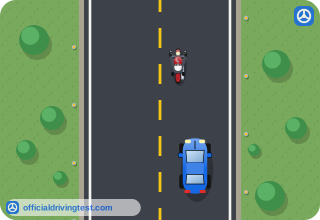
- A dry, smooth, straight road
- A wide, empty road shoulder
- Light traffic on a multilane road
- Gravel on the pavement
Show answer
Correct answer: Gravel on the pavement
Potholes, gravel, slippery surfaces, pavement seams, railroad crossings and grooved pavement are hazards that riders may have to avoid suddenly.
Source: South Carolina Driver's Manual (2026 (posted April 2026)), page 10-7 · Open this page in the manual (Manual page 10-7)
-
How does the speed of scooters and mopeds compare with that of motorcycles?
- They travel at about the same speeds
- They travel at much slower speeds
- They travel at much higher speeds
- They travel faster only on hills
Show answer
Correct answer: They travel at much slower speeds
The manual reminds drivers that scooters and mopeds move much more slowly than motorcycles.
Source: South Carolina Driver's Manual (2026 (posted April 2026)), page 10-7 · Open this page in the manual (Manual page 10-7)
-
How do commercial vehicles generally compare with cars?
- They are larger but more easily maneuverable
- They are smaller and more easily maneuverable
- They are larger and less easily maneuverable
- They are smaller but harder to see around
Show answer
Correct answer: They are larger and less easily maneuverable
Commercial vehicles are generally larger than cars and not as easy to maneuver.
Source: South Carolina Driver's Manual (2026 (posted April 2026)), page 10-7 · Open this page in the manual (Manual page 10-7)