South Carolina: Sharing the road — Part 1 Practice Test
Questions in this part include: “What are the minimum age and license requirements to drive a golf cart?” · “Which behavior does the manual list as typically associated with aggressive driving?”
Independent educational site · not affiliated with any government agency or DMV
Ready? Test yourself
- Instant feedback with an explanation
- Every answer cites its source in the manual
- Your best score is saved on this device
- Keyboard: press 1 to 4 to answer and Enter for the next question
Questions are original and based on the official manual "South Carolina Driver's Manual" (2026 (posted April 2026)), South Carolina Department of Motor Vehicles.
All 17 questions in this practice test
Take the test above first, then use this list to study. Tap “Show answer” to see the correct answer and explanation.
Show the questions and answersHide the questions
-
What are the minimum age and license requirements to drive a golf cart?
- At least 14 years old with a beginner’s permit
- At least 15 years old with a valid driver’s license
- At least 18 years old with a Class D license
- At least 16 years old with a valid driver’s license
Show answer
Correct answer: At least 16 years old with a valid driver’s license
Golf cart drivers must be at least 16 and hold a valid driver’s license.
Source: South Carolina Driver's Manual (2026 (posted April 2026)), page 2-2 · Open this page in the manual (Manual page 2-2)
-
What must a golf cart have affixed to it?
- An SCDMV-issued permit/registration decal
- A reflective slow-moving vehicle triangle
- An orange safety flag on a tall pole
- A county safety inspection sticker
Show answer
Correct answer: An SCDMV-issued permit/registration decal
A golf cart must display an SCDMV-issued permit/registration decal.
Source: South Carolina Driver's Manual (2026 (posted April 2026)), page 2-2 · Open this page in the manual (Manual page 2-2)
-
When may you operate a golf cart on the road under the manual’s rule?
- At night with headlights on
- Only on weekends
- During the day
- Any time of day
Show answer
Correct answer: During the day
The golf cart rule allows operation during the day within the listed limits.
Source: South Carolina Driver's Manual (2026 (posted April 2026)), page 2-2 · Open this page in the manual (Manual page 2-2)
-
A golf cart may be operated within how far of the address on its registration certificate?
- One mile
- Four miles
- Ten miles
- Twenty-five miles
Show answer
Correct answer: Four miles
The golf cart must stay within four miles of the address on its registration certificate.
Source: South Carolina Driver's Manual (2026 (posted April 2026)), page 2-2 · Open this page in the manual (Manual page 2-2)
-
On which roads may a golf cart be operated?
- Any street with a posted speed limit of 45 miles an hour or less
- Only interstate service roads
- Interstate highways during daylight hours
- Secondary streets and highways posted at 35 miles an hour or less
Show answer
Correct answer: Secondary streets and highways posted at 35 miles an hour or less
Golf carts are limited to secondary streets and highways posted at thirty-five miles an hour or less.
Source: South Carolina Driver's Manual (2026 (posted April 2026)), page 2-3 · Open this page in the manual (Manual page 2-3)
-
How does the manual define aggressive driving?
- Driving more than 10 mph over the speed limit on any road
- Driving without a valid license or with an expired permit
- Driving while a passenger in the vehicle is not buckled up
- Intentionally doing something that endangers people or property
Show answer
Correct answer: Intentionally doing something that endangers people or property
Aggressive driving is when someone intentionally does something that endangers other people or property.
Source: South Carolina Driver's Manual (2026 (posted April 2026)), page 3-5 · Open this page in the manual (Manual page 3-5)
-
Which behavior does the manual list as typically associated with aggressive driving?
- Signaling well before a turn
- Driving at a steady speed
- Following too closely
- Yielding to pedestrians
Show answer
Correct answer: Following too closely
The manual lists speeding, following too closely, and unsafe lane changes among aggressive behaviors.
Source: South Carolina Driver's Manual (2026 (posted April 2026)), page 3-5 · Open this page in the manual (Manual page 3-5)
-
Which of these does the manual name as a behavior typical of aggressive driving?
- Failing to obey traffic control devices
- Stopping for a red light
- Using a turn signal for every turn
- Driving in the right lane
Show answer
Correct answer: Failing to obey traffic control devices
Failing to obey traffic control devices such as stop signs and signals is a listed aggressive behavior.
Source: South Carolina Driver's Manual (2026 (posted April 2026)), page 3-5 · Open this page in the manual (Manual page 3-5)
-
How does the manual tell you to treat other road users?
- Stay out of their way by speeding up
- Use your horn to show you are annoyed
- Keep close behind them
- Be patient and courteous
Show answer
Correct answer: Be patient and courteous
The manual says to concentrate on driving and be patient and courteous to other road users.
Source: South Carolina Driver's Manual (2026 (posted April 2026)), page 3-5 · Open this page in the manual (Manual page 3-5)
-
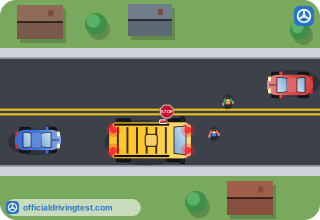
For how long must you stop for a school bus with its red or amber lights flashing or its stop arm extended?
- Only while children are visible outside the bus
- For about ten seconds, then proceed slowly
- Until the bus doors have closed
- The entire time it is stopped or preparing to stop
Show answer
Correct answer: The entire time it is stopped or preparing to stop
You must stay stopped for the whole time the bus is stopped or preparing to stop with flashing red or amber lights or its stop arm out.
Source: South Carolina Driver's Manual (2026 (posted April 2026)), page 7-8 · Open this page in the manual (Manual page 7-8)
-
After a school bus has stopped flashing its lights and its stop arm is no longer visible, what should you do?
- Proceed slowly, watching for children
- Speed up to make up for lost time
- Resume normal speed at once
- Stay stopped until the bus is out of sight
Show answer
Correct answer: Proceed slowly, watching for children
Once the lights stop flashing and the stop arm is gone, you proceed slowly and watch for children.
Source: South Carolina Driver's Manual (2026 (posted April 2026)), page 7-8 · Open this page in the manual (Manual page 7-8)
-
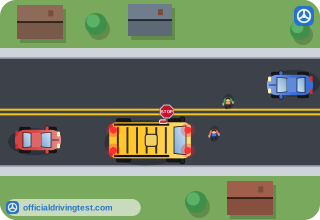
On a two-lane road, what are you required to do when a school bus is stopped?
- Slow down and pass with caution
- Stop for the school bus
- Stop only if you are behind the bus
- Continue if no children are visible
Show answer
Correct answer: Stop for the school bus
A driver on a two-lane road is required to stop for a stopped school bus.
Source: South Carolina Driver's Manual (2026 (posted April 2026)), page 7-9 · Open this page in the manual (Manual page 7-9)
-
On a four-lane or multi-lane highway, when must you stop for a school bus with flashing signals?
- You are meeting it from the opposite direction
- You are in the lane farthest from the bus
- Children are standing at the roadside
- You are traveling behind the school bus
Show answer
Correct answer: You are traveling behind the school bus
On a four-lane or multi-lane highway the stopping requirement applies when traveling behind a school bus.
Source: South Carolina Driver's Manual (2026 (posted April 2026)), page 7-9 · Open this page in the manual (Manual page 7-9)
-
A school bus is in a passenger loading zone completely off the main travel lanes. In what additional case do you not have to stop?
- Pedestrians are not allowed to cross the road
- No children are visible near the bus
- The bus driver signals you to go on
- You are traveling below the speed limit
Show answer
Correct answer: Pedestrians are not allowed to cross the road
You need not stop when the bus is in a loading zone completely off the main travel lanes and pedestrians are not allowed to cross the roadway.
Source: South Carolina Driver's Manual (2026 (posted April 2026)), page 7-9 · Open this page in the manual (Manual page 7-9)
-
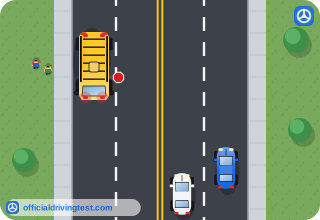
A school bus is stopped with its red lights flashing on a highway with four lanes, two in each direction. You are driving in the opposite direction from the bus. What are you required to do?
- You do not have to stop
- Stop and wait until the lights stop flashing
- Stop only if children are crossing the road
- Slow to a crawl and pass with caution
Show answer
Correct answer: You do not have to stop
On a four-lane highway with at least two lanes each way, a driver meeting a stopped school bus from the opposite direction does not have to stop.
Source: South Carolina Driver's Manual (2026 (posted April 2026)), page 7-10 · Open this page in the manual (Manual page 7-10)
-
For the school bus stopping exception, how is a multi-lane highway or multi-lane private road defined?
- Any road that has a center lane reserved for left turns
- Any road with three or more lanes going in the same direction only
- Four lanes, with at least two traffic lanes in each direction
- Any highway with a posted speed limit above 45 mph
Show answer
Correct answer: Four lanes, with at least two traffic lanes in each direction
The manual defines it as a highway or private road with four lanes and at least two traffic lanes in each direction.
Source: South Carolina Driver's Manual (2026 (posted April 2026)), page 7-10 · Open this page in the manual (Manual page 7-10)
-
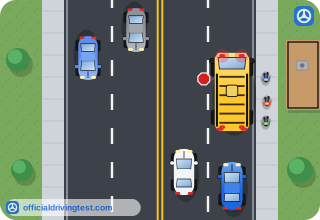
You are driving behind a stopped school bus that has its red lights flashing on a four-lane highway. What must you do?
- Stop only if the bus is on a two-lane road
- Stop and stay stopped
- Slow down and pass on the left
- Pass only if no children are visible
Show answer
Correct answer: Stop and stay stopped
A driver must always stop on any highway when behind the bus.
Source: South Carolina Driver's Manual (2026 (posted April 2026)), page 7-10 · Open this page in the manual (Manual page 7-10)