South Carolina: Sharing the road — Part 4 Practice Test
Questions in this part include: “Compared with cars, how large are the blind spots of commercial vehicles?” · “How far behind a large vehicle can its rear no zone extend?”
Independent educational site · not affiliated with any government agency or DMV
Ready? Test yourself
- Instant feedback with an explanation
- Every answer cites its source in the manual
- Your best score is saved on this device
- Keyboard: press 1 to 4 to answer and Enter for the next question
Questions are original and based on the official manual "South Carolina Driver's Manual" (2026 (posted April 2026)), South Carolina Department of Motor Vehicles.
All 16 questions in this practice test
Take the test above first, then use this list to study. Tap “Show answer” to see the correct answer and explanation.
Show the questions and answersHide the questions
-
Compared with cars, how large are the blind spots of commercial vehicles?
- Much larger
- About the same size
- Slightly smaller
- Much smaller
Show answer
Correct answer: Much larger
Commercial vehicles have much larger blind spots than cars.
Source: South Carolina Driver's Manual (2026 (posted April 2026)), page 10-7 · Open this page in the manual (Manual page 10-7)
-
Which statement about commercial vehicles compared with cars is correct?
- Shorter stopping distances, but more room to turn than cars
- Quicker acceleration than cars, and more room to turn
- Longer stopping and accelerating distances, and more room to turn
- Less room to turn, but longer stopping distances than cars
Show answer
Correct answer: Longer stopping and accelerating distances, and more room to turn
Commercial vehicles take longer to stop and to speed up, and they need more room to turn.
Source: South Carolina Driver's Manual (2026 (posted April 2026)), page 10-7 · Open this page in the manual (Manual page 10-7)
-
What is the "no zone" around a large truck or bus?
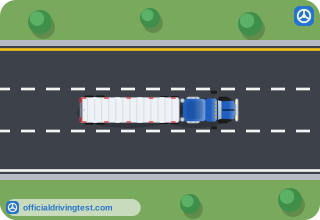
- The area where vehicles disappear into the driver's blind spots
- The area in front of it where passing is not allowed
- The distance behind it where following is against the law
- The area around it where it may not stop
Show answer
Correct answer: The area where vehicles disappear into the driver's blind spots
The no zone is made up of the blind spots around a large truck or bus where the driver cannot see other vehicles.
Source: South Carolina Driver's Manual (2026 (posted April 2026)), page 10-8 · Open this page in the manual (Manual page 10-8)
-
Where are the blind spots of large trucks and buses located?
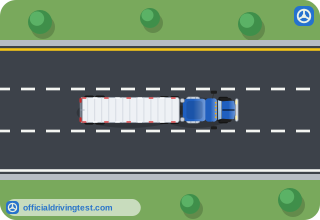
- Only on the sides and the rear
- Only at the front and the rear
- Only on the right side
- On the sides, rear, and front
Show answer
Correct answer: On the sides, rear, and front
A large commercial vehicle has blind spots on its sides, at its rear and at its front.
Source: South Carolina Driver's Manual (2026 (posted April 2026)), page 10-8 · Open this page in the manual (Manual page 10-8)
-
On which side do trucks have a larger blind spot?
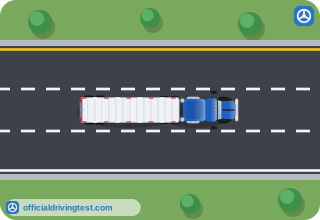
- The left side
- The right side
- Both sides equally
- Neither side, only the rear
Show answer
Correct answer: The right side
A truck's blind spot is larger on its right side, starting behind the cab and extending up to the length of the truck.
Source: South Carolina Driver's Manual (2026 (posted April 2026)), page 10-8 · Open this page in the manual (Manual page 10-8)
-
You cannot see a truck driver's face in the truck's side view mirror. What does this mean?
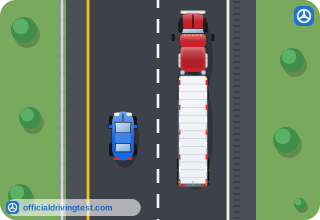
- The driver can see you only when braking
- The driver cannot see you
- You are in a safe position to pass
- The driver's mirror is out of adjustment
Show answer
Correct answer: The driver cannot see you
If you cannot see the driver's face in the side mirror, the driver cannot see you.
Source: South Carolina Driver's Manual (2026 (posted April 2026)), page 10-8 · Open this page in the manual (Manual page 10-8)
-
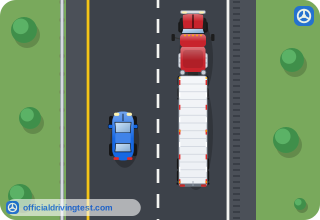
How long should you drive alongside a large vehicle?
- Until the driver signals
- As long as you stay in your lane
- Only while it is climbing a hill
- No longer than required
Show answer
Correct answer: No longer than required
Driving beside a large vehicle raises the chance of a collision if the driver swerves or changes lanes, so avoid it longer than necessary.
Source: South Carolina Driver's Manual (2026 (posted April 2026)), page 10-8 · Open this page in the manual (Manual page 10-8)
-
Under ideal conditions, what minimum distance does a loaded truck with good tires and properly adjusted brakes need to stop from 55 mph?
- 335 feet
- 165 feet
- 225 feet
- 450 feet
Show answer
Correct answer: 335 feet
The manual states a loaded truck traveling 55 mph needs a minimum of 335 feet to stop.
Source: South Carolina Driver's Manual (2026 (posted April 2026)), page 10-9 · Open this page in the manual (Manual page 10-9)
-
How does the stopping distance of a loaded truck at 55 mph compare with that of a car?
- About the same distance
- Slightly shorter than a car's
- Greater than 1½ times as long
- Less than half a car's distance
Show answer
Correct answer: Greater than 1½ times as long
A loaded truck needs more than 1½ times the stopping distance of a car.
Source: South Carolina Driver's Manual (2026 (posted April 2026)), page 10-9 · Open this page in the manual (Manual page 10-9)
-
Because large vehicles take longer to stop, what is essential?
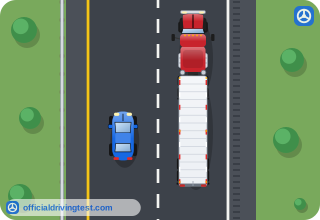
- Not to enter a roadway or change lanes in front of a large vehicle
- To change lanes quickly in front of one to keep traffic moving
- To brake hard after you pull in front of one
- To drive beside one until its driver signals
Show answer
Correct answer: Not to enter a roadway or change lanes in front of a large vehicle
Since a large vehicle needs so much room to stop, you should never pull out or change lanes right in front of it.
Source: South Carolina Driver's Manual (2026 (posted April 2026)), page 10-9 · Open this page in the manual (Manual page 10-9)
-
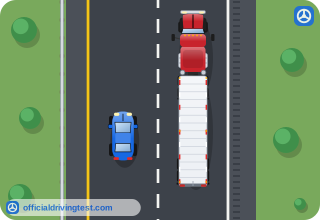
What should you do before pulling in front of a large vehicle that you are passing?
- Slow down as soon as you are beside its cab
- Check that its right turn signal is switched on
- Look for its whole front in your rear-view mirror
- Flash your headlights to tell its driver you are there
Show answer
Correct answer: Look for its whole front in your rear-view mirror
You should be able to see the whole front of the large vehicle in your rear-view mirror before you move in front of it.
Source: South Carolina Driver's Manual (2026 (posted April 2026)), page 10-9 · Open this page in the manual (Manual page 10-9)
-
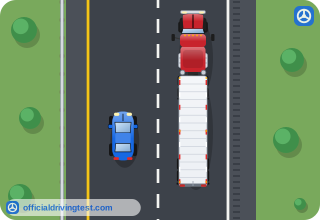
When passing a large vehicle, what should you be sure to do with your speed?
- Slow down as you pull in front
- Maintain it
- Speed up sharply, then brake
- Reduce it until the vehicle passes you
Show answer
Correct answer: Maintain it
The manual says to be sure to maintain your speed when passing a large vehicle.
Source: South Carolina Driver's Manual (2026 (posted April 2026)), page 10-9 · Open this page in the manual (Manual page 10-9)
-
How far behind a large vehicle can its rear no zone extend?
- Up to 50 feet
- Up to 100 feet
- Up to 500 feet
- Up to 200 feet
Show answer
Correct answer: Up to 200 feet
Large vehicles have huge blind spots directly behind them that extend up to 200 feet.
Source: South Carolina Driver's Manual (2026 (posted April 2026)), page 10-9 · Open this page in the manual (Manual page 10-9)
-
If you follow a large vehicle too closely and it brakes or stops suddenly, what could happen?
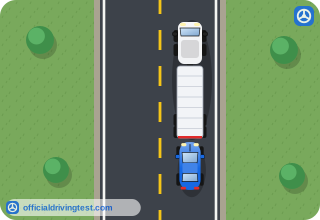
- Its driver sees you in the mirror and speeds up
- Its brake lights give you extra room to stop
- The vehicle swerves behind you
- You have no place to go and could run into it
Show answer
Correct answer: You have no place to go and could run into it
Inside the rear no zone you cannot see ahead, so a sudden stop leaves you with nowhere to go.
Source: South Carolina Driver's Manual (2026 (posted April 2026)), page 10-9 · Open this page in the manual (Manual page 10-9)
-
When following a large vehicle, how should you position your vehicle?
- Directly behind it, as close as you can safely get
- So the driver can see it in the side mirrors
- Where the driver cannot see you, to stay out of the way
- Alongside its cab, in the right-side blind spot
Show answer
Correct answer: So the driver can see it in the side mirrors
Position yourself so the driver can see your vehicle in his or her side mirrors.
Source: South Carolina Driver's Manual (2026 (posted April 2026)), page 10-10 · Open this page in the manual (Manual page 10-10)
-
About how fast must large vehicles drive when traveling up or down steep hills?
- Approximately 15 mph
- Approximately 25 mph
- Approximately 35 mph
- Approximately 45 mph
Show answer
Correct answer: Approximately 35 mph
On steep hills large vehicles must drive slowly, at approximately 35 mph, and therefore use the right lane.
Source: South Carolina Driver's Manual (2026 (posted April 2026)), page 10-10 · Open this page in the manual (Manual page 10-10)