South Carolina: Sharing the road — Part 2 Practice Test
Questions in this part include: “What should you do when you pass a bicyclist?” · “How does the manual describe bicycles when they are on roadways?”
Independent educational site · not affiliated with any government agency or DMV
Ready? Test yourself
- Instant feedback with an explanation
- Every answer cites its source in the manual
- Your best score is saved on this device
- Keyboard: press 1 to 4 to answer and Enter for the next question
Questions are original and based on the official manual "South Carolina Driver's Manual" (2026 (posted April 2026)), South Carolina Department of Motor Vehicles.
All 16 questions in this practice test
Take the test above first, then use this list to study. Tap “Show answer” to see the correct answer and explanation.
Show the questions and answersHide the questions
-
What should you do when you pass a bicyclist?
- Sound your horn and keep your speed so that you pass the bicyclist as quickly as you can
- Pass as close to the bicyclist as possible to finish the pass quickly
- Slow down and leave as much space as possible between you and the bicyclist
- Speed up so you are alongside the bicyclist for as short a time as you can
Show answer
Correct answer: Slow down and leave as much space as possible between you and the bicyclist
Slow down, leave as much space as possible between you and the bicyclist, and consider the bicyclist's speed.
Source: South Carolina Driver's Manual (2026 (posted April 2026)), page 7-16 · Open this page in the manual (Manual page 7-16)
-
Who should you give extra space to?
- Only pedestrians who are crossing in a marked crosswalk
- Only bicyclists who are riding in a marked bike lane
- Pedestrians and bicyclists, especially children and the elderly
- Only children who are walking next to the roadway
Show answer
Correct answer: Pedestrians and bicyclists, especially children and the elderly
The manual says to give extra space to pedestrians, especially children and the elderly, and to bicyclists.
Source: South Carolina Driver's Manual (2026 (posted April 2026)), page 8-8 · Open this page in the manual (Manual page 8-8)
-
When a tractor trailer is passing you, what should you do to leave a little more space?
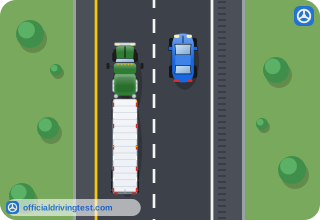
- Move to the portion of your lane nearest the tractor trailer
- Move to the outside portion of your lane, away from the tractor trailer
- Slow down sharply and stay centered in your lane
- Speed up to stay beside the tractor trailer's cab
Show answer
Correct answer: Move to the outside portion of your lane, away from the tractor trailer
You leave extra room by moving to the outside of your lane, away from the passing tractor trailer.
Source: South Carolina Driver's Manual (2026 (posted April 2026)), page 8-8 · Open this page in the manual (Manual page 8-8)
-
How does the manual describe bicycles when they are on roadways?
- They are considered vehicles
- They are considered pedestrians
- They are considered exempt from traffic laws
- They are considered special equipment
Show answer
Correct answer: They are considered vehicles
On roadways, bicycles are considered vehicles.
Source: South Carolina Driver's Manual (2026 (posted April 2026)), page 10-2 · Open this page in the manual (Manual page 10-2)
-
Which rules of the road are bicyclists required and expected to follow?
- Only the rules that apply to pedestrians
- Only the rules posted on signs
- The same rules as motorized vehicles
- Fewer rules, because they are slower
Show answer
Correct answer: The same rules as motorized vehicles
Bicyclists are required and expected to follow the same rules of the road as motorized vehicles.
Source: South Carolina Driver's Manual (2026 (posted April 2026)), page 10-2 · Open this page in the manual (Manual page 10-2)
-
How does the manual describe a skillful bicyclist?
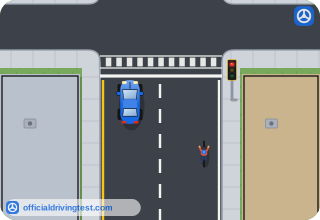
- Swerves to show where they are going
- Rides predictably and holds a steady line
- Always rides on the sidewalk
- Rides in the middle of the lane at all times
Show answer
Correct answer: Rides predictably and holds a steady line
A skillful bicyclist rides predictably and holds a steady line.
Source: South Carolina Driver's Manual (2026 (posted April 2026)), page 10-3 · Open this page in the manual (Manual page 10-3)
-
You see an unskillful bicyclist who swerves unpredictably and ignores traffic signs and signals. What should you be ready for?
- A sudden stop by every other driver
- A turn signal from the bicyclist
- The bicyclist to stay in one line
- Any sudden movements
Show answer
Correct answer: Any sudden movements
If you see an unskillful bicyclist, you should be ready for any sudden movements.
Source: South Carolina Driver's Manual (2026 (posted April 2026)), page 10-3 · Open this page in the manual (Manual page 10-3)
-
A bicycle path or bike lane crosses the road you are driving on. Who yields the right-of-way?
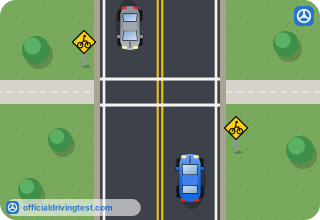
- The bicyclist yields
- The faster of the two yields
- You yield
- Whoever arrives second yields
Show answer
Correct answer: You yield
Drivers must yield right-of-way when a bicycle path or bike lane intersects a road.
Source: South Carolina Driver's Manual (2026 (posted April 2026)), page 10-3 · Open this page in the manual (Manual page 10-3)
-
When may you stop, park, or drive on a designated bicycle path or lane?
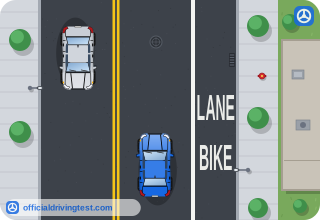
- When the road ahead is crowded
- When entering or leaving an alley or driveway
- When you need to pass a slower vehicle
- When you are turning right at an intersection
Show answer
Correct answer: When entering or leaving an alley or driveway
You may use a bike lane only to enter or leave an alley or driveway, for official duties, when directed by an officer, or in an emergency.
Source: South Carolina Driver's Manual (2026 (posted April 2026)), page 10-3 · Open this page in the manual (Manual page 10-3)
-
When approaching or passing a bicyclist, what should you do?
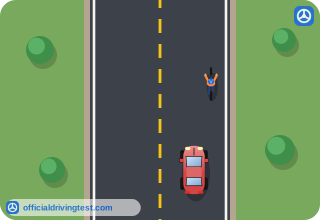
- Pass as closely as possible to save time
- Sound your horn and speed up
- Stay close behind and flash your lights
- Allow as much space as possible and slow down
Show answer
Correct answer: Allow as much space as possible and slow down
The manual says to allow as much space as possible and slow down when approaching or passing a bicyclist.
Source: South Carolina Driver's Manual (2026 (posted April 2026)), page 10-3 · Open this page in the manual (Manual page 10-3)
-
Why should you avoid slowing down or stopping quickly near bicyclists?
- A bicycle’s brakes are more powerful than a car’s, so it can always stop faster
- Bicyclists cannot see brake lights, so they will pass you
- A motor vehicle’s brakes are more powerful than a bicycle’s, so you could cause a collision
- Stopping quickly would damage your tires
Show answer
Correct answer: A motor vehicle’s brakes are more powerful than a bicycle’s, so you could cause a collision
A motor vehicle’s brakes are more powerful than a bicycle’s, so slowing down or stopping quickly near a bicyclist could cause a collision.
Source: South Carolina Driver's Manual (2026 (posted April 2026)), page 10-3 · Open this page in the manual (Manual page 10-3)
-
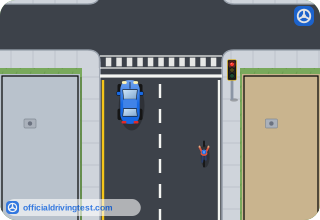
When may you sound your horn close to bicyclists?
- Whenever you want to pass them
- When there is a chance of a collision
- Whenever you approach them from behind
- Whenever they ride on the shoulder
Show answer
Correct answer: When there is a chance of a collision
The horn can startle bicyclists and make them steer into your path, so use it only when a collision is possible.
Source: South Carolina Driver's Manual (2026 (posted April 2026)), page 10-3 · Open this page in the manual (Manual page 10-3)
-
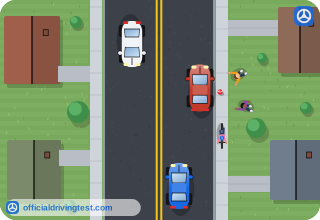
You see children riding bikes on the sidewalk. What should you watch for?
- They will stay on the sidewalk
- They will stop at every driveway
- They will signal before entering the road
- They may come onto the road
Show answer
Correct answer: They may come onto the road
The manual warns that children riding on the sidewalk may come onto the road, so you watch for bicyclists entering your lane.
Source: South Carolina Driver's Manual (2026 (posted April 2026)), page 10-4 · Open this page in the manual (Manual page 10-4)
-
What should you avoid doing around a bicyclist?
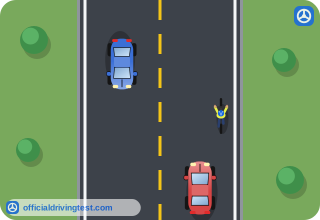
- Turning sharply in front of the bicyclist or forcing the bicyclist off the road
- Staying behind the bicyclist at a safe distance until it is safe to pass
- Slowing down as you approach the bicyclist
- Checking over your shoulder before you pass
Show answer
Correct answer: Turning sharply in front of the bicyclist or forcing the bicyclist off the road
The manual says to avoid turning sharply in front of a bicyclist and not to force a bicyclist off the road.
Source: South Carolina Driver's Manual (2026 (posted April 2026)), page 10-4 · Open this page in the manual (Manual page 10-4)
-
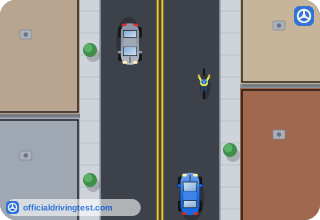
Bicyclists are required to ride in the direction of traffic. Where should you look for them?
- Only at the right edge of the road
- Only in bike lanes
- Anywhere on the roadway
- Only on the sidewalk
Show answer
Correct answer: Anywhere on the roadway
Although bicyclists must ride with traffic, the manual says to look for them riding anywhere on the roadway.
Source: South Carolina Driver's Manual (2026 (posted April 2026)), page 10-4 · Open this page in the manual (Manual page 10-4)
-
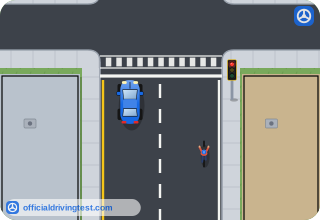
When should you be particularly careful around bicyclists?
- When the road is dry and clean
- When the road is wet or covered with sand or gravel
- When the bicyclist is wearing bright clothes
- When the bicyclist is riding in a bike lane
Show answer
Correct answer: When the road is wet or covered with sand or gravel
Wet roads and sand or gravel affect bicycles much more than vehicles, so extra care is needed.
Source: South Carolina Driver's Manual (2026 (posted April 2026)), page 10-4 · Open this page in the manual (Manual page 10-4)