Rhode Island: Right-of-way and turning — Part 5 Practice Test
Questions in this part include: “The roundabout procedures in this manual refer to which kind of roundabout?” · “In the manual's roundabout diagram, the label A marks which feature?”
Independent educational site · not affiliated with any government agency or DMV
Ready? Test yourself
- Instant feedback with an explanation
- Every answer cites its source in the manual
- Your best score is saved on this device
- Keyboard: press 1 to 4 to answer and Enter for the next question
Questions are original and based on the official manual "Rhode Island Driver’s Manual" (April 2024), Rhode Island Division of Motor Vehicles (DMV).
All 17 questions in this practice test
Take the test above first, then use this list to study. Tap “Show answer” to see the correct answer and explanation.
Show the questions and answersHide the questions
-
Instead of stop signs or traffic signals, what does a roundabout use to guide traffic?
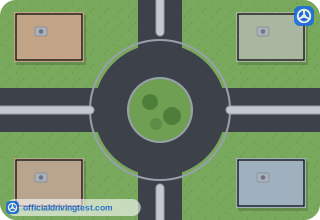
- Yield signs, directional signs, pavement markings
- Flashing red lights and railroad gates
- Stop lines, crossing guards and turn arrows
- Green arrows and horizontal signals
Show answer
Correct answer: Yield signs, directional signs, pavement markings
A roundabout has no stop signs or traffic signals; it uses yield signs, directional signs and pavement markings.
Source: Rhode Island Driver’s Manual (April 2024), page 40
-
The roundabout procedures in this manual refer to which kind of roundabout?
- Multi-lane roundabouts
- Single lane roundabouts
- Roundabouts with traffic signals
- Roundabouts with stop signs
Show answer
Correct answer: Single lane roundabouts
The manual says its information is about single lane roundabouts and warns that many states use multi-lane ones.
Source: Rhode Island Driver’s Manual (April 2024), page 40
-
When navigating a roundabout, what speed should a motorist drive?
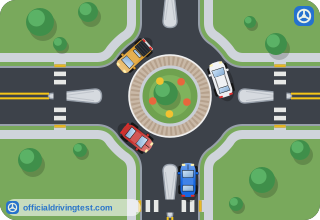
- Maintain highway speed
- Drive at the speed of the vehicle behind you
- Speed up to merge ahead of other vehicles
- Slow down to the posted speed
Show answer
Correct answer: Slow down to the posted speed
A motorist navigating a roundabout should slow down to the posted speed.
Source: Rhode Island Driver’s Manual (April 2024), page 40
-
In a roundabout, who has the right-of-way over a motorist?
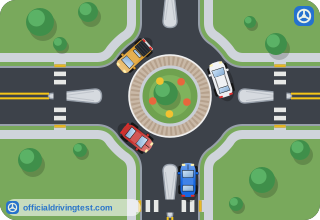
- Pedestrians and other motorists
- Only emergency vehicles
- Only vehicles about to exit
- Only bicyclists
Show answer
Correct answer: Pedestrians and other motorists
The motorist must yield to pedestrians and other motorists because they have the right-of-way.
Source: Rhode Island Driver’s Manual (April 2024), page 40
-
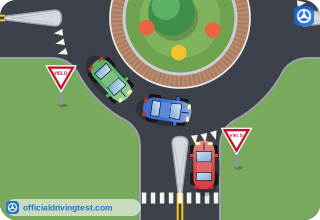
What should a motorist ensure before entering a roundabout?
- That the horn works
- That the center island is clear of pedestrians
- An adequate safe gap
- That all other vehicles have exited
Show answer
Correct answer: An adequate safe gap
The motorist must make sure of an adequate safe gap and move to the proper lane position.
Source: Rhode Island Driver’s Manual (April 2024), page 40
-
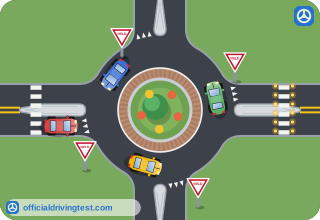
When may a driver stop inside a roundabout?
- To let a pedestrian cross in the center
- Only in an emergency
- When the exit is not yet visible
- When traffic ahead is moving slowly
Show answer
Correct answer: Only in an emergency
The manual says never to stop in a roundabout unless it is an emergency.
Source: Rhode Island Driver’s Manual (April 2024), page 40
-
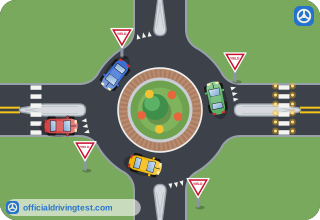
How should a driver leave a roundabout?
- Exit to the left after stopping in the circle
- Exit to the right without signaling
- Stop at the exit and wait for a gap
- Signal, exit to the right and yield to pedestrians
Show answer
Correct answer: Signal, exit to the right and yield to pedestrians
The exit step is to signal, then leave the roundabout to the right and yield to pedestrians.
Source: Rhode Island Driver’s Manual (April 2024), page 40
-
In the manual's roundabout diagram, the label A marks which feature?
- Splitter or refuge
- Center island
- Entry lane
- Yield sign
Show answer
Correct answer: Splitter or refuge
The diagram labels A as the splitter or refuge, B as the crosswalk and C as the center island.
Source: Rhode Island Driver’s Manual (April 2024), page 40
-
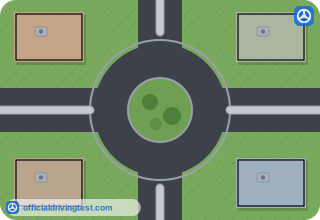
In the absence of any traffic control device or sign, whom must a driver about to enter a rotary yield to?
- All vehicles already in the rotary
- Only vehicles approaching from the right
- Only emergency vehicles
- No one, because the entering driver has the right-of-way
Show answer
Correct answer: All vehicles already in the rotary
Under R.I.G.L. 31-17-8, the driver entering a rotary yields to every vehicle already in it, whichever direction the driver comes from.
Source: Rhode Island Driver’s Manual (April 2024), page 41
-
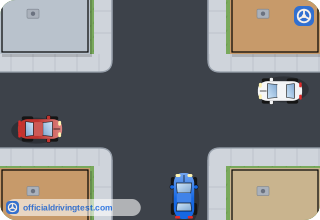
What is an intersection with no signs or signals called?
- A protected intersection
- An uncontrolled intersection
- A shared intersection
- A signaled intersection
Show answer
Correct answer: An uncontrolled intersection
Intersections without signs or signals are known as uncontrolled intersections.
Source: Rhode Island Driver’s Manual (April 2024), page 41
-
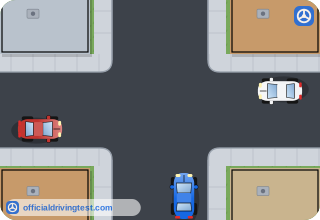
How must motorists treat an uncontrolled intersection?
- As if there were a stop sign present
- As if the light were flashing red
- As if they had the right-of-way
- As if there were a yield sign present
Show answer
Correct answer: As if there were a yield sign present
When approaching uncontrolled intersections, motorists must treat them as if a yield sign were there.
Source: Rhode Island Driver’s Manual (April 2024), page 41
-
How does the manual define right-of-way?
- The legal duty to stop and wait at every intersection you come to
- The right to drive at the posted speed limit on every roadway at all times
- The permission to pass another vehicle on a two-lane road when it is clear
- The privilege of having or giving other motorists immediate use of a roadway
Show answer
Correct answer: The privilege of having or giving other motorists immediate use of a roadway
The manual defines right-of-way as the privilege of having or giving other motorists immediate use of a certain roadway.
Source: Rhode Island Driver’s Manual (April 2024), page 41
-
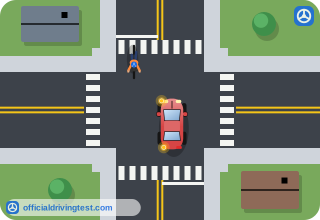
When turning left at an intersection, how should you treat oncoming bicyclists?
- Turn first, because bicycles are slower
- Sound your horn and then turn
- Treat them like pedestrians and turn behind them
- Yield to them just as you would to oncoming vehicles
Show answer
Correct answer: Yield to them just as you would to oncoming vehicles
The manual says to yield to oncoming bicyclists as you would to oncoming vehicles when turning left.
Source: Rhode Island Driver’s Manual (April 2024), page 55
-
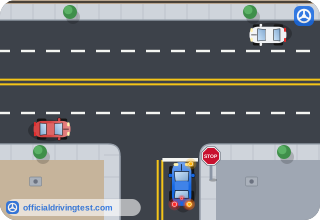
Before turning right at an intersection or driveway, what should you check?
- For bicyclists on your right or behind you going straight ahead
- That no bicyclist is ahead of you on the left side of the road
- That the bicycle lane is empty on the far side of the intersection
- That no pedestrians are waiting on the opposite curb
Show answer
Correct answer: For bicyclists on your right or behind you going straight ahead
Bicyclists going straight on your right or behind you may be in your path when you turn right.
Source: Rhode Island Driver’s Manual (April 2024), page 55
-
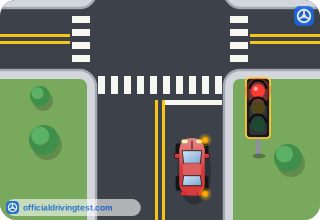
In Rhode Island, what is the rule for turning right at a red light?
- Permitted, not required, after a stop unless a sign prohibits it
- It is never permitted at any red light
- It is required whenever the way is clear
- It is permitted without stopping if no traffic is coming
Show answer
Correct answer: Permitted, not required, after a stop unless a sign prohibits it
Right on red is allowed but not required, and only after a full stop. A “no turn on red” sign forbids it.
Source: Rhode Island Driver’s Manual (April 2024), page 58
-
Before turning right on a red light after stopping, whom must you yield to?
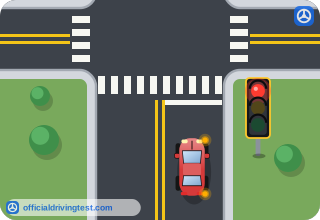
- Pedestrians only, not other vehicles
- Only vehicles approaching from behind you
- All oncoming traffic and pedestrians
- Only emergency vehicles
Show answer
Correct answer: All oncoming traffic and pedestrians
A driver turning right on red must first give way to all oncoming traffic and to pedestrians.
Source: Rhode Island Driver’s Manual (April 2024), page 58
-
With no signs or signals, two vehicles from different streets reach an intersection at about the same time. Which driver must yield the right-of-way?
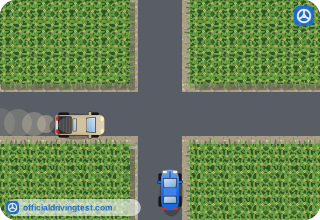
- The driver of the vehicle on the right
- The driver of the larger vehicle
- The driver of the faster vehicle
- The driver of the vehicle on the left
Show answer
Correct answer: The driver of the vehicle on the left
Where there are no signs or signals, the driver on the left yields to the vehicle on the right.
Source: Rhode Island Driver’s Manual (April 2024), page 58