Rhode Island: Right-of-way and turning — Part 2 Practice Test
Questions in this part include: “What are turnabouts?” · “In Rhode Island, when may you make a U-turn?”
Independent educational site · not affiliated with any government agency or DMV
Ready? Test yourself
- Instant feedback with an explanation
- Every answer cites its source in the manual
- Your best score is saved on this device
- Keyboard: press 1 to 4 to answer and Enter for the next question
Questions are original and based on the official manual "Rhode Island Driver’s Manual" (April 2024), Rhode Island Division of Motor Vehicles (DMV).
All 17 questions in this practice test
Take the test above first, then use this list to study. Tap “Show answer” to see the correct answer and explanation.
Show the questions and answersHide the questions
-
What are turnabouts?
- Maneuvers used to pass a slow vehicle on the left side of the road
- Maneuvers in which you turn your car around to drive in the opposite direction
- Maneuvers used to enter a freeway
- Maneuvers used to park beside a curb
Show answer
Correct answer: Maneuvers in which you turn your car around to drive in the opposite direction
A turnabout is a maneuver for turning the car around to go the opposite way.
Source: Rhode Island Driver’s Manual (April 2024), page 30
-
Before you make a turnabout, how far must you have clear visibility in each direction?
- Five hundred feet
- Two hundred feet
- One hundred feet
- One thousand feet
Show answer
Correct answer: Five hundred feet
The manual says to make certain you can see clearly 500 feet in each direction.
Source: Rhode Island Driver’s Manual (April 2024), page 30
-
Before you make a turnabout, how far from an intersection must you be?
- At least fifty feet
- At least five hundred feet
- At least two hundred feet
- At least one hundred feet
Show answer
Correct answer: At least two hundred feet
The manual says you must be at least 200 feet from an intersection before a turnabout.
Source: Rhode Island Driver’s Manual (April 2024), page 30
-
What does the manual say about local statutes and turnabouts?
- They never apply to turnabouts on public streets or roads
- They allow turnabouts on every street
- They apply only on freeways
- They may prohibit turnabouts, so be familiar with local regulations
Show answer
Correct answer: They may prohibit turnabouts, so be familiar with local regulations
Local laws can ban turnabouts, so you need to know the local traffic regulations.
Source: Rhode Island Driver’s Manual (April 2024), page 30
-
How many types of turnabouts does the manual describe?
- Two
- Three
- Five
- Four
Show answer
Correct answer: Four
The manual describes four types of turnabouts.
Source: Rhode Island Driver’s Manual (April 2024), page 30
-
How must you choose which turnabout to use?
- Choose the one that takes the least amount of time to finish
- Choose the safest one that best suits the traffic and the street
- Choose the one with the fewest steps
- Always choose a U-turn
Show answer
Correct answer: Choose the safest one that best suits the traffic and the street
The manual says to choose the safest turnabout that best suits the traffic and the street.
Source: Rhode Island Driver’s Manual (April 2024), page 30
-
After you have stopped at the right curb for a U-turn, how can you signal your intent?
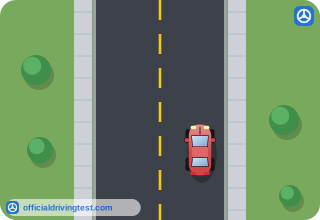
- With the right turn signal that you used to pull over
- With a short blast of your horn before you pull out
- With your left turn signal or your four-way hazard lights
- With your high-beam headlights flashed twice
Show answer
Correct answer: With your left turn signal or your four-way hazard lights
For a U-turn the manual allows the left turn signal or the four-way hazard lights.
Source: Rhode Island Driver’s Manual (April 2024), page 30
-
When making a U-turn, which way do you turn the steering wheel when you have a clear path?
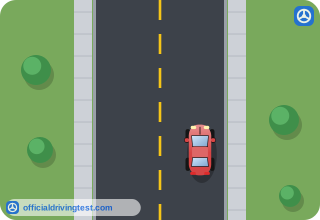
- All the way to the left
- All the way to the right
- Halfway to the left
- Straight ahead
Show answer
Correct answer: All the way to the left
With a clear path, you turn the wheel all the way to the left and drive slowly to the left.
Source: Rhode Island Driver’s Manual (April 2024), page 30
-
In Rhode Island, when may you make a U-turn?
- Anywhere you like, as long as no police officer is in sight to see it
- Only on streets wider than four lanes
- Only when it is allowed and does not interfere with traffic in either direction
- Only when there is no traffic behind you and the road ahead is clear
Show answer
Correct answer: Only when it is allowed and does not interfere with traffic in either direction
A U-turn must be allowed and must not interfere with traffic flow in either direction.
Source: Rhode Island Driver’s Manual (April 2024), page 30
-
What is an advantage of backing into a driveway or side street on the right side?
- It allows you to reenter traffic by driving forward
- It lets you stay in the left lane the whole time
- It is the only turnabout allowed on a narrow street
- It means you do not need to signal
Show answer
Correct answer: It allows you to reenter traffic by driving forward
Backing into the driveway lets you drive forward when you go back into traffic.
Source: Rhode Island Driver’s Manual (April 2024), page 30
-
When backing into a driveway or side street on the right side, where should you drive before you begin to back up?
- Into the middle of the intersection
- To the left edge of the road
- Directly into the driveway, front end first
- Past the street or driveway you plan to back into
Show answer
Correct answer: Past the street or driveway you plan to back into
You first drive past the street or driveway, then back into it.
Source: Rhode Island Driver’s Manual (April 2024), page 30
-
When backing into a driveway or side street on the right side, which way do you slowly turn the steering wheel as you begin to back up?
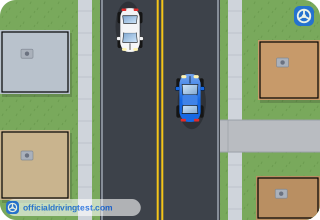
- To the left
- To the right
- Straight, then left
- Fully left, then fully right
Show answer
Correct answer: To the right
To back into a driveway on the right, you slowly turn the wheel to the right.
Source: Rhode Island Driver’s Manual (April 2024), page 30
-
When you finish backing into a driveway or side street on the right side, what should you do?
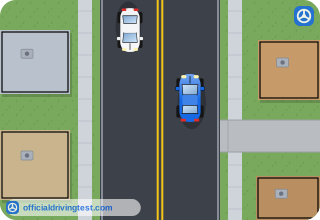
- Straighten the steering wheel and stop once you have cleared the curb line
- Keep backing up until you reach the end of the driveway
- Turn the wheel fully left and stop at the curb
- Turn off your signal and wait for the lane to clear behind you
Show answer
Correct answer: Straighten the steering wheel and stop once you have cleared the curb line
After backing in, you straighten the wheel and stop once you have cleared the curb line.
Source: Rhode Island Driver’s Manual (April 2024), page 30
-
Why is pulling into a street or driveway on the left more hazardous than backing in on the right?
- You must drive past the driveway first
- Your signal cannot be seen
- You will be backing into the travel lane
- You must cross a solid yellow line
Show answer
Correct answer: You will be backing into the travel lane
Backing out of a left-side driveway puts the vehicle's rear into the lane of traffic.
Source: Rhode Island Driver’s Manual (April 2024), page 30
-
When pulling into a street or driveway on the left, when do you straighten the front wheels and stop?
- When the car has reached the middle of the street
- When the car has crossed the curb line
- When the car is fully inside the driveway
- When another vehicle approaches
Show answer
Correct answer: When the car has crossed the curb line
You straighten the front wheels and stop as soon as the car has entered and crossed the curb line.
Source: Rhode Island Driver’s Manual (April 2024), page 31
-
When pulling into a street or driveway on the left, which way do you turn the steering wheel to slowly back up into the first lane of travel?
- To the left
- Straight
- Fully left, then fully right
- To the right
Show answer
Correct answer: To the right
You turn the wheel to the right and slowly back into the first lane of travel.
Source: Rhode Island Driver’s Manual (April 2024), page 31
-
When pulling into a street or driveway on the left, when do you begin to straighten the steering wheel as you back up?
- As soon as the car starts to move
- Only after the car has stopped
- At the very end of the turn
- At about the half-way point in the turn
Show answer
Correct answer: At about the half-way point in the turn
The manual says to begin straightening the wheel at about the halfway point of the turn.
Source: Rhode Island Driver’s Manual (April 2024), page 31