Rhode Island: Railroad crossings Practice Test
Crossing railroad tracks safely and what to do if your vehicle stalls on the tracks.
Independent educational site · not affiliated with any government agency or DMV
Ready? Test yourself
- Instant feedback with an explanation
- Every answer cites its source in the manual
- Your best score is saved on this device
- Keyboard: press 1 to 4 to answer and Enter for the next question
Questions are original and based on the official manual "Rhode Island Driver’s Manual" (April 2024), Rhode Island Division of Motor Vehicles (DMV).
All 7 questions in this practice test
Take the test above first, then use this list to study. Tap “Show answer” to see the correct answer and explanation.
Show the questions and answersHide the questions
-
If your vehicle stalls on railroad tracks and you know a train is approaching, what should you do first?
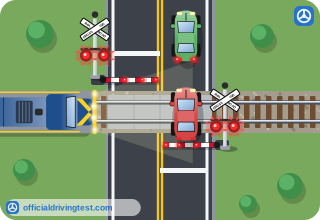
- Stay inside with your seat belt fastened and wait
- Keep trying to restart the engine
- Sound the horn until the train stops
- Get yourself and any passengers out and off the tracks
Show answer
Correct answer: Get yourself and any passengers out and off the tracks
The manual says to get yourself and your passengers out of the vehicle, off the tracks and as far away as possible.
Source: Rhode Island Driver’s Manual (April 2024), page 45
-
After leaving a stalled vehicle on the tracks with a train approaching, in which direction should you run, compared with the train's travel?
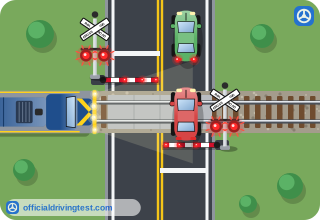
- In the same direction in which the train is moving
- In the opposite direction from which the train is moving
- Toward the train, to wave it down
- Straight across the tracks to the far side
Show answer
Correct answer: In the opposite direction from which the train is moving
The debris from a collision travels in the direction the train is moving, so you run far away in the opposite direction.
Source: Rhode Island Driver’s Manual (April 2024), page 45
-
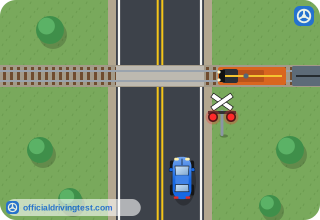
What should you do when red signals begin to flash or the gates are being lowered at a railroad crossing?
- Slow down and cross if no train is in sight
- Speed up to cross before the gates close
- Stop only if you can see a train
- Stop, look, and listen
Show answer
Correct answer: Stop, look, and listen
Flashing red signals and lowering gates mean you stop, look and listen.
Source: Rhode Island Driver’s Manual (April 2024), page 46
-
Which of these should you never attempt at a railroad crossing?
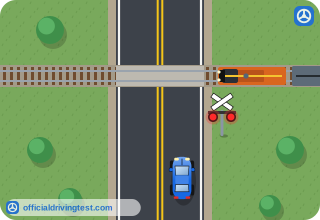
- Beating the train to the crossing or going around gates that are down
- Stopping when the red signals begin to flash on the crossing
- Waiting patiently while a bus crosses the tracks ahead of you
- Looking and listening for a train before you cross the tracks
Show answer
Correct answer: Beating the train to the crossing or going around gates that are down
The manual says never to try to beat a train or to go around gates that are down.
Source: Rhode Island Driver’s Manual (April 2024), page 46
-
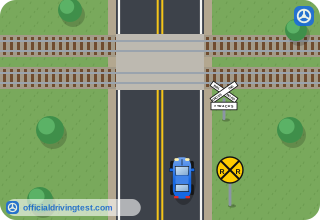
Which vehicles must always stop before crossing railroad tracks?
- Only school buses and other vehicles that are pulling trailers
- Only vehicles carrying more than ten passengers
- All buses, trucks carrying hazardous material, and certain other vehicles
- Only vehicles that are longer than a standard car
Show answer
Correct answer: All buses, trucks carrying hazardous material, and certain other vehicles
The manual says all buses, trucks transporting hazardous material and certain other vehicles must always stop, so you should wait patiently for them.
Source: Rhode Island Driver’s Manual (April 2024), page 46
-
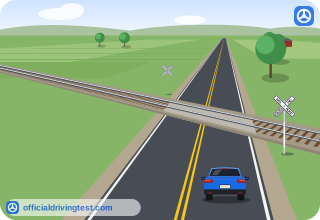
What should you assume about railroad tracks that appear to be abandoned?
- That no train will use them
- That only slow freight trains use them
- That trains use them only at night
- That a train will travel on the tracks
Show answer
Correct answer: That a train will travel on the tracks
The manual says never to assume a train cannot be present, even on tracks that look abandoned.
Source: Rhode Island Driver’s Manual (April 2024), page 46
-
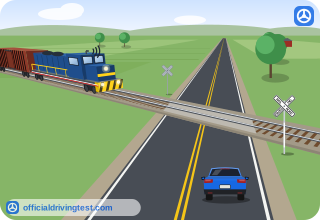
How far may it take a train to come to a complete stop after applying the brake?
- A quarter of a mile
- A mile and a half
- Half a mile
- Three miles
Show answer
Correct answer: A mile and a half
The manual says a train may need a mile and a half to stop after the brake is applied.
Source: Rhode Island Driver’s Manual (April 2024), page 46