Rhode Island: Right-of-way and turning — Part 3 Practice Test
Questions in this part include: “For how long should drivers completely cease all forward motion when stopping?” · “At a stop sign where there is no crosswalk but there is a clearly marked stop line, where must the driver stop?”
Independent educational site · not affiliated with any government agency or DMV
Ready? Test yourself
- Instant feedback with an explanation
- Every answer cites its source in the manual
- Your best score is saved on this device
- Keyboard: press 1 to 4 to answer and Enter for the next question
Questions are original and based on the official manual "Rhode Island Driver’s Manual" (April 2024), Rhode Island Division of Motor Vehicles (DMV).
All 17 questions in this practice test
Take the test above first, then use this list to study. Tap “Show answer” to see the correct answer and explanation.
Show the questions and answersHide the questions
-
When may you use the three-point turn?
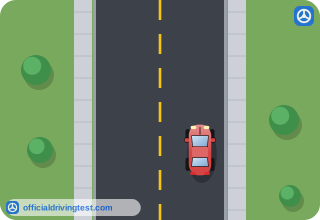
- To turn around on any freeway
- To turn around on a narrow street, unless it is prohibited
- To turn around only on a one-way street with no parked cars
- To turn around only in an area of heavy traffic
Show answer
Correct answer: To turn around on a narrow street, unless it is prohibited
The manual says the three-point turn is for turning around on a narrow street, where not prohibited.
Source: Rhode Island Driver’s Manual (April 2024), page 31
-
In the three-point turn, how can you signal after you have come to a complete stop?
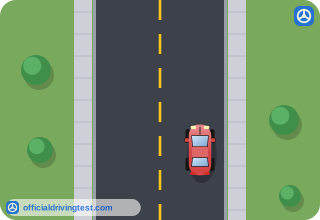
- With your right directional signal and no other signal
- With your horn
- With your left directional signal or the four-way hazard lights
- With your high beams
Show answer
Correct answer: With your left directional signal or the four-way hazard lights
After the stop, the signal is the left directional or the four-way hazard lights.
Source: Rhode Island Driver’s Manual (April 2024), page 31
-
In the three-point turn, where do you stop after turning the steering wheel fully to the left and driving forward across the street?
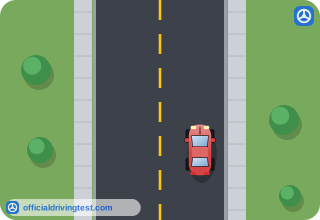
- At a point before the left side curb
- At the left side curb with the wheels touching it
- In the middle of the street
- Past the left side curb
Show answer
Correct answer: At a point before the left side curb
You stop before reaching the left side curb, then check traffic again.
Source: Rhode Island Driver’s Manual (April 2024), page 31
-
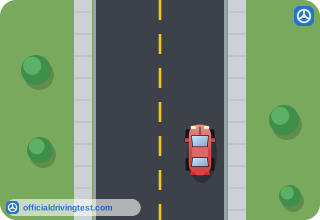
In the three-point turn, when you turn the steering wheel fully to the right and back up, when do you stop?
- When the rear wheels are touching the right side curb
- When the car is parallel to the curb
- When the front of the car is in the middle of the street
- When the car is back to where you started
Show answer
Correct answer: When the front of the car is in the middle of the street
You back up until the front of the car is in the middle of the street, then stop and check traffic.
Source: Rhode Island Driver’s Manual (April 2024), page 31
-
For how long should drivers completely cease all forward motion when stopping?
- A minimum of three seconds
- A minimum of one second
- A minimum of five seconds
- Until the car behind you stops
Show answer
Correct answer: A minimum of three seconds
The manual says to stop all forward motion for at least three seconds.
Source: Rhode Island Driver’s Manual (April 2024), page 31
-
In what order does the manual say to look during a stop, which gives you time to check before proceeding?
- Right, left, right
- Left, center, right, center
- Right, center, left, right
- Left, right, center, left again
Show answer
Correct answer: Left, right, center, left again
The stop is long enough to look left, right, center and left again before proceeding with caution.
Source: Rhode Island Driver’s Manual (April 2024), page 31
-
When a driver approaches a stop sign and there is a crosswalk, where must the driver stop?
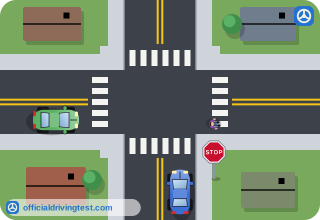
- Before the crosswalk, on the near side of the intersection
- In the middle of the crosswalk
- On the far side of the crosswalk
- With the front of the vehicle inside the intersection
Show answer
Correct answer: Before the crosswalk, on the near side of the intersection
The law says a driver must stop before entering the crosswalk on the near side of the intersection.
Source: Rhode Island Driver’s Manual (April 2024), page 32
-
At a stop sign where there is no crosswalk but there is a clearly marked stop line, where must the driver stop?
- Just past the stop line, where the intersecting road begins
- Anywhere before the sign, as long as the vehicle is stopped
- At the stop line
- At the point where the driver first sees the intersecting road
Show answer
Correct answer: At the stop line
When there is no crosswalk, the driver stops at the clearly marked stop line.
Source: Rhode Island Driver’s Manual (April 2024), page 32
-
At a stop sign with no crosswalk and no stop line, where must the driver stop?
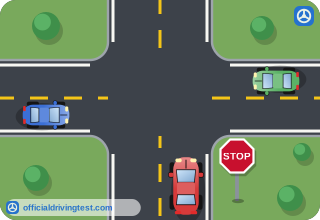
- At the sign itself, even if the driver cannot see traffic on the other road
- At the point nearest the intersecting highway with a view of approaching traffic
- In the middle of the intersection, where traffic from all directions can be seen
- At the far corner of the intersection, after checking both directions
Show answer
Correct answer: At the point nearest the intersecting highway with a view of approaching traffic
With no crosswalk and no stop line, the driver stops at the spot nearest the intersecting road that gives a view of approaching traffic.
Source: Rhode Island Driver’s Manual (April 2024), page 32
-
At an intersection with a four-way stop, you have come to a stop. Whom must you yield to?
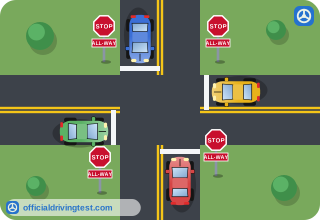
- Only vehicles that are going straight ahead through the intersection
- Only vehicles that arrive at the intersection after you have stopped
- Only the vehicle that is directly across the intersection from you
- All vehicles that were already stopped at the stop sign before you arrived
Show answer
Correct answer: All vehicles that were already stopped at the stop sign before you arrived
The manual says that once you are stopped you must yield to every vehicle that was already stopped before you arrived.
Source: Rhode Island Driver’s Manual (April 2024), page 32
-
At a four-way stop, you stop first. What must the vehicles that arrive at the intersection after you do?
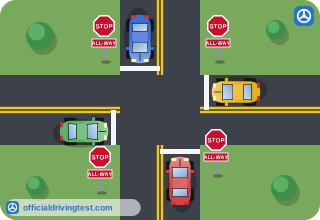
- Yield the right of way to you
- Go first if they are turning right
- Go ahead of you if they are larger vehicles
- Stop beside you and wait for a signal from you
Show answer
Correct answer: Yield the right of way to you
Vehicles arriving after you must yield to you because you stopped first.
Source: Rhode Island Driver’s Manual (April 2024), page 32
-
At a four-way stop, two vehicles arrive at the intersection at the same time. Which driver must yield?
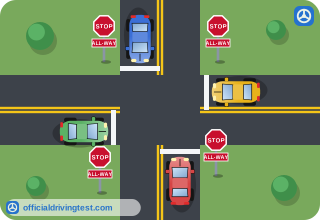
- The driver who has the other vehicle on his or her left
- The driver of the smaller vehicle
- The driver who has the other vehicle on his or her right
- The driver traveling on the busier street
Show answer
Correct answer: The driver who has the other vehicle on his or her right
When two vehicles arrive together, you yield the right of way to the vehicle on your right.
Source: Rhode Island Driver’s Manual (April 2024), page 32
-
Before starting from the curb or making a lane change, what must you do besides checking your mirrors?
- Look over your shoulder to make sure the blind spots are clear
- Sound your horn to warn drivers beside you
- Brake gently so drivers behind you slow down
- Turn your front wheels into the new lane before moving
Show answer
Correct answer: Look over your shoulder to make sure the blind spots are clear
The manual says to check mirrors and look over your shoulder so the blind spots are clear and no vehicle has entered your path.
Source: Rhode Island Driver’s Manual (April 2024), page 33
-
When entering the roadway from a private road or driveway, where must you stop?
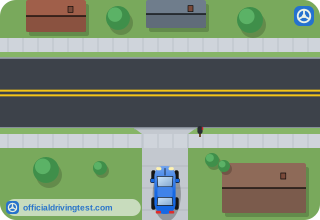
- Only at the curb line, before entering the road
- Only at the sidewalk, before entering the road
- At the sidewalk, then again at the curb line
- Only if other vehicles are approaching on the road
Show answer
Correct answer: At the sidewalk, then again at the curb line
You must stop at the sidewalk and then stop again at the curb line.
Source: Rhode Island Driver’s Manual (April 2024), page 33
-
When entering the roadway from a driveway, what does stopping at the sidewalk allow you to check for?
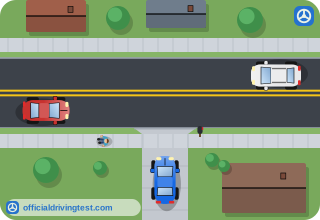
- Oncoming traffic in the road
- Pedestrians on the sidewalk
- Vehicles parked along the curb
- The condition of the road surface
Show answer
Correct answer: Pedestrians on the sidewalk
The stop at the sidewalk lets you check for pedestrians, while the stop at the curb lets you check for oncoming traffic.
Source: Rhode Island Driver’s Manual (April 2024), page 33
-
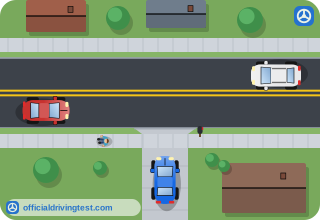
When entering the roadway from a driveway, what does stopping at the curb allow you to check for?
- Pedestrians on the sidewalk
- Whether the lane ahead is wide enough to pass
- Whether the sidewalk is clear of parked vehicles
- Oncoming traffic
Show answer
Correct answer: Oncoming traffic
Stopping at the curb is the stop that lets you check for oncoming traffic.
Source: Rhode Island Driver’s Manual (April 2024), page 33
-
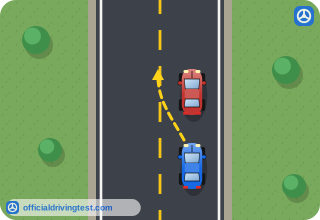
When you consider passing the vehicle ahead, how many of the three passing questions (legal, safe, worth it) must be answered YES?
- All three
- At least two of the three
- Only the question about whether passing is legal
- Any one of the three
Show answer
Correct answer: All three
All three questions must be answered yes before passing is justified.
Source: Rhode Island Driver’s Manual (April 2024), page 33