Rhode Island: Right-of-way and turning — Part 1 Practice Test
Questions in this part include: “As you approach an intersection for a left turn, which lane position should you take far enough in advance?” · “In the basics of making a turn, what does the "B" stand for?”
Independent educational site · not affiliated with any government agency or DMV
Ready? Test yourself
- Instant feedback with an explanation
- Every answer cites its source in the manual
- Your best score is saved on this device
- Keyboard: press 1 to 4 to answer and Enter for the next question
Questions are original and based on the official manual "Rhode Island Driver’s Manual" (April 2024), Rhode Island Division of Motor Vehicles (DMV).
All 17 questions in this practice test
Take the test above first, then use this list to study. Tap “Show answer” to see the correct answer and explanation.
Show the questions and answersHide the questions
-
When you approach an intersection where you want to turn left, when must you give the proper signal?
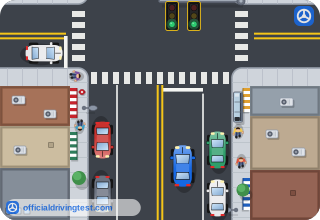
- Only after you have entered the intersection and stopped
- Only when another vehicle is approaching you
- In sufficient time to warn the driver of any vehicle behind you
- Once you have stopped and the way is clear
Show answer
Correct answer: In sufficient time to warn the driver of any vehicle behind you
The manual says to signal early enough to warn any driver behind you before a left turn.
Source: Rhode Island Driver’s Manual (April 2024), page 29
-
As you slow down for a left turn, what should you check in the mirror?
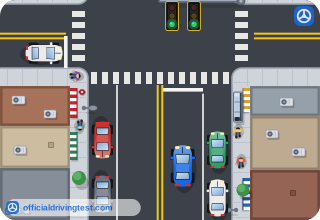
- That the driver of the vehicle behind you has understood your signal
- That no pedestrian is crossing the road behind your vehicle
- That your brake lights are working
- That the road behind you is free of oncoming traffic
Show answer
Correct answer: That the driver of the vehicle behind you has understood your signal
While slowing down, you watch the mirror to confirm the driver behind understood your signal.
Source: Rhode Island Driver’s Manual (April 2024), page 29
-
If the road is wide enough to do so without crossing the centerline, what should you do while preparing to turn left?
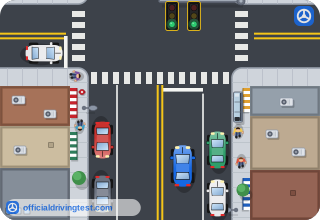
- Move close to the curb so no one can pass on your left
- Stop in the middle of the lane so following vehicles must wait
- Leave room for following vehicles to pass you on your right
- Move to the right edge of the lane so no one can pass you
Show answer
Correct answer: Leave room for following vehicles to pass you on your right
When the road is wide enough and you do not cross the centerline, you leave room for following vehicles to pass on your right.
Source: Rhode Island Driver’s Manual (April 2024), page 29
-
What should you do if you can't work your way to the center early enough to make a left turn?
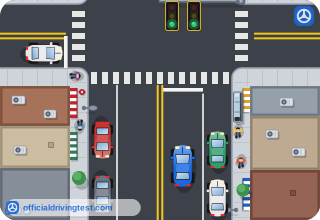
- Go on to the next intersection
- Turn left suddenly from the right-hand lane when it is clear
- Stop where you are and back up to the last intersection
- Make the turn from the right-hand lane with your signal on
Show answer
Correct answer: Go on to the next intersection
The manual says to go on to the next intersection rather than pulling suddenly to your left from the right-hand lane.
Source: Rhode Island Driver’s Manual (April 2024), page 29
-
As you approach an intersection for a left turn, which lane position should you take far enough in advance?
- Lane position #1
- Lane position #3
- The extreme right-hand side of the road
- Lane position #2
Show answer
Correct answer: Lane position #2
The manual says to be in lane position #2 well before a left turn.
Source: Rhode Island Driver’s Manual (April 2024), page 29
-
When you turn left, which vehicles have the right-of-way?
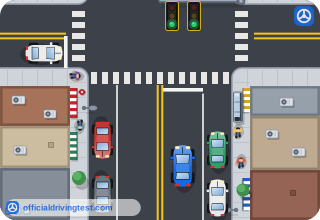
- Only the vehicle directly approaching you, and not the one on your right
- Both the vehicle directly approaching you and the one approaching on your right
- Only vehicles behind you
- None, because the turning driver always goes first
Show answer
Correct answer: Both the vehicle directly approaching you and the one approaching on your right
For a left turn, the oncoming vehicle and the vehicle approaching on your right both have the right-of-way.
Source: Rhode Island Driver’s Manual (April 2024), page 29
-
After turning left into a four-lane road, in which lane should you keep driving until you can change to the right lane without getting in the way of other vehicles?
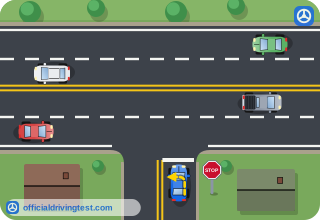
- The center lane
- The far left lane
- The lane next to the curb
- The lane you were in before the turn
Show answer
Correct answer: The center lane
After the turn you stay in the center lane until you can move to the right lane without getting in other vehicles' way.
Source: Rhode Island Driver’s Manual (April 2024), page 29
-
While waiting at an intersection to make a turn, what should you do with your wheels?
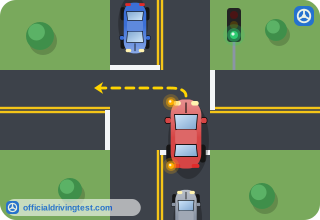
- Turn them into your intended path so you can go as soon as it is clear
- Turn them away from your intended path as a precaution
- Not turn them into your intended path of travel until you are clear to make the turn
- Turn them fully to the left whatever the turn
Show answer
Correct answer: Not turn them into your intended path of travel until you are clear to make the turn
The manual says not to point your wheels into your intended path until you are clear to turn.
Source: Rhode Island Driver’s Manual (April 2024), page 29
-
When making a turn, to whom must you always yield the right-of-way?
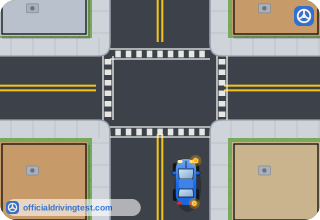
- Bicyclists in the street only
- Pedestrians in the street
- Vehicles driving behind you
- Parked vehicles on the roadside
Show answer
Correct answer: Pedestrians in the street
Both the left and right turn steps say to always yield to pedestrians in the street.
Source: Rhode Island Driver’s Manual (April 2024), page 29
-
What is the last step the manual lists for a proper turn?
- Turn on your hazard lights
- Sound your horn
- Change lanes right away
- Cancel your directional
Show answer
Correct answer: Cancel your directional
After completing the turn, the manual's last step is to cancel your directional signal.
Source: Rhode Island Driver’s Manual (April 2024), page 29
-
From where must right turns be taken?
- The center of the right-hand lane
- The left side of the right-hand lane
- Any lane that is clear
- The extreme right-hand side of the road
Show answer
Correct answer: The extreme right-hand side of the road
The manual says right turns must be started from the extreme right-hand side of the road.
Source: Rhode Island Driver’s Manual (April 2024), page 29
-
Why should you not swing to the left before turning right?
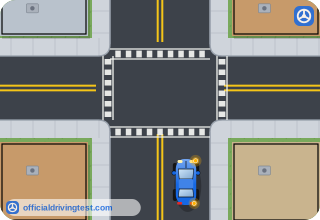
- It makes your turn signal harder to see in the other driver's mirror
- The driver following you may assume you are going to turn left
- It uses more fuel
- It puts your vehicle too near the curb
Show answer
Correct answer: The driver following you may assume you are going to turn left
Swinging left first is a dangerous habit because it signals a left turn to the driver behind.
Source: Rhode Island Driver’s Manual (April 2024), page 29
-
When you make a right turn, which vehicle has the right-of-way?
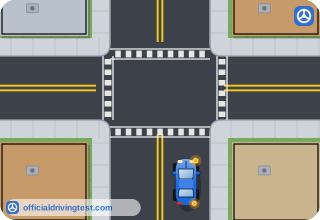
- The vehicle behind you
- Vehicles parked along the curb
- The motor vehicle directly approaching you
- No one, because the turning driver always has the right-of-way
Show answer
Correct answer: The motor vehicle directly approaching you
For a right turn, the manual says the vehicle directly approaching you has the right-of-way.
Source: Rhode Island Driver’s Manual (April 2024), page 30
-
In the basics of making a turn, what does the "B" stand for?
- Brake prior to the turn to reduce speed to a safe level
- Begin signaling after the turn starts
- Brake hard once you are in the middle of the turn
- Back up before turning
Show answer
Correct answer: Brake prior to the turn to reduce speed to a safe level
The B step is to brake before the turn so that you enter it at a safe speed.
Source: Rhode Island Driver’s Manual (April 2024), page 30
-
In the basics of making a turn, what does "covering the brake" mean?
- Pressing the brake pedal all the way down through the turn
- Keeping your foot off both pedals
- Gentle pressure on the brake pedal in case you need to brake
- Shifting to neutral during the turn
Show answer
Correct answer: Gentle pressure on the brake pedal in case you need to brake
Covering the brake means gentle pressure on the pedal in the first half of the turn, in case braking is needed.
Source: Rhode Island Driver’s Manual (April 2024), page 30
-
In the basics of making a turn, how should you drive out of the turn?
- By accelerating at a safe, comfortable rate of speed
- By braking until you are fully straight
- By coasting with your foot off the pedals
- By accelerating as hard as the vehicle allows
Show answer
Correct answer: By accelerating at a safe, comfortable rate of speed
The D step is to drive out of the turn by accelerating at a safe, comfortable rate.
Source: Rhode Island Driver’s Manual (April 2024), page 30
-
In the basics of making a turn, what does the "A" stand for?
- Accelerate before the turn
- Apply the parking brake
- Arrive at the intersection with the hazard lights on
- Approach the turn and plan your path through the turn
Show answer
Correct answer: Approach the turn and plan your path through the turn
The first step is to approach the turn while planning your path through it.
Source: Rhode Island Driver’s Manual (April 2024), page 30