Rhode Island: Right-of-way and turning
Who yields at intersections and four-way stops, how to make left and right turns, turnabouts, roundabouts and passing. Split into 5 shorter tests so you're not stuck in one long quiz.
Independent educational site · not affiliated with any government agency or DMV
Choose a part
Right-of-way and turning — Part 1
Questions in this part include: “As you approach an intersection for a left turn, which lane position should you take far enough in advance?”
StartRight-of-way and turning — Part 2
Questions in this part include: “What are turnabouts?”
StartRight-of-way and turning — Part 3
Questions in this part include: “For how long should drivers completely cease all forward motion when stopping?”
StartRight-of-way and turning — Part 4
Questions in this part include: “What does the manual say about taking the right-of-way for granted?”
StartRight-of-way and turning — Part 5
Questions in this part include: “The roundabout procedures in this manual refer to which kind of roundabout?”
StartAll 85 Right-of-way and turning questions with answers
Choose a part above to take a practice test, or study every question and answer here.
Show the questions and answersHide the questions
-
When you approach an intersection where you want to turn left, when must you give the proper signal?
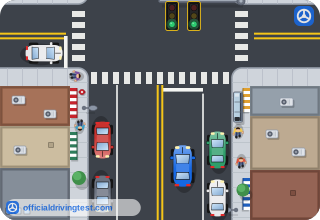
- Only after you have entered the intersection and stopped
- Only when another vehicle is approaching you
- In sufficient time to warn the driver of any vehicle behind you
- Once you have stopped and the way is clear
Show answer
Correct answer: In sufficient time to warn the driver of any vehicle behind you
The manual says to signal early enough to warn any driver behind you before a left turn.
Source: Rhode Island Driver’s Manual (April 2024), page 29
-
As you slow down for a left turn, what should you check in the mirror?
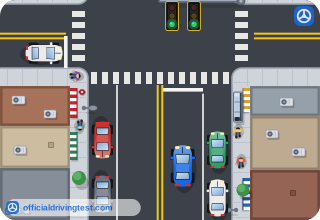
- That the driver of the vehicle behind you has understood your signal
- That no pedestrian is crossing the road behind your vehicle
- That your brake lights are working
- That the road behind you is free of oncoming traffic
Show answer
Correct answer: That the driver of the vehicle behind you has understood your signal
While slowing down, you watch the mirror to confirm the driver behind understood your signal.
Source: Rhode Island Driver’s Manual (April 2024), page 29
-
If the road is wide enough to do so without crossing the centerline, what should you do while preparing to turn left?
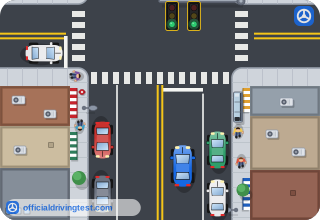
- Move close to the curb so no one can pass on your left
- Stop in the middle of the lane so following vehicles must wait
- Leave room for following vehicles to pass you on your right
- Move to the right edge of the lane so no one can pass you
Show answer
Correct answer: Leave room for following vehicles to pass you on your right
When the road is wide enough and you do not cross the centerline, you leave room for following vehicles to pass on your right.
Source: Rhode Island Driver’s Manual (April 2024), page 29
-
What should you do if you can't work your way to the center early enough to make a left turn?
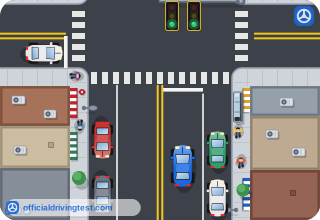
- Go on to the next intersection
- Turn left suddenly from the right-hand lane when it is clear
- Stop where you are and back up to the last intersection
- Make the turn from the right-hand lane with your signal on
Show answer
Correct answer: Go on to the next intersection
The manual says to go on to the next intersection rather than pulling suddenly to your left from the right-hand lane.
Source: Rhode Island Driver’s Manual (April 2024), page 29
-
As you approach an intersection for a left turn, which lane position should you take far enough in advance?
- Lane position #1
- Lane position #3
- The extreme right-hand side of the road
- Lane position #2
Show answer
Correct answer: Lane position #2
The manual says to be in lane position #2 well before a left turn.
Source: Rhode Island Driver’s Manual (April 2024), page 29
-
When you turn left, which vehicles have the right-of-way?
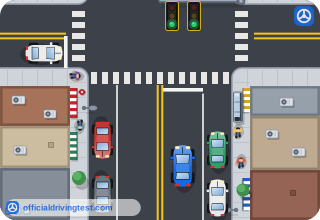
- Only the vehicle directly approaching you, and not the one on your right
- Both the vehicle directly approaching you and the one approaching on your right
- Only vehicles behind you
- None, because the turning driver always goes first
Show answer
Correct answer: Both the vehicle directly approaching you and the one approaching on your right
For a left turn, the oncoming vehicle and the vehicle approaching on your right both have the right-of-way.
Source: Rhode Island Driver’s Manual (April 2024), page 29
-
After turning left into a four-lane road, in which lane should you keep driving until you can change to the right lane without getting in the way of other vehicles?
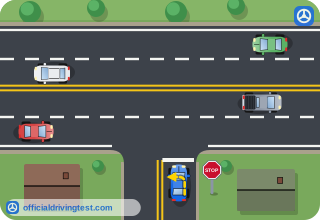
- The center lane
- The far left lane
- The lane next to the curb
- The lane you were in before the turn
Show answer
Correct answer: The center lane
After the turn you stay in the center lane until you can move to the right lane without getting in other vehicles' way.
Source: Rhode Island Driver’s Manual (April 2024), page 29
-
While waiting at an intersection to make a turn, what should you do with your wheels?
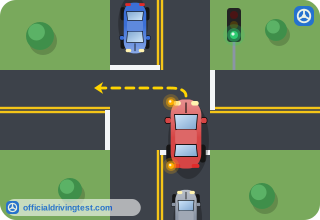
- Turn them into your intended path so you can go as soon as it is clear
- Turn them away from your intended path as a precaution
- Not turn them into your intended path of travel until you are clear to make the turn
- Turn them fully to the left whatever the turn
Show answer
Correct answer: Not turn them into your intended path of travel until you are clear to make the turn
The manual says not to point your wheels into your intended path until you are clear to turn.
Source: Rhode Island Driver’s Manual (April 2024), page 29
-
When making a turn, to whom must you always yield the right-of-way?
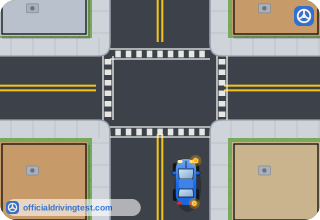
- Bicyclists in the street only
- Pedestrians in the street
- Vehicles driving behind you
- Parked vehicles on the roadside
Show answer
Correct answer: Pedestrians in the street
Both the left and right turn steps say to always yield to pedestrians in the street.
Source: Rhode Island Driver’s Manual (April 2024), page 29
-
What is the last step the manual lists for a proper turn?
- Turn on your hazard lights
- Sound your horn
- Change lanes right away
- Cancel your directional
Show answer
Correct answer: Cancel your directional
After completing the turn, the manual's last step is to cancel your directional signal.
Source: Rhode Island Driver’s Manual (April 2024), page 29
-
From where must right turns be taken?
- The center of the right-hand lane
- The left side of the right-hand lane
- Any lane that is clear
- The extreme right-hand side of the road
Show answer
Correct answer: The extreme right-hand side of the road
The manual says right turns must be started from the extreme right-hand side of the road.
Source: Rhode Island Driver’s Manual (April 2024), page 29
-
Why should you not swing to the left before turning right?
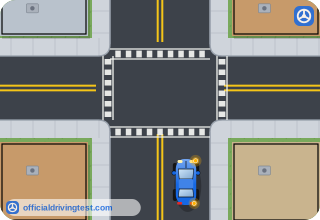
- It makes your turn signal harder to see in the other driver's mirror
- The driver following you may assume you are going to turn left
- It uses more fuel
- It puts your vehicle too near the curb
Show answer
Correct answer: The driver following you may assume you are going to turn left
Swinging left first is a dangerous habit because it signals a left turn to the driver behind.
Source: Rhode Island Driver’s Manual (April 2024), page 29
-
When you make a right turn, which vehicle has the right-of-way?
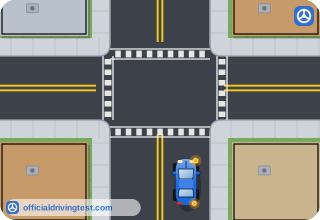
- The vehicle behind you
- Vehicles parked along the curb
- The motor vehicle directly approaching you
- No one, because the turning driver always has the right-of-way
Show answer
Correct answer: The motor vehicle directly approaching you
For a right turn, the manual says the vehicle directly approaching you has the right-of-way.
Source: Rhode Island Driver’s Manual (April 2024), page 30
-
In the basics of making a turn, what does the "B" stand for?
- Brake prior to the turn to reduce speed to a safe level
- Begin signaling after the turn starts
- Brake hard once you are in the middle of the turn
- Back up before turning
Show answer
Correct answer: Brake prior to the turn to reduce speed to a safe level
The B step is to brake before the turn so that you enter it at a safe speed.
Source: Rhode Island Driver’s Manual (April 2024), page 30
-
In the basics of making a turn, what does "covering the brake" mean?
- Pressing the brake pedal all the way down through the turn
- Keeping your foot off both pedals
- Gentle pressure on the brake pedal in case you need to brake
- Shifting to neutral during the turn
Show answer
Correct answer: Gentle pressure on the brake pedal in case you need to brake
Covering the brake means gentle pressure on the pedal in the first half of the turn, in case braking is needed.
Source: Rhode Island Driver’s Manual (April 2024), page 30
-
In the basics of making a turn, how should you drive out of the turn?
- By accelerating at a safe, comfortable rate of speed
- By braking until you are fully straight
- By coasting with your foot off the pedals
- By accelerating as hard as the vehicle allows
Show answer
Correct answer: By accelerating at a safe, comfortable rate of speed
The D step is to drive out of the turn by accelerating at a safe, comfortable rate.
Source: Rhode Island Driver’s Manual (April 2024), page 30
-
In the basics of making a turn, what does the "A" stand for?
- Accelerate before the turn
- Apply the parking brake
- Arrive at the intersection with the hazard lights on
- Approach the turn and plan your path through the turn
Show answer
Correct answer: Approach the turn and plan your path through the turn
The first step is to approach the turn while planning your path through it.
Source: Rhode Island Driver’s Manual (April 2024), page 30
-
What are turnabouts?
- Maneuvers used to pass a slow vehicle on the left side of the road
- Maneuvers in which you turn your car around to drive in the opposite direction
- Maneuvers used to enter a freeway
- Maneuvers used to park beside a curb
Show answer
Correct answer: Maneuvers in which you turn your car around to drive in the opposite direction
A turnabout is a maneuver for turning the car around to go the opposite way.
Source: Rhode Island Driver’s Manual (April 2024), page 30
-
Before you make a turnabout, how far must you have clear visibility in each direction?
- Five hundred feet
- Two hundred feet
- One hundred feet
- One thousand feet
Show answer
Correct answer: Five hundred feet
The manual says to make certain you can see clearly 500 feet in each direction.
Source: Rhode Island Driver’s Manual (April 2024), page 30
-
Before you make a turnabout, how far from an intersection must you be?
- At least fifty feet
- At least five hundred feet
- At least two hundred feet
- At least one hundred feet
Show answer
Correct answer: At least two hundred feet
The manual says you must be at least 200 feet from an intersection before a turnabout.
Source: Rhode Island Driver’s Manual (April 2024), page 30
-
What does the manual say about local statutes and turnabouts?
- They never apply to turnabouts on public streets or roads
- They allow turnabouts on every street
- They apply only on freeways
- They may prohibit turnabouts, so be familiar with local regulations
Show answer
Correct answer: They may prohibit turnabouts, so be familiar with local regulations
Local laws can ban turnabouts, so you need to know the local traffic regulations.
Source: Rhode Island Driver’s Manual (April 2024), page 30
-
How many types of turnabouts does the manual describe?
- Two
- Three
- Five
- Four
Show answer
Correct answer: Four
The manual describes four types of turnabouts.
Source: Rhode Island Driver’s Manual (April 2024), page 30
-
How must you choose which turnabout to use?
- Choose the one that takes the least amount of time to finish
- Choose the safest one that best suits the traffic and the street
- Choose the one with the fewest steps
- Always choose a U-turn
Show answer
Correct answer: Choose the safest one that best suits the traffic and the street
The manual says to choose the safest turnabout that best suits the traffic and the street.
Source: Rhode Island Driver’s Manual (April 2024), page 30
-
After you have stopped at the right curb for a U-turn, how can you signal your intent?
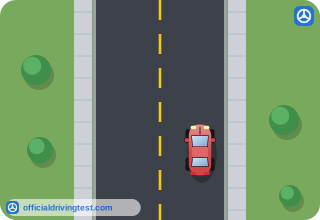
- With the right turn signal that you used to pull over
- With a short blast of your horn before you pull out
- With your left turn signal or your four-way hazard lights
- With your high-beam headlights flashed twice
Show answer
Correct answer: With your left turn signal or your four-way hazard lights
For a U-turn the manual allows the left turn signal or the four-way hazard lights.
Source: Rhode Island Driver’s Manual (April 2024), page 30
-
When making a U-turn, which way do you turn the steering wheel when you have a clear path?
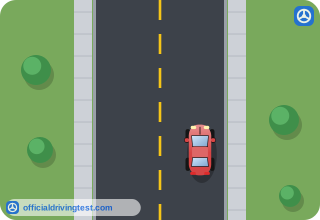
- All the way to the left
- All the way to the right
- Halfway to the left
- Straight ahead
Show answer
Correct answer: All the way to the left
With a clear path, you turn the wheel all the way to the left and drive slowly to the left.
Source: Rhode Island Driver’s Manual (April 2024), page 30
-
In Rhode Island, when may you make a U-turn?
- Anywhere you like, as long as no police officer is in sight to see it
- Only on streets wider than four lanes
- Only when it is allowed and does not interfere with traffic in either direction
- Only when there is no traffic behind you and the road ahead is clear
Show answer
Correct answer: Only when it is allowed and does not interfere with traffic in either direction
A U-turn must be allowed and must not interfere with traffic flow in either direction.
Source: Rhode Island Driver’s Manual (April 2024), page 30
-
What is an advantage of backing into a driveway or side street on the right side?
- It allows you to reenter traffic by driving forward
- It lets you stay in the left lane the whole time
- It is the only turnabout allowed on a narrow street
- It means you do not need to signal
Show answer
Correct answer: It allows you to reenter traffic by driving forward
Backing into the driveway lets you drive forward when you go back into traffic.
Source: Rhode Island Driver’s Manual (April 2024), page 30
-
When backing into a driveway or side street on the right side, where should you drive before you begin to back up?
- Into the middle of the intersection
- To the left edge of the road
- Directly into the driveway, front end first
- Past the street or driveway you plan to back into
Show answer
Correct answer: Past the street or driveway you plan to back into
You first drive past the street or driveway, then back into it.
Source: Rhode Island Driver’s Manual (April 2024), page 30
-
When backing into a driveway or side street on the right side, which way do you slowly turn the steering wheel as you begin to back up?
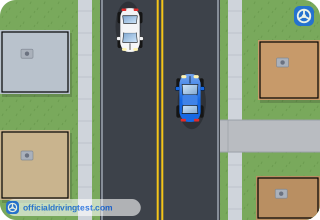
- To the left
- To the right
- Straight, then left
- Fully left, then fully right
Show answer
Correct answer: To the right
To back into a driveway on the right, you slowly turn the wheel to the right.
Source: Rhode Island Driver’s Manual (April 2024), page 30
-
When you finish backing into a driveway or side street on the right side, what should you do?
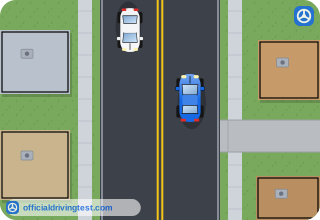
- Straighten the steering wheel and stop once you have cleared the curb line
- Keep backing up until you reach the end of the driveway
- Turn the wheel fully left and stop at the curb
- Turn off your signal and wait for the lane to clear behind you
Show answer
Correct answer: Straighten the steering wheel and stop once you have cleared the curb line
After backing in, you straighten the wheel and stop once you have cleared the curb line.
Source: Rhode Island Driver’s Manual (April 2024), page 30
-
Why is pulling into a street or driveway on the left more hazardous than backing in on the right?
- You must drive past the driveway first
- Your signal cannot be seen
- You will be backing into the travel lane
- You must cross a solid yellow line
Show answer
Correct answer: You will be backing into the travel lane
Backing out of a left-side driveway puts the vehicle's rear into the lane of traffic.
Source: Rhode Island Driver’s Manual (April 2024), page 30
-
When pulling into a street or driveway on the left, when do you straighten the front wheels and stop?
- When the car has reached the middle of the street
- When the car has crossed the curb line
- When the car is fully inside the driveway
- When another vehicle approaches
Show answer
Correct answer: When the car has crossed the curb line
You straighten the front wheels and stop as soon as the car has entered and crossed the curb line.
Source: Rhode Island Driver’s Manual (April 2024), page 31
-
When pulling into a street or driveway on the left, which way do you turn the steering wheel to slowly back up into the first lane of travel?
- To the left
- Straight
- Fully left, then fully right
- To the right
Show answer
Correct answer: To the right
You turn the wheel to the right and slowly back into the first lane of travel.
Source: Rhode Island Driver’s Manual (April 2024), page 31
-
When pulling into a street or driveway on the left, when do you begin to straighten the steering wheel as you back up?
- As soon as the car starts to move
- Only after the car has stopped
- At the very end of the turn
- At about the half-way point in the turn
Show answer
Correct answer: At about the half-way point in the turn
The manual says to begin straightening the wheel at about the halfway point of the turn.
Source: Rhode Island Driver’s Manual (April 2024), page 31
-
When may you use the three-point turn?
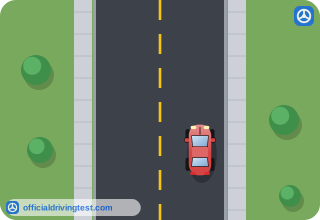
- To turn around on any freeway
- To turn around on a narrow street, unless it is prohibited
- To turn around only on a one-way street with no parked cars
- To turn around only in an area of heavy traffic
Show answer
Correct answer: To turn around on a narrow street, unless it is prohibited
The manual says the three-point turn is for turning around on a narrow street, where not prohibited.
Source: Rhode Island Driver’s Manual (April 2024), page 31
-
In the three-point turn, how can you signal after you have come to a complete stop?
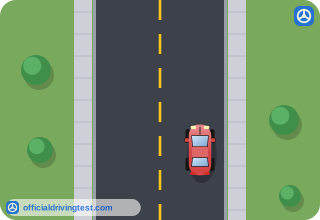
- With your right directional signal and no other signal
- With your horn
- With your left directional signal or the four-way hazard lights
- With your high beams
Show answer
Correct answer: With your left directional signal or the four-way hazard lights
After the stop, the signal is the left directional or the four-way hazard lights.
Source: Rhode Island Driver’s Manual (April 2024), page 31
-
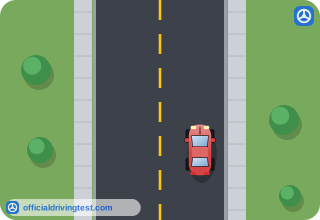
In the three-point turn, where do you stop after turning the steering wheel fully to the left and driving forward across the street?
- At a point before the left side curb
- At the left side curb with the wheels touching it
- In the middle of the street
- Past the left side curb
Show answer
Correct answer: At a point before the left side curb
You stop before reaching the left side curb, then check traffic again.
Source: Rhode Island Driver’s Manual (April 2024), page 31
-
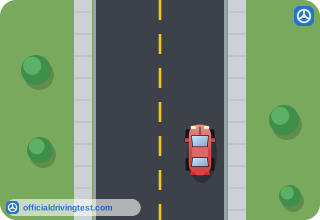
In the three-point turn, when you turn the steering wheel fully to the right and back up, when do you stop?
- When the rear wheels are touching the right side curb
- When the car is parallel to the curb
- When the front of the car is in the middle of the street
- When the car is back to where you started
Show answer
Correct answer: When the front of the car is in the middle of the street
You back up until the front of the car is in the middle of the street, then stop and check traffic.
Source: Rhode Island Driver’s Manual (April 2024), page 31
-
For how long should drivers completely cease all forward motion when stopping?
- A minimum of three seconds
- A minimum of one second
- A minimum of five seconds
- Until the car behind you stops
Show answer
Correct answer: A minimum of three seconds
The manual says to stop all forward motion for at least three seconds.
Source: Rhode Island Driver’s Manual (April 2024), page 31
-
In what order does the manual say to look during a stop, which gives you time to check before proceeding?
- Right, left, right
- Left, center, right, center
- Right, center, left, right
- Left, right, center, left again
Show answer
Correct answer: Left, right, center, left again
The stop is long enough to look left, right, center and left again before proceeding with caution.
Source: Rhode Island Driver’s Manual (April 2024), page 31
-
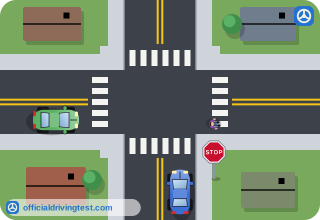
When a driver approaches a stop sign and there is a crosswalk, where must the driver stop?
- Before the crosswalk, on the near side of the intersection
- In the middle of the crosswalk
- On the far side of the crosswalk
- With the front of the vehicle inside the intersection
Show answer
Correct answer: Before the crosswalk, on the near side of the intersection
The law says a driver must stop before entering the crosswalk on the near side of the intersection.
Source: Rhode Island Driver’s Manual (April 2024), page 32
-
At a stop sign where there is no crosswalk but there is a clearly marked stop line, where must the driver stop?
- Just past the stop line, where the intersecting road begins
- Anywhere before the sign, as long as the vehicle is stopped
- At the stop line
- At the point where the driver first sees the intersecting road
Show answer
Correct answer: At the stop line
When there is no crosswalk, the driver stops at the clearly marked stop line.
Source: Rhode Island Driver’s Manual (April 2024), page 32
-
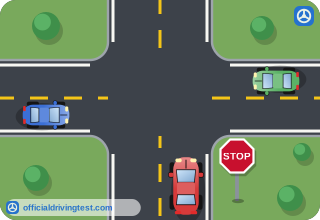
At a stop sign with no crosswalk and no stop line, where must the driver stop?
- At the sign itself, even if the driver cannot see traffic on the other road
- At the point nearest the intersecting highway with a view of approaching traffic
- In the middle of the intersection, where traffic from all directions can be seen
- At the far corner of the intersection, after checking both directions
Show answer
Correct answer: At the point nearest the intersecting highway with a view of approaching traffic
With no crosswalk and no stop line, the driver stops at the spot nearest the intersecting road that gives a view of approaching traffic.
Source: Rhode Island Driver’s Manual (April 2024), page 32
-
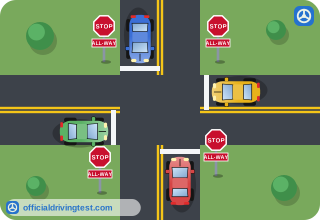
At an intersection with a four-way stop, you have come to a stop. Whom must you yield to?
- Only vehicles that are going straight ahead through the intersection
- Only vehicles that arrive at the intersection after you have stopped
- Only the vehicle that is directly across the intersection from you
- All vehicles that were already stopped at the stop sign before you arrived
Show answer
Correct answer: All vehicles that were already stopped at the stop sign before you arrived
The manual says that once you are stopped you must yield to every vehicle that was already stopped before you arrived.
Source: Rhode Island Driver’s Manual (April 2024), page 32
-
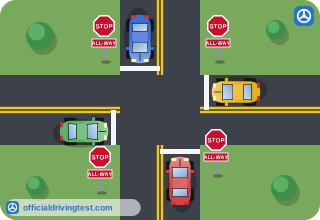
At a four-way stop, you stop first. What must the vehicles that arrive at the intersection after you do?
- Yield the right of way to you
- Go first if they are turning right
- Go ahead of you if they are larger vehicles
- Stop beside you and wait for a signal from you
Show answer
Correct answer: Yield the right of way to you
Vehicles arriving after you must yield to you because you stopped first.
Source: Rhode Island Driver’s Manual (April 2024), page 32
-
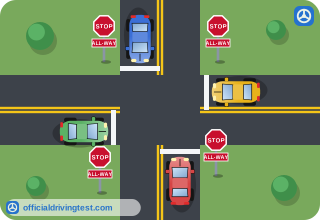
At a four-way stop, two vehicles arrive at the intersection at the same time. Which driver must yield?
- The driver who has the other vehicle on his or her left
- The driver of the smaller vehicle
- The driver who has the other vehicle on his or her right
- The driver traveling on the busier street
Show answer
Correct answer: The driver who has the other vehicle on his or her right
When two vehicles arrive together, you yield the right of way to the vehicle on your right.
Source: Rhode Island Driver’s Manual (April 2024), page 32
-
Before starting from the curb or making a lane change, what must you do besides checking your mirrors?
- Look over your shoulder to make sure the blind spots are clear
- Sound your horn to warn drivers beside you
- Brake gently so drivers behind you slow down
- Turn your front wheels into the new lane before moving
Show answer
Correct answer: Look over your shoulder to make sure the blind spots are clear
The manual says to check mirrors and look over your shoulder so the blind spots are clear and no vehicle has entered your path.
Source: Rhode Island Driver’s Manual (April 2024), page 33
-
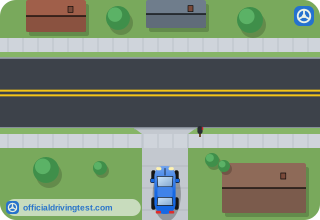
When entering the roadway from a private road or driveway, where must you stop?
- Only at the curb line, before entering the road
- Only at the sidewalk, before entering the road
- At the sidewalk, then again at the curb line
- Only if other vehicles are approaching on the road
Show answer
Correct answer: At the sidewalk, then again at the curb line
You must stop at the sidewalk and then stop again at the curb line.
Source: Rhode Island Driver’s Manual (April 2024), page 33
-
When entering the roadway from a driveway, what does stopping at the sidewalk allow you to check for?
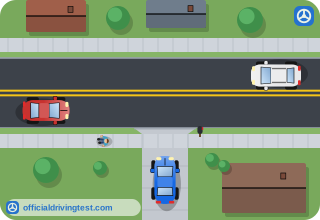
- Oncoming traffic in the road
- Pedestrians on the sidewalk
- Vehicles parked along the curb
- The condition of the road surface
Show answer
Correct answer: Pedestrians on the sidewalk
The stop at the sidewalk lets you check for pedestrians, while the stop at the curb lets you check for oncoming traffic.
Source: Rhode Island Driver’s Manual (April 2024), page 33
-
When entering the roadway from a driveway, what does stopping at the curb allow you to check for?
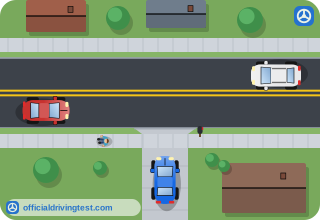
- Pedestrians on the sidewalk
- Whether the lane ahead is wide enough to pass
- Whether the sidewalk is clear of parked vehicles
- Oncoming traffic
Show answer
Correct answer: Oncoming traffic
Stopping at the curb is the stop that lets you check for oncoming traffic.
Source: Rhode Island Driver’s Manual (April 2024), page 33
-
When you consider passing the vehicle ahead, how many of the three passing questions (legal, safe, worth it) must be answered YES?
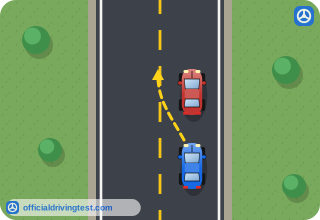
- All three
- At least two of the three
- Only the question about whether passing is legal
- Any one of the three
Show answer
Correct answer: All three
All three questions must be answered yes before passing is justified.
Source: Rhode Island Driver’s Manual (April 2024), page 33
-
On multiple lane highways, which lane does the law require you to use to pass?
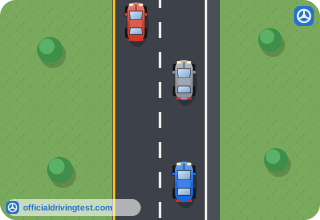
- The right lane
- The breakdown lane
- The left lane
- Whichever lane is open
Show answer
Correct answer: The left lane
The law requires the left lane for passing and the right lane for through traffic or normal driving.
Source: Rhode Island Driver’s Manual (April 2024), page 34
-
When another vehicle is passing you, what should you do?
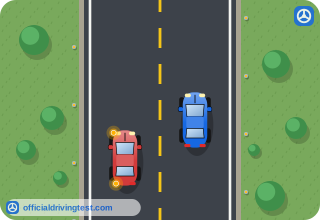
- Speed up so the other driver passes quickly
- Reduce your speed a little and keep to the right
- Move to the left lane to give more room
- Hold the same speed and stay in the middle of the lane
Show answer
Correct answer: Reduce your speed a little and keep to the right
You slow down a little and keep right so the other driver can pass safely.
Source: Rhode Island Driver’s Manual (April 2024), page 34
-
What are blind spots?
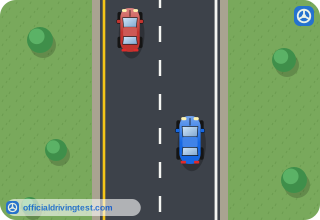
- Areas that cannot be seen through the windshield at night
- Areas that are hidden by road signs near an intersection
- Areas behind the vehicle that are visible only through the rear window
- Areas that cannot be seen in your rear or side-view mirrors
Show answer
Correct answer: Areas that cannot be seen in your rear or side-view mirrors
The manual defines blind spots as areas you cannot see in the rear or side-view mirrors.
Source: Rhode Island Driver’s Manual (April 2024), page 34
-
Before making a lane change or passing maneuver, what must a motorist check?
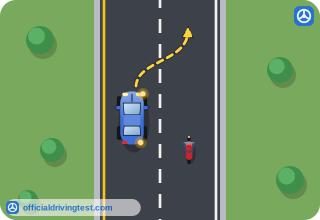
- Over his or her shoulder, to view areas the mirrors cannot show
- Only the rear-view mirror, because it shows the whole lane
- Only the side mirrors and the speedometer
- The vehicle ahead of the car being passed, with no need to look back
Show answer
Correct answer: Over his or her shoulder, to view areas the mirrors cannot show
A motorist must look over a shoulder to see the areas the mirrors do not show.
Source: Rhode Island Driver’s Manual (April 2024), page 34
-
Why does the manual say to avoid placing packages or other large items in the back seat or on the rear window ledge?
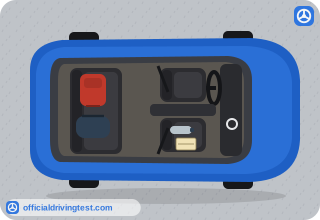
- They could block the view of the speedometer
- They could make the vehicle too heavy to stop
- They could cause a blind spot
- They could be thrown against the windshield
Show answer
Correct answer: They could cause a blind spot
Large items in the back seat or on the rear window ledge can create a blind spot.
Source: Rhode Island Driver’s Manual (April 2024), page 34
-
Which turn signal do you give to let the driver ahead or behind you know that you will be pulling out to pass?
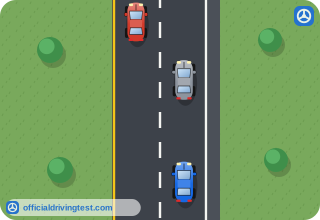
- A right turn signal
- A left turn signal
- The hazard lights
- No signal until you are beside the other vehicle
Show answer
Correct answer: A left turn signal
To pass on the left, the first step is to give a left turn signal.
Source: Rhode Island Driver’s Manual (April 2024), page 34
-
At night, what might it be necessary to do to warn the driver in front of you that you intend to pass?
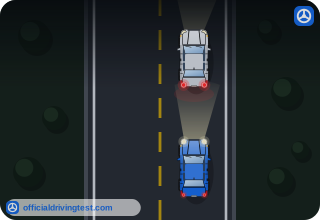
- Switch off your headlights for a few seconds
- Turn on your hazard lights until you have passed
- Keep your high beams on until you are back in your lane
- Blink your headlights from low beam to high beam and back
Show answer
Correct answer: Blink your headlights from low beam to high beam and back
The manual says it might be necessary to blink from low beam to high beam and back to low beam.
Source: Rhode Island Driver’s Manual (April 2024), page 34
-
When you have safely passed the vehicle, which signal should you activate?
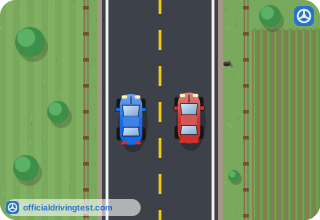
- Your right turn signal
- Your left turn signal
- Your hazard lights
- No signal, because the pass is finished
Show answer
Correct answer: Your right turn signal
After passing, you activate your right turn signal before returning to the right side.
Source: Rhode Island Driver’s Manual (April 2024), page 34
-
How far past the vehicle you are passing should you go before returning to the right side of the road?
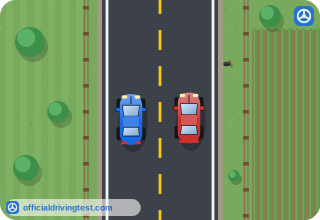
- Far enough to see the whole front bumper of the passed vehicle in your side mirror
- At least one full car length beyond the passed vehicle
- Far enough to see the tires of the passed vehicle on the pavement in your inside rear-view mirror
- Far enough that the passed vehicle is out of sight in your mirrors
Show answer
Correct answer: Far enough to see the tires of the passed vehicle on the pavement in your inside rear-view mirror
You should see the tires of the passed vehicle on the pavement in your inside rear-view mirror before returning.
Source: Rhode Island Driver’s Manual (April 2024), page 34
-
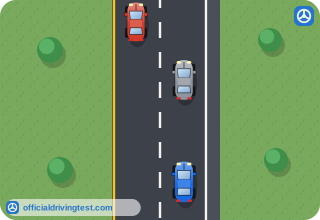
In general, on which side should you pass other vehicles?
- On the right
- On the left
- On whichever side has more room
- On the side away from oncoming traffic
Show answer
Correct answer: On the left
The manual says that, in general, vehicles should be passed only on the left.
Source: Rhode Island Driver’s Manual (April 2024), page 34
-
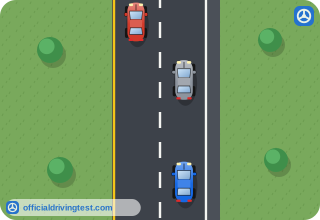
How many vehicles does the manual say you may pass at one time?
- Up to two
- As many as you can pass safely
- Up to three on a straight road
- Never more than one
Show answer
Correct answer: Never more than one
The manual says never to pass more than one vehicle.
Source: Rhode Island Driver’s Manual (April 2024), page 34
-
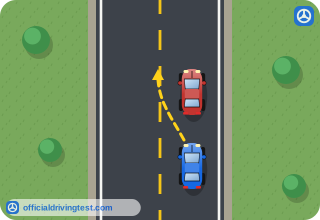
May you travel over the posted speed to pass a vehicle?
- No, never travel over the posted speed to pass
- Yes, if you return to the right lane quickly
- Yes, but only on a multiple lane highway
- Yes, by up to 5 miles per hour
Show answer
Correct answer: No, never travel over the posted speed to pass
The manual says never to travel over the posted speed to pass a vehicle.
Source: Rhode Island Driver’s Manual (April 2024), page 34
-
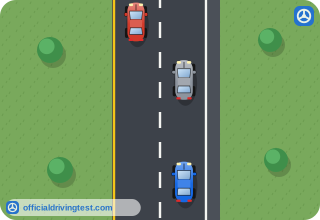
In which situation may a driver pass on the right of another vehicle?
- When the motor vehicle ahead is driving below the speed limit
- When the road ahead curves to the right
- When the motor vehicle ahead is making or about to make a left turn
- When the driver can use the shoulder to get around
Show answer
Correct answer: When the motor vehicle ahead is making or about to make a left turn
Passing on the right is allowed only in listed cases, including when the vehicle ahead is making or about to make a left turn.
Source: Rhode Island Driver’s Manual (April 2024), page 34
-
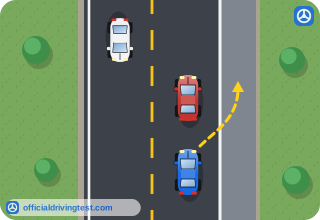
Under what conditions may you drive off the pavement or main traveled portion of the road to pass a motor vehicle?
- When the vehicle ahead is slow
- Under no conditions
- When you are on a one-way road
- When no vehicles are coming
Show answer
Correct answer: Under no conditions
The manual says that under no conditions can you drive off the pavement or main traveled portion of the road to pass.
Source: Rhode Island Driver’s Manual (April 2024), page 34
-
What does the manual say about taking the right-of-way for granted?
- Always take it, because the law grants it to you in every case
- Never do it; the law grants it, but the other driver may not, so yield
- Take it only when the other driver is looking at you
- Take it only on multiple lane highways, not on local roads
Show answer
Correct answer: Never do it; the law grants it, but the other driver may not, so yield
The law grants right-of-way, but the other driver may not, so you should yield to the other driver.
Source: Rhode Island Driver’s Manual (April 2024), page 36
-
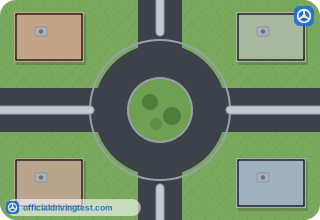
In which direction do roundabouts direct traffic around the center island?
- Clockwise
- Counterclockwise
- Straight across
- Back and forth
Show answer
Correct answer: Counterclockwise
Roundabouts send traffic counterclockwise around a center island.
Source: Rhode Island Driver’s Manual (April 2024), page 40
-
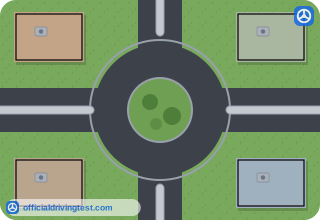
What is the purpose of a roundabout's circular intersection?
- To speed up traffic by removing all speed limits
- To make every driver stop at stop signs
- To give drivers a place to park near an intersection
- To slow traffic while reducing delays in traffic movement
Show answer
Correct answer: To slow traffic while reducing delays in traffic movement
The circular design slows traffic while cutting delays.
Source: Rhode Island Driver’s Manual (April 2024), page 40
-
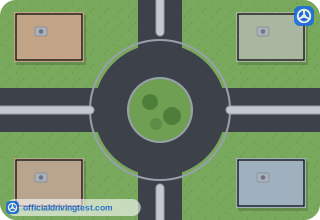
Instead of stop signs or traffic signals, what does a roundabout use to guide traffic?
- Yield signs, directional signs, pavement markings
- Flashing red lights and railroad gates
- Stop lines, crossing guards and turn arrows
- Green arrows and horizontal signals
Show answer
Correct answer: Yield signs, directional signs, pavement markings
A roundabout has no stop signs or traffic signals; it uses yield signs, directional signs and pavement markings.
Source: Rhode Island Driver’s Manual (April 2024), page 40
-
The roundabout procedures in this manual refer to which kind of roundabout?
- Multi-lane roundabouts
- Single lane roundabouts
- Roundabouts with traffic signals
- Roundabouts with stop signs
Show answer
Correct answer: Single lane roundabouts
The manual says its information is about single lane roundabouts and warns that many states use multi-lane ones.
Source: Rhode Island Driver’s Manual (April 2024), page 40
-
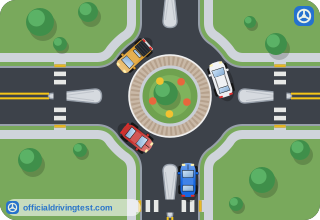
When navigating a roundabout, what speed should a motorist drive?
- Maintain highway speed
- Drive at the speed of the vehicle behind you
- Speed up to merge ahead of other vehicles
- Slow down to the posted speed
Show answer
Correct answer: Slow down to the posted speed
A motorist navigating a roundabout should slow down to the posted speed.
Source: Rhode Island Driver’s Manual (April 2024), page 40
-
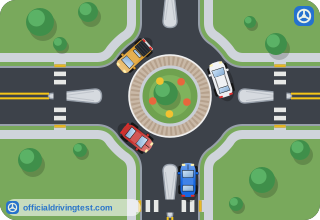
In a roundabout, who has the right-of-way over a motorist?
- Pedestrians and other motorists
- Only emergency vehicles
- Only vehicles about to exit
- Only bicyclists
Show answer
Correct answer: Pedestrians and other motorists
The motorist must yield to pedestrians and other motorists because they have the right-of-way.
Source: Rhode Island Driver’s Manual (April 2024), page 40
-
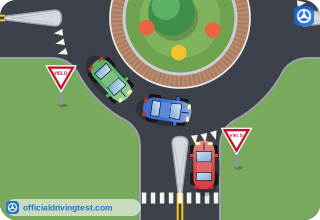
What should a motorist ensure before entering a roundabout?
- That the horn works
- That the center island is clear of pedestrians
- An adequate safe gap
- That all other vehicles have exited
Show answer
Correct answer: An adequate safe gap
The motorist must make sure of an adequate safe gap and move to the proper lane position.
Source: Rhode Island Driver’s Manual (April 2024), page 40
-
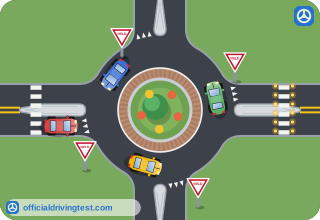
When may a driver stop inside a roundabout?
- To let a pedestrian cross in the center
- Only in an emergency
- When the exit is not yet visible
- When traffic ahead is moving slowly
Show answer
Correct answer: Only in an emergency
The manual says never to stop in a roundabout unless it is an emergency.
Source: Rhode Island Driver’s Manual (April 2024), page 40
-
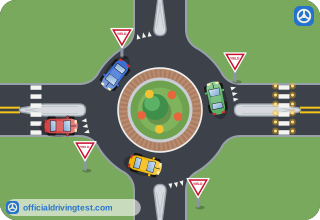
How should a driver leave a roundabout?
- Exit to the left after stopping in the circle
- Exit to the right without signaling
- Stop at the exit and wait for a gap
- Signal, exit to the right and yield to pedestrians
Show answer
Correct answer: Signal, exit to the right and yield to pedestrians
The exit step is to signal, then leave the roundabout to the right and yield to pedestrians.
Source: Rhode Island Driver’s Manual (April 2024), page 40
-
In the manual's roundabout diagram, the label A marks which feature?
- Splitter or refuge
- Center island
- Entry lane
- Yield sign
Show answer
Correct answer: Splitter or refuge
The diagram labels A as the splitter or refuge, B as the crosswalk and C as the center island.
Source: Rhode Island Driver’s Manual (April 2024), page 40
-
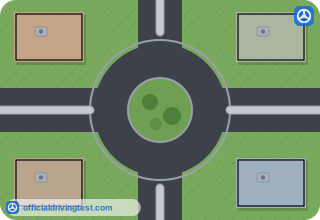
In the absence of any traffic control device or sign, whom must a driver about to enter a rotary yield to?
- All vehicles already in the rotary
- Only vehicles approaching from the right
- Only emergency vehicles
- No one, because the entering driver has the right-of-way
Show answer
Correct answer: All vehicles already in the rotary
Under R.I.G.L. 31-17-8, the driver entering a rotary yields to every vehicle already in it, whichever direction the driver comes from.
Source: Rhode Island Driver’s Manual (April 2024), page 41
-
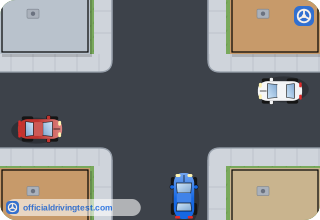
What is an intersection with no signs or signals called?
- A protected intersection
- An uncontrolled intersection
- A shared intersection
- A signaled intersection
Show answer
Correct answer: An uncontrolled intersection
Intersections without signs or signals are known as uncontrolled intersections.
Source: Rhode Island Driver’s Manual (April 2024), page 41
-
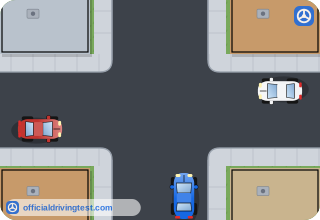
How must motorists treat an uncontrolled intersection?
- As if there were a stop sign present
- As if the light were flashing red
- As if they had the right-of-way
- As if there were a yield sign present
Show answer
Correct answer: As if there were a yield sign present
When approaching uncontrolled intersections, motorists must treat them as if a yield sign were there.
Source: Rhode Island Driver’s Manual (April 2024), page 41
-
How does the manual define right-of-way?
- The legal duty to stop and wait at every intersection you come to
- The right to drive at the posted speed limit on every roadway at all times
- The permission to pass another vehicle on a two-lane road when it is clear
- The privilege of having or giving other motorists immediate use of a roadway
Show answer
Correct answer: The privilege of having or giving other motorists immediate use of a roadway
The manual defines right-of-way as the privilege of having or giving other motorists immediate use of a certain roadway.
Source: Rhode Island Driver’s Manual (April 2024), page 41
-
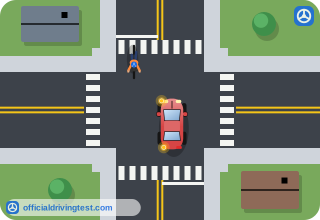
When turning left at an intersection, how should you treat oncoming bicyclists?
- Turn first, because bicycles are slower
- Sound your horn and then turn
- Treat them like pedestrians and turn behind them
- Yield to them just as you would to oncoming vehicles
Show answer
Correct answer: Yield to them just as you would to oncoming vehicles
The manual says to yield to oncoming bicyclists as you would to oncoming vehicles when turning left.
Source: Rhode Island Driver’s Manual (April 2024), page 55
-
Before turning right at an intersection or driveway, what should you check?
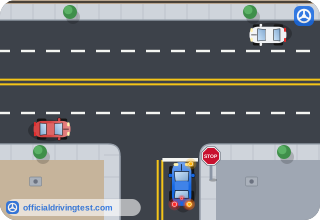
- For bicyclists on your right or behind you going straight ahead
- That no bicyclist is ahead of you on the left side of the road
- That the bicycle lane is empty on the far side of the intersection
- That no pedestrians are waiting on the opposite curb
Show answer
Correct answer: For bicyclists on your right or behind you going straight ahead
Bicyclists going straight on your right or behind you may be in your path when you turn right.
Source: Rhode Island Driver’s Manual (April 2024), page 55
-
In Rhode Island, what is the rule for turning right at a red light?
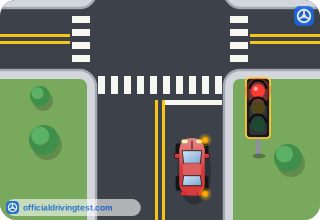
- Permitted, not required, after a stop unless a sign prohibits it
- It is never permitted at any red light
- It is required whenever the way is clear
- It is permitted without stopping if no traffic is coming
Show answer
Correct answer: Permitted, not required, after a stop unless a sign prohibits it
Right on red is allowed but not required, and only after a full stop. A “no turn on red” sign forbids it.
Source: Rhode Island Driver’s Manual (April 2024), page 58
-
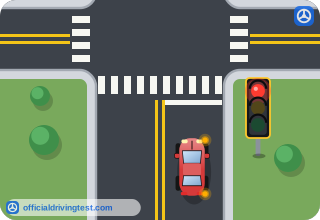
Before turning right on a red light after stopping, whom must you yield to?
- Pedestrians only, not other vehicles
- Only vehicles approaching from behind you
- All oncoming traffic and pedestrians
- Only emergency vehicles
Show answer
Correct answer: All oncoming traffic and pedestrians
A driver turning right on red must first give way to all oncoming traffic and to pedestrians.
Source: Rhode Island Driver’s Manual (April 2024), page 58
-
With no signs or signals, two vehicles from different streets reach an intersection at about the same time. Which driver must yield the right-of-way?
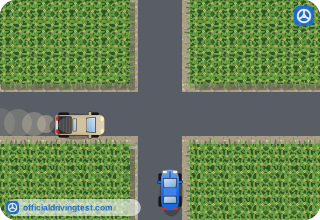
- The driver of the vehicle on the right
- The driver of the larger vehicle
- The driver of the faster vehicle
- The driver of the vehicle on the left
Show answer
Correct answer: The driver of the vehicle on the left
Where there are no signs or signals, the driver on the left yields to the vehicle on the right.
Source: Rhode Island Driver’s Manual (April 2024), page 58